
锦波生物

Search documents
锦波生物(920982) - 关于使用闲置自有资金购买理财产品的进展公告
2026-02-05 11:00
证券代码:920982 证券简称:锦波生物 公告编号:2026-007 山西锦波生物医药股份有限公司 关于使用闲置自有资金购买理财产品的进展公告 本公司及董事会全体成员保证公告内容的真实、准确和完整,没有虚假记 载、误导性陈述或者重大遗漏,并对其内容的真实性、准确性和完整性承担个 别及连带法律责任。 一、 授权委托理财情况 (一)审议情况 山西锦波生物医药股份有限公司(以下简称"公司")分别于 2025 年 4 月 19 日、2025 年 5 月 21 日召开第四届董事会第八次会议、2024 年年度股东会, 审议通过了《关于使用暂时闲置自有资金购买理财产品的议案》,在不影响公 司主营业务正常发展,并确保经营需求的前提下,公司拟使用不超过人民币 15 亿元的暂时闲置的自有资金购买安全性高、流动性好、风险低的银行理财产品 (包括但不限于银行定期存单、结构性存款或风险低理财产品等),且该等现 金管理产品不得用于质押,不用于以证券投资为目的的投资行为,相关内容详 见公司在北京证券交易所(www.bse.cn)披露的《使用闲置自有资金购买理财 产品的公告》(公告编号:2025-030)。 (二)披露标准 根据《北京证券 ...
医疗创新ETF(516820)盘中飘红,机构称医药行业长期增长逻辑未变
Xin Lang Cai Jing· 2026-02-05 05:35
风险提示:基金有风险,投资需谨慎。基金管理人承诺以诚实信用、勤勉尽责的原则管理和运用基金资 产,但不保证本基金一定盈利,也不保证最低收益。基金管理人提醒投资人基金投资的"买者自负"原 则,在做出投资决策后,基金运营状况与基金净值变化引致的投资风险,由投资人自行负担。基金的过 往业绩及其净值高低并不预示其未来业绩表现,基金管理人管理的其他基金的业绩不构成对本基金业绩 表现的保证。投资人购买基金,既可能按其持有份额分享基金投资所产生的收益,也可能承担基金投资 所带来的损失。投资人应当认真阅读《基金合同》《招募说明书》等基金法律文件,全面认识本基金的 风险收益特征和产品特性,并根据自身的投资目的、投资期限、投资经验、资产状况等判断基金是否和 投资人的风险承受能力相适应,理性判断市场,谨慎做出投资决策。本材料中相关信息来源于基金管理 人认为可靠的公开资料,相关观点、评估和预测仅反映当前的判断,后续可能有所变化。本材料所含任 何市场观点的内容皆基于相应的假设条件,而任何假设条件都可能随时发生变化。基金管理人不承诺、 不保证任何具有预测性质的市场观点必然得以实现。材料中提及的个股不构成投资推荐或建议。ETF基 金的二级市 ...
万元童颜针降至999元背后 :供需反转,医美企业向供应商要回定价权
Xin Lang Cai Jing· 2026-02-04 13:51
Core Viewpoint - The era where upstream medical beauty supply chain manufacturers rely solely on price control to maintain high profits may be coming to an end, as evidenced by recent collaborations between New Oxygen and 14 upstream manufacturers, including major players like Sota, Allergan, Aimeike, Huaxi Biology, Jinbo Biology, and Sihuan Pharmaceutical [1] Group 1 - New Oxygen has reached agreements with 14 upstream manufacturers, indicating a shift in the dynamics of the medical beauty industry [1] - Previous conflicts over pricing between New Oxygen and several suppliers, which even led to supply disruptions, appear to have been temporarily resolved with these new partnerships [1] - Industry insiders believe that this collaboration reflects a restructuring of power between upstream and downstream players in the medical beauty sector, signaling a significant change in the industry's development logic [1]

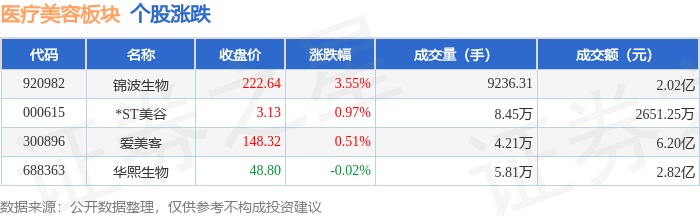
医疗美容板块2月4日涨0.31%,锦波生物领涨,主力资金净流出127.97万元
Zheng Xing Xing Ye Ri Bao· 2026-02-04 08:56
Core Viewpoint - The medical beauty sector experienced a slight increase of 0.31% on February 4, with Jinbo Biological leading the gains, while the overall market indices also showed positive performance [1] Group 1: Market Performance - The Shanghai Composite Index closed at 4102.2, up by 0.85% [1] - The Shenzhen Component Index closed at 14156.27, up by 0.21% [1] - Jinbo Biological's stock price rose to 222.64, reflecting a gain of 3.55% [1] Group 2: Individual Stock Performance - Jinbo Biological led the medical beauty sector with a trading volume of 9236.31 hands and a transaction value of 2.02 billion yuan [1] - Aimei Ke's stock price increased by 0.51% to 148.32, with a trading volume of 42,100 hands and a transaction value of 6.20 billion yuan [1] - Huaxi Biological's stock price slightly decreased by 0.02% to 48.80, with a trading volume of 58,100 hands and a transaction value of 282 million yuan [1] Group 3: Capital Flow - The medical beauty sector saw a net outflow of 1.2797 million yuan from main funds, while retail investors experienced a net outflow of 2.70494 million yuan [1] - Jinbo Biological had a net inflow of 33.9145 million yuan from main funds, accounting for 16.83% of its trading volume [2] - Aimei Ke experienced a net outflow of 127.67 million yuan from main funds, with a net inflow of 22.7409 million yuan from retail investors [2]




2026年商社美护行业年度策略:布局服务消费,掘金新消费
Guoyuan Securities· 2026-02-04 05:45
Group 1 - The report highlights that the new consumption sector performed well, with service consumption policies expected to continue catalyzing growth in 2026 [2][27] - In 2025, the overall performance of the optional consumption sector was weak, but sub-sectors like new consumption showed significant gains, particularly in the first half of the year [16][21] - The retail sales of consumer goods grew moderately, with service retail growth outpacing that of goods retail, indicating a shift towards service consumption [21][27] Group 2 - The tourism sector is expected to benefit from extended holiday periods and improved vacation policies, with companies like Trip.com and Tongcheng Travel being key focuses [3] - The hotel market is showing signs of recovery, with a narrowing decline in RevPAR and increasing leisure demand, highlighting companies like Jin Jiang Hotels and Huazhu Group [3] - The duty-free sector is experiencing a boost from new policies, particularly in Hainan, with a focus on high-end consumption recovery [3] Group 3 - The cosmetics industry saw a slight growth of 6.18% in 2025, with domestic brands continuing to gain market share [4][30] - The medical beauty market is projected to reach approximately 366.6 billion in 2025, with a K-shaped consumption differentiation emerging [4][30] - Innovations in core ingredients and the integration of biotechnology are driving brand growth in the cosmetics sector [4][36] Group 4 - The IP derivative market is expanding due to a flourishing supply of IP and commercial operations, with domestic policies expected to further mature the industry ecosystem [5] - Key players in the IP space include Shanghai Film, Light Media, and Pop Mart, with a focus on both domestic and international market expansion [5] Group 5 - The gold and jewelry sector saw a cumulative growth of 12.78% in retail sales from January to December, with a focus on brand premium capabilities and international expansion [6][9] - The rise of "self-wearing" scenarios is driving gold jewelry sales, with brands like Chao Hong Ji and Lao Pu Gold being highlighted for their international strategies [9]
整个社会都在喊没钱了,为什么这些公司反而年赚百亿?
创业家· 2026-02-03 10:39
Core Insights - The article emphasizes that despite the prevailing narrative of economic hardship, certain industries are thriving and generating substantial profits, particularly in Japan and China [3][4]. - It identifies eight key sectors that are capitalizing on changing consumer behaviors and preferences, presenting significant business opportunities [5]. Group 1: Key Industries - **Second-Hand Economy**: The second-hand luxury market in Japan, exemplified by companies like Daikokuya, has seen explosive revenue growth. In China, platforms like Hongbulin and Panghu are experiencing similar success, indicating a shift in consumer spending from new luxury goods to second-hand items [6][7][8]. - **Pet Economy**: With declining birth rates, young consumers are increasingly spending on pet products. Companies like Inaba in Japan and Guobao in China are witnessing strong stock performance due to rising demand for pet food and healthcare products [12][13][15]. - **Adult Care**: The adult diaper market in Japan has surpassed $10 billion, highlighting the economic potential of the aging population. This sector is viewed as a significant opportunity rather than a burden [17][18][19]. Group 2: Health and Wellness - **Health Food and Beverages**: The rise in health consciousness and demographic changes have led to increased demand for sugar-free beverages and functional foods. Brands like Suntory and various Chinese counterparts are experiencing significant growth in this area [21][22]. - **Beauty and Aesthetics**: The demand for beauty products, including collagen supplements and at-home beauty devices, remains strong. Companies like Jinbo Biological and U like are achieving substantial sales, indicating that consumers prioritize beauty even in economic downturns [23][24][26]. Group 3: Outdoor and Leisure - **Outdoor Recreation**: Companies in the outdoor equipment sector, such as Snow Peak in Japan and various Chinese brands, are benefiting from a growing interest in outdoor activities and camping, with significant sales increases reported [29][31]. - **Convenience Economy**: The trend towards convenience is driving growth in frozen food and smart home appliances. Brands like Anjijia and various AI-driven home devices are gaining traction as consumers seek to save time [39][40][42]. Group 4: Market Dynamics - The article posits that the current low-desire economic environment presents unique opportunities for businesses that can identify and invest in counter-cyclical trends. Companies that adapt to changing consumer needs and preferences are likely to emerge as winners in this landscape [44].

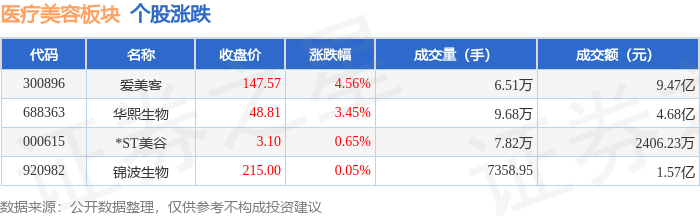
医疗美容板块2月3日涨3.9%,爱美客领涨,主力资金净流入7204.82万元
Zheng Xing Xing Ye Ri Bao· 2026-02-03 09:10
Group 1 - The medical beauty sector increased by 3.9% on February 3, with Ai Meike leading the gains [1] - The Shanghai Composite Index closed at 4067.74, up 1.29%, while the Shenzhen Component Index closed at 14127.1, up 2.19% [1] - Major stocks in the medical beauty sector showed varied performance, with Ai Meike closing at 147.57, up 4.56%, and Huaxi Biological at 48.81, up 3.45% [1] Group 2 - The medical beauty sector saw a net inflow of 72.0481 million yuan from main funds, while retail funds experienced a net outflow of 41.6043 million yuan [1] - Ai Meike had a net inflow of 85.9952 million yuan from main funds, but retail funds saw a net outflow of 38.6841 million yuan [2] - Huaxi Biological experienced a net outflow of 10.4367 million yuan from main funds, with a net inflow of 14.2989 million yuan from speculative funds [2]
经济越来越差,这八大行业越赚爆!
创业家· 2026-02-02 10:30
Core Insights - The article discusses how certain industries are thriving despite a general perception of economic downturn, highlighting eight key sectors that present significant business opportunities in a low-desire society [3][4]. Group 1: Economic Trends - The concept of a "low-desire society" does not equate to a lack of opportunities, as consumer behavior shifts towards different spending patterns [4]. - The article emphasizes that while people may not be purchasing luxury items or real estate, their money is flowing into alternative markets such as second-hand goods and pet care [6][11]. Group 2: Key Industries - **Second-Hand Economy**: The second-hand luxury market in Japan, represented by companies like Daikokuya, has seen a significant revenue increase, mirroring trends in China with platforms like Hongbulin and Panghu [6][7][8]. - **Pet Economy**: Despite declining birth rates, spending on pets is rising, with brands like Inaba in Japan and Guobao in China experiencing strong sales growth [11][12][13]. - **Adult Care**: The adult diaper market in Japan has surpassed $10 billion, indicating a growing potential for similar products in China [16][17][18]. - **Health Food and Beverages**: The rise in health consciousness has led to increased demand for sugar-free beverages and functional drinks, with brands like Dongpeng and Miao Ke Lan Duo gaining traction [21][22]. - **Beauty and Aesthetics**: The demand for beauty products, including collagen supplements and home beauty devices, remains strong, with companies like Jinbo Bio and U like achieving significant sales [23][25]. - **Outdoor Recreation**: Brands in the outdoor equipment sector, such as Kailas and Camel, are seeing rapid sales growth as consumers seek leisure activities [25][26]. - **Emotional Economy**: Products that provide emotional comfort, such as low-alcohol beverages and novelty items, are gaining popularity, reflecting a dual consumer behavior of frugality and indulgence [28][29][30]. - **Convenience Economy**: The demand for convenience foods and smart home appliances is increasing, as consumers prioritize time-saving solutions over cost [33][35][36]. Group 3: Market Opportunities - The article suggests that the current economic climate presents opportunities for those willing to invest in counter-cyclical sectors, emphasizing the importance of recognizing and acting on these trends [39].

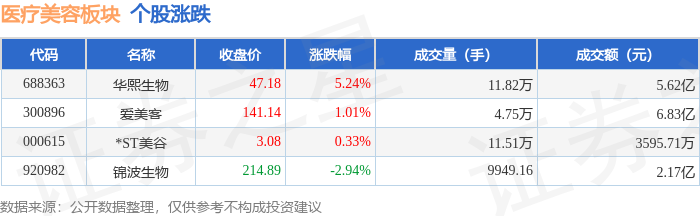
医疗美容板块2月2日涨2.68%,华熙生物领涨,主力资金净流入1亿元
Zheng Xing Xing Ye Ri Bao· 2026-02-02 09:10
Core Viewpoint - The medical beauty sector experienced a rise of 2.68% on February 2, with Huaxi Biological leading the gains, while the overall market indices, Shanghai Composite and Shenzhen Component, saw declines of 2.48% and 2.69% respectively [1] Group 1: Market Performance - The Shanghai Composite Index closed at 4015.75, down 2.48% [1] - The Shenzhen Component Index closed at 13824.35, down 2.69% [1] - The medical beauty sector stocks showed varied performance, with Huaxi Biological rising by 5.24% to a closing price of 47.18 [1] Group 2: Stock Details - Huaxi Biological (688363) had a trading volume of 118,200 shares and a transaction value of 562 million yuan [1] - Aimei Ke (300896) closed at 141.14, up 1.01%, with a trading volume of 47,500 shares and a transaction value of 683 million yuan [1] - ST Meigu (000615) closed at 3.08, up 0.33%, with a trading volume of 115,100 shares [1] - Jinbo Biological (920982) closed at 214.89, down 2.94%, with a trading volume of 9,949 shares and a transaction value of 217 million yuan [1] Group 3: Fund Flow Analysis - The medical beauty sector saw a net inflow of 100 million yuan from main funds, while retail investors experienced a net outflow of 59.89 million yuan [1] - Aimei Ke had a main fund net inflow of 55.54 million yuan, but a net outflow of 33.36 million yuan from retail investors [2] - Huaxi Biological experienced a main fund net inflow of 44.73 million yuan, with retail investors showing a net outflow of 27.92 million yuan [2]
北交所2026年投资策略:蓄势于微,成势于稀
Southwest Securities· 2026-02-02 03:05
Core Insights - The report highlights that the North Exchange (北交所) experienced a year of significant excess returns in 2025, with the North Exchange 50 Index rising by 38.8%, outperforming the CSI 300 by 21.1 percentage points [60]. - The report emphasizes the importance of liquidity improvements in 2026, driven by various factors including increased retail participation and the introduction of passive investment products like the North Exchange 50 ETF [7][54]. 2025 Sector Review - In 2025, the North Exchange showed a characteristic of "stable revenue, pressured profits," with overall revenue growing by 7.0% year-on-year in Q3 2025, while net profit attributable to shareholders declined by 4.8% [5][17]. - The report notes that sectors such as robotics, AI, military industry, and semiconductors demonstrated significant performance, indicating a strong correlation with the broader market [5][60]. 2026 Liquidity Outlook - The liquidity outlook for 2026 is expected to improve systematically, with increased retail investment and the launch of passive products anticipated to bring substantial incremental funds [7][54]. - Historical data suggests that previous market rallies in the North Exchange were driven by liquidity expansion, indicating a solid foundation for market support in 2026 [7]. Investment Themes - The investment strategy for 2026 focuses on three dimensions: technology growth sectors such as semiconductors and AI, macroeconomic recovery signals in consumer and cyclical sectors, and unique assets in the North Exchange that are key to domestic substitution and growth [8][5]. - The report highlights the importance of identifying high-scarcity and performance-driven targets within these themes [8]. New Stock Market Insights - The average first-day gain for new stocks in 2025 was an impressive 368.1%, primarily due to the valuation gap between primary and secondary markets [9]. - The North Exchange has a robust pipeline of new listings, particularly from advanced manufacturing sectors, which is expected to continue [9]. Industry Structure - As of December 31, 2025, the North Exchange had 287 listed companies, with 61.0% concentrated in mechanical equipment, electric power equipment, and other high-end manufacturing sectors, significantly higher than the corresponding figures for the ChiNext and STAR Market [10][12]. - The report indicates a strong focus on advanced manufacturing and "specialized, refined, distinctive, and innovative" enterprises, with a notable increase in the proportion of such companies over the years [14][16]. Financial Performance - In Q3 2025, the North Exchange's companies experienced a decline in net profit margins, with a year-on-year drop of 4.8%, contrasting with the growth seen in other markets [17][24]. - The report notes that the return on equity (ROE) was adversely affected by pressures on net profit margins and asset turnover rates, indicating a need for operational efficiency improvements [25][31]. Sector Profitability - The report highlights significant profitability disparities across sectors, with industries like automotive and home appliances showing strong growth resilience, while sectors such as media and pharmaceuticals faced severe profit declines [39]. - The automotive sector, in particular, saw a remarkable profit increase of 110.5%, indicating robust demand and market share gains [39]. Investment Participation - Institutional participation in the North Exchange has been increasing, with the number of funds holding North Exchange stocks rising significantly [40]. - The report notes that the North Exchange theme funds have outperformed the average industry returns, with several funds achieving returns exceeding 40% in 2025 [47][49]. Market Trends - The North Exchange's liquidity improved significantly in 2025, with daily trading volumes increasing from 29.9 billion yuan in 2023 to 266.9 billion yuan in 2025 [58]. - The report indicates that the North Exchange's volatility has decreased, reflecting a more stable trading environment [58].