
Stifel

Search documents
Housing In 2026: How Unaffordable Homes Could Create Windfall For Apartment REITs - Camden Prop Trust (NYSE:CPT), Dimensional Global Real Estate ETF (ARCA:DFGR)
Benzinga· 2025-12-25 21:01
Core Insights - The housing market is experiencing a significant shift due to high mortgage rates and declining new construction, creating opportunities for large landlords as homeownership becomes less attainable for many families [1][2]. Group 1: Market Dynamics - The gap between buying and renting has reached historic levels, with home prices needing to drop by approximately 24% to make buying competitive with renting, a scenario analysts consider unlikely [2]. - A supply crunch is emerging as new housing starts decline, with net apartment deliveries expected to fall to around 243,000 units in 2026, below the long-term average of 285,000 units [5]. - Demand for rentals is expected to remain strong as many potential buyers are priced out of the market, leading to renewed pricing power for landlords [6]. Group 2: Rental Market Outlook - Redfin forecasts that rents will increase by 2% to 3% nationwide in 2026, driven by the combination of steady demand and limited supply [6]. - The "Great Housing Reset" is anticipated to begin in 2026, where income growth may finally outpace home price growth, but relief for buyers will be slow [3][4]. Group 3: Investment Opportunities - Apartment REITs are being viewed as a contrarian value play, trading at a multiple of 15.3x funds from operations (FFO), significantly lower than the 10-year average of 19.2x [7]. - Major players in the rental market, such as Camden Property Trust, are well-positioned to benefit from the current market dynamics, as renting becomes the only viable option for many Americans [8].



10年来最一致的预测出炉!华尔街集体看好美股,这是狂欢还是陷阱?
Xin Lang Cai Jing· 2025-12-22 12:21
Core Viewpoint - Wall Street's stock market predictions for 2026 show an unprecedented level of optimism, raising concerns among market observers about potential market imbalances [1][5]. Group 1: Market Predictions - Sell-side strategists' predictions for the S&P 500 index are currently at their closest level in nearly a decade, with Oppenheimer's highest forecast at 8100 points and Stifel's lowest at 7000 points, reflecting only a 16% difference [1][5]. - Despite the S&P 500 index having recorded double-digit returns for three consecutive years, strategists expect an average increase of about 11% for 2026 [6]. Group 2: Market Sentiment and Risks - The consensus view among Wall Street analysts is seen as a contrarian indicator, suggesting that when expectations converge, market corrections may follow [1][5]. - Concerns include persistent inflation above the Federal Reserve's target, rising unemployment rates, and the lack of tangible returns from significant AI investments [1][5]. - The high level of agreement among predictions is viewed as potentially dangerous, as it indicates that expectations may already be priced into the market, making it sensitive to negative news [2][7]. Group 3: Historical Context and Analysis - Historical data indicates that Wall Street's stock predictions typically lag behind actual market performance by about two months [9]. - Analysts suggest that market movements dictate target prices rather than the other way around, indicating that current predictions may simply reflect bullish or bearish sentiments [9].
美国?燃油分销商ARKO Petroleum(APC.US)计划登陆纳斯达克 拟募资1亿美元
Zhi Tong Cai Jing· 2025-12-22 10:03
Group 1 - ARKO Petroleum plans to raise up to $100 million through an IPO on the Nasdaq stock exchange under the ticker symbol "APC" [1][2] - The company delivered approximately 1.5 billion gallons of fuel to gas stations, wholesale distributors, and other buyers in the nine months ending September 30, 2025 [1] - ARKO Petroleum operates three main business segments: Wholesale, Fleet Fueling, and GPMP, supplying fuel products through various contractual arrangements [1] Group 2 - The company, headquartered in Richmond, Virginia, was established in 2022 and achieved revenues of approximately $5.7 billion in the 12 months ending September 30, 2025 [2] - UBS Investment Bank, Raymond James, Stifel, Mizuho Securities, and Capital One Securities are acting as joint book-running managers for the IPO [2] - Pricing terms for the IPO have not yet been disclosed by the company [2]
ARKO Corp. Announces Filing of Registration Statement for Proposed Initial Public Offering of its Subsidiary, ARKO Petroleum Corp.
Globenewswire· 2025-12-19 13:30
Core Viewpoint - ARKO Corp. has filed a registration statement for the proposed initial public offering of Class A common stock of its subsidiary, ARKO Petroleum Corp., as part of its strategic plan [1] Group 1: Company Overview - ARKO Corp. is a Fortune 500 company and one of the largest convenience store operators, fuel wholesalers, and cardlock operators in the United States [1] - The company operates in four reportable segments: retail, wholesale, fleet fueling, and GPM Petroleum [5] - The retail segment includes convenience stores selling merchandise and fuel products, while the wholesale segment supplies fuel to independent dealers [5] Group 2: IPO Details - The proposed IPO will be managed by UBS Investment Bank, Raymond James, and Stifel as lead book-running managers, with Mizuho and Capital One Securities as joint book-running managers [2] - The registration statement has been filed but is not yet effective, meaning securities cannot be sold or offers accepted until it becomes effective [3] - The offering will be made only by means of a prospectus, which will be available from the managing underwriters [4]

Stifel Reports November 2025 Operating Data
Globenewswire· 2025-12-18 21:15
Core Insights - Stifel Financial Corp. reported record highs in total client assets and fee-based client assets for November 2025, with increases of 8% and 14% year-over-year respectively, attributed to strong recruiting and market gains [2] Selected Operating Data - Total client assets reached $553.606 billion, up from $513.931 billion a year ago, reflecting an 8% increase and a 1% increase from the previous month [2] - Fee-based client assets amounted to $224.662 billion, a 14% increase from $197.333 billion year-over-year and a 1% increase from the previous month [2] - Private Client Group fee-based client assets were $196.548 billion, also showing a 14% year-over-year increase from $172.527 billion and a 1% increase from the previous month [2] - Net bank loans, including loans held for sale, totaled $21.963 billion, marking a 6% increase from $20.727 billion year-over-year and a 1% increase from the previous month [2] - Client money market and insured product balances decreased by 10% year-over-year to $25.738 billion, but increased by 1% from the previous month [2] - Treasury deposits surged to $8.734 billion, a 96% increase from $4.451 billion a year ago and a 9% increase from the previous month [2]


What Makes Stifel Financial (SF) a Strong Momentum Stock: Buy Now?
ZACKS· 2025-12-18 18:01
Core Viewpoint - Stifel Financial (SF) is identified as a promising momentum stock with a Momentum Style Score of B and a Zacks Rank of 2 (Buy), indicating potential for short-term gains [3][12]. Momentum Style Score - The Zacks Momentum Style Score evaluates stocks based on price changes and earnings estimate revisions, helping investors identify strong momentum candidates [2][9]. - Stifel Financial's recent performance metrics suggest it is well-positioned within the momentum investing framework [3]. Price Performance - Over the past week, Stifel Financial shares increased by 2.86%, outperforming the Zacks Financial - Investment Bank industry, which rose by 2.16% [6]. - In a longer time frame, shares have appreciated by 11.67% over the past quarter and 22.59% over the last year, significantly outperforming the S&P 500, which gained only 2.16% and 12.81% respectively [7]. Trading Volume - The average 20-day trading volume for Stifel Financial is 774,737 shares, indicating a healthy trading activity that can signal bullish trends [8]. Earnings Outlook - In the last two months, three earnings estimates for Stifel Financial have been revised upwards, raising the consensus estimate from $7.23 to $7.40 [10]. - For the next fiscal year, three estimates have also moved higher with no downward revisions, suggesting positive earnings momentum [10].

美股AI多空拉锯战,空头首战告捷
Hu Xiu· 2025-12-18 10:30
Core Viewpoint - The recent significant decline in the US AI sector stocks, including major players like Oracle, Nvidia, and AMD, indicates a fundamental shift in valuation logic, moving from growth expectations to a focus on return on investment (ROI) [1][11]. Group 1: Market Reaction - The AI sector experienced a collective drop, with Nvidia down 3.81%, AMD down 5.29%, and Oracle down 5.40%, resulting in the loss of hundreds of billions in market value [1][6]. - The catalyst for this decline was the termination of a $10 billion financing deal by Blue Owl Capital with Oracle, raising concerns about Oracle's debt levels and spending [2][3]. Group 2: Systemic Risk - The exit of Blue Owl Capital signifies a crack in the funding chain for AI infrastructure, leading to fears of systemic risk across the industry [4][5]. - The market's reaction suggests that if a major player like Oracle, which has over $500 billion in orders, cannot secure funding for significant projects, it raises alarms about the entire AI infrastructure sector [4]. Group 3: Diverging Institutional Views - Analysts from KeyBanc and Stifel have lowered Oracle's target price due to concerns over its financial health and ability to fulfill its substantial order backlog [7]. - In contrast, Morgan Stanley's Joseph Moore remains bullish on Nvidia, raising its target price, arguing that the market is overreacting to competitive threats [9]. Group 4: Valuation and ROI Focus - The focus of investment has shifted from capital expenditure to ROI, with firms like Wellington Management emphasizing the need for sustainable returns to justify AI investments [11]. - Current estimates suggest that the AI industry must generate approximately $600 billion in annual revenue to validate the significant investments being made, while actual revenue projections for 2025 are much lower, around $150 billion to $200 billion [12][13]. Group 5: Impact on A-shares - The decline in US AI stocks has also affected related A-share companies, with significant drops observed in stocks like Zhongji Xuchuang and Xinyi Sheng [14].


Stifel预警:2026年标普500或涨9%,但需警惕20%下跌风险
Huan Qiu Wang· 2025-12-14 02:41
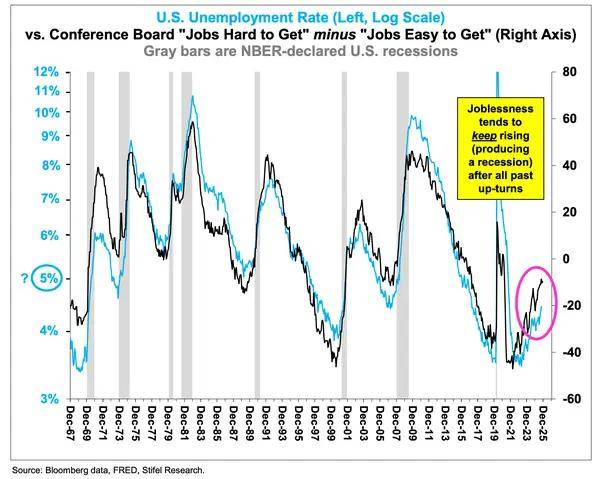
Core Viewpoint - Stifel's chief equity strategist Barry Bannister predicts a potential 9% increase in the S&P 500 index if the U.S. economy remains strong, but warns of a possible 20% decline in the event of a recession, which has a 25% likelihood according to Stifel's assessment [1][3]. Economic Outlook - Bannister's fundamental forecast suggests that the S&P 500 index could achieve positive returns by 2026, aligning with the Federal Reserve's recent upward revision of economic growth forecasts for that year [3]. - The expectation of a "soft landing" scenario indicates that the Federal Reserve's monetary policy easing is likely to support the market [3]. Downside Risks - The report highlights significant downside risks, including signs of a loosening labor market, with rising unemployment rates and increasing layoffs, which could negatively impact consumer spending that constitutes 68% of the economy [3]. - Current stock market valuations are at historical highs, making the market particularly vulnerable to shocks; the median market correction during recessions since World War II has been 20%, with an average decline of 23% [3]. - The risk premium for the S&P 500 index is nearing levels seen during the late 1990s tech bubble, raising concerns about overvaluation [3]. - A decline in speculative sentiment is noted, with a basket of high-volatility stocks experiencing significant drops, indicating a potential weakening in market risk appetite [3]. Investment Recommendations - In light of the dual risks, Bannister advises investors to prepare for potential gains while also establishing hedging positions [4]. - Recommended defensive assets for portfolio construction include the Consumer Staples Select Sector SPDR Fund (XLP), Invesco S&P 500 Low Volatility ETF (SPLV), JPMorgan Equity Premium Income ETF (JEPI), and iMGP DBi Managed Futures Strategy ETF (DBMF), which aim to provide lower correlation or more defensive exposure compared to traditional equities [4].

美股明年能否接着“狂欢”?知名投行:若经济衰退来袭,或迅速暴跌20%!
Sou Hu Cai Jing· 2025-12-13 03:08
Group 1 - The core viewpoint is that if the U.S. economy remains strong through 2026, the S&P 500 index is expected to rise by 9%, but investors should prepare for a potential 20% drop in case of a recession [1] - Stifel estimates a 25% probability of a recession occurring, despite it not being the base case for major Wall Street firms [1] - The labor market shows signs of instability, with rising unemployment and layoffs, which could lead to reduced consumer spending, negatively impacting an economy where 68% of GDP comes from consumer spending [1] Group 2 - The current stock valuations are at historical highs, which may pose challenges for investors, as the median market correction during recessions since World War II has been 20% [1] - Barry Bannister emphasizes that the price-to-earnings ratio becomes crucial when the S&P 500 is perceived as overvalued [2] - High-volatility stocks, such as Palantir and GameStop, have seen significant declines, indicating a potential early warning for a broader market downturn [2] Group 3 - The S&P 500's equity risk premium is nearing levels seen during the late 1990s and early 2000s dot-com bubble, suggesting heightened risk in current valuations [4] - Bannister's fundamental prediction is for the S&P 500 to achieve positive returns by 2026, but he advises establishing hedging positions with defensive stocks [6] - Recommended defensive ETFs include the Consumer Staples Select Sector SPDR Fund (XLP), Invesco S&P 500 Low Volatility ETF (SPLV), JPMorgan Equity Premium Income ETF (JEPI), and iMGP DBi Managed Futures Strategy ETF (DBMF) [6]
$15B Equity Services Inc. Appoints Alex David as President, CEO
Yahoo Finance· 2025-12-12 17:32
Leadership Changes - Alex David will become the president and CEO of Equity Services Inc. (ESI) starting December 16, succeeding Ata Azarshani, who is retiring after a 40-year career in financial services [1][3] - Brian Nelson has been appointed as the head of growth strategy at ESI, a newly created role, after leaving Atria Wealth Solutions [2] Company Background - ESI, founded in 1968, is the broker/dealer and registered investment advisor affiliate of National Life Insurance Company, which has a history dating back to 1848 [7] - Under Azarshani's leadership, ESI has grown to over 600 financial advisors and manages more than $15 billion in assets [4] Previous Experience of New CEO - Prior to joining ESI, Alex David was at Raymond James Financial Services, overseeing a division with over $100 billion in assets under management and generating over $100 million in new production [5] - David previously revitalized Century Securities at Stifel, quadrupling revenue to $60 million and increasing assets under management to $10 billion [6]