
中国信达

Search documents
不良资产转让市场火爆 AMC净利不增反降
Zheng Quan Shi Bao· 2025-05-21 17:55
Core Insights - The domestic non-performing loan (NPL) transfer market is experiencing explosive growth, particularly in personal NPL transfers, which has drawn attention to asset management companies (AMCs) specializing in NPL disposal [1][2] - Shandong Financial Asset Management Co., Ltd. (Shandong Jinzi) reported a 45% year-on-year decline in revenue and a 21% drop in net profit for 2024, attributed to increased difficulty in NPL disposal and intensified industry competition [1] - National AMCs are also facing mixed results, with China Cinda reporting a 47.8% decline in net profit and a pre-tax loss of 587 million yuan in its NPL business due to poor performance from certain subsidiaries [1] Industry Overview - The NPL transfer market is growing, but AMCs are not seeing corresponding increases in performance due to heightened competition and increased recovery difficulties, which are squeezing profit margins [2] - The AMC industry is undergoing a rapid reshuffle, with a need for short-term adjustments as it focuses on its core responsibilities, leading to a contraction in comprehensive financial business scale and revenue decline [3] - Optimism exists regarding macro policies in 2025 that may boost the NPL market, with expectations that the difficulties in NPL disposal have nearly bottomed out and recovery rates are stabilizing [3] Market Dynamics - Recent developments indicate a shift towards professionalization and marketization in the AMC sector, with the Ministry of Finance transferring shares of major AMCs to Central Huijin, enhancing the financial system's risk response capabilities [3] - China Cinda's entry into the personal NPL transfer market marks a significant change in the perception of national AMCs, which have traditionally focused on corporate NPLs [3][4] - The maturation of bulk personal loan transfer business is expected to provide new growth points and profit opportunities for AMCs, although weaker players may face market share pressures as competition intensifies [4]
资产支持票据产品报告(2025年4月):资产支持票据发行规模持续提升,其中资产支持商业票据约占一半,个人消费金融类资产表现活跃
Zhong Cheng Xin Guo Ji· 2025-05-19 14:39
Report Summary 1. Report Industry Investment Rating There is no information about the report industry investment rating in the provided content. 2. Core Viewpoints The asset - backed note issuance scale has continuously increased, with asset - backed commercial paper accounting for about half, and personal consumer finance - related assets are active [3]. 3. Summary by Relevant Catalogs 3.1 Issuance Situation - In April 2025, 58 asset - backed note products were issued, with a total issuance scale of 59.188 billion yuan. Compared with the previous month, the number of issuances increased by 9, and the issuance scale grew by 33.71%. Compared with the same period last year, the number of issuances increased by 11, and the issuance scale grew by 55.01%. Only 4 were publicly issued, and the rest were privately placed [4][5]. - The top five initiators in terms of issuance scale were China Orient Asset Management Co., Ltd. (8.945 billion yuan, 15.11%), Beijing Jingdong Century Trading Co., Ltd. (8.725 billion yuan, 14.74%), China Cinda Asset Management Co., Ltd. (6.043 billion yuan, 10.21%), SDIC Taikang Trust Co., Ltd. (5.964 billion yuan, 10.08%), and Huaneng Guicheng Trust Co., Ltd. (4.4 billion yuan, 7.43%). The total issuance scale of the top ten initiators was 48.094 billion yuan, accounting for 81.26% [5]. - The underlying asset types included personal consumer finance, specific non - financial claims, accounts receivable, micro - loans, and financial leasing. Personal consumer finance products accounted for 47.96% of the scale [7]. - The highest single - product issuance scale was 6.043 billion yuan, and the lowest was 1.0 billion yuan. The number and scale of products with a single - issuance scale between (0, 10] billion yuan were the largest, with 52 products issued, accounting for 66.13% of the scale [9]. - The shortest product term was 0.25 years, and the longest was 5.02 years. Products with a term between (0, 1] years had the largest issuance scale, accounting for 49.24%. Products with a term between (1, 2] years had the largest number of issuances, with 26 products issued [10]. - According to the issuance scale of notes at each level, AAAsf - rated notes accounted for 91.44% [11]. - The lowest issuance interest rate of one - year - around AAAsf - rated notes was 1.94%, the highest was 3.60%, and the interest rate center was around 2.02% [13]. - In April 2025, 24 ABCP products were issued, with a total issuance scale of 29.368 billion yuan, accounting for 49.62% of the ABN issuance scale. Specific non - financial claim ABCP accounted for 51.03% of the ABCP issuance scale, personal consumer finance ABCP accounted for 27.54%, and accounts receivable ABCP accounted for 11.60% [17]. 3.2 Secondary Market Transaction Situation - In April 2025, there were 563 secondary - market transactions of asset - backed notes, with a transaction amount of 54.198 billion yuan. The transaction amount decreased by 10.76% month - on - month, and the number of transactions decreased by 20.59% month - on - month. The transaction amount increased by 46.82% year - on - year, and the number of transactions increased by 35.66% year - on - year [4][18]. - The more active underlying asset types in the secondary - market transactions were personal consumer finance, specific non - financial claims, class REITs, accounts receivable, and supply chains, with transaction - amount proportions of 26.43%, 18.42%, 16.75%, 13.13%, and 5.23% respectively [18].
LP周报丨300亿,湖州也要放大招了
投中网· 2025-05-17 05:42
Core Viewpoint - Huzhou is emerging as a new player in the venture capital scene, actively promoting equity investment with the establishment of several significant funds, including a 300 billion yuan industrial mother fund aimed at key sectors such as new energy vehicles, semiconductors, and artificial intelligence [5][6][8]. Fund Establishments - Huzhou has launched a 300 billion yuan industrial mother fund, focusing on sectors like new energy vehicles, semiconductors, and biomedicine, marking a significant step in its industrial investment strategy [6][8]. - The China Insurance and China-Italy Asset Management have established a 130.01 billion yuan investment fund, continuing their active role in the primary market [10][11]. - A 50 billion yuan investment fund has been set up by Sinopec in Yantai, focusing on hydrogen energy ventures, showcasing the company's commitment to the investment landscape [12]. - The Jiangsu-based Xinnenghui New Energy Partnership has been established with a capital of 46 million yuan, focusing on the renewable energy sector [13]. - The Changjiang Intelligent Manufacturing Fund, led by Changjiang Industrial Group, has been registered with a target size of 30 billion yuan, emphasizing investments in high-end manufacturing and new energy vehicles [14][15]. - A 25 billion yuan equity investment fund has been established in Henan, focusing on the biomedical sector, reflecting the region's commitment to technological innovation [16]. - The Yunnan Traditional Chinese Medicine Industry Development Fund has been formed with a total size of 100 billion yuan, aimed at enhancing the local TCM industry [19]. GP Recruitment - The Sichuan University Technology Achievement Transformation Fund is seeking GP candidates to manage a 100 billion yuan fund, focusing on AI and other strategic emerging industries [23]. - The Nanzhang County Government Guidance Fund is inviting GPs to manage investments in key industries, including high-end manufacturing and modern agriculture [24]. - The Ningbo Angel Investment Guidance Fund is looking for GP candidates to establish sub-funds, with a minimum size of 50 million yuan [25]. - The Shaoxing City Industrial Fund is recruiting GPs to manage a 150 billion yuan fund, focusing on emerging and traditional industries [26][27]. - The Jiujing Mountain Red Equity Investment Fund is seeking GPs to support local companies aiming for public listing, with a registered size of 5 billion yuan [28].



发挥功能优势 深耕破产重整领域
Jin Rong Shi Bao· 2025-05-15 04:45
Core Viewpoint - The recent guidance from the National Financial Supervision Administration emphasizes the need for financial asset management companies to engage in orderly rescue operations for troubled enterprises, utilizing various financial tools to support the real economy and mitigate risks [1] Group 1: Financial Asset Management Companies - Financial asset management companies are encouraged to utilize multi-layered rescue tools such as bridge financing, co-benefit debt investment, mezzanine investment, and temporary equity holding to effectively address the challenges faced by troubled enterprises [1] - China Cinda is committed to implementing the central government's decisions and regulatory requirements, focusing on its primary responsibilities and actively participating in corporate restructuring and orderly rescue operations [1][4] Group 2: Corporate Restructuring and Support - China Cinda has developed a unique approach to corporate rescue, focusing on bankruptcy restructuring as a key method for value restoration and new beginnings for troubled enterprises [1][2] - The company has engaged in various projects across critical sectors, investing over 18 billion yuan to help companies like Beida Jade Bird, Xining Special Steel, and others regain operational capabilities [2][3] Group 3: Case Studies - In the case of Fangyuan Nonferrous, which faced over 30 billion yuan in liabilities, China Cinda's intervention led to a net profit of 550 million yuan in 2023 and stabilized employment for over 2,000 workers [3] - For Xining Special Steel, China Cinda's innovative restructuring model, which included a 1.3 billion yuan investment, resulted in a 58.54% increase in steel production and 2.7 billion yuan in revenue in the first half of 2024 [3]


中国信达这家分公司再收罚单,涉及变相为企业融资
Sou Hu Cai Jing· 2025-05-14 11:17
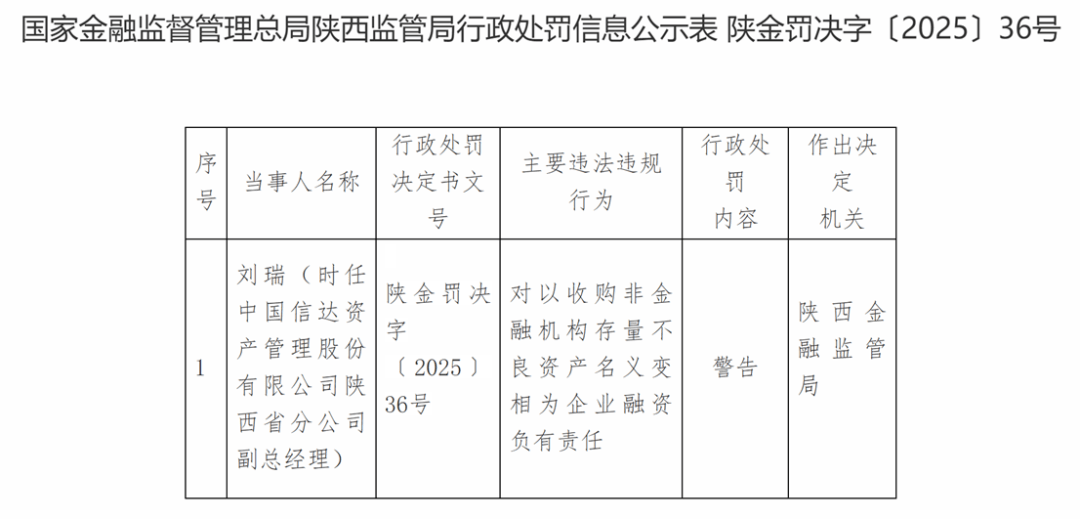
Core Viewpoint - China Cinda Asset Management Co., Ltd. faces regulatory scrutiny due to improper financing practices disguised as asset acquisitions, leading to warnings for its executives [1][4]. Regulatory Actions - Liu Rui, the former deputy general manager of China Cinda's Shanxi branch, received a warning for being responsible for financing disguised as the acquisition of non-financial institutions' bad assets [1][4]. - In January 2025, China Cinda's Shanxi branch was fined 620,000 yuan for similar violations, including inadequate assessment of bad assets [4]. Financial Performance - China Cinda reported a revenue of 73.04 billion yuan in 2024, a year-on-year decline of 4.11%, and a net profit of 3.51 billion yuan, down 49.84% [6]. - The company has experienced a continuous decline in net profit over the past three years, with figures of 13 billion yuan, 7.23 billion yuan, and 6.99 billion yuan from 2021 to 2023 [7]. Business Segments - The core business of China Cinda, which is bad asset management, has seen a decline in revenue from 80.1 billion yuan in 2020 to 40.37 billion yuan in 2024, representing a decreasing share of total revenue from 70.5% to 55.3% [8]. - In 2024, the bad asset management segment reported a pre-tax loss of 587 million yuan, marking a 112.89% decline year-on-year [8]. Ownership Changes - Recently, the Ministry of Finance plans to transfer all domestic shares of China Cinda to Central Huijin Investment Ltd., changing the actual controller from the Ministry of Finance to Huijin [9].
信用策略系列:2.2%以上信用债全景
Minsheng Securities· 2025-05-14 08:25
Group 1: Overview of Credit Bonds - As of May 12, 2025, the total outstanding credit bond market, including financial bonds, is 431396 billion, with local government bonds (城投债) at 186206 billion, industrial bonds at 103498 billion, and financial bonds at 141692 billion [8][12] - Among local government bonds, 63480 billion are valued above 2.2%, accounting for 34.1% of the total [10][12] - The report categorizes local government bonds into four tiers based on their valuation and distribution across provinces [16] Group 2: Distribution of Local Government Bonds - In Jiangsu, Zhejiang, Anhui, and Fujian, the proportion of bonds valued above 2.2% is below 30%, but the total scale is relatively large, with Jiangsu having a rich supply of 1-3 year AA(2) bonds [10][17] - In Sichuan, Hunan, Hubei, and Jiangxi, the valuation is in the mid-range, with 30-40% of bonds valued above 2.2%, and Sichuan alone has over 4800 billion in such bonds [10][21] - In Henan, Shandong, and Shaanxi, the overall valuation is higher, with bonds valued between 2.29% and 2.40%, and the proportion of bonds above 2.2% ranges from 47% to 63% [10][12] Group 3: Industrial Bonds - As of May 12, 2025, the total outstanding industrial bonds amount to 103498 billion, with 21368 billion valued above 2.2%, representing 20.6% of the total [3][12] - The real estate sector has over 5300 billion in bonds valued above 2.2%, while sectors like construction, non-bank financials, coal, steel, and retail also show significant amounts [3][12] Group 4: Financial Bonds - The total outstanding financial bonds is 141692 billion, with 9093 billion valued above 2.2%, which is 6.4% of the total [4][12] - Among bank subordinated bonds, over 3400 billion are valued above 2.2%, primarily concentrated in bonds with a maturity of over three years [4][12] - Insurance bonds valued above 2.2% exceed 1500 billion, with major issuers including Ping An Life, Taikang Life, and Sunshine Life [4][12]
恒大500米超高地标项目将复活?央企接盘
Sou Hu Cai Jing· 2025-05-13 23:27
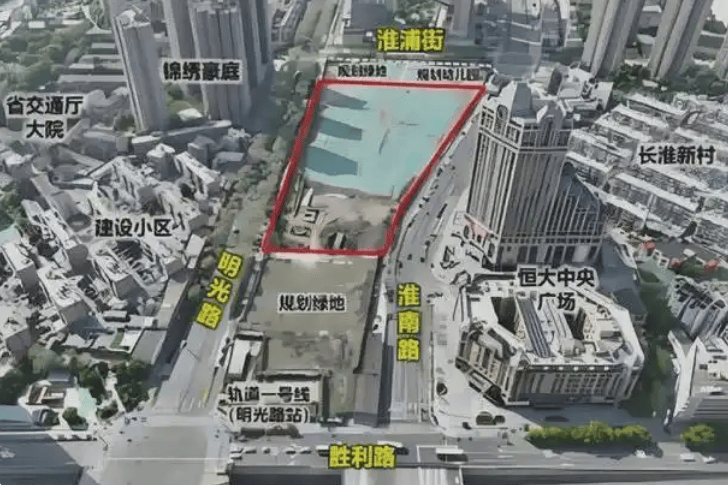
这样一宗地块,原应是"香饽饽",此前却经历了延期出让,如今又以底价被中海拿下。 这背后的原因在于该地块特殊的出让条件——同步承担合肥恒大 中心D1、D2塔楼续建任务。 土地出让公告显示,土地竞买人须同步保障合肥市包河区华山路与南宁路交口东北角项目D1、D2塔楼续建交付任务。经第三方测算,续建交付费用约 3.92亿元,此款由竞得人负责支付。 500米超高地标迎来曙光 中海此次拿下的地块,正是曾被寄予厚望成为"安徽第一高楼"的滨湖恒大中央广场4号商业用地。 据出让公告,在土地成交后7个自然日内、《国有建设用地使用权出让合同》签订前,由竞得人与总承包单位等方面签订保交付资金保障协议,并在签订 协议后7个自然日内,支付1亿元至项目共管账户,6个月内支付第二笔1亿元,12个月内付清尾款1.92亿元。 公告还规定了项目交付周期,即在第一笔款项支付后,D1、D2塔楼立即启动复工,复工18个月内建成交付。 然而,2016年因环保问题停工,2018年彻底陷入停滞,2023年恒大债务危机后项目彻底停摆。截至2024年,主楼核心筒仍裸露在荒地中,与周边新建住宅 形成鲜明对比。 图源:搜狐新闻网 ▲ 滨湖恒大中心D1\D2塔楼效果图 ...

信达地产股份有限公司收购报告书
Zhong Guo Zheng Quan Bao· 2025-05-08 21:55
Group 1 - The acquisition involves Central Huijin Investment Co., Ltd. acquiring shares in Xinda Real Estate Co., Ltd. through a state-owned equity transfer, resulting in indirect ownership of 1,552,939,583 shares, which represents 54.45% of the total issued shares of Xinda Real Estate [2][17] - The acquisition has been approved by the Ministry of Finance and the National Financial Regulatory Administration, with further approvals from other financial regulatory bodies pending [2][12] - The acquisition is classified as a state-owned equity transfer, exempting the acquirer from making a public offer as it results in ownership exceeding 30% of the company's issued shares [19] Group 2 - Central Huijin Investment Co., Ltd. is a wholly state-owned enterprise under the State Council, with its primary purpose being to manage state financial assets and investments [5][6] - The company does not engage in any commercial operations or interfere with the daily operations of its invested enterprises [7] - The financial data for the last three years indicates that the company has not faced any administrative or criminal penalties, nor does it have any significant civil litigation or arbitration related to economic disputes [9][10] Group 3 - There are currently no plans for Central Huijin to increase or dispose of its holdings in Xinda Real Estate within the next 12 months [11] - The acquisition does not intend to change the main business operations of Xinda Real Estate or its subsidiaries, nor does it plan to make significant adjustments to the company's management or employee hiring policies [23][26] - The independence of Xinda Real Estate in terms of personnel, assets, finance, and operations will remain intact post-acquisition, with no impact on its competitive position or related party transactions [29][30]

金谷信托践行“金融五篇大文章” 深耕主业聚力提质
Jing Ji Guan Cha Wang· 2025-04-30 03:00
Core Viewpoint - Jingu Trust, a subsidiary of China Cinda Asset Management, has achieved steady growth in 2024, with total revenue of 1.411 billion yuan and a profit of 742 million yuan, while adhering to its mission of supporting national strategies and enhancing the real economy [1] Group 1: Strategic Initiatives - Jingu Trust has implemented the "Five Major Articles" to align with national strategies, focusing on technology, green development, inclusive finance, elderly care, and digital economy [2][3][4] - The company has established various trust plans, including a 15 billion yuan green trust and a 5.05 million yuan rural revitalization trust, to support emerging industries and promote sustainable development [2][3] Group 2: Financial Services and Innovations - Jingu Trust has successfully launched a bankruptcy service trust with a scale of 13 billion yuan, enhancing its capabilities in managing special assets and providing professional services [5] - The company has also set up a 5.5 billion yuan trust to assist a small bank in resolving non-performing assets, demonstrating its role in stabilizing local economies [6] Group 3: Social Responsibility and Charitable Initiatives - The company has created the "Cinda Great Love" charitable trust brand, contributing over 80 million yuan to various regions, and has established innovative charitable trust models [8] - In 2024, Jingu Trust distributed 10.499 billion yuan in benefits to beneficiaries, emphasizing its commitment to maximizing the interests of its clients [8] Group 4: Future Outlook - Jingu Trust aims to continue its focus on the core functions of trust services, enhancing its professional capabilities and innovating business models to support high-quality economic development [9]
利源股份:2024年报净利润-7.18亿 同比下降296.69%
Tong Hua Shun Cai Bao· 2025-04-28 19:20
Financial Performance - The company reported a basic earnings per share of -0.2000 yuan for 2024, a decrease of 300% compared to -0.0500 yuan in 2023 [1] - The net profit for 2024 was -7.18 billion yuan, representing a significant decline of 296.69% from -1.81 billion yuan in 2023 [1] - The operating revenue decreased by 29.98% to 3.34 billion yuan in 2024 from 4.77 billion yuan in 2023 [1] - The return on equity was -100.75% in 2024, a drop of 547.08% from -15.57% in 2023 [1] Shareholder Information - The top ten unrestricted shareholders collectively hold 130,772.68 million shares, accounting for 36.83% of the circulating shares, a decrease of 24,327.57 million shares from the previous period [2] - The largest shareholder, Beiyou Intelligent Technology (Shenzhen) Co., Ltd., holds 80,000 million shares, representing 22.54% of the total share capital, with no change [3] - Notable changes include the exit of China Cinda Asset Management Co., Ltd. and Zheng Shicai from the top ten shareholders [3] Dividend Policy - The company has announced no distribution or capital increase for the current period [4]
