极氪

Search documents
“既漂亮又先进”——中国电动汽车在黎巴嫩市场受认可度持续攀升
Xin Hua Wang· 2025-11-17 07:36
极狐经销商埃迪·谢尔法内认为,中国电动汽车在黎巴嫩市场具有明显竞争优势。"中国电动汽车在设 计、技术、质量、价格和维护成本上都有很强的竞争力。" "中国用极强的创新力向世界证明其能够制造既漂亮又先进的汽车。"极氪经销商伯纳德·阿卜杜拉感 慨,中国电动汽车在黎巴嫩市场的受认可度持续提升。 "黎巴嫩消费者对中国电动汽车兴趣浓厚,中国品牌在电池、车载软件和智能技术等方面处于行业领先 地位。"在黎巴嫩首都贝鲁特举办的电动出行展上,展会主办方电子生态经济解决方案公司首席执行官 吉尔贝特·特古这样对记者说。 贝鲁特电动出行展本月11日至17日举行,吸引了包括极狐、极氪、小鹏、岚图等中国品牌在内的17个电 动汽车品牌参展,约50款车型亮相。展会设置互动体验区、智能驾驶展示区和充电解决方案展示区,为 观众提供全方位体验。 记者在现场看到,展厅内人头攒动,消费者在各个展台仔细观看汽车内饰和智能大屏,体验交互系统, 并向经销商咨询最新技术。 观众法里斯·法赫德目前拥有四辆电动汽车,其中三辆为中国品牌,他打算进一步"扩充车队"。他 说:"我最看重中国电动汽车的设计和智能系统。它们的技术、质量和价格都让人满意。" 经销商巴泽尔吉汽车 ...
通讯|“既漂亮又先进”——中国电动汽车在黎巴嫩市场受认可度持续攀升
Xin Hua She· 2025-11-17 07:19
Core Viewpoint - The recognition of Chinese electric vehicles in the Lebanese market is continuously increasing, driven by their advanced technology, design, and competitive pricing [1][2]. Group 1: Market Reception - Lebanese consumers show strong interest in Chinese electric vehicles, with local brands leading in battery technology, onboard software, and smart features [1]. - The electric mobility exhibition in Beirut featured 17 electric vehicle brands, including Chinese brands like Arcfox, Zeekr, Xpeng, and Lantu, showcasing around 50 models [1]. - Consumers actively engaged with the vehicles at the exhibition, highlighting their satisfaction with the design and smart systems of Chinese electric cars [1]. Group 2: Sales and Growth - Chinese brands have seen significant sales growth in Lebanon, with positive feedback from consumers regarding quality and after-sales service [1]. - The continuous updates in technology and vehicle design by Chinese brands are aligning well with local consumer needs, enhancing their market presence [1]. Group 3: Competitive Advantage - Chinese electric vehicles possess a clear competitive edge in design, technology, quality, pricing, and maintenance costs in the Lebanese market [1]. - The innovative capabilities of Chinese manufacturers are proving their ability to produce attractive and advanced vehicles, further boosting their recognition in Lebanon [1]. Group 4: Market Potential - Despite being in its early stages, the Lebanese electric vehicle market holds significant potential, with high consumer expectations for vehicle quality and driving experience [2]. - The confidence of dealers in introducing more Chinese brands is bolstered by the widespread recognition of Chinese electric vehicles in the Middle East due to their innovative designs and advanced manufacturing [2].
通讯丨“既漂亮又先进”——中国电动汽车在黎巴嫩市场受认可度持续攀升
Xin Hua Wang· 2025-11-17 07:15
Core Viewpoint - Lebanese consumers show a strong interest in Chinese electric vehicles, recognizing their leading position in battery technology, onboard software, and smart technologies [1][2]. Group 1: Market Recognition - The electric mobility exhibition in Beirut featured 17 electric vehicle brands, including Chinese brands like Arcfox, Zeekr, Xpeng, and Lantu, showcasing around 50 models [1]. - The exhibition provided interactive experience zones, smart driving displays, and charging solution showcases, enhancing consumer engagement [1]. - Local consumers are increasingly satisfied with the design, technology, quality, and pricing of Chinese electric vehicles, leading to a growing fleet among owners [1]. Group 2: Dealer Insights - Dealers report significant sales growth for Chinese brands in Lebanon, attributing this to high-quality after-sales service and continuous updates in technology and design [1]. - Chinese electric vehicles are perceived to have a competitive advantage in design, technology, quality, price, and maintenance costs [1]. - The innovative capabilities of Chinese manufacturers are highlighted as a key factor in their ability to produce attractive and advanced vehicles [1]. Group 3: Market Potential - Despite being in its early stages, the Lebanese electric vehicle market is seen as having substantial potential, driven by high consumer expectations for vehicle quality and driving experience [2]. - The confidence of dealers in introducing more Chinese brands is bolstered by the widespread recognition of Chinese electric vehicles in the Middle East market due to their innovative designs and advanced manufacturing processes [2].
中国工业机器人上演“升职记”
Ren Min Ri Bao Hai Wai Ban· 2025-11-17 07:02
Core Insights - The evolution of industrial robots in China is transforming them from auxiliary tools to primary labor forces in manufacturing, significantly impacting global smart manufacturing dynamics [1][2][3] Group 1: Industrial Robot Development - China has become the world's largest industrial robot market, with an expected 2.027 million units by 2024, accounting for over 50% of global installations since the 14th Five-Year Plan [2][4] - In 2022, China installed nearly 300,000 new robots, surpassing the total installations in all other regions combined [3] - The density of industrial robots in China reached 470 units per 10,000 people, significantly exceeding the global average, indicating rapid advancements in smart manufacturing capabilities [3][4] Group 2: Application and Integration - Industrial robots are increasingly integrated into various sectors, with applications in 71 major industries and 241 sub-industries, enhancing productivity and efficiency [4][5] - The rise of "dark factories" in China, where automation is prevalent, is exemplified by companies like Midea, Xiaomi, and Gree adopting advanced robotic technologies in their manufacturing processes [4][5] - The integration of AI with robotics is enabling real-time monitoring and optimization of equipment performance, a practice that is not yet widespread in other regions [5][6] Group 3: Future Prospects and Innovations - The Chinese government is promoting the "Robot+" initiative to expand the depth and breadth of robot applications, focusing on areas like welding, assembly, and material handling [6][7] - Despite the early-stage application of humanoid robots in industrial settings, there is a growing ecosystem supported by government initiatives and a surge in startups focusing on specialized components [6][7] - The development of robots is seen as a solution to labor shortages and is expected to create new job opportunities in various sectors, including education, healthcare, and elder care [7]

吉利汽车Q3利润增长59%,极氪交付量同比增长13% | 财报见闻
Hua Er Jie Jian Wen· 2025-11-17 06:31
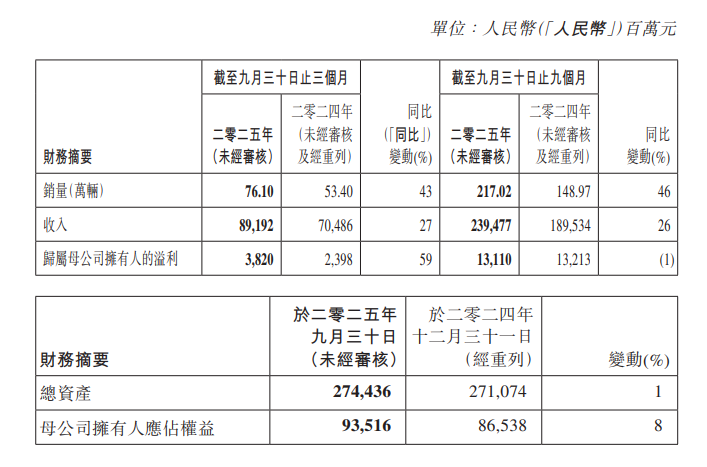
Core Viewpoint - Geely Automobile reported significant growth in both sales and profits for Q3 2025, with total sales increasing by 43% to 761,000 units and revenue rising by 27% to RMB 89.192 billion, indicating strong performance in both fuel and new energy vehicles [1][3][5]. Financial Performance - In Q3 2025, Geely's revenue reached RMB 89.2 billion, marking a historical high and a 15% increase from the previous quarter [5]. - The net profit attributable to the parent company was RMB 3.8 billion, reflecting a 59% year-on-year increase [5]. - The total gross profit for Q3 was RMB 14.8 billion, with an 11% quarter-on-quarter growth [5]. Sales and Delivery - Zeekr, Geely's premium electric vehicle brand, delivered approximately 140,000 units in Q3 2025, a 13% increase year-on-year, generating revenue of about RMB 31.6 billion [6]. - As of the end of October, Geely has achieved a cumulative sales volume of 2.477 million units for the year, reaching 82.6% of its annual target of 3 million units [1]. Cost Management and Profitability - The company attributed its profit growth to scale effects, cost control, and brand integration synergies, with net profit growth outpacing revenue growth [3]. - Adjusted net profit for the first nine months of the year was RMB 10.62 billion, a 59% increase year-on-year when excluding one-time items from the previous year [3]. Accounting Changes - Geely has changed its accounting policy effective January 1, 2025, from the "purchase method" to the "equity method" for joint control entities, impacting the way acquisitions are recorded and necessitating restatement of prior financial results [8]. - This change aims to enhance financial reporting transparency and align with international practices, affecting the financial data comparison for 2024 [8].


吉利汽车(00175.HK)第三季度纯利增长59%至38亿元,燃油车与新能源车销量实现同步增长
Ge Long Hui· 2025-11-17 04:11
Core Viewpoint - Geely Automobile (00175.HK) reported strong growth in Q3 2025, with simultaneous increases in sales of both fuel and new energy vehicles, leading to a total sales growth of 43% year-on-year and a revenue increase of 27% [1] Financial Performance - The net profit attributable to shareholders for Q3 2025 reached RMB 3.8 billion, representing a 59% year-on-year increase [1] - For the nine months ending September 30, 2025, the net profit attributable to shareholders was RMB 10.62 billion, a 59% increase compared to RMB 6.68 billion for the same period in 2024 [1] Subsidiary Performance - Zeekr, a subsidiary of the group, showed excellent performance in Q3, with total deliveries of approximately 140,000 vehicles, a 13% increase year-on-year [1] - Revenue for Zeekr in the same quarter was approximately RMB 31.6 billion, a 9.4% increase year-on-year, with a gross profit of RMB 6 billion, up 50% year-on-year [1] - The gross margin for Zeekr reached 19.0%, an increase of 5.1 percentage points from 13.9% in Q3 2024 [1]
In India’s car labs, Chinese models are the new benchmark
MINT· 2025-11-17 00:30
Core Insights - The Indian automotive industry is increasingly benchmarking against Chinese carmakers, particularly in the electric vehicle (EV) sector, as they lead in technology and consumer-centric design [2][4][11] Industry Trends - Chinese vehicles like Xiaomi SU7, BYD Seal, Nio ET, and Zeekr 7X are becoming the focus of benchmarking efforts in India, reflecting a shift from traditional European and American models [2][3] - The approach of Chinese manufacturers often involves designing software first, prioritizing consumer convenience, which contrasts with the traditional hardware-first methodology [5] Competitive Advantages - Chinese automakers are noted for providing premium features at lower price points, making advanced technologies such as ADAS and smart cockpit designs more accessible [6][7] - Over the past decade, Chinese companies have invested significantly in building EV ecosystems, with an estimated $143 billion spent on EV and battery projects, supported by government subsidies [8] Market Perception - Social media comparisons highlight the technological advancements of Chinese vehicles, showcasing superior performance in various tests against established European brands [9] - Executives from major automotive companies, including Ford, have expressed surprise at the rapid technological advancements made by Chinese manufacturers [10] Future Outlook - Indian companies are expected to use Chinese benchmarks for EV technology, which is seen as beneficial due to the similarities in market conditions between India and China [11] - There is optimism within the Indian automotive sector that as EVs become mainstream, India may also set benchmarks for global companies [12]

中国工业机器人上演“升职记”(国际论道)
Ren Min Ri Bao Hai Wai Ban· 2025-11-16 23:10
Core Insights - The article highlights the transformation of industrial robots in China from auxiliary tools to primary labor forces, significantly impacting global smart manufacturing dynamics [3][4][6]. Group 1: Industrial Robot Development - China's industrial robot market is projected to reach 2.027 million units by 2024, making it the largest in the world [3][4]. - In 2022, China installed nearly 300,000 new robots, surpassing the total installations in other regions combined [4]. - The density of industrial robots in China has reached 470 units per 10,000 people, significantly above the global average [4]. Group 2: Application and Integration - Industrial robots are now utilized across 71 major sectors and 241 sub-sectors of the national economy, accounting for over 50% of global new installations since the 14th Five-Year Plan [5][6]. - Major Chinese companies like Midea, Xiaomi, and Gree have adopted "dark factories" that leverage advanced robotics for production [5][6]. - The integration of AI with robotics is enhancing operational efficiency, with real-time monitoring and data analysis optimizing equipment performance [6][8]. Group 3: Future Prospects and Innovations - The Chinese government is promoting the "Robot+" initiative to expand the application of robots in various manufacturing processes, particularly in welding, assembly, and material handling [7]. - There is a growing ecosystem for humanoid robots in China, supported by government initiatives and a surge in startups focusing on specialized components [7][8]. - The development of humanoid robots is still in early stages, but they are expected to play a significant role in industrial and service sectors in the future [7][8].

比亚迪华东首个产业园落地南部新城
Nan Jing Ri Bao· 2025-11-16 00:19
Core Insights - BYD has officially opened its first comprehensive industrial park in East China, located in Nanjing's South New City, covering approximately 43,000 square meters, which will promote the gathering of the new energy vehicle industry chain and the development of new productivity in the region [1][2] - The park is positioned as "New Quality + Culture," showcasing advanced technologies such as BYD's megawatt flash charging technology, which allows for a 400-kilometer range with just 10 minutes of charging, and plans to exhibit L4-level intelligent driving assistance systems and drone technology [1] - The establishment of the BYD New Quality Cultural Industrial Park aligns with the South New City's focus on green energy and low-altitude economy, aiming to attract upstream and downstream enterprises and create industrial synergy [2] Industry Context - The Daming Road area in Nanjing, known as a traditional "automobile street," is transitioning from fuel vehicles to new energy vehicles, with 28 automotive stores, including brands like Xiaomi and Xpeng, forming an emerging industrial cluster [2] - In 2024, the automotive industry in Qinhuai District is projected to achieve a revenue of 6.28 billion yuan, accounting for 10% of the district's total retail sales, indicating a strong growth trajectory for new energy vehicle sales amidst declining traditional fuel vehicle sales [2] - The South New City management committee is actively supporting the project by providing tailored services throughout the project lifecycle, which is expected to enhance the region's automotive industry's smart and green transformation [2]

特斯拉被禁、新势力躺枪、燃油车未能幸免?!新国标要重拳出击了?
电动车公社· 2025-11-16 00:05
Core Viewpoint - The recent draft of the "Technical Conditions for Motor Vehicle Operation Safety" proposed by the Ministry of Public Security has sparked significant discussion in the automotive industry, particularly regarding its implications for the design and performance of electric vehicles and traditional cars [1][2]. Summary by Sections Regulations Impacting Vehicle Design - The draft includes mandatory national standards that, if not met, will prohibit the sale of vehicles. Key regulations target unreasonable designs in electric vehicles, affecting brands from Tesla to traditional manufacturers [2]. - Specific requirements include maintaining mechanical emergency structures for doors, mandatory physical controls for various functions, and restrictions on screen usage while driving [3][4]. Public Reaction and Debate - The regulation mandating a default acceleration time of over 5 seconds for vehicles has generated mixed reactions. Supporters argue it enhances safety, while opponents believe it restricts vehicle performance and could hinder the growth of the electric vehicle sector [6][7]. Global Perspectives on Road Safety Regulations - The article explores how different countries manage road safety. For instance, in the UK, insurance companies play a crucial role in regulating vehicle performance through pricing models based on various risk factors [8][10]. - Australia employs a tiered licensing system to ensure drivers gain experience before operating high-performance vehicles, reflecting a structured approach to driver capability [17][21]. - Japan's "gentlemen's agreement" among manufacturers historically limited vehicle performance to enhance safety, demonstrating a unique industry self-regulation approach [32][35]. Future Considerations - The draft regulations may signify the beginning of a more structured approach to vehicle performance and safety in the industry, rather than a blanket restriction on high-performance vehicles. The potential for a tiered licensing system or vehicle classification based on performance is suggested as a way to balance safety and technological advancement [51][58].