
成都银行

Search documents
本周聚焦:黄金波动下的机遇与挑战:银行贵金属业务有望成重要增长极
GOLDEN SUN SECURITIES· 2025-10-27 00:58
Investment Rating - The report maintains an "Accumulate" rating for the banking sector, indicating a positive outlook despite challenges in the gold market in 2025 [1]. Core Insights - The gold market is expected to present both opportunities and challenges for banks, with a trend towards deepening precious metal business driven by central bank purchases [1][2]. - The demand for gold bars and coins has increased significantly, reflecting a growing need for gold as a hedge and store of value among residents [4]. - The establishment of a market-making system for gold trading is anticipated to enhance market liquidity and stability, positioning listed banks as key players [3][4]. Summary by Sections 1. Policy and Market Environment - As of September 2025, China's official gold reserves reached 74.06 million ounces, marking an increase for 11 consecutive months [2]. - In Q2 2025, global central banks added 166 tons of gold to their reserves, with 95% of surveyed central banks expecting further increases in the next 12 months [2]. - New policies allowing insurance funds to invest in gold are expected to create new opportunities for banks to provide services to insurance institutions, enhancing their intermediary income [2]. 2. Business Dynamics and Revenue Contribution - In the first half of 2025, China's gold consumption was 505.205 tons, a year-on-year decrease of 3.54%, with significant growth in gold bar and coin consumption by 23.69% [4]. - The decline in gold jewelry consumption is prompting banks to shift focus from traditional jewelry sales to investment-oriented precious metal businesses [4]. - The growth in investment demand for gold bars and coins is expected to stabilize income from investment-related businesses, enhancing the profitability of the precious metals segment for banks [4]. 3. Industry Trends - The report highlights a structural shift in gold consumption, with investment demand rising while jewelry demand declines, indicating a need for banks to adapt their business strategies [4]. - The performance of the banking sector is expected to benefit from expansionary policies aimed at stabilizing the economy, with specific banks like Ningbo Bank and Jiangsu Bank recommended for investment due to positive fundamental changes [8]. 4. Key Data Tracking - The report includes various financial metrics, such as average daily trading volume and margin financing balances, which are essential for assessing market conditions [9][10].





招商基金王平旗下招商中证红利ETF三季报最新持仓,重仓宁波华翔
Sou Hu Cai Jing· 2025-10-26 21:39
Core Viewpoint - The report from the招商中证红利交易型开放式指数基金 indicates a net value growth rate of 9.21% over the past year, with significant changes in the top ten holdings compared to the previous quarter [1]. Group 1: Fund Performance - The fund achieved a net value growth rate of 9.21% over the last year [1]. - The report highlights the addition of new stocks to the top ten holdings, including 潞安环能, 中谷物流, 农业银行, 南钢股份, and 建设银行 [1]. Group 2: Changes in Top Holdings - New entries in the top ten holdings include: - 潞安环能 (669709): 7.7764 million shares valued at 1.11 billion - 中谷物流 (603560): 10.0744 million shares valued at 1.1 billion - 农业银行 (601288): 161.424 million shares valued at 1.08 billion - 南钢股份 (600282): 199.957 million shares valued at 1.05 billion - 建设银行 (601939): 117.632 million shares valued at 1.01 billion [2]. - 宁波华翔 (002048) saw an increase in holdings by 56.7 thousand shares, making it the largest holding at 2.73 billion [1][2]. - Other stocks that exited the top ten holdings include 成都银行, 兴业银行, 大秦铁路, 江苏银行, and 交通银行 [1][2].






关注信贷需求修复:银行业周报-20251026
Xiangcai Securities· 2025-10-26 14:50
Investment Rating - The industry investment rating is maintained at "Overweight" [4][7]. Core Insights - The new policy financial tools have been implemented to boost credit demand, with over 330 billion yuan allocated by three policy banks [3][27]. - A total of 500 billion yuan in new policy financial tools has been initiated, with 250 billion yuan already invested in 12 major economic provinces, focusing on infrastructure, foreign trade, and emerging sectors like digital economy and AI [4][5]. - The expected leverage effect of the 500 billion yuan policy financial tools could generate approximately 5 trillion yuan in investments and 4 trillion yuan in loans [4][29]. - The rapid deployment of these financial tools is anticipated to enhance credit demand in the fourth quarter, particularly benefiting regional banks due to the demonstration effect from major economic provinces [5][29]. Summary by Sections Market Review - The banking index increased by 1.40% during the period from October 20 to October 26, 2025, underperforming the CSI 300 index by 1.84 percentage points [9]. - The performance of major banks was relatively strong, with Agricultural Bank of China leading with a 4.86% increase [9]. Financial Market - The central bank's net injection in the open market was 198.1 billion yuan, maintaining a loose monetary environment [18]. - The average issuance rates for one-year interbank certificates of deposit were 1.68% for state-owned banks and 1.74% for regional banks, with a notable increase in net financing of 425.3 billion yuan in October [22][26]. Industry Dynamics - The policy financial tools are expected to support long-term public loans and improve loan term structures, with a focus on sustainable credit demand release during project operation cycles [29]. - Investment in emerging industries, particularly AI, is projected to maintain strong financing demand, with technology innovation loans expected to grow rapidly [5][29]. Investment Recommendations - The report suggests focusing on state-owned banks for their stable high dividend yields and potential valuation recovery opportunities for joint-stock and regional banks amid improving economic expectations [7][30].

浦发银行半月获股东三度增持 银行股“资本投票”潮已至?
Jing Ji Guan Cha Wang· 2025-10-26 12:05
Group 1 - China Mobile increased its stake in Shanghai Pudong Development Bank through convertible bonds, raising its ownership from 17.00% to 18.18% between October 10 and October 24, 2025 [1][2] - The stake increase occurred in three separate transactions on October 13, 17, and 24, each crossing the 1% disclosure threshold, reflecting a strategic management of shareholding [1][2] - The transactions involved a total of 450,156,195 shares, 149,805,835 shares, and 118,611,350 shares being converted from convertible bonds [1] Group 2 - Other major shareholders in the banking sector have also been increasing their stakes, indicating a growing confidence in the banking industry [2] - Postal Savings Bank's major shareholder increased its stake by 19.91 million shares, with plans for further increases within the next 12 months [2] - The trend of increasing stakes is not limited to large banks, as regional banks like Qingdao Bank and Suzhou Bank have also seen significant increases from local state-owned enterprises [3][4] Group 3 - The current wave of bank share increases is characterized by diverse stakeholders, including local state-owned platforms, central state-owned enterprises, foreign institutional investors, and industrial capital [5] - The increases are primarily funded by self-owned capital, with a general commitment to long-term holding, particularly in regional banks in economically active areas [5] - This trend reflects a broader restructuring logic within the financial system, as stakeholders publicly endorse the long-term value of banks through their investments [5][6] Group 4 - The recent increase in bank shares indicates a shift in valuation logic, moving from short-term profit fluctuations to a focus on structural advantages such as customer base, regional economic resilience, and asset quality stability [6] - Banks with these characteristics are becoming attractive to long-term investors, serving as a stabilizing force in the financial market [6]

四川商投集团发行西南地区首单北交所公司债券
Zhong Guo Jin Rong Xin Xi Wang· 2025-10-25 07:24
Core Insights - Sichuan Commercial Investment Group successfully issued the first corporate bond on the Beijing Stock Exchange in Southwest China, with a scale of 1 billion yuan and a term of 3 years at an interest rate of 2.45% [1] Company Overview - Sichuan Commercial Investment Group is the only provincial-level modern commercial circulation service investment platform and modern supply chain security platform in Sichuan, focusing on ensuring livelihood, promoting consumption, leading openness, and serving industries [1] Bond Issuance Details - The bond issuance is aimed at repaying interest-bearing debts, and it marks the company's first appearance in the exchange market with an AAA rating [1] - Multiple financial institutions participated in the subscription, including Chengdu Bank, Huaxia Wealth Management, Guiyang Bank, and others [1] Market Context - The corporate bond market on the Beijing Stock Exchange is set to officially open on January 15, 2024, with a product system that includes various types of bonds such as corporate bonds, enterprise bonds, and support bonds for small and micro enterprises [1] - The Beijing Stock Exchange has been actively conducting bond research and training to meet the financing needs of quality issuers nationwide [1]
四川商投集团成功发行西南地区首单北交所公司债券
Xin Lang Cai Jing· 2025-10-25 06:17
近日,四川省商业投资集团有限责任公司成功发行西南地区首单北交所公司债券。本期债券由财通证券 担任主承销商和簿记管理人,发行规模10亿元,期限为3年,发行利率2.45%,债券募集资金拟全部用 于偿还有息债务。成都银行、华夏理财、贵阳银行、中邮理财、浦发银行、兴银理财、恒丰银行等多家 金融机构参与认购。 ...
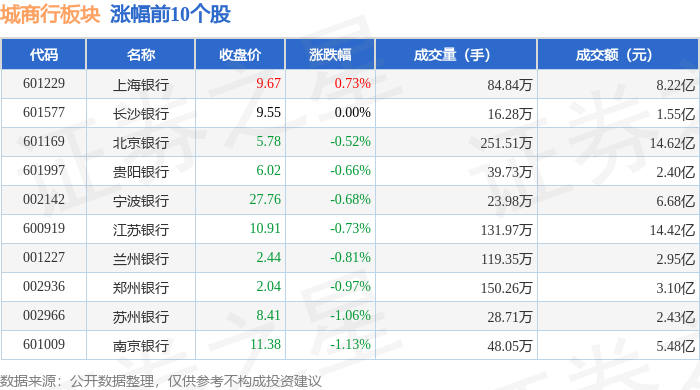
城商行板块10月24日跌0.76%,厦门银行领跌,主力资金净流出1.42亿元
Zheng Xing Xing Ye Ri Bao· 2025-10-24 08:27
Core Insights - The city commercial bank sector experienced a decline of 0.77% on October 24, with Xiamen Bank leading the drop [1] - The Shanghai Composite Index closed at 3950.31, up 0.71%, while the Shenzhen Component Index closed at 13289.18, up 2.02% [1] Stock Performance - Shanghai Bank closed at 9.67, up 0.73% with a trading volume of 848,400 shares and a transaction value of 822 million [1] - Xiamen Bank closed at 6.68, down 1.76% with a trading volume of 153,100 shares and a transaction value of 103 million [2] - The majority of city commercial bank stocks showed negative performance, with notable declines in Beijing Bank (-0.52%) and Guizhou Bank (-0.66%) [1][2] Capital Flow - The city commercial bank sector saw a net outflow of 142 million from institutional investors, while retail investors contributed a net inflow of 55.9 million [2] - Jiangsu Bank had a net inflow of 70.84 million from institutional investors, while Shanghai Bank experienced a net outflow of 78.96 million from retail investors [3] Individual Stock Analysis - Chengdu Bank had a slight negative net flow from institutional investors of 19.75 million, but a positive inflow from retail investors of 596.99 million [3] - Lanzhou Bank saw a net inflow of 13.36 million from institutional investors, while it faced a net outflow of 1.48 million from retail investors [3]

中国银行业_市场反馈_板块轮动是投资者关注的关键-China Banks_ Marketing feedback_ sector rotation a key investor watch
2025-10-23 13:28
Summary of Conference Call Notes on China Banks Industry Overview - **Sector**: China Banks - **Investor Sentiment**: There is decent investor interest in China banks amid market consolidation, with approximately 80% of institutions met being long-only funds [2][3] Key Points and Arguments Investor Positioning and Market Dynamics - Many long-only investors have trimmed their positions in China banks due to a sector rally before July, considering the resurgence of geopolitical risks [2] - Investors are more focused on sector rotation rather than fundamentals, with potential buying flows expected from insurers [2] - A 6% dividend yield in the H-share banks universe is viewed as a good entry point by some investors [2] Macro Sentiment - Overall sentiment among investors is not bearish, with a consensus that macro trends are stabilizing despite previous downturns in property and local government financing vehicle (LGFV) debt risks [3] - Discussions during investor meetings have shifted towards potential upside cases, including government initiatives and positive effects from strong stock markets [3] Bank Fundamentals - Investors are less concerned about dividend yield sustainability following asymmetric rate cuts in May, which positively impacted net interest margins (NIM) [4] - Concerns regarding asset quality have eased, particularly related to developer loans and LGFV debt [4] - The performance of state-owned enterprises (SOE) banks in Q2 exceeded expectations, driven by bond trading [4] Specific Bank Insights - There is a divided opinion on China Merchants Bank (CMB), with some investors optimistic about the rebound of retail deposit CASA ratios, while others are concerned about its earnings growth being on par with SOE banks [4] - Other banks of interest include Bank of China (BOC), CITIC, Bank of Chengdu, and Bank of Ningbo [4] Stock Recommendations - The report remains constructive on defensive names due to soft domestic macro conditions and trade uncertainties [5] - Expected positive year-over-year growth in revenue and earnings for SOE banks in the upcoming Q3 [5] - Preferred stocks include CITIC-H, CCB-H, BOC-H, and ICBC-H [5] Risks Identified - Major risks to China banks include: 1. Deterioration in asset quality due to a soft macro environment and property market activity [8] 2. Risks related to capital adequacy and potential dilution from refinancing [8] 3. Downside in interest rates affecting bank profitability [8] Additional Insights - The upcoming 4th Plenary Session and interest rate outlook were frequently discussed, although overall policy expectations remain low [3] - The report indicates a shift in investor focus towards potential positive developments rather than solely on risks [3] This summary encapsulates the key insights and dynamics discussed in the conference call regarding the China banking sector, highlighting investor sentiment, macroeconomic conditions, specific bank performance, and associated risks.

降薪潮蔓延至高管!成都银行董监高薪酬总额跌13.4%,董事长年薪55.6万,谁是“降薪最多者”?
Zhong Jin Zai Xian· 2025-10-23 11:49
Core Insights - The banking industry is experiencing a significant salary reduction trend that has reached top management levels, with Chengdu Bank's senior management compensation decreasing by 1.708 million yuan in 2024, a drop of 13.4% compared to 2023 [1] - The overall reduction in senior management compensation at Chengdu Bank over the past three years has been nearly 48%, indicating a long-term trend rather than a short-term occurrence [1][5] - The average salary for the core management team in 2024 is 736,500 yuan, with a median salary of 734,600 yuan, reflecting a balanced compensation structure [2] Salary Overview - The total compensation for Chengdu Bank's board and senior management has decreased from 17.7835 million yuan in 2022 to 9.2566 million yuan in 2024, showing a cumulative reduction of 8.5269 million yuan over three years [1] - The highest-paid executive in 2024 is Vice Chairman He Weizhong, while the lowest is Secretary of the Board Chen Haibo, with a salary difference of less than 150,000 yuan [2] - Chairman Wang Hui's salary increased by 13,700 yuan to 790,500 yuan in 2024, reflecting adjustments related to his position change [4] Notable Salary Reductions - The most significant salary reduction was experienced by 70-year-old foreign Vice Chairman He Weizhong, whose compensation dropped from 1.4063 million yuan in 2023 to 781,000 yuan in 2024, a decrease of 562,000 yuan or 41.8% [3] - Despite the substantial reduction, He Weizhong's salary remains slightly above the median for the management team, indicating it is still within a reasonable range for the industry [3] Reasons for Salary Adjustments - The ongoing reduction in executive compensation is driven by changes in the banking operating environment and policy directives, with Chengdu Bank reporting strong performance in 2024, including total revenue of 22.982 billion yuan and net profit of 12.850 billion yuan [5] - As a state-owned enterprise, Chengdu Bank's executive compensation must adhere to the salary assessment mechanisms set by the municipal state-owned assets supervision and administration commission, which considers multiple performance indicators [5] Industry Trends - The salary reductions at Chengdu Bank are part of a broader trend in the banking sector, with many listed banks reporting management salary decreases ranging from 5% to over 30% in 2024 [6] - This collective adjustment aligns with the financial industry's goals of cost reduction and efficiency improvement, as well as regulatory expectations linking compensation to risk and social responsibility [6] Implications for the Banking Sector - The changes in executive compensation at Chengdu Bank provide a model for salary structure reform in urban commercial banks, characterized by long-term, differentiated, and compliant adjustments [7] - The ongoing salary adjustments are expected to become a new normal in the banking industry, promoting a shift from expansion to quality improvement [7] - A rational adjustment in the compensation system is seen as beneficial for both employee cohesion and investor interests, ensuring operational efficiency and shareholder value [7][8]
策略复制粘贴,重仓高度重合,百亿基金经理包揽业绩倒数前三
Zhong Guo Jing Ji Wang· 2025-10-23 07:24
Core Viewpoint - Wang Mingxu, a fund manager at GF Fund, has multiple products ranking among the bottom performers in terms of annual returns, indicating a significant performance issue within his independently managed funds [1][2]. Group 1: Performance Analysis - As of October 21, six of the bottom 15 actively managed equity products by annual return are from GF Fund, all managed by Wang Mingxu, with three of them occupying the last three positions [1]. - Wang Mingxu's independently managed products have shown a high concentration strategy, which has led to poor performance in the current market environment, resulting in a systemic risk where all products suffer when market styles diverge from core holdings [2]. - The total scale of Wang Mingxu's managed products is 108.91 billion yuan, down from a peak of 306.52 billion yuan in mid-2021, indicating a gradual decline in assets under management [3]. Group 2: Investment Strategy - Wang Mingxu's independently managed products exhibit two notable characteristics: strong strategy replication and high overlap in major holdings [1]. - The top ten holdings across Wang Mingxu's products show significant overlap, with stocks like Jiangsu Bank, Sifang Jingchuang, and Midea Group appearing frequently, indicating a concentrated investment approach [6][7]. - In the second quarter, there was a consistent strategy across Wang Mingxu's products, with a collective reduction in real estate and brokerage stocks, while increasing positions in city commercial banks and high-end liquor stocks [7]. Group 3: Historical Context - Wang Mingxu has over 20 years of experience in the securities industry and has been with GF Fund since June 2018, where he also serves as the assistant general manager [3][4]. - Since the establishment of several of his products during market peaks in 2020-2021, they have faced significant market corrections, leading to poor performance metrics [4].