
海螺水泥

Search documents
新华财经|开放共享形成合力 推动新场景大规模应用“落地开花”
Xin Hua She· 2025-11-12 02:06
Core Viewpoint - The State Council's recent implementation opinion emphasizes the importance of scene cultivation and large-scale application of new scenarios, highlighting the need for enhanced intelligence levels and multi-party participation in various sectors [1][2]. Group 1: Scene Cultivation and Key Areas - The implementation opinion focuses on five areas, proposing 22 key fields for scene cultivation and opening, including digital economy and artificial intelligence [2]. - The mining safety sector is identified as a key area for intelligent construction, with efforts to enhance safety management and accident rescue through intelligent scene development [2]. - The agricultural sector, particularly seed industry innovation, is encouraged to adopt open scene models, as demonstrated by Guangzhou's initiative to transform closed production bases into open R&D platforms [2][3]. Group 2: Multi-Party Participation and Collaboration - The implementation opinion calls for increased scene openness, particularly from state-owned enterprises, to attract participation from private enterprises and research institutions [4]. - This approach aims to create significant business opportunities by relaxing entry restrictions for social capital and private enterprises [4]. - Companies like Conch Cement are leveraging digital technology to enhance their core business through collaborative innovation and open scene strategies, achieving notable efficiency improvements [4]. Group 3: Localized and Scalable Applications - The implementation emphasizes the need for localized strategies that consider regional resources and conditions to avoid redundant construction [6]. - Cities like Guangzhou are focusing on specific fields such as clean energy and modern seed industry to establish themselves as innovation testing grounds [6]. - The International Advanced Technology Application Promotion Center in Hefei is actively developing public service platforms for robotics, aiming to create a market scale of over ten million yuan through pilot applications [6][7]. Group 4: Future Directions and Investment - The National Development and Reform Commission plans to accelerate the launch of significant comprehensive scenes that drive new technologies and products in various sectors [7]. - The initiative has already led to the selection and publication of over 350 application scenarios, attracting nearly 40 billion yuan in investments [7].

广州明年起新房100%采用装配式建筑,盖楼进入“拼乐高”时代
第一财经· 2025-11-11 13:12
Core Viewpoint - The article discusses the increasing adoption of prefabricated construction methods in China, driven by government policies aimed at improving efficiency, sustainability, and quality in the construction industry [3][5][12]. Policy Promotion - Major cities like Guangzhou have mandated that 100% of residential land sold from 2026 will utilize prefabricated construction, with similar initiatives for commercial and industrial land [3][5]. - The Ministry of Housing and Urban-Rural Development aims for prefabricated buildings to account for 30% of new urban construction by 2025 and 40% by 2030 [5][12]. - Cities are setting specific targets for the implementation of prefabricated construction across various sectors, with Guangzhou targeting an industrial output of 500 billion yuan by 2030 [5][6]. Market Growth - The prefabricated construction market in China has surpassed 1.2 trillion yuan in 2023, with expectations for further growth driven by policy support [8]. - The market is expected to see increased penetration rates as more cities adopt prefabricated construction standards [8]. Industry Chain Dynamics - The prefabricated construction industry involves a complex supply chain, including raw material suppliers (e.g., cement, steel), modular construction companies, and real estate developers [9]. - Major companies like Vanke and Poly are actively engaging in prefabricated construction projects, with significant areas under construction [10]. Efficiency and Environmental Impact - Prefabricated construction can reduce construction time by 30% to 50% and lower energy consumption by 20%, water usage by 63%, and construction waste by 91% [14]. - The construction sector is a significant contributor to carbon emissions, accounting for 50.9% of national emissions, highlighting the potential for prefabricated methods to aid in achieving carbon reduction goals [13][12]. Safety and Quality Concerns - Concerns about safety and quality remain prevalent among the public, but industry experts assert that prefabricated buildings can meet or exceed the safety standards of traditional construction [15]. - Prefabricated components undergo rigorous quality control, ensuring structural integrity and performance [15]. Challenges and Future Outlook - The prefabricated construction sector faces challenges such as low penetration rates and the need for improved collaboration across the supply chain [16]. - Technical difficulties include the complexity of design, safety during transportation and assembly, and the need for precise construction management [16].

广州明年起新房100%采用装配式建筑,盖楼进入“拼乐高”时代
Di Yi Cai Jing· 2025-11-11 09:47
Core Viewpoint - The penetration rate of prefabricated buildings in China is still low, indicating significant room for optimization and growth in the industry [1][12]. Industry Development - Prefabricated construction, which involves manufacturing building components in factories and assembling them on-site, is gaining traction due to policy support [2][3]. - As of 2020, the area of newly started prefabricated buildings in China reached approximately 630 million square meters, a year-on-year increase of 50%, accounting for 20.5% of new construction area [3]. - The Ministry of Housing and Urban-Rural Development aims for prefabricated buildings to constitute 30% of new urban construction by 2025 and 40% by 2030 [3]. Regional Initiatives - Cities like Guangzhou have set ambitious targets, mandating that 100% of residential land sold from 2026 will implement prefabricated construction, with a goal of 80% of new buildings being prefabricated by 2030 [3]. - In Hunan, the newly started prefabricated building area reached 16.25 million square meters in the first three quarters of the year, representing 64.6% of new construction [4]. Market Size and Growth - The market size of the prefabricated construction industry in China has surpassed 1.2 trillion yuan in 2023, with expectations for further growth driven by policy initiatives [5]. - The industry is projected to expand significantly by 2025 as penetration rates continue to rise [5]. Supply Chain and Key Players - The prefabricated construction supply chain includes upstream suppliers of raw materials like cement and steel, midstream modular construction companies, and downstream real estate firms [6]. - Major companies involved in prefabricated construction include China State Construction Technology Group and Shanghai Modern Architectural Design Group, with real estate developers like Vanke and Poly actively engaging in this sector [6][7]. Efficiency and Environmental Impact - Prefabricated buildings can reduce construction time by 30% to 50% and lower energy consumption by 20%, water usage by 63%, and construction waste by 91% [10]. - The construction industry accounts for 45.5% of total energy consumption and 50.9% of carbon emissions in China, highlighting the potential for significant energy savings and emissions reductions through prefabricated construction [9]. Safety and Quality Concerns - Concerns regarding safety and quality remain prevalent among the public, but prefabricated buildings can meet or exceed the safety standards of traditional construction methods [11][12]. - The standardized production of prefabricated components ensures better quality control and structural integrity compared to on-site construction [12]. Challenges and Future Outlook - The prefabricated construction industry faces challenges such as low collaboration efficiency across the supply chain and the need for improved design, production, and construction management [12]. - As technology advances and standardization increases, the long-term costs of prefabricated construction are expected to decrease, making it a more viable option for developers [7][12].
强势股追踪 主力资金连续5日净流入94股
Zheng Quan Shi Bao Wang· 2025-11-11 08:55
Core Insights - The article highlights the significant net inflow of main funds into various stocks, with a total of 94 stocks experiencing a net inflow for five consecutive days or more as of November 11 [1] Group 1: Main Fund Inflows - Han's Meditech (寒武纪-U) leads with a continuous net inflow for 54 days, totaling 6.722 billion yuan [1] - Industrial and Commercial Bank of China (工商银行) follows with a net inflow of 1.225 billion yuan over 7 days [1] - The top stocks by net inflow days include: - Han's Meditech (54 days) - CITIC Bank (中信银行) (10 days) - China Communications Construction (交通银行) (8 days) [1] Group 2: Performance Metrics - Han's Meditech (寒武纪-U) has a cumulative increase of 42.40% during the inflow period [1] - Huazhong City A (华侨城A) shows a significant increase of 22.08% over the last 6 days [1] - Other notable performers include: - Wanhua Chemical (万华化学) with a 10.31% increase - China Film (中国电影) with a 34.51% increase [1] Group 3: Fund Inflow Proportions - Huazhong City A (华侨城A) has the highest proportion of net inflow to trading volume at 15.29% [1] - Other stocks with notable inflow proportions include: - Shenzhou Digital (神州数字) at 8.05% - CITIC Bank (中信银行) at 12.50% [1]


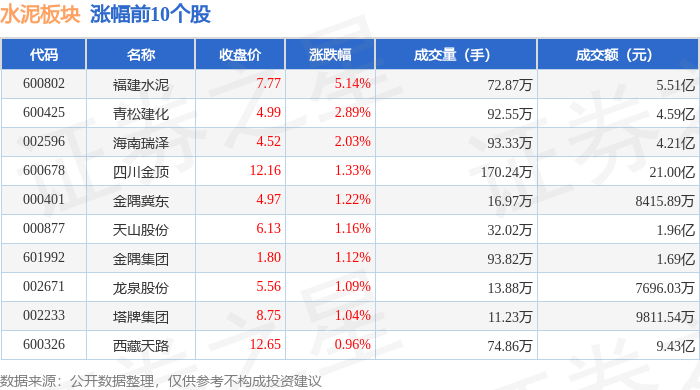
水泥板块11月11日涨0.59%,福建水泥领涨,主力资金净流出2.77亿元
Zheng Xing Xing Ye Ri Bao· 2025-11-11 08:46
Market Overview - The cement sector increased by 0.59% on November 11, with Fujian Cement leading the gains [1] - The Shanghai Composite Index closed at 4002.76, down 0.39%, while the Shenzhen Component Index closed at 13289.0, down 1.03% [1] Individual Stock Performance - Fujian Cement (600802) closed at 7.77, up 5.14% with a trading volume of 728,700 shares and a turnover of 551 million yuan [1] - Other notable performers include: - Qingsong Jianhua (600425) at 66.6, up 2.89% [1] - Hongzhiwu (002596) at 4.52, up 2.03% [1] - Sichuan Jinding (600678) at 12.16, up 1.33% [1] - Tianshan Co. (000877) at 6.13, up 1.16% [1] Capital Flow Analysis - The cement sector experienced a net outflow of 277 million yuan from institutional investors, while retail investors saw a net inflow of 349 million yuan [2] - The capital flow for individual stocks shows: - Fujian Cement had a net inflow of 46.43 million yuan from institutional investors [3] - Xizang Tianlu (600326) had a net inflow of 44.65 million yuan [3] - An outflow was noted for Huaxin Cement (600801) with a net outflow of 1.59 million yuan from institutional investors [3]



【财经分析】开放共享形成合力 推动新场景大规模应用“落地开花”
Xin Hua Cai Jing· 2025-11-11 03:39
Core Insights - The State Council has issued implementation opinions to accelerate the cultivation and large-scale application of new scenarios, emphasizing the importance of scenarios in developing new productive forces and enhancing intelligence levels [1][2] Group 1: Key Areas of Focus - The implementation opinions focus on five areas, proposing 22 key fields for scenario cultivation and opening, including digital economy and artificial intelligence, with mining safety being one of the highlighted sectors [2] - The opinions aim to enhance the intelligent construction of mining safety by addressing four specific scenarios: mining operations, hazardous tasks, safety management, and accident rescue [2] Group 2: Industry Collaboration and Innovation - The document encourages collaboration between state-owned enterprises and private sectors, allowing for greater participation from private companies, SMEs, and research institutions in scenario development [4] - The opening of core business scenarios by state-owned enterprises is expected to create significant business opportunities and enhance industry upgrades through collaborative innovation [4] Group 3: Regional Adaptation and Application - The implementation emphasizes the need for tailored approaches based on local resources and conditions to avoid redundant construction and ensure effective scenario application [5] - Various regions are leveraging their strengths to promote scenario openness, with Guangzhou focusing on clean energy, modern seed industry, and deep-sea development as initial areas of attack [5][6] Group 4: Market Impact and Future Directions - The International Advanced Technology Application Promotion Center in Hefei has initiated over 2000 scenario and technology selections, leading to nearly 400 billion yuan in investments and the establishment of over 90 projects [6] - The National Development and Reform Commission plans to accelerate the launch of significant comprehensive scenarios that focus on new industries, key sectors, and social welfare, promoting the rapid deployment of new technologies and products [6]
传统建材短期维稳,玻纤涨价动能延续 | 投研报告
Zhong Guo Neng Yuan Wang· 2025-11-11 03:28
Core Insights - The construction materials industry in China is experiencing a mixed performance, with a decline in revenue but an increase in net profit due to cost-cutting measures and price hikes [1][2]. Revenue and Profitability - In the first three quarters of 2025, 77 listed companies in the construction materials sector achieved a total revenue of 489.86 billion yuan, a year-on-year decrease of 5.74% [2]. - The net profit attributable to shareholders reached 19.25 billion yuan, reflecting a year-on-year increase of 21.46% [2]. - The overall gross profit margin for the industry was 19.38%, up by 0.22 percentage points year-on-year [2]. Cash Flow and Management - The operating cash flow for the construction materials sector improved significantly, with a year-on-year increase of 52.91% [2]. - This improvement is attributed to enhanced collection efforts and better credit risk management by companies [2]. Cement Sector - The cement market is facing weak overall demand, although there was a slight improvement in October [2]. - Cement prices saw a month-on-month increase of 2.22%, but the demand is expected to decline again in November due to seasonal factors [2]. Consumer Building Materials - Retail sales of building and decoration materials grew by 1.6% year-on-year from January to September 2025, with a month-on-month increase of 10.49% in September [3]. - The ongoing urban renewal strategy is expected to boost demand for high-quality green building materials [3]. Fiberglass Market - The fiberglass market showed slight recovery in demand for yarns, with stable pricing from leading companies [3]. - The demand for electronic yarns increased, leading to price hikes, particularly for high-end products [3]. Float Glass Market - The average price of float glass increased in October, but the market remains cautious with high inventory levels [4]. - Short-term price stability is expected due to limited improvement in demand towards the end of the fourth quarter [4]. Investment Recommendations - For consumer building materials, companies with strong brand and product quality are expected to benefit, with recommendations for companies like Beixin Building Materials and Weixing New Materials [4]. - In the cement sector, companies like Shangfeng Cement are recommended due to expected supply-demand balance improvements [4]. - The fiberglass market is anticipated to see demand growth, with recommendations for companies like China Jushi [4].
海螺水泥20251110
2025-11-11 01:01
Summary of Conference Call on Conch Cement and the Cement Industry Company and Industry Overview - The conference call focused on Conch Cement and the cement industry in China, highlighting the impact of macro policies and market dynamics on the sector [1][2][3]. Key Points and Arguments Industry Dynamics - The cement industry is experiencing a price decline since the second quarter of 2023, which has offset profit gains from lower coal costs [2][5]. - Conch Cement's gross profit dropped significantly to 50 CNY/ton in Q3 2025, with competitors like Tianshan and Jidong facing losses [2][6]. - The overall industry is in a low-price and low-profit state, with only a few leading companies maintaining slight profits [2][6]. Demand and Supply Outlook - Short-term demand remains weak, but further price declines are limited due to many companies already incurring losses, suggesting a potential price stabilization and slight recovery [7][8]. - China's cement demand is expected to continue declining, with a 5% drop in national cement production in the first nine months of the year, totaling approximately 1.7 billion tons for the year [9]. - The need for policy and market interventions to address supply-demand imbalances is emphasized, including stricter production controls and mergers to reduce excess capacity [10][12]. Competitive Advantages of Conch Cement - Conch Cement has competitive advantages in cost management and market positioning, including large-scale procurement, efficient production lines, and high capacity utilization [3][13][14]. - The company primarily operates in East and Central South China, leveraging a transportation network to reduce costs significantly [14]. Financial Performance and Future Projections - In the first three quarters of 2025, Conch Cement reported a profit of approximately 6.3 billion CNY, with Q3 profit at 1.9 billion CNY, reflecting a year-on-year increase of 3.4% [15]. - Future profit projections estimate around 9 billion CNY for 2025, 10 billion CNY for 2026, and potentially 11 billion CNY thereafter, indicating a low current valuation with good investment potential [15]. Additional Important Insights - The cement industry is characterized by cyclical trends, with historical correlations between cement prices and stock prices [3]. - The implementation of daily production controls and carbon trading policies is anticipated to significantly impact the industry by 2026, potentially leading to a more balanced supply-demand scenario [12]. - The ongoing price war in the industry is expected to continue until at least the first three quarters of 2024, with a potential price increase anticipated towards the end of 2024 and into 2025 [5][8].
中金2026年展望 | 港股:“牛市”的下一步
中金点睛· 2025-11-10 23:38
Core Viewpoint - The Chinese market in 2025 is characterized as a bull market driven by industry trends (AI), fundamental improvements, and liquidity narratives, with significant contributions from risk premiums and structural performance [2][17]. Group 1: Market Dynamics - The market's performance is influenced by excess liquidity chasing scarce return assets, leading to significant structural changes and asset rotation [25][26]. - The Hang Seng Index and Hang Seng Tech Index saw a 30% increase, primarily driven by risk premiums rather than earnings growth [17][18]. - Structural characteristics include significant contributions from a small number of stocks, with 15 stocks accounting for 70% of index gains, while many others underperformed [2][19]. Group 2: Liquidity Environment - The liquidity environment remains abundant, with macro, micro, and external liquidity factors contributing to the current state [28][30]. - Macro liquidity is characterized by low interest rates and a loose monetary policy, while micro liquidity reflects a lack of effective demand leading to capital stagnation [28][30]. - External liquidity is expected to remain loose in the first half of 2026, influenced by the Federal Reserve's interest rate policies and the ongoing "de-dollarization" narrative [34][35]. Group 3: Scarce Assets and Credit Cycle - The concept of "scarce assets" is determined by the credit cycle, with different phases affecting asset preferences, such as fixed-return assets during credit contraction and growth assets during recovery [3][36]. - The current credit cycle is expected to experience fluctuations, making it challenging for scarce return assets to expand broadly across the market [40][41]. - The government’s fiscal policies are limited in scope, with structural preferences affecting the ability to stimulate traditional demand sectors [45][46]. Group 4: Sector Outlook - Emerging demand sectors, particularly in technology and AI, are projected to maintain high growth, although expectations may be overly optimistic [41][42]. - Traditional demand sectors, such as real estate and consumer goods, are likely to weaken again after a brief recovery, primarily due to low income expectations and cost-return mismatches [43][44]. - Fiscal spending is expected to be limited but may shift structurally to support sectors with higher growth potential, such as technology and innovation [45][46].

港股红利低波ETF(159569)涨1.31%,成交额5529.22万元
Xin Lang Cai Jing· 2025-11-10 10:13
流动性方面,截止11月10日,港股红利低波ETF(159569)近20个交易日累计成交金额10.18亿元,日均 成交金额5090.23万元;今年以来,206个交易日,累计成交金额82.47亿元,日均成交金额4003.18万 元。 来源:新浪基金∞工作室 11月10日,景顺长城国证港股通红利低波动率ETF(159569)收盘涨1.31%,成交额5529.22万元。 港股红利低波ETF(159569)成立于2024年8月14日,基金全称为景顺长城国证港股通红利低波动率交 易型开放式指数证券投资基金,基金简称为景顺长城国证港股通红利低波动率ETF。该基金管理费率每 年0.50%,托管费率每年0.08%。港股红利低波ETF(159569)业绩比较基准为国证港股通红利低波动率 指数收益率(使用估值汇率折算)。 规模方面,截止11月7日,港股红利低波ETF(159569)最新份额为2.60亿份,最新规模为3.75亿元。回 顾2024年12月31日,港股红利低波ETF(159569)份额为1.13亿份,规模为1.29亿元。即该基金今年以 来份额增加129.92%,规模增加189.92%。 风险提示:市场有风险,投资需谨慎。 ...