
过剩流动性

Search documents
黄金白银的“沸腾”行情分析师都看不懂:贵金属市场逻辑已“崩坏”?
Xin Lang Cai Jing· 2026-01-29 03:35
Core Viewpoint - The price of gold has surged past $5,500 per ounce, reaching a historical high, while silver has also seen significant gains, indicating a broader rally in precious metals driven by geopolitical tensions, rising government debt, and uncertainty in interest rates and currencies [3][9]. Group 1: Gold and Silver Price Movements - Gold has continued its upward trend, breaking the $5,500 mark, with silver also experiencing a notable increase, surpassing $117 per ounce, reflecting a year-to-date rise of nearly 65% [3][9]. - Analysts attribute the demand for these metals to investors seeking refuge from geopolitical risks and economic uncertainties, with central bank purchases providing additional support for gold prices [3][9]. Group 2: Market Dynamics and Influences - The recent price increases in precious metals are seen as being less influenced by physical supply and demand, and more by unstable liquidity flows, leading to extreme price volatility [4][10]. - The dollar index has decreased by nearly 11% over the past 12 months, contributing to the rise in gold prices as it is perceived as a currency [11]. Group 3: Speculative Capital and Market Behavior - The influx of speculative capital into the precious metals market has distorted price behavior, with relatively small inflows causing significant price increases, detaching prices from traditional supply-demand dynamics [13]. - Analysts warn that the current price levels may not be sustainable, as the physical supply of metals cannot quickly adjust to meet the surging demand, potentially leading to a sharp reversal if liquidity dries up [13].


牛市下一步怎么走?中金刘刚:跟随信用扩张的方向
Xin Lang Cai Jing· 2026-01-16 06:40
Group 1 - The core viewpoint of the article is that the current market's structural differentiation and intense rotation are fundamentally due to excess liquidity, described as "too much money" chasing scarce return assets, which vary by stage [1][3][5] - The direction of capital flow is determined by "the direction of credit expansion," suggesting that investment strategies for 2026 should closely follow this trend [1][3] Group 2 - The outlook for the US market is optimistic, with expectations of an upward credit cycle and a positive view on US stocks, predicting a potential profit growth of 10-15% [5] - Despite discussions of market bubbles, it is advised not to exit the market too early, indicating confidence in continued growth [5] - Fiscal policy is noted to be more expansive compared to the previous year, with potential for exceeding expectations [5] - The US dollar is expected to remain stable, with a possibility of slight strengthening rather than significant weakening [5]

中金:港股近期跑输A股 结构缺亮点及资金面暂处弱势
Zhi Tong Cai Jing· 2026-01-13 02:09
Group 1 - The core viewpoint of the report is that while A-shares have experienced a strong start to 2026 with a "16 consecutive days of gains," Hong Kong stocks have been notably absent from this rally, primarily due to a lack of attractive sectors and a weak liquidity environment [1][2] - The driving force behind the A-share market's performance is the "excess liquidity" chasing "scarce return assets," with small-cap stocks outperforming larger ones, and valuation expansion being the main contributor to the gains [2][3] - The report identifies four key sectors in Hong Kong stocks—dividends, internet, innovative pharmaceuticals, and new consumption—that are unique and irreplaceable compared to A-shares, despite their current lack of market attention [1][6] Group 2 - The underperformance of Hong Kong stocks is attributed to three main factors: the lack of market focus on its unique structural advantages, a weak liquidity environment, and a reflection of a weakening fundamental backdrop [3][4] - The report highlights that the liquidity environment for Hong Kong stocks faces multiple constraints, including uncertainty regarding the strength of southbound capital flows and an increasing demand for IPO financing, which could exceed HKD 400 billion in 2026 [4][5] - Despite the overall market outlook favoring A-shares, Hong Kong stocks still present unique structural opportunities that could attract long-term investment, particularly in sectors like innovative pharmaceuticals and high-dividend stocks [6]
中金:港股和A股谁“错”了?
Xin Lang Cai Jing· 2026-01-12 01:18
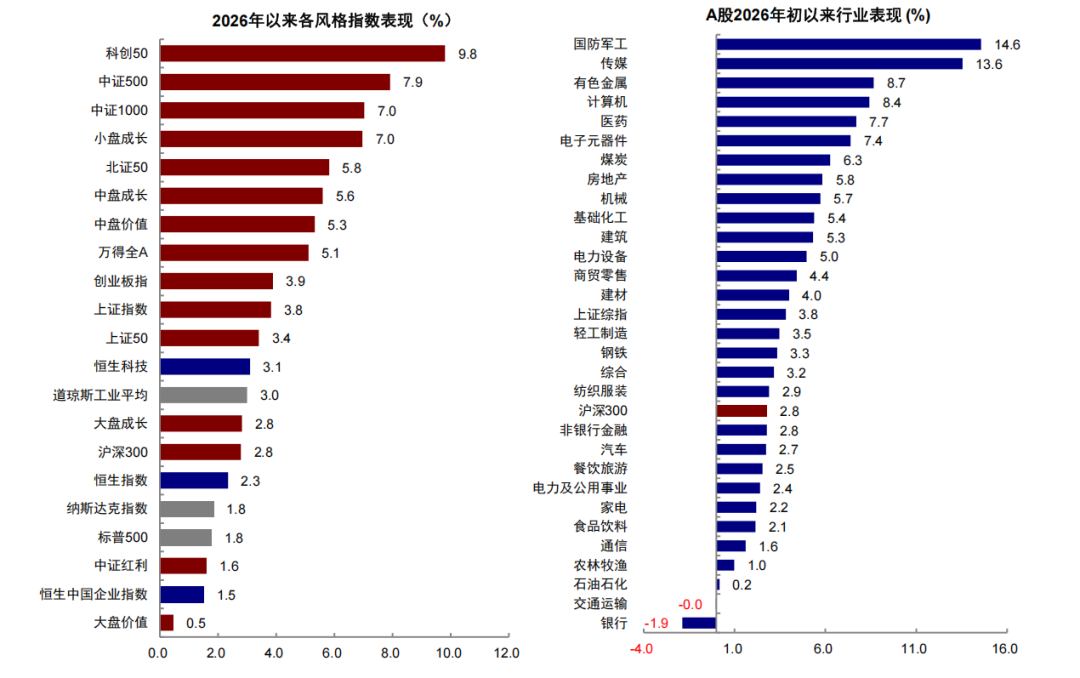
Group 1 - The core driver of the A-share market's strong performance at the beginning of 2026 is the "excess liquidity" chasing "scarce return assets," rather than significant changes in the macroeconomic fundamentals [2][11] - The A-share market has shown a clear structural preference for sectors like commercial aerospace, non-ferrous metals, and brain-computer interfaces, with small-cap stocks outperforming large-cap stocks [2][3] - The A-share market's gains have primarily been driven by valuation expansion, while traditional consumer stocks have lagged behind due to their closer correlation with domestic demand fundamentals [2][5] Group 2 - The Hong Kong stock market has underperformed due to a lack of attractive structural opportunities and a weaker funding environment, reflecting a deteriorating fundamental backdrop [10][13] - The absence of significant inflows from southbound capital has been noted, with December's average daily inflow dropping to 10.9 million HKD, significantly lower than the 60 million HKD average for the entire year [18][20] - The Hong Kong IPO market remains active, with a total of 2,858 million HKD raised in 2025, but the overall market performance has been muted compared to A-shares [20][21] Group 3 - Historical analysis indicates that the "spring market" effect is more pronounced in A-shares than in Hong Kong stocks, with A-share indices showing an average increase of 4.6% during the period from early December to early March, compared to only 0.5% for Hong Kong stocks [23][24] - The A-share market has consistently outperformed the Hong Kong market in terms of sector performance, particularly in technology, military, and home appliance sectors, which have shown average gains around 10% [23][24] Group 4 - The structural differences between A-shares and Hong Kong stocks lead to varying earnings growth rates, with A-shares expected to see a growth rate of 4%-5% in 2026 compared to 3% for Hong Kong stocks [30] - A-shares benefit from a more favorable micro liquidity environment, while Hong Kong stocks face multiple constraints, including potential declines in southbound capital inflows [33][34] - The unique structural opportunities in Hong Kong, such as high dividend yields and sectors like internet and innovative pharmaceuticals, provide a complementary investment avenue despite the overall market underperformance [35][36]
中金:2026年A股大概率优于港股 跟随信用扩张方向布局
智通财经网· 2026-01-12 00:36
Group 1 - The core view is that A-shares are expected to outperform Hong Kong stocks in 2026 due to relative advantages in fundamentals and liquidity, while Hong Kong stocks still hold structural appeal [1][34] - A-shares are projected to have an overall profit growth rate of approximately 4%-5% in 2026, compared to about 3% for Hong Kong stocks, driven by differences in sector composition [34][42] - Key sectors for A-shares include technology hardware, manufacturing, and cyclical industries, while Hong Kong stocks are characterized by dividend, internet, innovative pharmaceuticals, and new consumption sectors, which are less favored in the current market [1][42] Group 2 - The strong performance of A-shares at the beginning of the year is attributed to excess liquidity chasing scarce return assets, rather than significant changes in macro fundamentals [2][12] - The market structure has shown that small-cap stocks have significantly outperformed large-cap stocks, continuing the trend from 2025 [2][3] - A-shares have seen record high margin trading balances and daily trading volumes, indicating strong investor interest and liquidity [8][9] Group 3 - Hong Kong stocks have lagged due to a lack of attractive structural opportunities and weaker liquidity, reflecting a deteriorating fundamental outlook [12][15] - The absence of significant foreign capital inflows and the impact of high U.S. Treasury yields have constrained Hong Kong's liquidity environment [17][20] - The IPO market in Hong Kong remains active, with a total of 2,858 million HKD raised in 2025, but the demand for capital is expected to increase further in 2026 [23][24] Group 4 - The historical cross-year effect shows that A-shares tend to perform better than Hong Kong stocks during the spring season, with A-shares averaging a 4.6% increase compared to 0.5% for Hong Kong stocks over the past 20 years [27][28] - The analysis indicates that A-shares have a higher probability of positive returns during the spring season, particularly in sectors like technology and consumer goods [28][29] Group 5 - The liquidity environment for A-shares is expected to benefit from domestic micro liquidity changes, while Hong Kong stocks face multiple constraints [40][41] - The structural characteristics of Hong Kong stocks, such as dividends and innovative sectors, provide unique investment opportunities that are not easily replicated in A-shares [42][46] - The investment strategy should focus on sectors aligned with credit expansion, including AI, dividends, cyclical, and consumption sectors, with A-shares generally having an advantage in technology and cyclical sectors [45][46]
中金:港股和A股谁“错”了?
中金点睛· 2026-01-11 23:58
Core Viewpoint - The strong performance of A-shares at the beginning of 2026 is primarily driven by "excess liquidity" chasing "scarce return assets," rather than significant changes in the macroeconomic fundamentals [2][3][5]. Group 1: A-share Market Dynamics - The A-share market has seen a 16-day consecutive rise, with small-cap stocks outperforming large-cap stocks, continuing the trend from 2025 [3][5]. - The main contributors to the A-share gains are valuation expansions, with sectors like commercial aerospace and materials leading the charge [5][8]. - A-share trading volumes have reached historical highs, with a single-day turnover exceeding 30 trillion yuan, indicating strong market activity [5][8]. Group 2: Hong Kong Market Performance - The Hong Kong market has lagged behind, primarily due to a lack of attractive structural opportunities and weaker capital flows [9][11]. - Key sectors in Hong Kong, such as dividends, internet, and new consumption, are not currently in the market's focus, leading to underperformance [11][19]. - The Hong Kong IPO market remains active, with significant fundraising, but the overall market sentiment is subdued compared to A-shares [17][19]. Group 3: Capital Flow and Liquidity - Domestic capital flows have favored A-shares, with southbound capital flows slowing down significantly since late 2025 [15][19]. - The liquidity environment for A-shares is more favorable, benefiting from domestic microeconomic conditions, while Hong Kong faces constraints from external factors [28][30]. - The anticipated inflow of southbound capital in 2026 may not match the record levels seen in 2025, as A-shares attract more attention [30][32]. Group 4: Structural Differences and Future Outlook - A-shares are expected to have a higher overall profit growth rate of 4%-5% in 2026, compared to Hong Kong's 3%, driven by stronger sectors like technology and manufacturing [25][26]. - The structural advantages of Hong Kong, including its focus on dividends and innovative drugs, provide unique investment opportunities, even as A-shares outperform overall [30][32]. - The ongoing credit cycle and its impact on market dynamics will guide investment strategies, with a focus on sectors like AI, dividends, and cyclical stocks [33].

中金:维持恒指乐观26,000点预测不变 可延续“红利+科技互联网”组合作为配置底仓
智通财经网· 2025-12-02 02:07
Group 1 - The market has been experiencing volatility and lack of direction due to high expectations and positions in the technology growth sector, alongside concerns about the AI bubble and cooling interest rate cut expectations from the Federal Reserve, leading to a significant pullback in the Hang Seng Technology Index by approximately 16.6% from its peak [1] - The domestic consumption and real estate sectors, despite attractive valuations and positions, have seen a weakening of fundamentals, making it difficult for investors to reach a consensus [1] - The banking sector has rebounded nearly 10% from the end of September, emerging as a preferred choice in the current environment of uncertainty [1] Group 2 - Over the past two years, the essence of China's asset dynamics can be summarized as the pursuit of "scarce assets" driven by "excess liquidity," with market consensus rapidly inflating asset prices once they are recognized as scarce [2] - The technology sector remains a sustained growth direction, with hardware in A-shares showing greater elasticity and software in Hong Kong stocks demonstrating resilience, although high valuations and expectations necessitate additional industry progress or liquidity to catalyze growth [3] - Domestic consumption and real estate chains, while having low expectations and valuations, face challenges in forming a lasting consensus due to weakening fundamentals, although policy catalysts could create temporary trading opportunities [3] Group 3 - Dividend stocks continue to be a good hedge against the backdrop of domestic credit contraction [3] - External demand chains should focus on strong and early cycles, with potential catalysts from increased physical investment due to U.S. fiscal policies ahead of midterm elections and unexpected Federal Reserve rate cuts [3] - An "barbell" investment strategy combining dividends and technology internet stocks is recommended, with dynamic adjustments to weights based on market conditions to achieve effective hedging and balance [4]
中金:下一阶段的行业选择思路
中金点睛· 2025-11-30 23:49
Core Viewpoint - The market has been experiencing volatility due to high expectations and positions in the technology growth sector, alongside concerns about the AI bubble and the Federal Reserve's interest rate outlook, leading to a significant pullback in the Hang Seng Tech index by approximately 16.6% from its peak [2] - Despite attractive valuations in domestic consumption and real estate, the recent weakening of fundamentals has hindered consensus among investors, making dividend stocks a preferred choice in the current environment [2][7] - The company maintains an optimistic outlook for the Hang Seng Index at 26,000 points, validating this view despite fluctuations in October [2] Market Dynamics - The current market turmoil reflects a disconnect between fundamentals and expectations, indicative of a weakening domestic credit cycle, as evidenced by the peak in private social financing in June and a marginal decline in M1 growth in October [7][8] - The market's oscillation between dividend and technology stocks highlights the ongoing struggle between current fundamentals and future expectations [7] Investment Strategy - Investors are advised to consider the credit cycle as a guiding framework for macroeconomic direction and asset allocation, focusing on sectors that align with credit expansion [10][11] - The past two years have seen a trend of "excess liquidity" chasing "scarce assets," with the potential for rapid price increases followed by liquidity shifts to new opportunities [12] Sector Analysis - **Technology Sector**: The AI industry remains a key growth area, supported by domestic policy, but faces challenges due to high valuations and expectations. Short-term focus should be on hardware domestic substitution, while long-term prospects depend on application demand and profitability realization [20][21] - **Domestic Consumption and Real Estate**: Although these sectors have low expectations and valuations, the weakening fundamentals make sustained consensus difficult. Potential short-term trading opportunities may arise with policy catalysts, but caution is advised against "static valuation traps" [17][42] - **Dividend Stocks**: These assets serve as a hedge against weak domestic demand, with the Hang Seng High Dividend Index offering a static yield of approximately 5.8%. However, the range of high-dividend stocks has narrowed, with less than 25% of eligible stocks yielding above 5% [43][45] External Demand and Cyclical Opportunities - The recovery of the U.S. credit cycle may boost global manufacturing, benefiting sectors tied to exports and commodity pricing. Key indicators to watch include U.S. manufacturing PMI and existing home sales [34][37] - The cyclical recovery in external demand may provide short-term trading windows, particularly in the first quarter, as domestic PPI is expected to rise [39][42] Conclusion - The investment strategy should focus on a "barbell" approach, combining dividend and technology stocks while dynamically adjusting weights based on market conditions. External demand-driven cyclical sectors and innovative pharmaceuticals may offer additional flexibility in the portfolio [17][19]

流动性红利加持,港股科技成资金配置首选
Mei Ri Jing Ji Xin Wen· 2025-11-28 03:53
Group 1 - The core viewpoint of the article highlights that the Hong Kong stock market's technology sector is becoming a primary target for capital due to its high growth potential, amidst a backdrop of "excess liquidity" and "asset allocation scarcity" in the domestic market [1] - By 2025, southbound capital is expected to reach a record inflow of over 1.3 trillion HKD, with a significant increase in the technology sector's share, making it a core focus for domestic investors in Hong Kong stocks [1] - The influx of funds is strongly supported by a loose liquidity environment, as the one-year fixed deposit rate in China has dropped to a historical low of 0.95%, leading to a noticeable trend of "activating" deposits among the 150 trillion CNY in household savings [1] Group 2 - The M1 money supply growth rate rose to 7.2% year-on-year in September, with 1.3 trillion CNY in household demand deposits shifting towards the capital market during July and August [1] - Amid the global trend of "de-dollarization," funds from the Asia-Pacific region, excluding Japan, are rapidly increasing their allocation to the Chinese market, approaching a benchmark level, which is driving the valuation recovery of the Hong Kong technology sector [1] - With the continuation of a loose liquidity framework, the premium for funds in the technology sector is expected to further expand [1]
恒生科技指数劲升1.15%,哔哩哔哩、小米、阿里领涨
Mei Ri Jing Ji Xin Wen· 2025-11-25 04:24
Group 1 - The Hang Seng Index rose by 0.61%, the Hang Seng Tech Index increased by 1.15%, and the Hang Seng China Enterprises Index climbed by 0.75% during the midday session, with a market turnover of HKD 133.003 billion [1] - In the technology sector, Bilibili surged by 5.12%, with Kango Bio, Xiaomi, and Alibaba rising over 4%, while Baidu Group increased by 3.22% and Kuaishou by 2.55%. On the downside, Kingdee International fell by 1.46%, Midea Group by 1.13%, and JD Group by 0.44% [1] - The influx of southbound funds reached a record HKD 1.3 trillion by 2025, with a significant increase in the technology sector's share, making it a core focus for domestic investors in Hong Kong stocks [1] Group 2 - The influx of funds is supported by a loose liquidity environment, with the one-year fixed deposit rate in China dropping to a historical low of 0.95%. The trend of "activating" deposits is evident, with M1 year-on-year growth reaching 7.2% in September [2] - A total of CNY 1.3 trillion in resident demand deposits shifted to the capital market during July and August, indicating a strong movement towards investment [2] - The trend of "de-dollarization" globally has led to a rapid increase in the allocation of funds from Asia-Pacific (excluding Japan) to the Chinese market, enhancing the valuation recovery of Hong Kong's technology sector [2]
