
稀缺资产

Search documents
未来20年什么是优质资产?
Sou Hu Cai Jing· 2026-02-26 16:53
Core Insights - The era of real estate as a guaranteed appreciating asset is fading, with a shift towards a market characterized by inventory competition rather than overall expansion [1][3] - The focus has shifted from price appreciation to liquidity, questioning whether properties can be sold in the future [3][10] Market Dynamics - The market is transitioning to a phase where supply is shrinking and buyer expectations are increasingly selective, leading to a critical question: which properties will lose their appeal first? [3] - Properties that are well-located and have stable management tend to sell quickly, while those with significant drawbacks may remain unsold for extended periods, indicating a stark difference in liquidity [3][8] Scarcity and Value - The concept of "scarcity" in real estate needs careful evaluation; not all marketed "scarce" properties are genuinely unique or limited in supply [4][6] - True scarce assets should have low substitutability and nearly irreplaceable supply characteristics, which is crucial in a competitive inventory market [6] Holding Costs and Investment Viability - The hidden costs of property ownership, such as maintenance fees and opportunity costs, can lead to negative returns over time, especially in a low-growth environment [6][10] - Evaluating a property’s long-term hold potential should consider demand for living or usage, rental income covering holding costs, and future liquidity [6][10] Community and Maintenance - The long-term value of second-hand properties increasingly depends on the community's ability to maintain and govern itself effectively [8] - Properties in well-maintained communities tend to have shorter sales cycles compared to those in poorly managed areas, highlighting the importance of community governance [8] Future Investment Strategy - The next two decades will require a more discerning approach to real estate investment, emphasizing the ability to distinguish between genuine scarcity and superficial marketing claims [10]


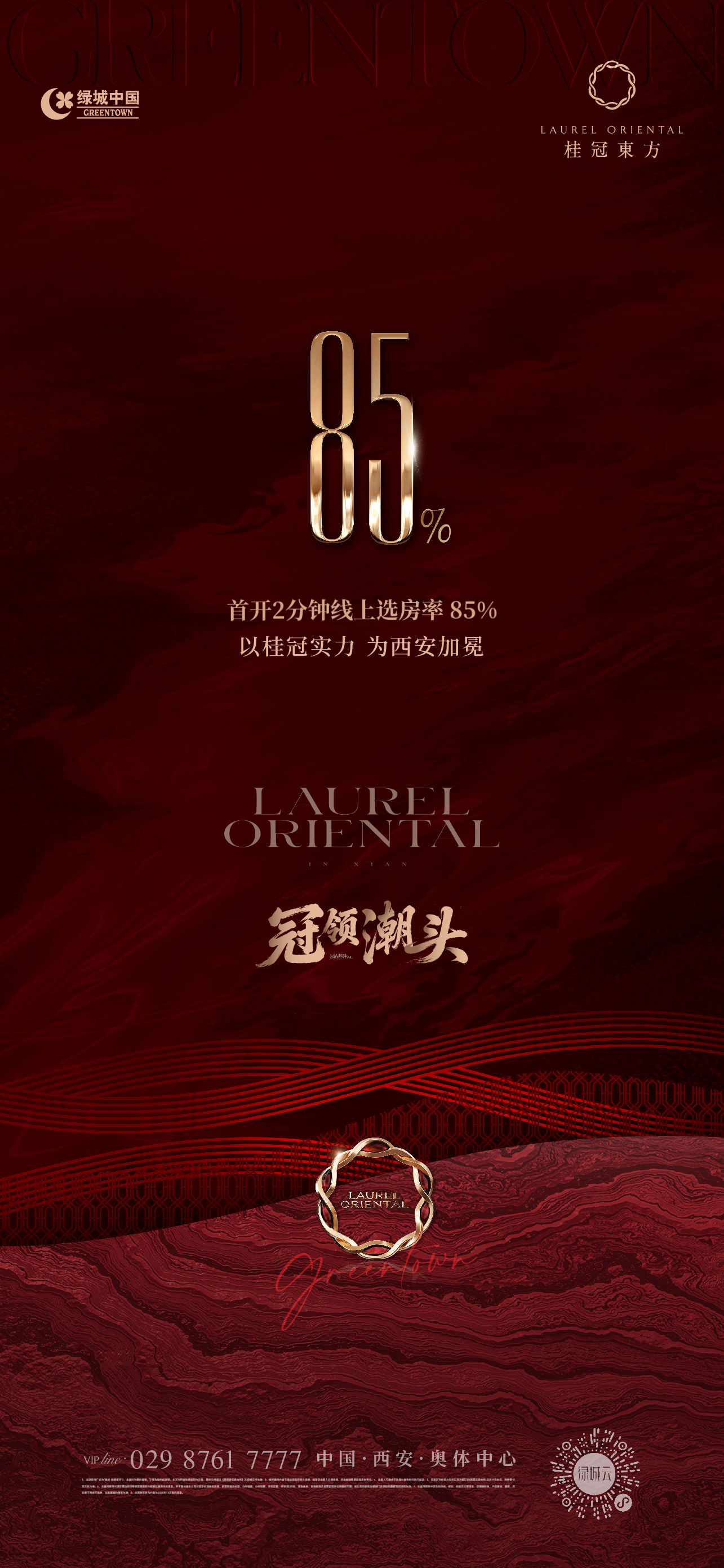
奥体3.0时代封面|桂冠東方首开大捷,重塑西安高端生活范式
Xin Lang Cai Jing· 2026-01-26 07:39
Core Viewpoint - The successful launch of Greentown's "Gui Guan Dong Fang" project, achieving 85% sales in just 2 minutes, highlights the principle that scarcity equates to value in the real estate market, particularly in high-end segments [1][3]. Group 1: Market Dynamics - The "Greentown phenomenon" continues to manifest in Xi'an's high-end market, with projects like "Chang'an Yuhua" selling out instantly and "Gui Guan Dong Fang" demonstrating exceptional market performance, reinforcing Greentown's dominance in product quality [1][3]. - The project occupies the last residential land in the core area of the Olympic Sports Center, making it a coveted asset for high-net-worth families seeking to secure a prime position in urban development [3][5]. Group 2: Brand Trust and Customer Sentiment - Greentown has established a deep-rooted relationship with the city over nine years, becoming synonymous with quality, reputation, and lifestyle, which fosters strong emotional connections with high-end clientele [5][7]. - The brand's long-term commitment to the Olympic Sports Center has positioned it as a leader in defining and enhancing the area's value, further solidifying customer trust [5][7]. Group 3: Product Offering and Customer Needs - The "Gui Guan Dong Fang" project offers customized solutions that address the core concerns of families looking to upgrade their living conditions, including noise reduction systems and community spaces designed for social interaction and cultural engagement [7][8]. - The project features a main unit of approximately 180 square meters, providing a rare entry point into the top-tier area at a competitive price, appealing to families seeking long-term living solutions [10][13]. Group 4: Market Positioning and Future Outlook - The success of "Gui Guan Dong Fang" illustrates the structural opportunities in Xi'an's real estate market, emphasizing that only projects with scarce land, superior product quality, and strong brand backing can thrive across market cycles [13].
中金:维持恒指乐观26,000点预测不变 可延续“红利+科技互联网”组合作为配置底仓
智通财经网· 2025-12-02 02:07
Group 1 - The market has been experiencing volatility and lack of direction due to high expectations and positions in the technology growth sector, alongside concerns about the AI bubble and cooling interest rate cut expectations from the Federal Reserve, leading to a significant pullback in the Hang Seng Technology Index by approximately 16.6% from its peak [1] - The domestic consumption and real estate sectors, despite attractive valuations and positions, have seen a weakening of fundamentals, making it difficult for investors to reach a consensus [1] - The banking sector has rebounded nearly 10% from the end of September, emerging as a preferred choice in the current environment of uncertainty [1] Group 2 - Over the past two years, the essence of China's asset dynamics can be summarized as the pursuit of "scarce assets" driven by "excess liquidity," with market consensus rapidly inflating asset prices once they are recognized as scarce [2] - The technology sector remains a sustained growth direction, with hardware in A-shares showing greater elasticity and software in Hong Kong stocks demonstrating resilience, although high valuations and expectations necessitate additional industry progress or liquidity to catalyze growth [3] - Domestic consumption and real estate chains, while having low expectations and valuations, face challenges in forming a lasting consensus due to weakening fundamentals, although policy catalysts could create temporary trading opportunities [3] Group 3 - Dividend stocks continue to be a good hedge against the backdrop of domestic credit contraction [3] - External demand chains should focus on strong and early cycles, with potential catalysts from increased physical investment due to U.S. fiscal policies ahead of midterm elections and unexpected Federal Reserve rate cuts [3] - An "barbell" investment strategy combining dividends and technology internet stocks is recommended, with dynamic adjustments to weights based on market conditions to achieve effective hedging and balance [4]
中金:下一阶段的行业选择思路
中金点睛· 2025-11-30 23:49
Core Viewpoint - The market has been experiencing volatility due to high expectations and positions in the technology growth sector, alongside concerns about the AI bubble and the Federal Reserve's interest rate outlook, leading to a significant pullback in the Hang Seng Tech index by approximately 16.6% from its peak [2] - Despite attractive valuations in domestic consumption and real estate, the recent weakening of fundamentals has hindered consensus among investors, making dividend stocks a preferred choice in the current environment [2][7] - The company maintains an optimistic outlook for the Hang Seng Index at 26,000 points, validating this view despite fluctuations in October [2] Market Dynamics - The current market turmoil reflects a disconnect between fundamentals and expectations, indicative of a weakening domestic credit cycle, as evidenced by the peak in private social financing in June and a marginal decline in M1 growth in October [7][8] - The market's oscillation between dividend and technology stocks highlights the ongoing struggle between current fundamentals and future expectations [7] Investment Strategy - Investors are advised to consider the credit cycle as a guiding framework for macroeconomic direction and asset allocation, focusing on sectors that align with credit expansion [10][11] - The past two years have seen a trend of "excess liquidity" chasing "scarce assets," with the potential for rapid price increases followed by liquidity shifts to new opportunities [12] Sector Analysis - **Technology Sector**: The AI industry remains a key growth area, supported by domestic policy, but faces challenges due to high valuations and expectations. Short-term focus should be on hardware domestic substitution, while long-term prospects depend on application demand and profitability realization [20][21] - **Domestic Consumption and Real Estate**: Although these sectors have low expectations and valuations, the weakening fundamentals make sustained consensus difficult. Potential short-term trading opportunities may arise with policy catalysts, but caution is advised against "static valuation traps" [17][42] - **Dividend Stocks**: These assets serve as a hedge against weak domestic demand, with the Hang Seng High Dividend Index offering a static yield of approximately 5.8%. However, the range of high-dividend stocks has narrowed, with less than 25% of eligible stocks yielding above 5% [43][45] External Demand and Cyclical Opportunities - The recovery of the U.S. credit cycle may boost global manufacturing, benefiting sectors tied to exports and commodity pricing. Key indicators to watch include U.S. manufacturing PMI and existing home sales [34][37] - The cyclical recovery in external demand may provide short-term trading windows, particularly in the first quarter, as domestic PPI is expected to rise [39][42] Conclusion - The investment strategy should focus on a "barbell" approach, combining dividend and technology stocks while dynamically adjusting weights based on market conditions. External demand-driven cyclical sectors and innovative pharmaceuticals may offer additional flexibility in the portfolio [17][19]

中金刘刚最新研判:2026年“牛市”的下一步,是“信用扩张”的方向决定一切
Wind万得· 2025-11-18 22:52
Core Viewpoint - The core logic for global asset allocation in 2026 is to "follow the direction of credit expansion" [1] Group 1: Market Dynamics - The hidden mainline of the market is that the direction of credit expansion determines the strength of assets and the flow of funds [3] - The past couple of years in the Chinese market have been characterized by "excess liquidity" chasing "scarce return assets," with the recognized scarce assets changing over time [3] - Key factors for future market judgment include whether the liquidity environment has been damaged and whether scarce assets can expand to a broader range [3] Group 2: Credit Expansion and Investment Strategy - The investment strategy for 2026 is framed around the "credit cycle," focusing on three main subjects of credit expansion [4] - In the Chinese market, the credit cycle is expected to experience a slowdown, with structural prosperity still present despite challenges [6] - The U.S. market is seeing a gradual recovery in the credit cycle, supported by fiscal and monetary easing, with no significant signs of bubble formation in AI investments [7] Group 3: Structural Opportunities in China - The overall credit cycle in China is expected to face challenges starting from Q4, but structural prosperity remains effective [9] - The correlation between market performance and economic expectations has increased, indicating a need to focus on structural trends for excess returns [9] - Three structural directions for prosperity include AI-driven trends, capacity cycle reversals, and external demand mapping [9] Group 4: Hong Kong Market Outlook - The outlook for the Hong Kong market in 2026 suggests limited index space, with potential growth coming from structural changes or unexpected pullbacks rather than pure valuation expansion [11] - The Hang Seng Index's dynamic valuation is currently at 11.4 times, indicating a position above the historical average, suggesting that the market is not "cheap" [11] Group 5: Recommended Investment Directions - It is advisable to maintain a moderate allocation to dividend assets to counter the weakening of the overall credit cycle [13] - Key sectors to focus on include AI software and hardware, electric new energy, chemicals, home furnishings, and innovative pharmaceuticals, with careful consideration of valuation and crowding [13] - A potential rise in China's PPI towards the end of this year could provide an opportunity for market shifts towards cyclical and certain consumer sectors [14]

中金:产业趋势与流动性助推牛市 港股市场长期受益
智通财经网· 2025-11-11 00:17
Core Viewpoint - The Chinese market in 2025 is expected to exceed expectations, characterized as a bull market driven by industry trends (AI), fundamental improvements, and liquidity narratives [1][2] Macroeconomic Environment - The concept of "excess liquidity" is driving the pursuit of "scarce assets," with liquidity remaining abundant but the credit cycle shifting to oscillation or even slowdown [2] - The recognition of "scarce assets" changes with the credit cycle, impacting the types of assets that attract investment [2][3] Liquidity and Scarcity - The current situation in China is characterized by a coexistence of deflation and localized inflation, with excess liquidity leading to significant asset price differentiation [3][4] - The key questions for future market judgments are whether the liquidity environment has been damaged and if scarce assets can expand to a broader range [3][4] Credit Cycle and Asset Expansion - The credit cycle is expected to oscillate and slow down, making it difficult for scarce return assets to expand significantly [5][6] - The government’s role in stimulating credit expansion is limited, and structural issues remain a challenge for long-term growth [6][7] Market Trends - The Hang Seng Index's dynamic valuation is currently at 11.4 times, indicating that the market is not "cheap" and future index space will require earnings recovery rather than relying solely on valuation expansion [8][9] - The overall earnings growth is projected to be modest, with a baseline scenario estimating a 3% growth in 2026 [9] Investment Strategy - The company suggests maintaining a moderate allocation to dividend assets to counterbalance the weak credit cycle expansion [10] - Focus on sectors that can still expand credit, such as AI technology, new energy, and innovative pharmaceuticals, while underweighting real estate and consumer goods [10][11]
中金2026年展望 | 港股:“牛市”的下一步
中金点睛· 2025-11-10 23:38
Core Viewpoint - The Chinese market in 2025 is characterized as a bull market driven by industry trends (AI), fundamental improvements, and liquidity narratives, with significant contributions from risk premiums and structural performance [2][17]. Group 1: Market Dynamics - The market's performance is influenced by excess liquidity chasing scarce return assets, leading to significant structural changes and asset rotation [25][26]. - The Hang Seng Index and Hang Seng Tech Index saw a 30% increase, primarily driven by risk premiums rather than earnings growth [17][18]. - Structural characteristics include significant contributions from a small number of stocks, with 15 stocks accounting for 70% of index gains, while many others underperformed [2][19]. Group 2: Liquidity Environment - The liquidity environment remains abundant, with macro, micro, and external liquidity factors contributing to the current state [28][30]. - Macro liquidity is characterized by low interest rates and a loose monetary policy, while micro liquidity reflects a lack of effective demand leading to capital stagnation [28][30]. - External liquidity is expected to remain loose in the first half of 2026, influenced by the Federal Reserve's interest rate policies and the ongoing "de-dollarization" narrative [34][35]. Group 3: Scarce Assets and Credit Cycle - The concept of "scarce assets" is determined by the credit cycle, with different phases affecting asset preferences, such as fixed-return assets during credit contraction and growth assets during recovery [3][36]. - The current credit cycle is expected to experience fluctuations, making it challenging for scarce return assets to expand broadly across the market [40][41]. - The government’s fiscal policies are limited in scope, with structural preferences affecting the ability to stimulate traditional demand sectors [45][46]. Group 4: Sector Outlook - Emerging demand sectors, particularly in technology and AI, are projected to maintain high growth, although expectations may be overly optimistic [41][42]. - Traditional demand sectors, such as real estate and consumer goods, are likely to weaken again after a brief recovery, primarily due to low income expectations and cost-return mismatches [43][44]. - Fiscal spending is expected to be limited but may shift structurally to support sectors with higher growth potential, such as technology and innovation [45][46].

塔尖人群重返楼市,广州凯旋新世界屡现大客跨区扫货
Nan Fang Du Shi Bao· 2025-07-25 10:53
Core Insights - The luxury real estate market in Guangzhou and Shenzhen is experiencing explosive growth, with significant increases in transaction volumes for high-end properties [1][2] - The top-tier buyer demographic is actively engaging in the luxury market, driven by a desire for scarce assets and a stable investment environment [3][4] Market Performance - In the first half of 2025, the transaction volume for luxury properties priced between 150,000 to 200,000 CNY/m² surged by 960% in Shenzhen and 116.7% in Guangzhou [1][2] - For properties priced above 200,000 CNY/m², Guangzhou saw a staggering increase of 233.3%, while Shanghai experienced a 17.3% rise [2] - The total transaction volume for luxury properties priced over 50 million CNY increased by 48.5% and 43% for new and second-hand properties, respectively [2] Supply and Demand Dynamics - The supply of luxury properties, particularly those priced between 30 million to 50 million CNY, has decreased by nearly 30%, highlighting a supply-demand imbalance [2][3] - The scarcity of high-end real estate is becoming more pronounced due to a reduction in land transactions over the past four years, leading to a perception of luxury properties as "rare assets" [3] Key Players - The Kai Xuan New World project in Guangzhou has emerged as a standout performer in the luxury market, achieving significant sales figures and attracting top-tier buyers [2][4] - The project has maintained a strong reputation over 20 years, drawing affluent buyers from across the country, including high-net-worth individuals and families [4][5] Product Offerings - The latest offering from Kai Xuan New World, the "Chuan Shi Zun Di," features spacious layouts ranging from 254 m² to 835 m², catering to the needs of high-end buyers [5][7] - The design emphasizes large communal spaces and scenic views, appealing to the lifestyle preferences of the elite demographic [5][7] Investment Climate - The resurgence of interest from top-tier buyers in the luxury market coincides with a recovery in the stock market, indicating a potential new wave of wealth opportunities [7]
