光迅科技

Search documents
帮主郑重盘中解盘:科创板炸出千亿黑马!芯片算力赛道今儿个火透了
Sou Hu Cai Jing· 2025-09-22 11:05
Group 1 - Chip company Chip Yuan has become the 13th company on the STAR Market to reach a market value of 100 billion yuan, indicating strong investor interest in the semiconductor sector [3] - Other companies in the chip design sector, such as Jingchen Technology and Hengxuan Technology, also experienced significant gains, with increases exceeding 7%, reflecting a positive sentiment in the market [3] - In the computing hardware sector, companies like Guangku Technology and Lingyun Technology saw their stock prices rise over 10%, reaching historical highs, demonstrating robust demand in the industry [3][4] Group 2 - The surge in these sectors is attributed to a major partnership between Nvidia and Intel, where Nvidia is set to invest $5 billion in Intel, enhancing collaboration in the AI infrastructure and chip production [3] - This partnership is expected to provide a "booster" to the semiconductor and computing industries, as Intel will customize x86 CPUs for Nvidia's data centers and produce chips with Nvidia's RTX GPUs for personal computers [3][4] - The current activity in the A-share computing concept stocks and the recovery of the chip chain is not merely speculative but is driven by significant industry movements and demand [4]


华为哈勃押注,湖北武汉冲出一家光纤IPO!为光迅科技供货
格隆汇APP· 2025-09-22 10:38
Group 1 - The article discusses a new IPO in Wuhan, Hubei, focusing on a fiber optic company backed by Huawei Hubble [1] - The company is a supplier for Guangxun Technology, indicating a strategic partnership that may enhance its market position [1] - The IPO is seen as a significant development in the fiber optic industry, reflecting growing investment interest in this sector [1]


9月22日深证国企ESGR(470055)指数涨0.02%,成份股冠捷科技(000727)领涨
Sou Hu Cai Jing· 2025-09-22 10:20
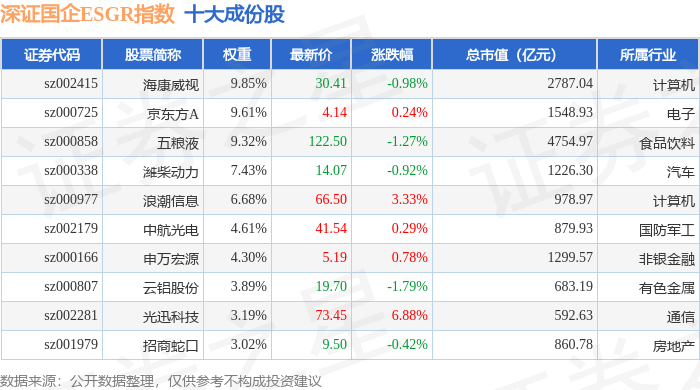
Core Points - The Shenzhen State-owned Enterprise ESGR Index (470055) closed at 1582.19 points on September 22, with a slight increase of 0.02% and a trading volume of 39.461 billion yuan, resulting in a turnover rate of 1.48% [1] - Among the index constituents, 19 stocks rose while 30 stocks fell, with Qanji Technology leading the gainers at a 10.04% increase, and Shougang Co., Ltd. leading the decliners with an 8.73% drop [1] Index Constituents Summary - The top ten constituents of the Shenzhen State-owned Enterprise ESGR Index are as follows: - Hikvision (sz002415) with a weight of 9.85%, latest price at 30.41, and a decrease of 0.98% [1] - BOE Technology Group (sz000725) with a weight of 9.61%, latest price at 4.14, and an increase of 0.24% [1] - Wrigley (sz000858) with a weight of 9.32%, latest price at 122.50, and a decrease of 1.27% [1] - Weichai Power (sz000338) with a weight of 7.43%, latest price at 14.07, and a decrease of 0.92% [1] - Inspur Information (sz000977) with a weight of 6.68%, latest price at 66.50, and an increase of 3.33% [1] - AVIC Optoelectronics (sz002179) with a weight of 4.61%, latest price at 41.54, and an increase of 0.29% [1] - Shenwan Hongyuan (sz000166) with a weight of 4.30%, latest price at 5.19, and an increase of 0.78% [1] - Yun Aluminum (sz000807) with a weight of 3.89%, latest price at 19.70, and a decrease of 1.79% [1] - Lightwave Technology (sz002281) with a weight of 3.19%, latest price at 73.45, and an increase of 6.88% [1] - China Merchants Shekou (sz001979) with a weight of 3.02%, latest price at 9.50, and a decrease of 0.42% [1] Capital Flow Analysis - The net inflow of main funds into the constituents of the Shenzhen State-owned Enterprise ESGR Index totaled 103 million yuan, while speculative funds saw a net outflow of 721 million yuan, and retail investors had a net inflow of 618 million yuan [1] - Detailed capital flow for key stocks includes: - Qanji Technology with a net inflow of 507 million yuan from main funds [2] - Lightwave Technology with a net inflow of 502 million yuan from main funds [2] - Inspur Information with a net inflow of 276 million yuan from main funds [2] - BOE Technology Group with a net inflow of 38.54 million yuan from main funds [2] - Shenwan Hongyuan with a net inflow of 31.09 million yuan from main funds [2]

通信设备板块9月22日涨0.2%,光库科技领涨,主力资金净流出17.46亿元
Zheng Xing Xing Ye Ri Bao· 2025-09-22 08:53
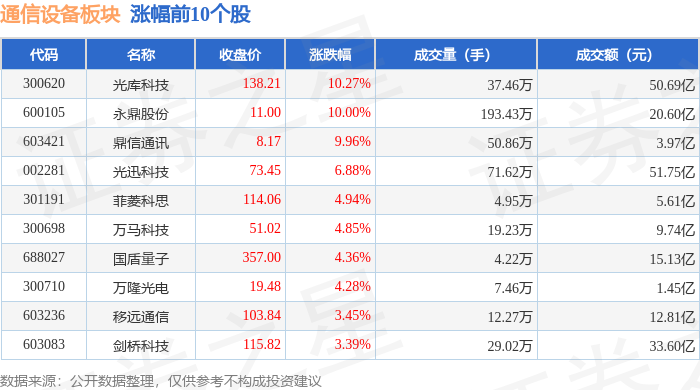
Market Overview - On September 22, the communication equipment sector rose by 0.2% compared to the previous trading day, with Guangku Technology leading the gains [1] - The Shanghai Composite Index closed at 3828.58, up 0.22%, while the Shenzhen Component Index closed at 13157.97, up 0.67% [1] Top Gainers in Communication Equipment Sector - Guangku Technology (300620) closed at 138.21, up 10.27% with a trading volume of 374,600 shares [1] - Yongding Co., Ltd. (600105) closed at 11.00, up 10.00% with a trading volume of 1,934,300 shares [1] - Dingxin Communication (603421) closed at 8.17, up 9.96% with a trading volume of 508,600 shares [1] - Other notable gainers include Guangxun Technology (002281) up 6.88% and Feiling Kesi (301191) up 4.94% [1] Top Losers in Communication Equipment Sector - Sega Technology (002796) closed at 19.59, down 7.68% with a trading volume of 480,600 shares [2] - Kunheng Shunwei (688283) closed at 31.15, down 5.12% with a trading volume of 32,900 shares [2] - Changying Tong (688143) closed at 48.09, down 4.89% with a trading volume of 73,700 shares [2] Capital Flow Analysis - The communication equipment sector experienced a net outflow of 1.746 billion yuan from institutional investors, while retail investors saw a net inflow of 1.607 billion yuan [2] - Notable net inflows from retail investors were observed in stocks like Guangku Technology and Guangxun Technology, while significant outflows were noted in stocks like ZTE Corporation [3] Individual Stock Capital Flow - ZTE Corporation (000063) had a net inflow of 560 million yuan from institutional investors, but a net outflow of 378 million yuan from retail investors [3] - Yongding Co., Ltd. (600105) saw a net inflow of 531 million yuan from institutional investors, with a net outflow from retail investors [3] - Guangxun Technology (002281) had a net inflow of 502 million yuan from institutional investors, while retail investors experienced a net outflow [3]





不临海也“闯”深海,武汉企业凭“光”织就海底数字网
Chang Jiang Ri Bao· 2025-09-22 08:33
Group 1 - The construction of a maritime power is a significant strategic task for the rejuvenation of the Chinese nation, with advanced marine technology being a key indicator of this development [1] - The development of submarine optical cable communication is crucial for supporting marine resource development and offshore operations [1][2] - Wuhan has become the largest production base for optical fibers and cables globally, with leading companies showcasing new capabilities in transoceanic transmission [2][3] Group 2 - The total length of global submarine optical cables has reached 1.4 million kilometers, equivalent to circling the Earth 35 times, carrying trillions of dollars in financial data daily [4] - Historically, the technology and market for submarine cables have been monopolized by companies from the US, France, and Japan, making submarine cables a core element of international technological competition [4] - Wuhan enterprises are pushing for technological innovation and breakthroughs in this context of international competition [4][6] Group 3 - Yangtze Optical Fibre and Cable Company has maintained the world's largest market share in preform, optical fiber, and optical cable for nine consecutive years [6] - The company recently laid the world's first 7-core optical fiber submarine experimental cable, providing a revolutionary solution for "expanding capacity without increasing size" [6] - FiberHome Technologies announced a record transmission speed of 254.7 Tb/s over a 200-kilometer standard single-mode fiber, supporting long-distance signal transmission [6] Group 4 - The construction of a complete industrial chain capability is essential for the development of submarine optical cables [7] - The technology developed by China Information Communication Technologies Co., Ltd. achieved a world record for single-span transmission of 1002.75 kilometers, which has significant applications in near-sea fisheries and marine resource protection [7][8] - Submarine optical cables are critical for various applications, including real-time data transmission for oil and gas platforms and international quantum communication [8] Group 5 - FiberHome is investing nearly 3 billion yuan to build Asia's largest marine communication industrial park, capable of producing 10,000 kilometers of submarine optical cables annually [10] - The company has a complete industrial chain layout in optical fiber and submarine cable technology, actively participating in the optimization and construction of global marine networks [10] - The collaborative innovation model between enterprises and research institutions in Wuhan is fostering rapid technology transfer into industrial capabilities [10]


算力硬件股震荡回升 光库科技涨超10%创历史新高
Xin Lang Cai Jing· 2025-09-22 02:27
Core Viewpoint - The computing hardware stocks experienced a rebound during trading, with significant gains observed in several companies, indicating a positive market sentiment in the sector [1] Company Summaries - Guangku Technology and Lingyun Light both surged over 10%, reaching historical highs, reflecting strong investor confidence and potential growth in the computing hardware market [1] - Other companies such as Guangxun Technology, Shengyi Technology, Pengding Holdings, and Cambridge Technology also saw increases, suggesting a broader upward trend in the industry [1]
从昇腾迭代路线图看国产算力发展趋势
2025-09-22 01:00
Summary of Key Points from the Conference Call Industry and Company Involved - The conference call primarily discusses **Huawei** and its impact on the **AI chip** and **communication** industries, particularly focusing on the development of **domestic computing power** in China. Core Insights and Arguments - **Chip Iteration Acceleration**: Huawei plans to release the 950 chip in Q1 2026, the 960 chip in Q4 2026, and the 970 chip in Q4 2027, aiming to surpass NVIDIA's NV576 ultra-low power solution, indicating a significant enhancement in its competitiveness in the AI chip sector [1][2] - **Open Ecosystem Development**: Huawei's announcement of the UB zero-area interconnection network and increased open-source efforts are expected to drive the industry chain towards higher value-added directions, enhancing the pricing power of leading manufacturers [1][5] - **Investment Recommendations**: Analysts suggest focusing on domestic chip companies (e.g., Cambricon, Haiguang Information), system integrators (e.g., Digital China, China Sunway), and supporting facilities like PCS switches, which are likely to benefit from Huawei's advancements [1][6][7] - **Impact of Super Nodes**: The shift from single-card AI inference to super node systems is driven by the increasing complexity of tasks, which raises the competitive threshold and necessitates more resources for network and system design [4] Additional Important Content - **Communication Sector Benefits**: The open ecosystem in the communication field is expected to create growth opportunities for companies like **FiberHome** and **Infinet**, which have received authorization to produce super node servers under their own brand, enhancing profit margins compared to traditional sales models [3][10] - **Liquid Cooling and Power Supply**: Companies involved in liquid cooling and power supply components are becoming increasingly important as Huawei's ecosystem expands, with firms like **Infinet** positioned to lead in the liquid cooling supply chain [3][13] - **Market Response and Future Outlook**: The recent Huawei conference showcased a strong market response, with increased confidence in expanding both domestic and international markets, indicating potential for significant growth in global competitiveness [8][9] - **Copper Connection Demand**: **Huafeng**, a leader in the copper connection sector, has seen increased demand due to Huawei's super node sales, with improved profit margins reported [11] - **Light Module Industry**: Companies like **Hua Gong Technology** and **Guangxun Technology** are expected to benefit from increased demand for light modules as Huawei enhances overall computing power [12] - **Impact on NVIDIA Supply Chain**: The domestic production of Ascend servers is expected to have a limited impact on NVIDIA's supply chain, as the revenue from China is a small portion of NVIDIA's overall income [15]
全球算力基建加速,密集催化提升预期
2025-09-22 00:59
Summary of Key Points from Conference Call Industry Overview - The telecommunications industry is experiencing accelerated infrastructure development, driven by significant investments from large domestic and international companies, as well as technological innovations [3][4] - Emerging technologies such as CPO, OIO, and hollow fiber optics are gaining attention, further propelling industry growth, particularly in the optical communication sector [3] Company Insights - Leading companies in the telecommunications sector, such as Xuchuang and Xinyi, currently have relatively low valuations, but their Q3 performance is expected to exceed market expectations, potentially boosting their market value [1][4] - The supply chain for silicon photonics is rapidly expanding, with suppliers like Tower planning to significantly increase production capacity by June next year [1][6] - Companies like Xuchuang and Yuanjie are anticipated to maintain stable growth due to the increasing penetration of silicon photonics [8] Emerging Technologies - New technologies like OCS and CPU are impacting the telecommunications industry but will not completely replace traditional technologies. Leading companies are expected to maintain their strong positions while benefiting from the growth of second-tier companies like Cambridge and Huylv [5] - The introduction of liquid cooling technology is necessary due to increased power consumption of optical modules in the 3.2T era [10][11] Market Dynamics - The domestic market is more event-driven, focusing on short-term catalysts, while the overseas market emphasizes long-term investment value based on industry trends and performance [7] - The upcoming Huawei super node architecture is expected to generate significant demand for 800G connections, benefiting companies like Guangxun Technology and Huagong Technology [12][20] Future Outlook - The silicon photonics supply chain is projected to grow robustly, with significant increases in production capacity expected in the near future [6][8] - The next generation of optical interconnect technologies, such as CPC and CPU, is being actively discussed, with potential advancements in materials and electrical connection architectures [9] - Key events like the ECOC conference and OCP summit are anticipated to catalyze developments in the overseas computing power chain [13] Investment Recommendations - It is advisable to focus on leading companies in the main sectors while also monitoring second-tier companies for breakthrough opportunities and the long-term trading potential brought by new technologies [1][7][20]


周末谷歌OCS持续发酵
傅里叶的猫· 2025-09-21 12:05
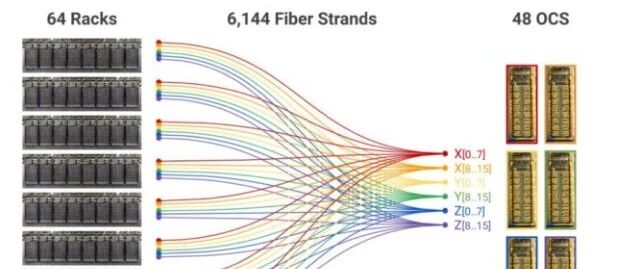
Core Viewpoint - OCS (Optical Circuit Switch) technology is still in its early stages in the data center sector, with Google being the only company to achieve large-scale procurement so far. The technology is being explored by other major companies, indicating a growing interest and potential market expansion [5][7][10]. Summary by Sections OCS Development and Adoption - Google began exploring OCS technology in 2017-2018 and has now entered a phase of large-scale application, utilizing a 3D Torus network architecture to connect thousands of TPU units [6][7]. - Other major companies like Microsoft and NVIDIA are also testing OCS applications, although they have not yet reached the scale of Google [7][9]. Market Potential - The current OCS market is estimated to be around 6 billion USD with approximately 15,000 units in use. Projections suggest that by 2030, the market could exceed 20 billion USD with at least 50,000 units deployed [11][12]. - The demand for OCS technology is expected to grow significantly, particularly in AI supernode networks, which currently account for over 50% of OCS applications [18][19]. Technical Routes and Challenges - There are three main technical routes for OCS: MEMS, silicon-based liquid crystal, and piezoelectric ceramic, each with its own advantages and disadvantages [12][13][14]. - The MEMS solution is currently used by Google but has reliability concerns due to moving parts. The silicon-based liquid crystal solution is favored by NVIDIA and Microsoft for its high reliability and low cost [12][13]. Competitive Advantages - OCS offers high bandwidth, low latency, and low power consumption, making it suitable for specific applications like emergency network connections and DCI (Data Center Interconnect) [8][9][10]. - The technology's ability to create stable optical switching channels aligns well with the predictable traffic patterns in data centers, allowing it to replace traditional electrical switches in certain scenarios [10][11]. Future Outlook - The growth of OCS technology will depend on overcoming current limitations, such as increasing port numbers and reducing switching latency from milliseconds to microseconds or nanoseconds [18][19]. - The maturity of OCS vendors and their ability to provide reliable solutions will also play a crucial role in the technology's adoption and market growth [19].


中芯国际传来大消息,DUV光刻机迎来历史性突破,哪些公司最受益?
Sou Hu Cai Jing· 2025-09-21 00:13
Group 1: Semiconductor Industry - Semiconductor Manufacturing International Corporation (SMIC) is testing DUV lithography machines from Shanghai startup Yulian Sheng, with promising initial results for 7nm process technology [1] - Yulian Sheng is a joint venture between Shanghai Kechuang Group's subsidiary Chuangke Micro and Huawei's subsidiary New Kai, marking its first media appearance [1] - Key suppliers for Yulian Sheng include Yongxin Optical and Wavelength Optics, with Yongxin being a dark horse in the lithography machine supply chain, showing strong performance and lower valuation compared to Maolai Optical [1] Group 2: Domestic Computing Chip Market - Domestic computing chips are experiencing a surge, with Alibaba's Tianshu and Baidu's Kunlun chips winning significant contracts in domestic operator procurement [1] - The domestic computing industry chain is gaining momentum, potentially becoming a market focus, as the adoption of domestic chips may lead to new solutions rather than copying Nvidia's models [1] - Potential investment targets include Inspur Information (server manufacturing) and LightSpeed Technology (optical devices) [1] Group 3: Oil and Shipping Industry - The Middle East situation is escalating, with increased attacks from Israel, leading to tighter oil tanker supply and demand dynamics, especially as October approaches [3][4] - OPEC+ is expected to release an additional 1.65 million barrels per day in October, which will stabilize demand [4] - Low oil prices are driving global refinery restocking, with China's crude oil imports rising to approximately 11.65 million barrels per day in August, providing crucial support for demand [4] Group 4: Shipping Dynamics - The deterioration of relations between Europe and Russia due to the Ukraine conflict is reducing short-haul oil transport routes, while increasing long-haul routes from the Middle East and the Americas to the Far East [5] - The increase in VLCC (Very Large Crude Carrier) oil transport demand is expected to normalize freight rates, benefiting Chinese shipowners like COSCO Shipping Energy [5] Group 5: Federal Reserve Interest Rate Decision - The Federal Reserve is anticipated to lower interest rates by 25 basis points, with a potential surprise of 50 basis points, impacting market sentiment [6] - A rate cut is expected to benefit Hong Kong stocks, CROs, and the real estate sector, with a focus on state-owned enterprises for stability [7] - The biotech sector may see improved financing conditions, particularly benefiting companies with higher overseas receivables [7]