
南京银行

Search documents
空缺8个月后悬念揭晓?杭州银行或迎47岁新行长!
Xin Lang Cai Jing· 2025-12-26 09:03
Core Viewpoint - Hangzhou Bank is undergoing a leadership transition with the potential promotion of Vice President Zhang Jingke to President, following the resignation of former President Yu Liming due to personal reasons. Despite this change, the bank has maintained revenue growth, although at its lowest rate in recent years [1][18]. Group 1: Leadership Changes - Zhang Jingke, born in August 1978, is expected to be promoted to President, marking a significant internal advancement as he has been with Hangzhou Bank for over 20 years [1][18]. - Yu Liming, the former President, resigned on April 2, 2023, after being reported missing, leading to a temporary appointment of Chairman Song Jianbin as acting President until a new President is approved [8][26]. - The bank's executive team has expanded to seven Vice Presidents following the return of Wang Lixiong to the role, enhancing the management structure [25][24]. Group 2: Financial Performance - For the first three quarters, Hangzhou Bank reported a revenue of 28.88 billion yuan, a year-on-year increase of 1.35%, marking the lowest growth rate in recent years [10][30]. - The net profit for the same period reached 15.885 billion yuan, reflecting a 14.53% increase year-on-year, indicating strong profitability despite revenue growth challenges [10][30]. - The bank's total assets grew to 2.3 trillion yuan, an 8.67% increase from the previous year, showcasing overall financial stability [10][30]. Group 3: Revenue Breakdown - Net interest income increased by 9.96% to 20.093 billion yuan, while net fee and commission income rose by 12.65% to 3.298 billion yuan [11][30]. - Investment income saw a significant increase of 22.3% to 7.307 billion yuan, although the bank faced a loss of 2.294 billion yuan from fair value changes, contrasting with a gain of 1.033 billion yuan in the previous year [11][30]. - The decline in total revenue was primarily attributed to the negative fair value changes, which had a substantial impact on overall performance [30][33]. Group 4: Risk Management and Profitability - The bank's credit impairment losses decreased by 38.47% year-on-year to 2.82 billion yuan, contributing to the maintenance of double-digit net profit growth [33]. - Hangzhou Bank's non-performing loan coverage ratio remains high at 513.64%, indicating a conservative approach to risk management [33]. - Despite strong profit growth, the bank's cash dividend payout ratio has been below 25% for four consecutive years, raising concerns about shareholder returns compared to peers [35][36].



A股银行ESG强制披露扩容至27家,超六成上市银行入列
Sou Hu Cai Jing· 2025-12-26 07:28
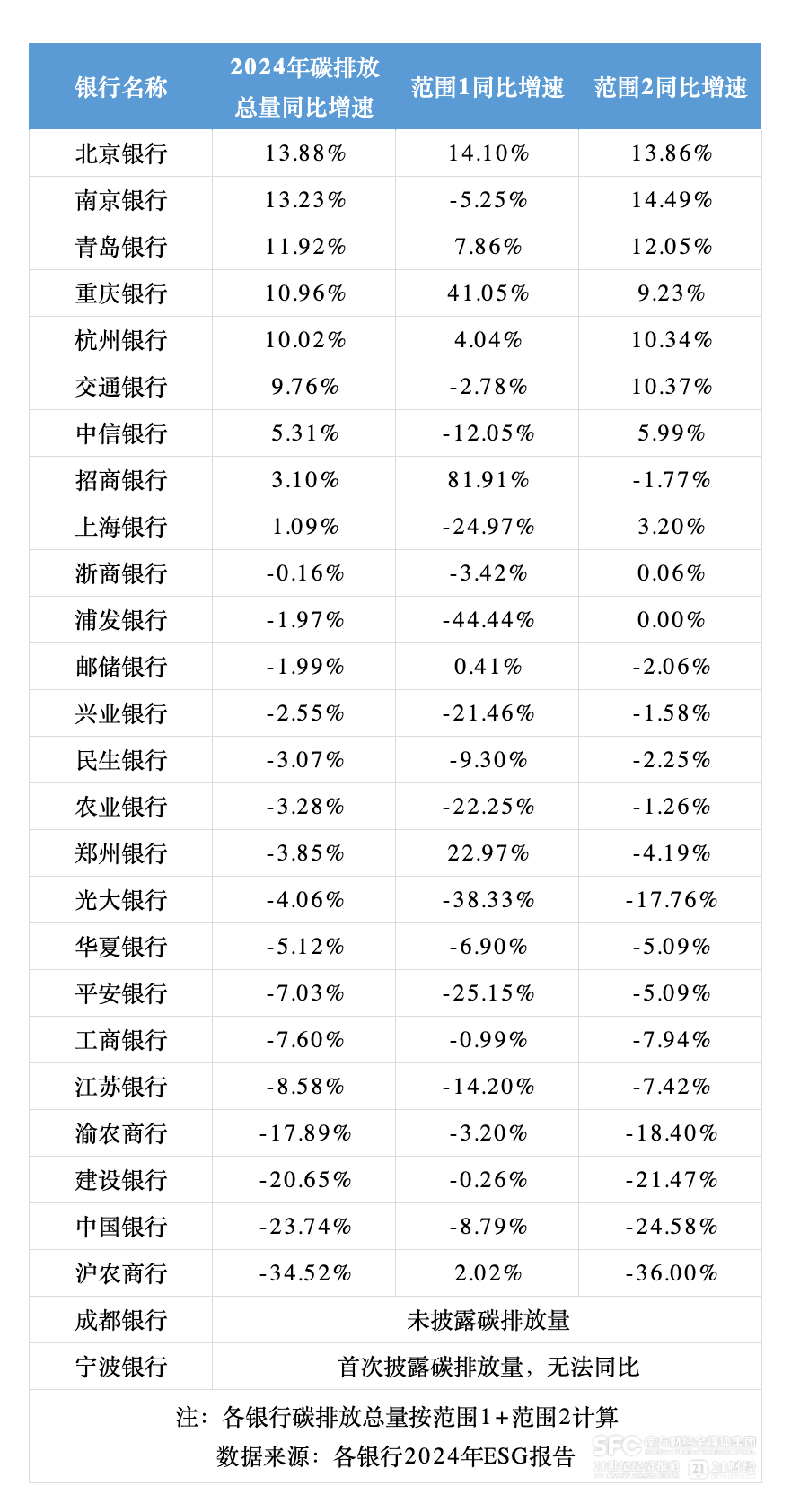
在信息披露的深度层面,范围3温室气体排放的核算与披露仍是难点。据梳理,2024年报告期内有10家银行尝试披露范围3排放,较去年增加6家,但各机构 披露的具体口径与覆盖范围存在较大差异。北京绿色金融协会方面曾表示,对于披露尚不完善的银行,应将碳排放披露提升至战略层面进行系统规划。 基于上证180、深证100等主要市场指数的最新调整结果,A股银行ESG强制信息披露名单实现扩容,新增成都银行与上海农村商业银行(沪农商行)两家机 构。至此,适用《上市公司自律监管指引——可持续发展报告》强制披露要求的上市银行数量达到27家。 根据统计,目前这27家银行的整体构成包括6家国有大型商业银行、9家股份制银行、10家城市商业银行以及2家农村商业银行。这代表着超过六成的A股上 市银行(共计42家)正式进入ESG强制披露序列。公开资料显示,上述银行均已完成了2024年度ESG报告的编制与发布。 强制性信息披露框架将银行业ESG实践的重心聚焦于运营碳排放与绿色金融业务。在已披露碳排放数据的26家银行中,有16家银行的年度碳排放总量实现同 比下降。然而,数据显示不同机构的减碳进展参差不齐,部分银行碳排放量仍同比上升,其中北京银行与南京 ...

西北首家上市银行股权大调整,国资整合释放什么信号?
Sou Hu Cai Jing· 2025-12-26 03:16
成立于1997年的西安银行,2019年3月在上海证券交易所主板上市,成为西北首家A股上市银行。经过 多年发展,该行已构建起覆盖广泛的服务网络,下辖176个营业网点,注册资本达44.44亿元。最新财报 数据显示,截至2025年三季度末,西安银行资产总额突破5500亿元,达5511.35亿元,较上年末增长 14.73%;贷款及垫款本金总额3017.60亿元,同比增幅高达27.19%,业务规模实现快速扩张。 盈利能力方面,今年前三季度西安银行表现稳健,实现营业收入76.91亿元,同比增长39.11%;归属于 母公司股东的净利润20.33亿元,同比增长5.51%,基本每股收益0.46元。截至12月24日收盘,该行股价 报3.75元/股,总市值达166.6亿元,在区域银行业中保持着良好的市场表现。 12月24日,西北首家A股上市银行西安银行发布股权变动公告,长安国际信托股份有限公司拟将其持有 的4827万股股份协议转让至西安投资控股有限公司,标志着该行在国有金融资本优化配置方面迈出关键 一步,也成为今年全国地方国企金融股权整合浪潮中的又一典型案例。 本次股权转让完成后,西安投控的持股比例将从13.91%提升至14.99 ...
上市银行,密集出手!9家赎回,超1000亿!
券商中国· 2025-12-25 11:55
Core Viewpoint - The motivation for listed banks to redeem existing "high-interest" preferred shares is increasing in a low-interest-rate environment, aiming to save on interest costs [1][4]. Group 1: Redemption of Preferred Shares - Changsha Bank announced the redemption of 6 billion yuan of its preferred shares "Changyin You 1" on December 25, 2025, marking it as the fifth bank to redeem preferred shares in December [1][4]. - A total of 9 banks have redeemed preferred shares since 2025, with a cumulative redemption amount exceeding 1,000 billion yuan [4][5]. - The redemption actions include banks such as Nanjing Bank (4.9 billion yuan), Shanghai Bank (20 billion yuan), and Beijing Bank (4.9 billion yuan) [3][4]. Group 2: Market Trends and Supply - The total outstanding preferred shares of banks is 6,453.5 billion yuan, accounting for 99.58% of the preferred share market [5]. - Since 2020, the issuance of new preferred shares has nearly halted, leading to a gradual reduction in the outstanding volume [5][6]. - The introduction of perpetual bonds in 2019 has diversified the capital supplement tools available to banks, reducing the attractiveness of preferred shares [5][6]. Group 3: Investment Dynamics - Preferred shares are becoming increasingly scarce, making them a valuable asset for asset management institutions, including public funds and insurance funds [8][9]. - As of June 2025, approximately 3,079 billion yuan of bank preferred shares were held by wealth management products, representing 40.66% of the total outstanding preferred shares [8]. - The liquidity of bank preferred shares remains low compared to other capital supplement tools, with a low turnover rate in the market [9].





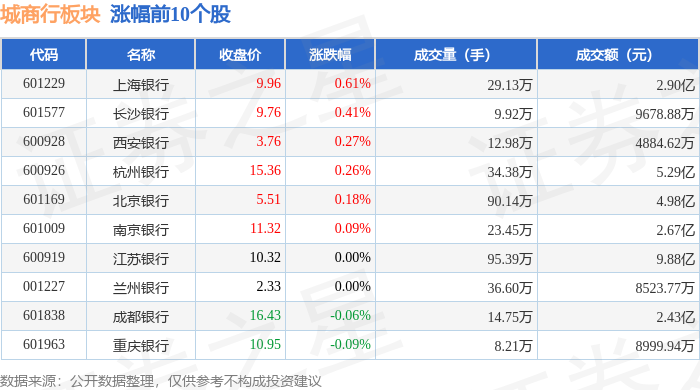
城商行板块12月25日涨0.07%,上海银行领涨,主力资金净流出1.11亿元
Zheng Xing Xing Ye Ri Bao· 2025-12-25 09:14
Market Performance - The city commercial bank sector increased by 0.07% compared to the previous trading day, with Shanghai Bank leading the gains [1] - The Shanghai Composite Index closed at 3959.62, up 0.47%, while the Shenzhen Component Index closed at 13531.41, up 0.33% [1] Individual Stock Performance - Shanghai Bank (601229) closed at 9.96, up 0.61% with a trading volume of 291,300 shares and a transaction value of 290 million [1] - Other notable performers include: - Changsha Bank (601577) at 9.76, up 0.41% [1] - Xi'an Bank (600928) at 3.76, up 0.27% [1] - Hangzhou Bank (600926) at 15.36, up 0.26% [1] - Beijing Bank (601169) at 5.51, up 0.18% [1] Capital Flow Analysis - The city commercial bank sector experienced a net outflow of 111 million from institutional investors, while retail investors saw a net inflow of 121 million [2] - The overall capital flow indicates a mixed sentiment, with institutional investors withdrawing funds while retail investors are increasing their positions [2] Detailed Capital Flow by Bank - Hangzhou Bank (600926) had a net inflow of 38.46 million from institutional investors, but a net outflow of 43.46 million from speculative funds [3] - Beijing Bank (601169) saw a net inflow of 23.41 million from institutional investors, with a net outflow of 18.77 million from speculative funds [3] - Guizhou Bank (601997) had a significant net inflow of 22.19 million from institutional investors, but a net outflow of 36.07 million from retail investors [3]
对话2026年关键词:金融地产篇
2025-12-25 02:43
Summary of Conference Call Records Industry Overview - The non-bank financial sector, particularly online insurance and brokerage firms, is expected to have greater growth potential compared to banks in the coming year. Online insurance benefits from an increase in equity positions, which could enhance investment returns if the stock market performs well. Additionally, adjustments in household asset allocation favor stable income products from insurance [1][2][3]. Key Insights on Insurance and Brokerage - Insurance companies listed in H-shares have shown significant recovery, while A-shares lag behind. It is anticipated that the fundamentals of insurance will further improve in 2026. The optimization of insurance product structures, including new products like commercial insurance and dividend-type critical illness insurance, is expected to contribute to growth [1][2]. - Brokerages have performed well during year-end market conditions, particularly in the spring season, where historical data shows a high success rate. Despite underperformance in A-share brokerages this year, ongoing performance releases and increased market activity suggest potential for excess returns in the coming year [1][3]. Banking Sector Strategy - The banking sector's strategy for 2026 will focus on interest margins and asset growth. The balance between volume and price is expected to stabilize under real estate policy impacts, with interest margins becoming a key revenue growth driver. Loan pricing is projected to bottom out and recover, while deposit rates are expected to decline, supporting a gradual recovery in interest margins [4][5]. - Credit growth is expected to remain flat or slightly lower than in 2025, with a continued divergence between social financing growth and credit growth. The overall credit expansion is anticipated to slow down, maintaining a tight balance between deposits and loans [5]. Capital Supplementation in Banking - In 2025, the Ministry of Finance added four state-owned banks, with plans to complete additional capital increases for two more major state-owned banks in 2026. Due to a constrained external financing environment, smaller banks are expected to rely on convertible bonds for growth. Long-term funds from insurance capital, bank shareholders, and asset management companies are becoming primary sources of funding for bank stocks [6]. Macroeconomic Outlook - A positive macroeconomic trend is expected to support the banking sector's fundamentals, although rapid profit growth is unlikely. The public fund reform may lead to a shift in asset allocation towards performance benchmark indices, potentially alleviating revenue pressures in the banking industry in 2026 [7]. Real Estate Sector Predictions - The real estate industry is expected to rely on economic recovery for resolution of its issues. Predictions indicate a decline of approximately 10% in sales amounts and areas, with new construction and actual completions expected to drop by about 15% [9]. - Developers face significant risks in land acquisition, including accurately assessing customer demand and high-risk investments. The stability of the asset side is increasingly uncertain, with high leverage posing additional risks [11]. Investment Recommendations in Real Estate - Investors should focus on real estate companies with high accuracy in land acquisition, low valuations with potential for marginal improvement, and those with strong competitive advantages in shopping center operations. Companies like Greentown China and China Resources Land are highlighted for their high acquisition accuracy rates [12][13]. - The second-hand housing intermediary sector, exemplified by Beike, is noted for its potential growth and should be considered as part of the investment strategy [14].
智能体如何重塑金融业?这场会议给出答案
Guo Ji Jin Rong Bao· 2025-12-25 02:34
Group 1 - The core theme of the event is the transformation of the banking industry through AI technology, emphasizing that the application of intelligent agents has shifted from optional to essential for banks [2][4] - The "14th Five-Year Plan" highlights the importance of AI in driving the digital transformation of the financial sector, positioning it as a key practice for enhancing financial services and promoting high-quality development [2][3] - Experts suggest that the focus of digital finance should shift from the "household sector" to the "enterprise sector," as the latter has a lower level of digitalization, which can enhance the efficiency of financial institutions [2][3] Group 2 - The development of digital finance is seen as a means to support supply-side structural reforms, requiring banks to apply digital capabilities across various management and operational levels [3] - The successful implementation of intelligent agents in finance relies on three factors: technological breakthroughs, iterative business scenarios, and supportive policies [4][5] - Financial institutions are encouraged to enhance their technological maturity and adapt to new business scenarios while building a collaborative ecosystem for the deployment of intelligent agents [5][9] Group 3 - The event highlighted the challenges faced by banks in AI application, including the need for high-quality knowledge bases and the integration of business and technology [6][7] - There are significant challenges in software testing for AI applications, including the need for comprehensive testing across various dimensions and ensuring fairness and safety in AI applications [8][9] - The future of intelligent agents in banking is expected to focus on creating operational loops that assess both business outcomes and model parameters for continuous improvement [9][10]
南京银行股份有限公司 关于优先股全部赎回及摘牌完成的 公 告
Zhong Guo Zheng Quan Bao - Zhong Zheng Wang· 2025-12-25 01:14
证券简称: 南京银行证券代码:601009 编号: 2025-096 优先股简称:南银优2 优先股代码:360024 南京银行股份有限公司 本公司董事会及全体董事保证本公告内容不存在任何虚假记载、误导性陈述或者重大遗漏,并对其内容 的真实性、准确性和完整性承担法律责任。 南京银行股份有限公司(以下简称"本公司")于2015年12月23日非公开发行0.49亿股优先股(以下简 称"本次优先股"),发行规模为人民币49亿元,优先股简称"南银优1",优先股代码"360019"。 本公司于2025年12月18日披露了《南京银行股份有限公司关于优先股全部赎回及摘牌的公告》。本公司 已于2025年12月23日向2025年12月22日在中国证券登记结算有限责任公司上海分公司(以下简称"中登 上海分公司")登记在册的本次优先股股东足额支付本次优先股票面金额及2024年12月23日至2025年12 月22日持有期间的股息,共计人民币51.3814亿元,赎回本公司全部已发行的本次优先股。 根据中登上海分公司提供的数据,本次优先股已于2025年12月23日注销。本公司本次优先股的赎回及摘 牌已完成。 特此公告。 南京银行股份有限公司 ...
A股银行ESG强信披名单扩容,北京银行、南京银行成碳排大户
2 1 Shi Ji Jing Ji Bao Dao· 2025-12-24 12:15
2026年即将到来,在监管要求下ESG 强制信息披露元年大幕正在拉开,而A股银行ESG强信披名单也迎来了扩容。 依据证监会指导沪深北交易所《上市公司自律监管指引——可持续发展报告》,ESG强信披阵营锁定上证180、深证100、科创50、创业板指成分股及境内 外同步上市企业。伴随上证180等指数调整,成都银行、沪农商行两家上市银行新晋入列。 | 银行名称 | 2024年碳排放 总量同比增速 | 范围1同比增速 | 范围2同比增速 | | --- | --- | --- | --- | | 北京银行 | 13.88% | 14.10% | 13.86% | | 南京银行 | 13.23% | -5.25% | 14.49% | | 青岛银行 | 11.92% | 7.86% | 12.05% | | 重庆银行 | 10.96% | 41.05% | 9.23% | | 杭州银行 | 10.02% | 4.04% | 10.34% | | 交通银行 | 9.76% | -2.78% | 10.37% | | 中信银行 | 5.31% | -12.05% | 5.99% | | 招商银行 | 3.10% | 81.9 ...
“硬核”拦截百万巨款 警银联动破获“案中案” ——南京银行南京金盛路支行成功阻断电信网络诈骗
Yang Zi Wan Bao Wang· 2025-12-24 11:18
Core Viewpoint - Nanjing Bank successfully intercepted a telecom fraud case involving 1 million yuan, showcasing the effectiveness of the police-bank cooperation mechanism in preventing financial crimes [1][2]. Group 1: Incident Overview - On November 4, a customer attempted to transfer 1 million yuan at Nanjing Bank's Jinsheng Road branch, raising suspicions due to vague explanations regarding the transfer purpose and recipient information [1]. - The bank staff, trained in fraud detection, activated the police-bank cooperation mechanism and reported the case to local police [1]. Group 2: Investigation and Outcome - Upon police investigation, the customer could not provide valid proof of the transaction, leading to the identification of a typical telecom fraud case [1]. - Further investigation revealed that the large transfer was linked to another fraudulent scheme disguised as a loan, resulting in the freezing of the involved funds and the dismantling of the fraud network [2]. Group 3: Institutional Response - The successful interception of the funds reflects Nanjing Bank's commitment to anti-fraud efforts and employee training, as well as the effective operation of the police-bank cooperation mechanism [2]. - The bank plans to continue enhancing collaboration with law enforcement and improving anti-fraud processes to safeguard customer assets [2].