海通证券

Search documents
IPO承销保荐费格局生变
Jing Ji Wang· 2026-01-13 06:36
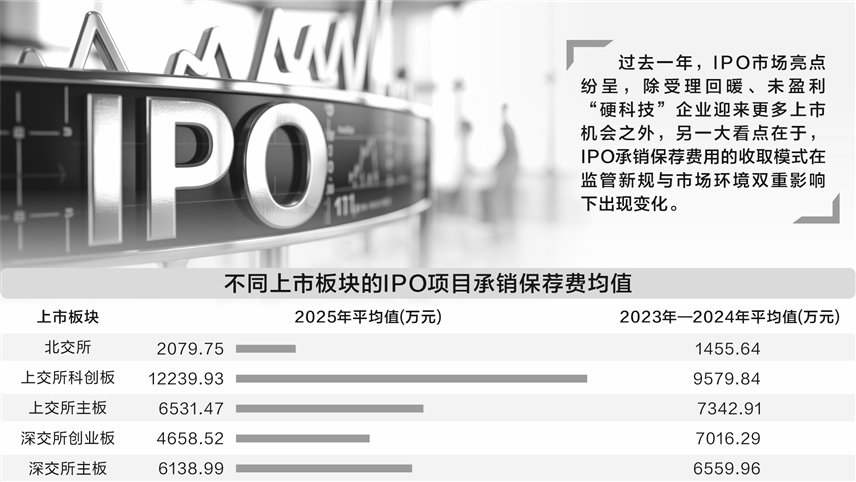
Core Insights - The IPO market is experiencing significant changes in underwriting and advisory fee structures due to new regulations and market conditions, with a notable shift from the previously dominant tiered fee model to a mixed fee model that includes fixed rates and minimum or maximum fee clauses [4][5] Fee Structures - The tiered fee model, which was prevalent in 2023 with 38% of cases, has drastically decreased to 6% by 2025, with most remaining cases adopting a decreasing fee percentage [3][4] - The traditional model of "actual fundraising amount × fixed rate" is now used by 33% of IPOs in 2025, with underwriting fees typically ranging from 5% to 9% [4] - A new model combining fixed rates with limit conditions has gained traction, with 49% of IPOs in 2025 utilizing this approach, up from 25% in 2023, primarily due to changing fundraising expectations [5] - The "one-price" fee model has been adopted by 12% of IPOs in 2025, focusing on direct pricing for online offerings [5] Market Trends - The average underwriting fee for the Sci-Tech Innovation Board reached 1.22 billion yuan in 2025, a significant increase from the previous average of 957.98 million yuan [7] - Conversely, the average underwriting fees for the main board and the ChiNext board have decreased, with the main board averaging 65.31 million yuan and the ChiNext board at 46.58 million yuan, reflecting a decline of over 30% for the ChiNext board compared to previous years [7][8] - The Beijing Stock Exchange has seen a notable increase in IPO fees, with an average of 20.80 million yuan in 2025, up 43% from the previous average of 14.56 million yuan [8] Market Concentration - The IPO underwriting market continues to exhibit a "head effect," with a small number of securities firms capturing the majority of market share, as only 13 firms generated over 100 million yuan in IPO revenue in the past year [9] - CITIC Securities leads the market with nearly 1.1 billion yuan in underwriting fees, followed by CITIC Construction Investment and Guotai Junan, indicating a concentration of high-quality projects among top firms [9]





五年IPO变局 券商投行谁在潮头?
2 1 Shi Ji Jing Ji Bao Dao· 2026-01-13 05:55
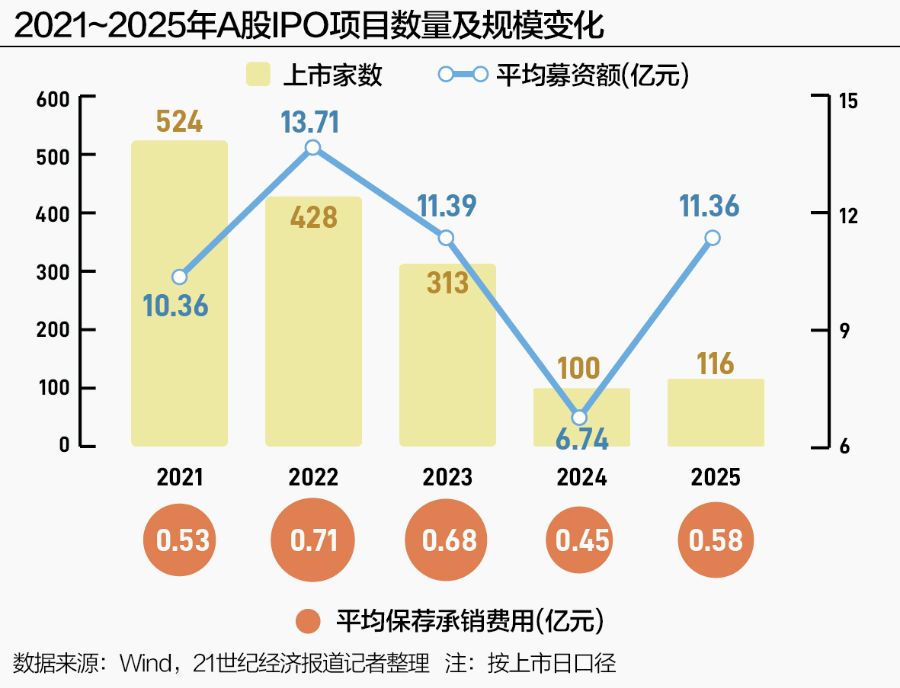
Core Insights - The A-share and Hong Kong IPO markets have shown signs of recovery in 2025, leading to discussions about a potential "IPO boom" [1] - The last significant IPO year for both markets was in 2021, marking a peak in IPO numbers and fundraising [2] A-share Market Summary - In 2025, the number of new A-share listings increased to 116, with total fundraising reaching 131.8 billion yuan, nearly doubling year-on-year [3] - The average fundraising amount per IPO rose significantly to 11.36 million yuan, with average underwriting fees for brokers increasing to 0.58 million yuan [7] - The focus has shifted from quantity to quality, with a notable increase in the "value" of individual projects [7] - The largest IPOs in recent years have transitioned from traditional sectors to technology-driven companies, particularly in semiconductors and renewable energy [11] - Leading brokers like CICC and CITIC Securities have maintained their competitive edge, with CICC involved in three of the largest IPOs in the past five years [12][13] Broker Competition in A-share Market - The competition among brokers has evolved, with CITIC Securities and CICC dominating the top spots in underwriting [13][14] - In 2025, the merger of Haitong Securities and Guotai Junan created a new leader in underwriting volume, while the competition in the lower tiers has intensified [14] - CITIC Securities has consistently led in underwriting revenue, with significant contributions from high-quality projects [15][16] Hong Kong Market Summary - The Hong Kong IPO market has experienced a "V-shaped" recovery, with total fundraising in 2025 exceeding 285.8 billion HKD, reclaiming the top position globally [20] - The average fundraising amount per IPO surged to 24.43 million HKD in 2025, driven by large projects from leading companies [20][22] - The narrative of the Hong Kong IPO market has shifted from internet-driven stories to technology and manufacturing innovations [22] Broker Competition in Hong Kong Market - Foreign investment banks like Morgan Stanley and Goldman Sachs continue to hold key positions in large IPO projects, while Chinese brokers are increasing their participation [23][24] - The rise of Chinese brokers, particularly in joint underwriting roles, reflects their growing influence in the Hong Kong market [24][25] - Futu Securities has consistently led in the number of IPOs underwritten, while traditional bank-affiliated brokers are also making significant contributions [25][28] Future Outlook - The consensus indicates a more active IPO market in 2026, but challenges related to supply and market absorption capacity are anticipated [29] - The ability of brokers to price assets and manage project depth will be crucial for success in the upcoming years [29]
保险证券ETF(515630)涨超2%,基本面改善+估值修复进行时
Xin Lang Cai Jing· 2026-01-13 02:35
Group 1 - The Shanghai Municipal Government has issued measures to promote the quality and efficiency of the service industry and boost consumption, including encouraging health insurance products specifically for the elderly and supporting insurance products that provide care services for special groups [1] - Despite short-term fluctuations, the fundamental improvement logic of the insurance sector remains intact, with valuations expected to continue recovering towards 1x PEV due to factors such as stable interest rates, rising equity markets, and decreasing liability costs [1] - The insurance sector's performance in the first half of 2026 is anticipated to exceed expectations, supported by a low base in the first half of 2025, where some companies reported negative double-digit profit growth year-on-year [1] Group 2 - As of January 13, 2026, the CSI 800 Securities Insurance Index has risen by 1.99%, with significant gains in constituent stocks such as Hualin Securities (up 10.02%) and China Life (up 5.06%) [1] - The CSI 800 Securities Insurance Index is based on the CSI 800 Index and includes securities from the insurance sector, providing investors with diverse investment options [2] - The top ten weighted stocks in the CSI 800 Securities Insurance Index account for 64.71% of the index, including major companies like China Ping An and China Life [2]
保险股接下来怎么看
2026-01-13 01:10
Summary of Conference Call on Insurance Sector Industry Overview - The insurance sector is currently experiencing low valuations, with China Pacific Insurance (CPIC) and Ping An Insurance (Group) Company of China, Ltd. (Ping An) having P/EV ratios of approximately 0.7 and 0.8 respectively for 2026, indicating rapid growth in intrinsic value [1][2] - China Life Insurance Company Limited (China Life) has a higher valuation in the A-share market at around 0.9 times P/EV, attributed to its faster growth in intrinsic value, but the Hong Kong-listed version is recommended due to significant discounts compared to A-shares [3][4] Key Insights and Arguments - The quality of pre-receipt data from late 2025 to early 2026 is strong, with a decline in bank deposit rates leading to increased funds flowing into insurance products. It is expected that premium growth will be high in the first quarter of 2026 but may face pressure in the third quarter [1][5] - Rising interest rates are beneficial for insurance companies' fixed-income investments, alleviating risks associated with interest spread losses. The yield on 10-year government bonds has risen to approximately 1.9%, an increase of 30 basis points from the previous year [5][7] - The proportion of equity assets in insurance companies is around 15.5%. A strong stock market will enhance insurance companies' earnings [5][7] Impact of Dividend Insurance Products - Dividend insurance products have a shorter effective duration, allowing insurance companies to be more flexible in their fixed-income asset allocation and increasing their risk appetite. It is anticipated that dividend insurance will constitute a significant portion of new premium growth [6][9] Investment Strategies and Profit Expectations - Insurance companies are focusing on increasing their equity allocation to benefit from stock market gains. Despite a solid profit outlook for 2025, the primary profit source is expected to be in the third quarter, with a relatively low profit base in the first half of 2026 [8] - The anticipated performance for the first quarter of 2026 is optimistic, with expectations that even if the market's growth in the third quarter is lower than the previous year, profits will remain stable [8] Market Performance and Forecasts - Recent performance of insurance stocks has been strong, with notable increases in share prices for Xinhua Insurance and CPIC at the start of 2026. However, Ping An's performance has been more volatile [2] - By the end of January, major insurance companies are expected to release profit forecasts. China Life and Xinhua Insurance are likely to announce forecasts, while Ping An's profit growth is projected to be lower than 50% for the year [11] Industry Valuation and Future Outlook - The overall outlook for the insurance industry in the first half of 2026 is optimistic, with no significant negative factors affecting the asset and liability sides. Valuations could reach 1.5 times PEV under favorable market conditions, while they may drop to 0.7 to 0.8 times PEV under poor conditions [12] - The policy environment remains supportive, and large listed companies are expected to continue outperforming smaller firms in premium growth, enhancing their market share [12]



沪指17连阳,北向资金成交额创互联互通机制开通以来第三高
Huan Qiu Wang· 2026-01-13 01:08
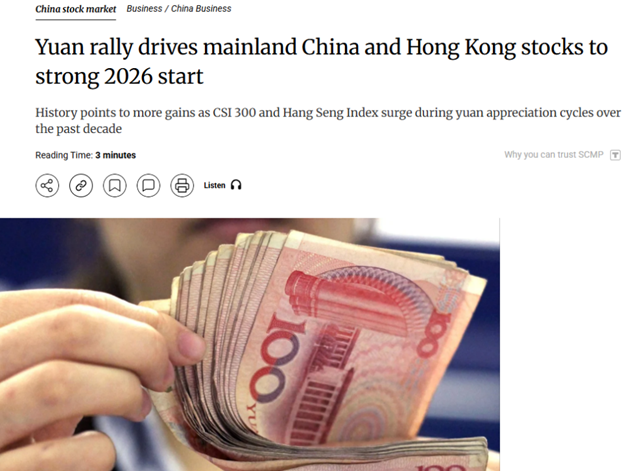
【环球网财经综合报道】1月12日,A股放量上涨,上证指数豪取17连阳,刷新逾10年新高;A股全天成 交3.64万亿元,创单日成交额历史新高;北向资金买入和卖出成交额达3989.80亿元,创互联互通机制开 通以来第三高。 《南华早报》近日发文称,随着人民币突破关键的7元兑1美元水平,2026年以来,人民币计价的中国内 地股市(沪深300指数)和香港恒生指数已上涨超过3%,这是此前两年半以来未见的情况。 报道还提到,历史数据显示,人民币走强有利于中国股市。海通证券Quantile基金研究发现,自2017年 以来,在五次人民币升值周期中,沪深300指数平均上涨18%。方正证券报告也显示,在过去十年的六 次人民币升值期间,恒生指数平均上涨16%。 此外,对中国经济韧性和出口增长的乐观预期,以及对北京提供更多增长稳定措施的期望,助力了人民 币的上涨。汇丰预计,今年年底前美元兑人民币汇率将升至6.95,摩根士丹利预计,2027年升值至 6.80,主要得益于强劲的外部平衡。 方正证券分析师朱晨晨表示:"这一轮人民币升值的空间还有更多。这将进一步提升人民币计价的核心 中国资产,如A股和港股的吸引力,引导海外资本回流进行再配置 ...
IPO承销保荐费格局生变:阶梯式收费锐减 混合模式成主流
Zheng Quan Shi Bao Wang· 2026-01-12 23:30
Core Insights - The number of IPOs using the "tiered fee" model has significantly decreased, dropping from approximately 38% in 2023 to 6% in 2025, with existing cases generally adopting a "decreasing fee ratio" standard [1] - A hybrid fee model based on "fundraising amount × fixed rate" with additional "minimum fee or maximum fee" clauses has become the mainstream charging method, accounting for 49% of current practices [1] Fee Models - The "tiered fee" model, once mainstream in 2023 with at least 89 IPOs, has seen a drastic decline, with only 5 cases in 2025, of which 4 are clearly using a "decreasing fee ratio" [2] - The traditional "actual fundraising amount × fixed rate" model was adopted by 26 IPOs in 2025, representing 33%, with underwriting fees typically ranging from 5% to 9% [3] - The "fixed rate with limit conditions" model, which includes "minimum fee" or "maximum fee," was used by 38 companies in 2025, making up 49%, up from 25% in 2023 [3] - The "flat fee" model was utilized by 9 IPOs in 2025, accounting for 12%, primarily for online direct pricing [4] Fee Trends by Market Segment - The average underwriting fee for the Sci-Tech Innovation Board reached 122 million yuan in 2025, a significant increase from the average of 95.8 million yuan between 2023 and 2024 [5] - The average underwriting fees for the main board and the ChiNext have decreased, with the main board averaging 65.3 million yuan and the ChiNext at 46.6 million yuan in 2025, down over 30% from previous years [6] - The North Exchange has seen a notable increase in IPO fees, with an average of 20.8 million yuan in 2025, up 43% from 14.6 million yuan in 2023-2024 [6] Market Dynamics - The IPO underwriting market continues to exhibit a "head effect," with a few leading firms capturing the majority of market share due to their strategic positioning and project reserves [7] - Only 13 securities firms generated over 100 million yuan in IPO revenue in the past year, with CITIC Securities leading at nearly 1.1 billion yuan [8] - Other top firms include China International Capital Corporation, Guotai Junan, Huatai United, and CICC, with revenues of 883 million yuan, 843 million yuan, 650 million yuan, and 491 million yuan respectively [9] - The top firms have a clear focus on high-quality projects in the main board and Sci-Tech Innovation Board, with over 80% of their projects concentrated in these segments [10]
证券代码:300917 证券简称:特发服务 公告编号:2026-001
Zhong Guo Zheng Quan Bao - Zhong Zheng Wang· 2026-01-12 22:58
Core Viewpoint - The company held its 35th meeting of the second board of directors on January 9, 2026, where several key resolutions were passed regarding cash management and the establishment of a wholly-owned subsidiary in Hong Kong [1][4]. Group 1: Board Meeting Details - The meeting was conducted via communication methods, with all 9 directors present, and was deemed legally valid [1]. - The board approved the use of up to RMB 21 million of temporarily idle raised funds and up to RMB 130 million of temporarily idle self-owned funds for cash management from February 21, 2026, to February 22, 2027 [1][3]. - The board proposed to authorize the chairman to make investment decisions and sign relevant contracts within the approved limits [1]. Group 2: Establishment of Subsidiary - The board approved the establishment of a wholly-owned subsidiary in Hong Kong, named "Hong Kong Te Fa Service Co., Ltd." to enhance business development and operational efficiency [4]. - The strategic committee of the board also reviewed and approved this proposal [4]. Group 3: Shareholder Meeting - The company plans to hold its first extraordinary general meeting of 2026 on January 28, 2026, to review the proposals put forth by the board [5][6]. - The voting results for all resolutions were unanimous, with 9 votes in favor and no opposition or abstentions [3][5].

深圳市特发服务股份有限公司第二届董事会第三十五次会议决议公告
Shang Hai Zheng Quan Bao· 2026-01-12 18:07
Group 1 - The company held its 35th meeting of the second board of directors on January 9, 2026, with all 9 directors present, and the meeting was conducted in accordance with legal regulations [2][3][6] - The board approved a proposal to use up to RMB 21 million of temporarily idle raised funds and up to RMB 130 million of temporarily idle self-owned funds for cash management from February 21, 2026, to February 22, 2027 [3][4][5] - The board also approved the establishment of a wholly-owned subsidiary in Hong Kong, named "Hong Kong TeFa Service Co., Ltd." to enhance business development and market competitiveness [8][9] Group 2 - The board proposed to hold the first extraordinary shareholders' meeting of 2026 on January 28, 2026, to review related proposals [10] - The voting results for all proposals were unanimous, with 9 votes in favor and no votes against or abstaining [6][10]
从“辅助”到“引擎”:互联网分公司成券商转型胜负手
Zheng Quan Ri Bao Zhi Sheng· 2026-01-12 17:08
Core Viewpoint - The securities industry is undergoing a significant transformation, marked by the closure of over 180 offline branches and the rapid rise of internet subsidiaries, indicating a trend towards digitalization and smart transformation in the sector [1][2]. Group 1: Industry Trends - The establishment of internet subsidiaries is becoming a new strategy for securities firms to capture online market share and expand customer bases, driven by favorable market conditions and increased trading activity [2][6]. - By 2025, the total number of new investor accounts in the capital market is expected to reach 30.0571 million, providing ample opportunities for securities firms to enhance their internet business [2]. - Major firms like China Galaxy Securities and Dongwu Securities are actively setting up internet subsidiaries, reflecting a broader trend of digital transformation in the industry [2][3]. Group 2: Differences Between Internet Subsidiaries and Traditional Branches - Internet subsidiaries differ from traditional branches in strategic focus, targeting a broader customer base through standardized and centralized operations, while traditional branches primarily serve high-net-worth and corporate clients [3]. - The operational logic of internet subsidiaries is data and algorithm-driven, contrasting with the reliance on personal experience and social networks in traditional branches [3][4]. - Internet subsidiaries operate as independent units with unified rights, responsibilities, and benefits, allowing for quicker decision-making and a full-cycle approach to customer acquisition and revenue generation [3][4]. Group 3: Functional Roles of Internet Subsidiaries - The core functions of internet subsidiaries include conducting targeted marketing and lead generation on external platforms, managing daily operations of various online platforms, providing refined customer service, and acting as a "smart brain" for data monitoring and AI application across all business processes [4][5]. - Internet subsidiaries aim to address traditional pain points in the securities industry, such as inadequate service for long-tail customers and low operational efficiency due to dispersed operations [5][6]. Group 4: Performance and Effectiveness - The effectiveness of internet subsidiaries is being validated through various practices, with firms like Guotai Junan and Dongwu Securities reporting significant growth in customer acquisition and asset management [6][7]. - Guotai Junan's internet subsidiary has doubled its customer acquisition on new media platforms in 2025 compared to 2024, while Dongwu Securities has successfully attracted nearly 3 million followers and accumulated 150 million yuan in assets [6][7]. Group 5: Challenges and Future Outlook - Despite the progress, internet subsidiaries face challenges such as internal collaboration barriers and the need for alignment with headquarters on operational strategies [8][9]. - Not all securities firms are suited to establish internet subsidiaries, as some leading firms have already integrated internet capabilities into their operations, while smaller firms may prefer to focus resources on key business areas [8][9]. - The future of internet business in the securities industry will depend on advancements in technology, business models, and organizational structures, with a focus on creating long-term customer engagement and breaking down traditional departmental barriers [9][10].



邀请函|“车研有AI”国泰海通汽车+AI主题投资研究沙龙
国泰海通证券研究· 2026-01-12 14:01
Core Viewpoint - The article discusses the investment opportunities and trends in the automotive industry, particularly focusing on the integration of AI technologies within this sector [1]. Group 1: Automotive Industry Insights - The automotive industry is experiencing a significant transformation driven by advancements in AI, which is expected to enhance vehicle performance and consumer experience [1]. - Companies that effectively leverage AI technologies are likely to gain a competitive edge, leading to increased market share and profitability [1]. Group 2: Investment Opportunities - The integration of AI in automotive manufacturing and services presents new investment opportunities, particularly in companies that are at the forefront of this technological shift [1]. - Investors are encouraged to consider firms that are innovating in AI applications for autonomous driving, smart manufacturing, and enhanced customer engagement [1].