阿里巴巴

Search documents
万亿外贸市场,为何成了AI应用富矿
3 6 Ke· 2026-02-25 12:23
Core Insights - The integration of AI in foreign trade is rapidly transforming traditional business models, enhancing efficiency and responsiveness in customer interactions [1][2] - The potential market for AI services in foreign trade is estimated to be in the hundreds of billions, driven by the growth of cross-border e-commerce and the need for technological service expenditures [1][2] - The industry is witnessing a surge in AI adoption due to advancements in model capabilities and a significant reduction in inference costs, making AI solutions more accessible [2][3] Group 1: Market Potential and Growth - By 2025, China's total foreign trade import and export value is projected to reach 45.47 trillion yuan, with cross-border e-commerce accounting for 2.75 trillion yuan [1] - The traditional foreign trade SaaS market is valued at several hundred billion yuan, with AI transformation accelerating the growth of the foreign trade AI service market [1][2] - The AI service market in foreign trade is expected to have a potential space in the range of hundreds of billions, based on a 3-5% technology service expenditure ratio from the cross-border e-commerce scale [1][2] Group 2: Industry Dynamics and Competition - The foreign trade sector is becoming a prime candidate for AI transformation due to its complex business scenarios and fragmented data, attracting various players from traditional software providers to startups [2][7] - Major players in the market include Alibaba's OKKI, which has developed AI marketing tools, and various global CRM companies enhancing their AI capabilities [9][10] - The market is characterized by a high degree of fragmentation, allowing for greater survival space for new entrants compared to other sectors [10][12] Group 3: AI Application and Adoption - AI is being utilized in various aspects of foreign trade, including customer service, marketing material generation, and intelligent customer acquisition, significantly improving operational efficiency [1][3][4] - The demand for AI tools is increasing as businesses recognize the benefits of AI in generating marketing materials and automating customer outreach processes [3][4][6] - The acceptance of AI tools among cross-border sellers is high, with many willing to adopt new technologies that enhance their operational capabilities [6][12] Group 4: Challenges and Strategic Approaches - The industry faces challenges in building unique barriers to entry, with players needing to leverage proprietary know-how and data accumulation to differentiate themselves [11][12] - Companies are exploring various growth strategies, including developing comprehensive AI capabilities across multiple business functions or focusing on specific applications to deepen market penetration [11][12] - The transition from traditional SaaS growth models to product-led growth (PLG) is evident, with AI applications showing higher conversion rates compared to traditional software [13][14] Group 5: Future Outlook - The potential for AI applications in foreign trade is expected to expand beyond domestic markets, with opportunities for Chinese companies to serve overseas markets as well [17] - The integration of AI in foreign trade is still in its early stages, with significant room for growth as companies leverage AI to address traditional marketing and customer acquisition challenges [17]


韩国顶级国策智库承认,中国多项尖端科技领先韩国,对华产业政策应转向合作利用
3 6 Ke· 2026-02-25 12:11
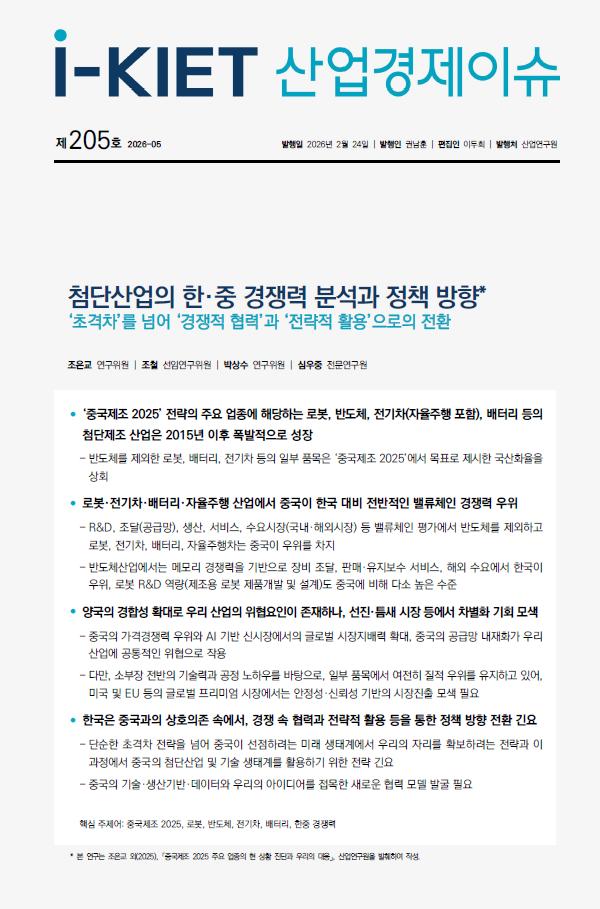
昨天,韩国国家级国策智库——韩国产业研究院( Korea Institute for Industrial Economics and Trade, KIET)发布了《韩中尖端产业竞争力分析及政策方 向》报告,在韩国产业界引发广泛关注与震动。 韩国产业研究院是韩国唯一专注于产业与贸易交叉领域研究的国家级政策研究机构,自1976年由韩国政府设立以来,始终以助力韩国产业发展、提升国家 竞争力为核心使命,是韩国产业政策制定的核心智囊支撑。 这家韩国顶级国策研究机构经过半年多的研究分析,不得不承认在物理AI时代,中国机器人、半导体、电动汽车、电池等尖端制造业快速增长,已经对 韩国形成了明显优势。 KIET的报告封面(图源:KIET) 而对于韩国一直引以为傲的半导体产业,韩国产业研究院的评估结论是中国两国实力相当。这主要是因为韩国虽然在存储器半导体领域拥有世界最高水平 的竞争力,但 中国 在AI芯片、IGBT等非存储器领域却拥有相对较高的竞争力,多数专家认为中国在AI芯片设计等领域具有压倒性优势,甚至在无晶圆厂 制造、封装等环节也具备技术、价格、基础设施等方面的领先实力。 报告直言,"中国追赶韩国的时代已然终结,如今轮 ...
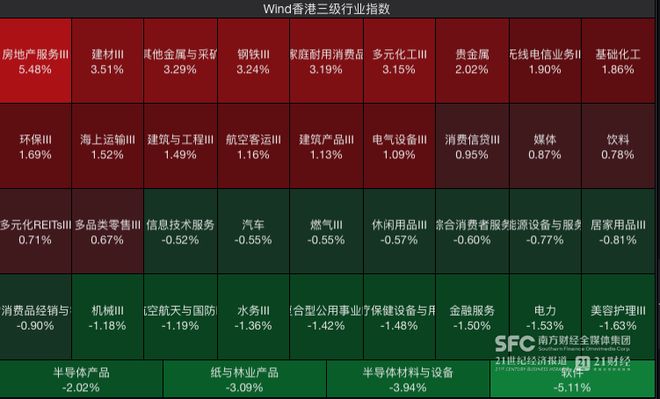
恒指温和收涨 周期股领涨科技分化
2 1 Shi Ji Jing Ji Bao Dao· 2026-02-25 12:09
Market Overview - The Hong Kong stock market experienced a mixed performance with a structural characteristic of "strong cyclicals, weak technology" as policy support and rising commodity prices drove the market upward, while profit-taking affected the technology sector [1][2] - The Hang Seng Index rose by 0.66% to 26,765.72 points with a trading volume of 236.765 billion HKD, while the Hang Seng Tech Index slightly declined by 0.19% to 5,260.5 points with a trading volume of 51.908 billion HKD [1][2] Sector Performance - Cyclical sectors such as real estate services (+5.48%), building materials (+3.51%), and mining (+3.29%) led the gains, supported by favorable policies and rising commodity prices [2] - In contrast, technology sectors like software (-5.11%) and semiconductor materials and equipment (-3.94%) saw significant declines due to profit-taking from previously high-performing stocks [2] Individual Stocks - Notable gainers included Tianbao Energy (+69.49%) due to a projected profit increase of 84.5% year-on-year, and Semir Holdings (+60.53%) benefiting from active small-cap market sentiment [2] - Major decliners included Zhijing International Financial (-26.32%), Zhuoyue Holdings (-23.08%), and China National Pharmaceutical Group (-18.75%) [2] Trading Activity - The top three stocks by trading volume were Tencent Holdings (11.981 billion HKD), Alibaba-W (7.110 billion HKD), and HSBC Holdings (6.193 billion HKD) [2] Policy and Economic Developments - The Hong Kong budget proposed optimizing the listing system, including revising "same share, different rights" requirements and advancing T+1 settlement cycle consultations, aiming to enhance market efficiency [2] - New policies in Shanghai's real estate market, including shortening the social security period for non-local buyers and increasing public housing loan limits, stimulated the Hong Kong real estate sector [2] Future Outlook - Analysts suggest focusing on three sectors: precious metals and energy due to rising geopolitical risks, consumer sectors at relatively low valuations, and technology sectors expected to rebound as AI applications accelerate [3] - Concerns over potential VAT increases in service sectors may affect investor sentiment, but pre-meeting policy expectations could support the Hong Kong market [3] - The real estate sector showed overall gains during the Spring Festival, with a continued positive outlook for first-tier and select second-tier cities [3]





恒指温和收涨 周期股领涨科技分化丨港股复盘
2 1 Shi Ji Jing Ji Bao Dao· 2026-02-25 12:00
Core Viewpoint - The Hong Kong stock market experienced a mixed performance with a structural divergence, where cyclical sectors outperformed while technology stocks faced profit-taking pressures [1] Market Performance - The Hang Seng Index rose by 0.66% to 26,765.72 points with a trading volume of 236.765 billion HKD, while the Hang Seng Tech Index slightly declined by 0.19% to 5,260.5 points with a trading volume of 51.908 billion HKD [1] - Southbound capital recorded a net outflow of 3.569 billion HKD [1] Sector Performance - Cyclical sectors such as real estate services (+5.48%), building materials (+3.51%), and other metals and mining (+3.29%) led the gains, driven by favorable policies and rising commodity prices [1][2] - Technology sectors, including software (-5.11%) and semiconductor materials and equipment (-3.94%), showed significant declines due to profit-taking [1][2] Individual Stock Movements - Notable gainers included Tianbao Energy (+69.49%) due to a profit forecast increase of 84.5% year-on-year, and Semmy Holdings (+60.53%) benefiting from active small-cap market sentiment [2] - Major decliners included Zhijing International Finance (-26.32%), Chuangyue Holdings (-23.08%), and China National Pharmaceutical Group (-18.75%) [2] Major Transactions - The top three stocks by trading volume were Tencent Holdings (11.981 billion HKD), Alibaba-W (7.110 billion HKD), and HSBC Holdings (6.193 billion HKD) [3] - Conch Group plans to increase its stake in Conch Cement A-shares (7 to 14 billion HKD) and Conch Venture (10.61%), contributing to the rise in building materials stocks [3] Policy and Economic Factors - The Hong Kong budget proposed optimizing the listing system, including revising "same share different rights" requirements and advancing T+1 settlement cycle consultations [3] - New policies in Shanghai's real estate market aimed at stimulating demand, such as shortening social security requirements for non-local buyers and increasing public housing loan limits [3] Future Outlook - Analysts suggest focusing on three sectors: precious metals and energy due to rising geopolitical risks, consumer sectors at relatively low valuations, and technology sectors expected to rebound as AI applications accelerate [4]
阿里云集齐四大顶尖开源模型 进一步推动AI应用爆发
Zheng Quan Ri Bao Wang· 2026-02-25 11:59
Core Insights - Alibaba Cloud has launched a new Coding Plan that includes four top open-source model APIs: Qwen3.5, GLM-5, MiniMax M2.5, and Kimi K2.5, allowing users to switch between models freely and enjoy higher token limits and stability [1][2][3] - The AI Agent market in China is projected to exceed 3.3 trillion yuan by 2028, indicating a significant growth potential for AI applications [2] - Alibaba Cloud's unique model commercial strategy, which aggregates top open-source AI models, enhances its competitive edge in the cloud and AI sectors [2][4] Model Features - Qwen3.5 boasts a total of 397 billion parameters with only 17 billion activated, achieving high efficiency and cost-effectiveness [1] - GLM-5 is the flagship model from Zhiyu, experiencing high demand for its API services [1] - MiniMax M2.5 is designed specifically for agent scenarios, excelling in advanced Excel processing and deep research tasks [1] - Kimi K2.5 shows significant improvements in programming and agent capabilities [1] Market Position - As of 2025, Alibaba Cloud is expected to capture 36% of the Chinese cloud market, significantly outpacing its competitors [4] - The integration of multiple models into a single platform simplifies the development process for developers and small startups, enhancing research and development efficiency [4] Cost Efficiency - The Coding Plan Lite offers up to 18,000 requests per month for new users at a cost of only 7.9 yuan, while the Pro plan allows for 90,000 requests at 39.9 yuan, significantly reducing costs for high-frequency coding scenarios [3] - This pricing strategy addresses the rising computational costs associated with AI agents, making it easier for developers to innovate and deploy applications [3]
锐捷网络:海外合作伙伴数量增长到2600多家
Zheng Quan Ri Bao· 2026-02-25 11:41
Core Insights - The company is a leading supplier of data center switches for major internet companies such as Alibaba, Tencent, and ByteDance [2] - The company has established a large partner network with over 2,600 overseas partners, contributing to the growth of its international business [2] - The company has developed a compliance system and support platform for its overseas operations, ensuring a solid foundation for business expansion [2] Business Performance - The company's overseas business has been continuously growing, primarily targeting the SMB market and certain enterprise-level campus markets [2] - The success in overseas markets is attributed to effective market channel development and the establishment of support platforms [2]
2月25日南向资金追踪:腾讯控股、美团-W、阿里巴巴-W净买入额居前,分别为8.18亿港元、6.78亿港元、6.06亿港元
Jin Rong Jie· 2026-02-25 11:09
恒生指数今日涨0.66%,报26765.72点,大市成交2367.65亿港元。 本文源自:市场资讯 作者:智投君 港股通成交数据披露(沪深合计) 证券简称成交金额净买入额收盘价涨跌幅腾讯控股 0070063.68亿港元8.18亿港元522.50港元0.48%美团-W 036909.38亿港元6.78亿港元82.70港元1.60%阿里巴巴-W 0998837.67亿港元6.06亿港元148.30港元0.20%小米集团-W 0181022.13亿港元5.38亿港元35.60港元-0.39%长飞光纤光缆 0686927.59亿港元1.82亿港元131.30港元1.63%中芯国际 0098126.75亿港元1.68亿港元69.85港元0.65%中国海洋石油 0088315.28亿港元-0.88亿港元25.48港元-0.39%南方恒生科技 0303326.75亿港元-3.01亿港元5.14港元-0.10%中远海能 0113815.19亿港元-3.58亿港元19.02港元0.96%恒生中国企业 0282811.38亿港元-11.37亿港元92.84港元0.61%盈富基金 0280044.36亿港元-44.10亿港元26. ...

冲刺“十五五”规上工业万亿产值,广州黄埔亮剑“两业融合”
Nan Fang Du Shi Bao· 2026-02-25 10:53
"今年,我们的目标是:地区生产总值和固定资产投资增长5%以上,规上工业总产值突破8600亿,社会 消费品零售总额突破2000亿,引进优质产业项目500个以上,其中百亿级项目8个。"2月25日,在2026年 广州市高质量发展大会上,黄埔区区长冼银崧亮出年度发展"任务书",勾勒经济大区开局之年的奋进图 景。 而作为广州实体经济的主战场,黄埔区明确将以"决战姿态",通过稳增长、强产业、深改革三大路径, 加速实现经济量质"双提升",全力冲刺"十五五"全区规上工业总产值破万亿的远景目标。 瞄准今年一季度经济实现"开门红",黄埔区已将区级核算的29项经济指标逐项拆解、细化举措,并建 立"部门+镇街+园区"三级联动的协同作战体系,确保各项部署快速落地见效。 在做强工业"顶梁柱"方面,黄埔区坚持传统产业、战略性新兴产业、未来产业并举,加快打造"2个2000 亿级、5个1000亿级、若干个500亿级"的现代化产业集群,力争在"十五五"期间实现规上工业总产值突 破万亿。今年,该区将全力推动180个项目开工、120个项目竣工投产,新增100家规上高新技术企业, 加速向"智造强区"跃升。 在激发消费"新潜力"方面,黄埔区将加快推进投 ...

净卖出超40亿港元 抛售三大ETF继续加仓腾讯
Xin Lang Cai Jing· 2026-02-25 10:25
Core Viewpoint - Southbound capital flow decreased significantly today, with a total transaction of approximately HKD 925.13 billion, accounting for 39.07% of the total turnover of the Hang Seng Index [1] Group 1: Southbound Capital Flow - Southbound capital outflow amounted to approximately HKD 40.57 billion today, with net outflow from the Shanghai-Hong Kong Stock Connect at about HKD 54.95 billion and net inflow from the Shenzhen-Hong Kong Stock Connect at approximately HKD 14.38 billion [1] - Major ETFs such as the Tracker Fund of Hong Kong, Hang Seng China Enterprises, and Southern Hang Seng Technology experienced significant sell-offs, with net sales of HKD 44.1 billion, HKD 11.36 billion, and HKD 3 billion respectively [1] Group 2: Individual Stock Performance - Tencent Holdings saw a net buy of HKD 8.18 billion, with a price increase of 0.48% [2][3] - Meituan-W recorded a net buy of HKD 6.78 billion, with a price increase of 1.60% [2][3] - Alibaba-W had a net buy of HKD 6.06 billion, with a price increase of 0.20% [2][3] - Xiaomi Group-W experienced a net buy of HKD 5.38 billion, but saw a price decrease of 0.39% [2][3] - Changfei Optical Fiber Cable had a net buy of HKD 1.82 billion, with a price increase of 1.63% [2][3] - China Merchants Energy had a net outflow of HKD 3.58 billion, with a price increase of 0.96% [2][3]



2026年三大趋势,春节档大战后,腾爱优芒需要一份爆款成绩单
3 6 Ke· 2026-02-25 10:23
Core Insights - The Spring Festival this year saw streaming platforms like iQIYI, Tencent Video, and Youku struggling to produce blockbuster long dramas, with a focus on ancient and period dramas leading to a lack of standout hits [3][5] - In contrast, the short drama market thrived, with several series achieving over 1 billion views, indicating a shift in viewer preferences towards shorter content [3][5] Streaming Market Performance - Long dramas captured a market share of less than 20%, while short dramas consistently broke the 1 billion view mark, highlighting the challenges faced by long-form content [5] - The overall performance of long dramas reflects a year of increased competition, fewer blockbusters, and compressed profit margins, leading to a decline in project launches [5][18] Content Strategy and Trends - Streaming platforms are adopting a "layered attack" strategy for long dramas, combining innovative or ancient dramas targeting young audiences with family-friendly content to maximize viewership [7][10] - The emergence of generative AI technology is reshaping the video content industry, pushing platforms towards cost efficiency and innovative content creation [6][24] Future Directions - Three major trends are anticipated for 2026: the rise of innovative content like "infinite flow" narratives, new revenue-sharing models to support mid-tier productions, and the potential growth of AI-driven animated series [24][31] - The shift towards "infinite flow" and other innovative genres is seen as a key driver for attracting younger audiences and breaking away from formulaic storytelling [25][27] - The implementation of new revenue-sharing models is expected to revitalize mid-tier dramas, allowing them to find sustainable business models and audiences [28][30] User Engagement and Market Dynamics - The competition among platforms is shifting from acquiring new users to maximizing engagement and retention of existing users, with many new shows concluding within two weeks of their premiere [21][17] - The rise of micro-short dramas is becoming a significant trend, with platforms leveraging these formats to capture viewer attention in a fragmented market [23][31] Industry Challenges - The long video industry is facing significant challenges, with a decline in viewership for top content and a growing divide where a small number of high-quality shows capture the majority of audience attention [20][18] - The market is characterized by a "20/80" or even "10/90" rule, where a few standout series dominate viewership, leaving many mid-tier productions struggling for visibility [20][18]