
圆通速递

Search documents
上市快递四巨头业绩分化
Shen Zhen Shang Bao· 2025-11-03 16:21
Core Viewpoint - The express delivery industry in China is experiencing significant performance differentiation among major listed companies, driven by the ongoing effects of the "anti-involution" policy, leading to a shift from scale expansion to quality upgrades in operations [1][4]. Performance Differentiation - The total express delivery volume in China reached 1,450.8 billion pieces in the first three quarters of 2023, a year-on-year increase of 17.2%, with total revenue of 1,085.74 billion yuan, up 8.9% [1]. - Shentong Express led the growth with a revenue of 38.57 billion yuan, a year-on-year increase of 15.17%, and a net profit of 756 million yuan, up 15.81%, showing strong profitability [1]. - YTO Express, benefiting from scale advantages, reported a revenue of 54.156 billion yuan, a 9.69% increase, and a net profit of 2.877 billion yuan, with a 10.97% growth in the third quarter [1]. - SF Holding achieved a revenue growth of 8.89% to 83.08 billion yuan, with a net profit increase of 9.07% [2]. - Yunda Holdings faced significant pressure, with a revenue of 37.493 billion yuan, a 5.59% increase, and a net profit of 730 million yuan, down 48.15% [2]. Market Share and Competitive Landscape - In the third quarter, YTO Express held the largest market share at 15.05%, followed by Shentong Express at 13.18%, which surpassed Yunda [3]. - Yunda's business volume grew by 6.61% to 6.417 billion pieces, the slowest among the four major companies, with a market share of 13% [3]. - SF Holding's business volume surged by 33.4% to 4.31 billion pieces, significantly increasing its market share by 0.9 percentage points to 8.7% [3]. Pricing and Revenue Trends - The "anti-involution" policy has effectively curbed the long-standing price wars in the industry, leading to a stabilization and recovery in per-package revenue [3]. - In September, the per-package revenue for Shentong, YTO, and Yunda was 2.12 yuan, 2.21 yuan, and 2.02 yuan, respectively, showing year-on-year increases of 4.95%, 1.09%, and 0.5% [3]. - SF Holding's per-package revenue was 13.87 yuan, slightly down year-on-year but up 0.60 yuan from the previous month, indicating ongoing optimization of its pricing structure [3]. Future Outlook - The industry anticipates continued effects from the "anti-involution" policy, leading to profit recovery for companies [4]. - Regulatory measures are expected to push companies towards quality upgrades, with several express companies already announcing price increases in response to market conditions [4]. - Historical trends suggest that after years of refined operations, express companies will have higher network efficiency and greater earnings elasticity, with price increases and stricter checks on low-priced packages likely to enhance profit margins [4].



申通快递申邮宝等App被下架!公示后仍未按照要求落实整改
Nan Fang Du Shi Bao· 2025-11-03 14:37
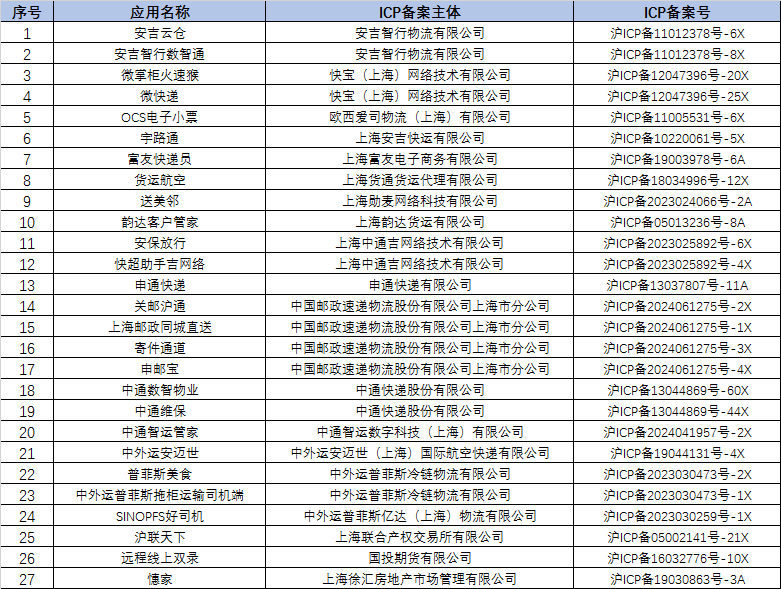
Core Points - The Shanghai Municipal Communications Administration has removed 27 apps for infringing user rights, including those from Shentong Express and Shunfeng [1][3] Group 1: Regulatory Actions - The removal of the apps is based on violations of laws such as the Personal Information Protection Law and the Cybersecurity Law [3] - The action is part of a broader initiative announced by four government departments to protect personal information by 2025 [3] Group 2: List of Affected Apps - The list of apps that have been removed includes notable names such as Shentong Express, Shanghai Postal Same-City Delivery, and Shunyoubao [2][3] - A total of 27 apps were identified for non-compliance during a review period [3] Group 3: Future Monitoring - The Shanghai Municipal Communications Administration will continue to monitor the affected apps and may impose further penalties, including administrative fines and inclusion in a poor credit list for telecom operations [3]


华源晨会精粹20251103-20251103
Hua Yuan Zheng Quan· 2025-11-03 14:03
Group 1: Fixed Income Market Insights - The manufacturing PMI has significantly declined, indicating a favorable environment for the bond market, influenced by the progress in US-China trade negotiations and the Federal Reserve's interest rate cuts [2][6] - The Federal Reserve's recent 25 basis points rate cut and the end of balance sheet reduction in December may ease global liquidity pressures, potentially narrowing the interest rate differential between China and the US, attracting foreign capital back [2][6] - The new public fund regulations are expected to enhance performance benchmark management and optimize information disclosure, primarily impacting actively managed equity funds, which may lead to improved research and risk control capabilities among institutions [2][6] Group 2: Automotive Industry Outlook - The upcoming reduction of the new energy vehicle purchase tax subsidy by half in 2026 is anticipated to impact the sales of electric vehicles, with a projected growth rate of 9% for 2026 [15][19] - The expected decline in subsidies will affect approximately 90% of new energy vehicle consumers, particularly those purchasing lower-priced models, which may lead to a significant drop in total demand [17][18] - Despite the subsidy reduction, the industry is expected to maintain structural opportunities, with a projected 2025 new energy passenger vehicle insurance volume of 12.83 million units, reflecting a year-on-year increase of 19% [18][19] Group 3: Transportation Sector Developments - The logistics sector is showing signs of recovery, with the "Tongda system" companies reporting improved single-package profits, indicating the effectiveness of price increases in the fourth quarter [22][31] - The shipping market is experiencing a surge in VLCC rates, reaching a ten-year high of $125,000 per day, driven by tightening capacity and increased demand [24][25] - The recent US-China trade agreement is expected to alleviate trade tensions and boost shipping activities, particularly in container exports from China to the US [24][25] Group 4: Precious Metals Market Analysis - Recent declines in gold and silver prices follow a two-month period of strong increases, attributed to US-China trade negotiations and the Federal Reserve's monetary policy changes [36][38] - The long-term outlook for precious metals remains positive, with expectations of price recovery supported by ongoing geopolitical tensions and central bank policies [36][37]
A股快递企业三季报盘点:业绩分化、“反内卷”成效显现
Mei Ri Jing Ji Xin Wen· 2025-11-03 13:29
Core Insights - The competitive landscape of the express delivery industry is becoming clearer as major A-share companies release their Q3 financial reports, revealing significant performance divergence among them [1][3][8] Financial Performance - In Q3, Shentong and Yunda reported net profit growth of 40.32% and 10.97% year-on-year, respectively, while SF Express faced short-term profit pressure due to strategic investments, and Yunda's net profit dropped by 48.15% year-on-year [1][3] - Shentong achieved a revenue of 38.57 billion yuan in the first three quarters, a 15.17% increase year-on-year, with a net profit of 756 million yuan, up 15.81% [3] - Yunda's revenue was 37.49 billion yuan, a 5.59% increase, but its net profit fell to 730 million yuan, down 48.15% [3] - SF Express reported a revenue of 225.3 billion yuan, an 8.9% increase, but its net profit decreased by 8.53% to 2.571 billion yuan in Q3 due to strategic investments [4][3] Market Dynamics - The express delivery market is experiencing a shift from aggressive price competition to a focus on quality and value, driven by regulatory guidance and industry self-discipline [2][8] - The "anti-involution" policy has led to a recovery in average express prices, with Q3 prices rising by 0.5% compared to Q2 [8] - Shentong's business volume reached 6.515 billion pieces in Q3, surpassing Yunda's 6.417 billion pieces, indicating a shift in market share [1][6] Strategic Initiatives - SF Express is increasing its focus on e-commerce logistics, with a 20% quarter-on-quarter increase in business volume from its e-commerce collection model [4] - The company is implementing flexible pricing strategies to capture key growth segments while aiming for long-term competitiveness [4][9] Industry Trends - The overall express delivery industry saw a revenue of 1.1 trillion yuan and a volume of 145.08 billion pieces in the first three quarters, reflecting year-on-year growth of 8.9% and 17.2%, respectively [8] - The industry is transitioning towards a new phase of healthy development, moving away from the "price for volume" model to optimizing service quality and operational efficiency [8][10]
上海市通信管理局:申通快递等APP被下架
中国基金报· 2025-11-03 12:47
Core Viewpoint - The Shanghai Municipal Communications Administration announced the removal of 27 apps (SDKs) due to violations related to the collection and use of personal information [2][4]. Summary by Sections Announcement Details - The announcement was made on November 3, indicating that the apps failed to comply with regulations regarding personal information protection [2][4]. - The action is part of a broader initiative mandated by multiple government departments to enhance personal information protection by 2025 [2]. List of Affected Apps - A total of 27 apps were identified for removal, including well-known services such as "韵达客户管家" (Yunda Customer Manager), "申通快递" (Shentong Express), and "微快递" (Weikuai Express) [3][4]. - Each app is associated with specific companies and has been listed with their respective ICP registration numbers [3]. Future Actions - The Shanghai Municipal Communications Administration will continue to monitor these apps and may implement further actions, including administrative penalties and inclusion in a list of poor-performing telecom service providers [4].


上海市通信管理局:申通快递等APP被下架
Xin Lang Cai Jing· 2025-11-03 12:22
Core Points - Shanghai Municipal Communications Administration announced the removal of 27 apps (SDKs) due to violations related to personal information protection [1][2][3] Group 1: Regulatory Actions - The removal of the apps is based on laws such as the Personal Information Protection Law, Cybersecurity Law, and Telecommunications Regulations [1][2] - The action is part of a broader initiative by four government departments to enhance personal information protection by 2025 [1][2] Group 2: Non-compliance Issues - The 27 apps failed to rectify issues related to the illegal collection and use of personal information within the specified correction period [1][2] - Apps such as Yunda Customer Manager, Shentong Express, and Shanghai Postal Same-City Delivery were among those that did not comply with the required corrections [1][2] Group 3: Future Monitoring - The Shanghai Municipal Communications Administration will continue to monitor the listed apps and may impose further actions such as service suspension or administrative penalties [3]
物流板块11月3日跌0.08%,圆通速递领跌,主力资金净流出9136.6万元
Zheng Xing Xing Ye Ri Bao· 2025-11-03 08:47
Market Overview - The logistics sector experienced a slight decline of 0.08% on November 3, with YTO Express leading the drop [1] - The Shanghai Composite Index closed at 3976.52, up 0.55%, while the Shenzhen Component Index closed at 13404.06, up 0.19% [1] Individual Stock Performance - The top-performing stocks in the logistics sector included: - Hengji Daxin (002492) with a closing price of 9.35, up 10.00% and a trading volume of 201,600 shares, totaling 185 million yuan [1] - ST Xuefa (002485) closed at 4.27, up 4.91% with a trading volume of 28,100 shares, totaling 11.976 million yuan [1] - Wanlin Logistics (603117) closed at 5.51, up 4.55% with a trading volume of 285,000 shares, totaling 156 million yuan [1] Fund Flow Analysis - The logistics sector saw a net outflow of 91.366 million yuan from institutional investors, while retail investors contributed a net inflow of 90.156 million yuan [2] - The main stocks with significant fund flow included: - Pulu Tong (002769) with a net outflow of 33.8752 million yuan from institutional investors [3] - Hengji Daxin (002492) had a net inflow of 28.2131 million yuan from institutional investors [3] - Furan De (605050) saw a net inflow of 18.5723 million yuan from institutional investors [3]

华创证券:继续强调快递业“反内卷”下投资机会 持续看好顺丰控股(002352.SZ)
智通财经网· 2025-11-03 06:14
Core Viewpoint - The report from Huachuang Securities expresses optimism about the express delivery industry, highlighting a rebound in pricing elasticity and improved financial metrics for major players in Q3 2025 [1] Group 1: Business Volume - The express delivery industry shows resilient growth, with a projected volume growth rate of 17.2% for the first three quarters of 2025 [2] - In terms of business volume and market share for the first three quarters of 2025: YTO Express (22.6 billion pieces, 15.6%) > Yunda Express (19.1 billion pieces, 13.2%) > Shentong Express (18.9 billion pieces, 13.0%) > Jitu Express (16.2 billion pieces, 11.1%) > SF Express (12.1 billion pieces, 8.3%) [2] - SF Express leads in growth rate at 33.4%, followed by YTO Express at 15.0%, while the industry average is 13.3% [2] Group 2: Pricing - The express delivery industry generated revenue of 1,085.74 billion yuan in the first three quarters of 2025, marking an 8.9% year-on-year increase, while the average ticket price decreased by 7.1% to 7.5 yuan [3] - For Q3 2025, the average ticket prices were: YTO Express (2.14 yuan, -2.4% year-on-year, +0.026 yuan quarter-on-quarter) > Shentong Express (2.05 yuan, +2.1% year-on-year, +0.082 yuan quarter-on-quarter) > Yunda Express (1.95 yuan, -2.1% year-on-year, +0.035 yuan quarter-on-quarter) > SF Express (13.57 yuan, -14.4% year-on-year, +0.079 yuan quarter-on-quarter) [3] Group 3: Performance Overview - In the first three quarters of 2025, SF Express led the industry in net profit with 8.31 billion yuan, a 9.1% increase, followed by YTO Express (2.88 billion yuan, -1.8%) and Shentong Express (760 million yuan, +15.8%) [4] - For Q3 2025, net profits were: SF Express (2.57 billion yuan, -8.5%) > YTO Express (1.05 billion yuan, +11.0%) > Shentong Express (300 million yuan, +40.3%) > Yunda Express (200 million yuan, -45.2%) [4] - The non-GAAP net profit for Q3 2025 showed similar trends, with SF Express at 2.23 billion yuan, down 14.2%, while Shentong Express saw a significant increase of 59.6% [4][5] Group 4: Single Ticket Analysis - The non-GAAP net profit per ticket increased for all major players in Q3 2025, with Shentong Express showing the highest year-on-year growth [5] - The non-GAAP net profit per ticket for Q3 2025 was: Shentong Express (0.049 yuan) > YTO Express (0.131 yuan) > Yunda Express (0.031 yuan) [5] Group 5: Asset Analysis - Capital expenditures for the first three quarters of 2025 were as follows: SF Express (6.7 billion yuan, -2.6%) > YTO Express (6.3 billion yuan, +34.1%) > Yunda Express (1.9 billion yuan, +51.9%) > Shentong Express (2.1 billion yuan, -10.5%) [5]
快递反内卷初见成效,油运旺季值得期待:—交通运输行业周报(2025年10月27日-2025年11月2日)-20251103
Hua Yuan Zheng Quan· 2025-11-03 05:28
Investment Rating - The investment rating for the transportation industry is "Positive" (maintained) [4] Core Views - The express delivery sector is showing resilience in demand, with a "de-involution" trend leading to price increases, which is expected to enhance corporate profitability. Long-term positive competition opportunities are anticipated in the e-commerce express delivery market [14] - The shipping sector is expected to benefit from the OPEC+ production increase cycle and the Federal Reserve's interest rate cuts, with a notable improvement in the oil transportation market anticipated in Q4 2025 [14] - The shipbuilding sector is in the early stages of a green renewal cycle, with demand driven by shipping market recovery and green updates. The shipbuilding market is expected to see improved activity as various constraints ease [14] - The aviation sector is projected to see Q3 performance as a signal for a long-term market upturn, with stable demand growth and cost improvements expected [14] - The supply chain logistics sector is expected to see performance elasticity from the transformation of logistics parks in South China, with a focus on high dividends and value reassessment [15] Summary by Sections Express Delivery - The "Tongda" companies reported Q3 2025 performance with improved single-ticket profits, reflecting the impact of price increases. YTO, Shentong, and Yunda's revenues were 18.27 billion, 13.55 billion, and 12.66 billion yuan, respectively, with year-on-year growth of 8.73%, 13.62%, and 3.29% [5] - YTO's business volume reached 7.721 billion pieces, a year-on-year increase of 15.0%, while Shentong and Yunda's volumes were 6.515 billion and 6.417 billion pieces, with year-on-year growth of 10.7% and 6.6% [5] Shipping - VLCC TCE rates surged to $125,000/day, a 10-year high, driven by tightening capacity and increasing demand [7] - The SCFI index rose by 10.5% week-on-week, indicating a positive trend in container shipping rates [8] - The BDTI index increased by 8.47% week-on-week, reflecting rising oil tanker rates [9] Aviation - Global passenger demand grew by 3.6% in September 2025, with a load factor of 83.4% [10] - China National Airlines plans to purchase up to 10 A350F freighters, with a total value of approximately $4.65 billion [11] Road and Rail - National logistics operations were stable from October 20 to 26, with rail freight at 79.224 million tons, a 1.37% decrease [12] - Sichuan Chengyu reported Q3 2025 revenue of 1.96 billion yuan, a 1.52% year-on-year decline, but net profit increased by 8.96% [13]


华创证券:继续强调快递业“反内卷”下投资机会 持续看好顺丰控股
Zhi Tong Cai Jing· 2025-11-03 03:54
Core Viewpoint - The report from Huachuang Securities expresses optimism about the express delivery industry, highlighting a rebound in pricing elasticity and a resilient growth in demand, particularly in Q3 2025. Group 1: Business Volume - The industry demand shows resilient growth with a volume increase of 17.2% in the first three quarters of 2025, with SF Express leading the growth [1] - In terms of business volume and market share for the first three quarters of 2025: YTO Express (22.6 billion pieces, 15.6%) > Yunda (19.1 billion pieces, 13.2%) > Shentong (18.9 billion pieces, 13.0%) > Jitu (16.2 billion pieces, 11.1%) > SF Express (12.1 billion pieces, 8.3%) [1] - For Q3 2025, the growth rates are as follows: SF Express (33.4%) > YTO (15.0%) > industry average (13.3%) > Shentong (10.7%) > Jitu (10.4%) > Yunda (6.6%) [2] Group 2: Pricing - In the first three quarters of 2025, the express delivery industry generated revenue of 1,085.74 billion yuan, a year-on-year increase of 8.9%, while the average ticket price decreased by 7.1% to 7.5 yuan [3] - Company performance in Q3 2025 shows: YTO (2.14 yuan, -2.4% YoY, +0.026 yuan QoQ) > Shentong (2.05 yuan, +2.1% YoY, +0.082 yuan QoQ) > Yunda (1.95 yuan, -2.1% YoY, +0.035 yuan QoQ); SF Express reported a ticket price of 13.57 yuan, down 14.4% YoY, but up 0.079 yuan QoQ [3] Group 3: Profit Performance - In the first three quarters of 2025, the net profit attributable to shareholders is led by SF Express (8.31 billion yuan, +9.1%) > YTO (2.88 billion yuan, -1.8%) > Shentong (760 million yuan, +15.8%) > Yunda (730 million yuan, -48.2%) [4] - For Q3 2025, the net profit figures are: SF Express (2.57 billion yuan, -8.5%) > YTO (1.05 billion yuan, +11.0%) > Shentong (300 million yuan, +40.3%) > Yunda (200 million yuan, -45.2%) [4] - The non-GAAP net profit for Q3 2025 shows SF Express (2.23 billion yuan, -14.2%) > YTO (1.01 billion yuan, +9.1%) > Shentong (320 million yuan, +59.6%) > Yunda (200 million yuan, -40.6%) [4] Group 4: Single Ticket Analysis - The non-GAAP net profit per ticket increased by at least 0.01 yuan in Q3 2025 compared to Q2 2025, with YTO leading at 0.131 yuan > Shentong at 0.049 yuan > Yunda at 0.031 yuan [5] - Year-on-year growth in Q3 2025 shows Shentong with the highest increase, while YTO and Yunda experienced declines [5] Group 5: Capital Expenditure - In the first three quarters of 2025, capital expenditures for major companies are as follows: SF Express (6.7 billion yuan, -2.6%) > YTO (6.3 billion yuan, +34.1%) > Yunda (1.9 billion yuan, +51.9%) > Shentong (2.1 billion yuan, -10.5%) [5]