景顺长城

Search documents
科技类ETF大战
Ren Min Ri Bao· 2025-12-08 10:38
Group 1 - The core viewpoint of the articles highlights a surge in the issuance of technology-focused ETFs, particularly those targeting the artificial intelligence (AI) sector, indicating a strong interest from public fund companies in this area [1][3][4] - Seven public fund companies have launched the first batch of "Double Innovation Artificial Intelligence ETFs," with one company ending its fundraising early due to reaching the 1 billion yuan limit [1][2][3] - The ETFs are designed to track the CSI Innovation and Entrepreneurship Artificial Intelligence Index, which includes 50 leading companies focused on AI technology development and its commercial applications across various sectors [3][4] Group 2 - A total of 19 new ETFs targeting the AI sector, including robotics and semiconductors, have been reported to the China Securities Regulatory Commission (CSRC) within a week, reflecting the growing trend in technology investments [2][3] - The influx of funds into these technology ETFs is expected to bring over 30 billion yuan in new capital to the AI and technology sectors if all funds reach their maximum fundraising targets [3] - Industry experts attribute the rapid growth in technology ETF offerings to supportive government policies, strong market performance, and a competitive landscape among fund companies [4][5] Group 3 - Investment managers express a strong belief in the long-term potential of AI, alongside other sectors such as semiconductors, biotechnology, and clean energy, viewing AI as a "golden track" for long-term investments [5][6] - Key investment opportunities within AI are identified as the computing power and algorithm sectors, with a particular focus on storage-related opportunities in the computing power segment [6] - Companies that can integrate AI into their business models to innovate products or services are also seen as valuable investment prospects [6]
基金业薪酬监管再升级,有多少基金经理将降薪?
Sou Hu Cai Jing· 2025-12-08 07:41
Core Viewpoint - The new performance evaluation guidelines for public funds shift from a framework-based approach to rigid constraints, emphasizing the priority of investor interests and addressing long-standing industry issues such as scale orientation and profit imbalance [2][5][11] Summary by Sections Performance Evaluation Guidelines - The new guidelines, titled "Performance Evaluation Management Guidelines for Fund Management Companies (Draft for Comments)," aim to enhance the performance evaluation system by quantifying assessment indicators and strengthening salary constraints [2][5] - The previous version released in June 2022 introduced innovative requirements such as deferred performance compensation and self-purchase by executives and fund managers, which received mixed reactions from the market [2][5] Key Changes in Guidelines - The core assessment focus has shifted to prioritize investor returns, with all indicators designed around "actual returns for holders" [5] - Long-term assessment requirements have transitioned from "principle-based" to "rigid constraints," mandating that long-term investment returns account for at least 80% of quantitative assessment indicators [6] - Differentiated assessment requirements for various roles have been established, with specific weightings for executives, fund managers, and sales personnel [7] - The self-purchase requirement for fund managers has increased to a minimum of 40% of their annual performance, with a holding period of at least one year [8] - A tiered salary adjustment mechanism has been introduced, linking performance directly to salary changes, with specific thresholds for reductions based on performance relative to benchmarks [9] - Shareholder dividend constraints have been formalized, requiring adjustments based on fund performance and investor losses [10] - The guidelines address internal salary distribution fairness, aiming to reduce disparities between executive and employee compensation [11] - The scope of the guidelines has been expanded to include subsidiaries and key personnel involved in public fund operations, ensuring comprehensive regulatory coverage [11] New Indicators Introduced - Five new key indicators have been introduced to provide precise quantitative measures for performance evaluation, including fund profit margin and the definition of actively managed equity funds [12][14] - The profit margin indicator measures net returns relative to average net asset value, enhancing the focus on actual profitability [12] - The definition of actively managed equity funds has been clarified to include specific fund types, ensuring rigorous assessment in high-impact areas [14] - The proportion of profitable investors is now a key metric, shifting focus from product performance to actual investor outcomes [14] - A salary total determination mechanism has been established, linking salary adjustments to various performance and operational factors [15] - Deferred payment timelines for performance compensation have been clarified, ensuring alignment with performance verification periods [15] Detailed Assessment Scenarios - The guidelines address common issues in the industry, such as fund managers managing multiple products and the potential for performance manipulation [17] - A dual-weighted assessment approach based on fund size and management duration has been introduced to ensure fair evaluations [17] - The guidelines prohibit the evasion of assessments through increased concurrent roles, promoting specialization and preventing conflicts of interest [18]


ETF规模5.7万亿,“指数大厂”下一步会干啥
2 1 Shi Ji Jing Ji Bao Dao· 2025-12-07 06:57
Core Insights - The rapid growth of the ETF market in China, reaching a total scale of 5.7 trillion yuan by December 5, is attributed to the favorable policies and environment for long-term investments in the capital market [1] - Major index fund companies are focusing on enhancing investor experience and competitiveness through various strategies, including optimizing index quality, promoting systematic investment in ETFs, and building strong brands [1][2][3][4] Group 1: ETF Market Growth - The ETF market in China has surpassed two trillion yuan milestones within the year, indicating significant growth [1] - The characteristics of ETFs, such as transparency, low fees, comprehensive assets, and high liquidity, make them suitable for long-term investments in equity markets [1] Group 2: Index Optimization - Many fund companies are exploring ways to improve index construction, moving from single-factor to multi-factor approaches and incorporating AI and derivative tools [2] Group 3: Investor Engagement - Initiatives like the "定投中国——ETF定投案例展" aim to help investors understand the logic and advantages of systematic investment in ETFs, reducing emotional interference and enhancing investment experience [3] Group 4: Brand Development - Leading fund companies are launching index investment mini-programs and creating educational content to enhance service experience and investor engagement [4]
ETF规模5.7万亿,“指数大厂”下一步会干啥
21世纪经济报道· 2025-12-07 06:52
Core Insights - The rapid growth of the ETF market in China, reaching a total scale of 5.7 trillion yuan by December 5, is attributed to the favorable policies and environment for long-term investments in the capital market [1] - Major index fund companies are focusing on enhancing investor experience and competitiveness through quality index development, systematic investment strategies, and brand building [1][4] Group 1: ETF Market Growth - The ETF market has crossed two trillion yuan milestones within the year, indicating a significant acceleration in market scale [1] - The characteristics of ETFs, such as transparency, low fees, comprehensive assets, and high liquidity, make them suitable for long-term investments, especially in high-risk sectors like technology [1] Group 2: Index Optimization - Fund companies are exploring ways to optimize index construction beyond market capitalization, aiming for smarter index strategies that outperform the market [2] - Innovations may include integrating active management insights, multi-factor approaches, and AI learning into index products [2] Group 3: Investor Engagement - Initiatives like the "Investing in China - ETF Investment Case Exhibition" aim to help investors understand the logic and advantages of ETF investments through various formats [3] - Regular fixed-amount investments can mitigate emotional interference and reduce risks associated with market timing [3] Group 4: Brand Development - Leading fund companies are launching index investment mini-programs to enhance user experience, allowing for fund selection, market tracking, and community interaction [4] - The creation of educational content and brand identity around index investing is seen as a strategy to improve service experience and investor engagement [4]

ETF规模5.7万亿,“指数大厂”下一步会干啥?|财经早察
2 1 Shi Ji Jing Ji Bao Dao· 2025-12-07 01:15
Core Insights - The rapid growth of the ETF market in China, reaching a total scale of 5.7 trillion yuan, is attributed to favorable national policies aimed at enhancing the capital market [1] - Major index fund companies are focusing on improving index quality and investor experience in the evolving landscape of index investing [1][2] Group 1: ETF Market Growth - The ETF market has crossed two trillion yuan milestones this year, indicating significant growth and interest from long-term investors [1] - The characteristics of ETFs, such as transparency, low fees, and high liquidity, make them attractive for medium to long-term investments, especially in high-risk sectors like technology [1] Group 2: Index Optimization - Many fund companies are exploring ways to optimize index construction, moving from single-factor to multi-factor approaches, and incorporating AI and derivative tools [2] - The goal is to create smarter index products that can outperform the market [2] Group 3: Investor Engagement - Initiatives like the "定投中国——ETF定投案例展" aim to educate investors on the benefits of systematic investment in ETFs, helping them to manage emotions and reduce risks associated with market volatility [3] - Fixed-amount, fixed-time investment strategies are highlighted as effective methods for enhancing investor experience [3] Group 4: Brand Development - Leading fund companies are launching index investment mini-programs to enhance user experience, allowing investors to track funds, analyze portfolios, and engage in community discussions [4] - The creation of educational content and brand identity, including mascots and comprehensive reports, reflects a commitment to improving service and investor education [4]
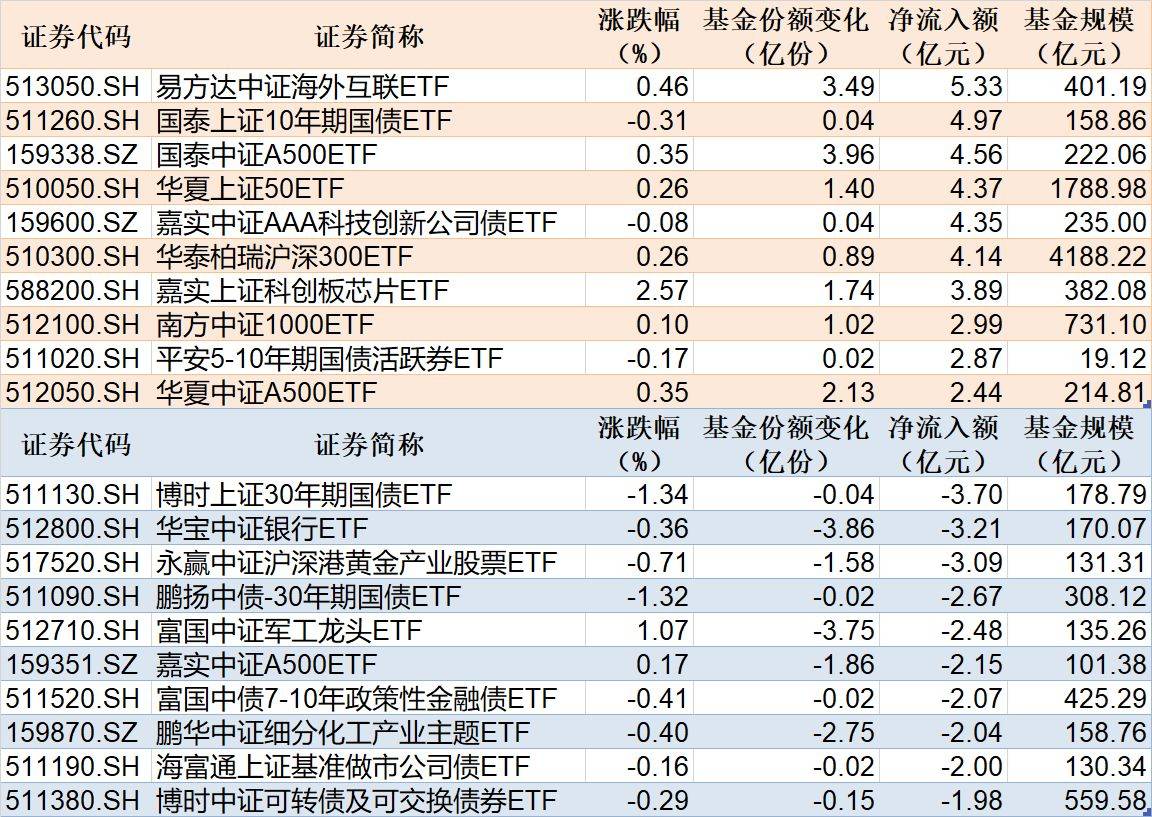
ETF规模速报 | 中概互联网ETF净流入超5亿元,30年国债ETF博时净流出超3亿元
Sou Hu Cai Jing· 2025-12-05 01:36
Market Overview - The market rebounded after hitting a low, with the ChiNext Index rising over 1% [1] - The robotics sector experienced a significant surge, while the commercial aerospace sector continued its strong performance [1] - The consumer sector showed volatility, particularly in Hainan, which saw a collective decline [1] ETF Market Activity - On December 4, the non-monetary ETF market saw notable inflows, with E Fund's CSI Overseas Internet ETF increasing by 349 million shares, resulting in a net inflow of 533 million yuan [1] - Other ETFs with significant inflows included Guotai's 10-Year Government Bond ETF, which saw a 4.97 million yuan net inflow, and Guotai's CSI A500 ETF, which had a net inflow of 456 million yuan [1][2] Fund Performance - The top-performing ETFs by net inflow for December 4 included: - E Fund's CSI Overseas Internet ETF with a 0.46% increase and a net inflow of 533 million yuan [2] - Guotai's CSI A500 ETF with a 0.35% increase and a net inflow of 456 million yuan [2] - Conversely, the worst performers included Bosera's 30-Year Government Bond ETF, which saw a 1.34% decrease and a net outflow of 370 million yuan [2] Monthly ETF Inflows - As of December 4, the top 20 ETFs by net inflow for the month included: - Harvest's CSI AAA Technology Innovation Bond ETF with a net inflow of 2.576 billion yuan [4] - Huaxia's CSI A500 ETF with a net inflow of 1.087 billion yuan [4] - E Fund's CSI Overseas Internet ETF with a net inflow of 822 million yuan [4] Overall ETF Market Statistics - As of December 4, the total ETF shares in the market reached 32,527.70 million, with a total scale of 57,034.88 million yuan [4] - The materials sector saw the largest increase in shares, with two funds tracking it, while the Shanghai Stock Exchange Sci-Tech Innovation Board Chip Index had the highest number of funds tracking it [4]
年末权益基金攻防分化,谁更适配跨年行情?
Di Yi Cai Jing· 2025-12-04 12:48
Core Viewpoint - The year-end market dynamics show a divergence in strategies among institutional investors, with some adopting a cautious approach while others see opportunities in market fluctuations [1][4]. Group 1: Year-End Market Dynamics - As of December 3, the average return of 4,686 active equity funds since November has been -2.67%, indicating a significant reduction in performance volatility compared to previous months [1]. - Notably, several high-performing funds with over 50% annual returns have shown a marked decrease in monthly volatility, suggesting that fund managers have likely made adjustments to their portfolios [2]. - A total of 223 active equity funds have suspended large-scale subscriptions, with 28 funds limiting daily subscriptions to no more than 10,000 yuan to protect existing investors [2][3]. Group 2: Fund Manager Strategies - Some fund managers have reduced stock positions and adjusted their holdings to mitigate risks, while others believe that current market fluctuations may present new buying opportunities [2][4]. - New funds launched in the fourth quarter are rapidly building positions, with nearly 90% of 69 newly established active equity products experiencing net value fluctuations, indicating active investment strategies [3]. Group 3: Market Expectations - Analysts expect that the A-share market will enter a period of upward momentum, with short-term fluctuations not altering the overall positive trend [4][5]. - The market is anticipated to benefit from improved economic conditions, favorable liquidity, and supportive policies, which are expected to strengthen A-shares [5]. Group 4: Sector Focus - The technology sector is highlighted as a key area for investment, with analysts suggesting that high-growth and potential reversal opportunities should be prioritized [5][6]. - Traditional consumer goods, particularly in the leisure food and white goods sectors, are also noted for their attractive dividend yields, making them worthy of attention in the context of year-end valuation adjustments [6].
“稳健型”基金名单来啦~(含发车解读)
Sou Hu Cai Jing· 2025-12-03 10:11
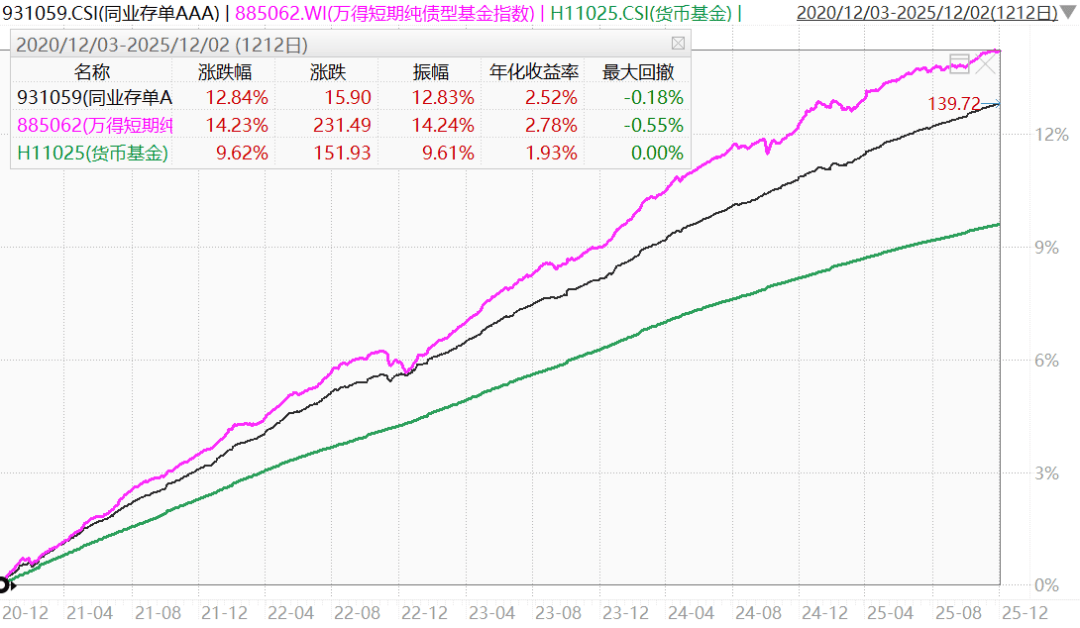
Group 1: Characteristics of Interbank Certificate of Deposit Index Funds - The average yield of interbank certificate of deposit index funds is between that of money market funds and short-term bond funds, with a maximum drawdown of 0.18% and an annualized yield of 2.52% [1][8] - The underlying assets are primarily large-denomination deposits from banks, with the largest fund, "Huatai-PineBridge Interbank Certificate of Deposit Index 7-Day Holding," having 92% of its assets in interbank certificates [3] - Some funds may deviate from the norm, such as "Yimi Interbank Certificate of Deposit Index 7-Day Holding," which invested 19% in government bonds, although this is within the contractual limit of 20% for other investments [5] Group 2: Fund Performance and Management - As of 2024, the interbank certificate of deposit index has increased by 4.01% with a maximum drawdown of 0.06%, and only a few funds have outperformed this index [8][9] - The funds that have outperformed the index include "Chuangjin Hexin" and "Huatai-PineBridge," with respective yields of 4.17% and 4.07% [9] - The management fees for these funds are 0.2% annually plus a 0.05% custody fee, meaning a total of approximately 0.5% over two years [8] Group 3: Bond Fund Characteristics - The criteria for selecting bond funds include being a medium to long-term pure bond fund, with a maximum drawdown not exceeding 2% since 2021, and a yield exceeding 18% [10] - The "Medium to Long-Term Pure Bond Fund Index" has risen by 16.15% since 2021, with a maximum drawdown of 1.08% [10] - Notable funds that meet the criteria include "Penghua Fenglu" and "Southern Jinli," with respective yields of 29.80% and 32.47% [11] Group 4: Market Trends and Economic Indicators - The Federal Reserve's expectation for a rate cut in December has risen to 89.2%, influencing the recent rebounds in U.S. stocks, gold, and silver [22] - The potential appointment of Hassett as the new Fed Chair is seen as a positive for market liquidity, contributing to the strength of U.S. stocks and gold [25] - Concerns about market bubbles are highlighted, with current valuations being compared to historical highs, indicating a need for caution [25]
从巴西到泰国……公募拓展全球朋友圈!国际化迈向第4阶段
券商中国· 2025-12-02 11:01
Core Viewpoint - The Chinese fund industry is actively expanding its global presence, entering a new phase of internationalization characterized by policy-driven growth, diverse products, and two-way capital flow [1][4][6]. Group 1: Internationalization Stages - The internationalization of public funds has progressed through three stages since 2006: the initial stage (2006-2014) focused on breaking into overseas markets with QDII funds and establishing overseas subsidiaries [5]. - The expansion stage (2015-2019) saw the launch of mutual recognition mechanisms between mainland and Hong Kong funds, allowing for two-way capital flow [6]. - The acceleration stage (2020-2024) has led to a more diverse product offering and the establishment of subsidiaries in various countries, moving beyond just Hong Kong [6][7]. Group 2: Recent Developments - In November, significant developments included the listing of the first Thai ETF linked to the ChiNext 50 Index and the launch of two Brazilian ETFs in China, enhancing cross-border investment opportunities [2][3]. - The signing of a cooperation memorandum between the China Securities Investment Fund Industry Association and the German Federal Association of Investment and Asset Management indicates growing international collaboration [2][3]. Group 3: Future Outlook - The future of public fund internationalization is expected to feature global network expansion, differentiated product strategies, and deeper interconnectivity [7]. - The cross-border ETF market is projected to grow significantly, with a notable increase in scale and penetration rates observed in recent years [7]. - Investment firms are encouraged to adopt a global perspective in asset allocation, emphasizing the importance of professional research support for cross-border ETF strategies [7].

基金界最激烈的一场战役还未打完
虎嗅APP· 2025-12-02 10:44
以下文章来源于妙投APP ,作者段明珠 妙投APP . 虎嗅旗下二级市场投研服务品牌,为您提供精选上市公司价值拆解,热门赛道产业链梳理 先搞清楚为何A500ETF成了兵家必争之地? 出品 | 妙投APP 作者 | 段明珠 编辑 | 关雪菁 头图 | AI生成 一年前,近70家公募的中证A500ETF首发大混战,堪称基金史上节奏最快、投入最大、同质化竞争最惨烈的一场指数发行战役。 如今,A500ETF的发展进入持久战阶段( 持营 ),已有近80家基金公司发行百余只产品,牵引的资金总规模近2300亿元;其中已有不少掉队者。 但A500ETF可能仍是市场上 唯一一个头部阵营尚未稳固的宽基赛道 。近期传闻"A500ETF可能会纳入期权标的,上交所和深交所各一只",如果消息为 真,最终入选的基金就有可能杀出重围,坐稳中证A500ETF的头部交椅。 一时间,这场战役将迎来新一轮升维战。 如果说过去中国ETF市场还是1.0时代,以产品创新驱动规模发展;A500ETF上市一年来掀起的"腥风血雨"意味着市场已经进入2.0时代, 比拼的核心 是资源与执行力 。 作为市场最佳切面,通过复盘近一年来各基金公司在A500ETF的种种举 ...