中国人民银行

Search documents
央行发布2025金融稳定报告 金融风险整体收敛、总体可控
Chang Jiang Shang Bao· 2025-12-28 23:15
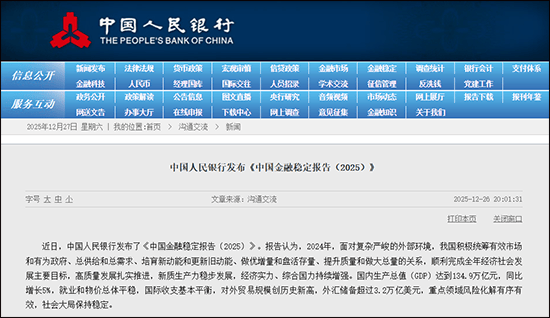
Core Viewpoint - The People's Bank of China released the "China Financial Stability Report (2025)", summarizing the economic and financial development in 2024 and outlining systematic deployments for the "14th Five-Year Plan" period [1] Economic Performance - In 2024, China's GDP reached 134.9 trillion yuan, growing by 5% year-on-year, with steady development of new productivity and enhanced economic strength [1] - Employment and prices remained stable, with international balance of payments roughly balanced and foreign trade reaching a historical high [1] - Foreign exchange reserves exceeded 3.2 trillion USD, indicating a robust financial system [1] Monetary Policy - The monetary policy was precisely targeted, with two reductions in the reserve requirement ratio totaling 1 percentage point and two cuts in policy interest rates totaling 0.3 percentage points [1] - These measures effectively guided the downward trend in deposit and loan rates, reducing financing burdens for market entities [1] - Support policies were enhanced in key areas such as technology, green finance, inclusive finance, elderly care, and digital finance [1] Real Estate Market - A series of measures were introduced to address issues in the real estate market, including lowering down payment ratios and canceling the national mortgage rate floor [2] - The establishment of a financial policy system for housing rental and the promotion of a new development model for the real estate industry were also highlighted [2] Financial Stability and Risk Management - The central and local governments collaborated to reform small financial institutions, significantly reducing the number of high-risk institutions [2] - The deposit insurance fund and financial stability guarantee fund were continuously strengthened, with legislative progress on financial stability laws [2] - In the first half of 2025, the central bank rated 3,529 banking institutions, showing overall stability and controllable financial risks [2] Banking Sector Performance - By the end of 2024, the total assets of the banking sector reached 444.57 trillion yuan, growing by 6.54% year-on-year, with a non-performing loan ratio of 1.50% [2] - The capital adequacy ratio remained at a reasonable level of 15.74%, with large commercial banks enhancing their loss absorption capacity through various measures [2] Financial Market Overview - The financial market operated smoothly, with a significant increase in the level of openness [3] - In 2024, various bonds worth 79.3 trillion yuan were issued, a year-on-year increase of 11.7% [3] - The stock market rebounded with the Shanghai Composite Index rising by 12.7% [3] - The foreign exchange market showed resilience, with the hedging ratio increasing to 26.8% [3] - The gold market was active, with prices rising by 28.2% year-on-year, reflecting a balance between risk aversion and market diversification [3] Future Outlook - The central bank aims to maintain a stable growth trajectory and implement proactive macro policies during the "14th Five-Year Plan" period [3] - Emphasis will be placed on promoting stable economic growth and reasonable price recovery as key considerations for monetary policy [3]
月供要降!存量公积金贷款利率,即将下调
凤凰网财经· 2025-12-28 12:36
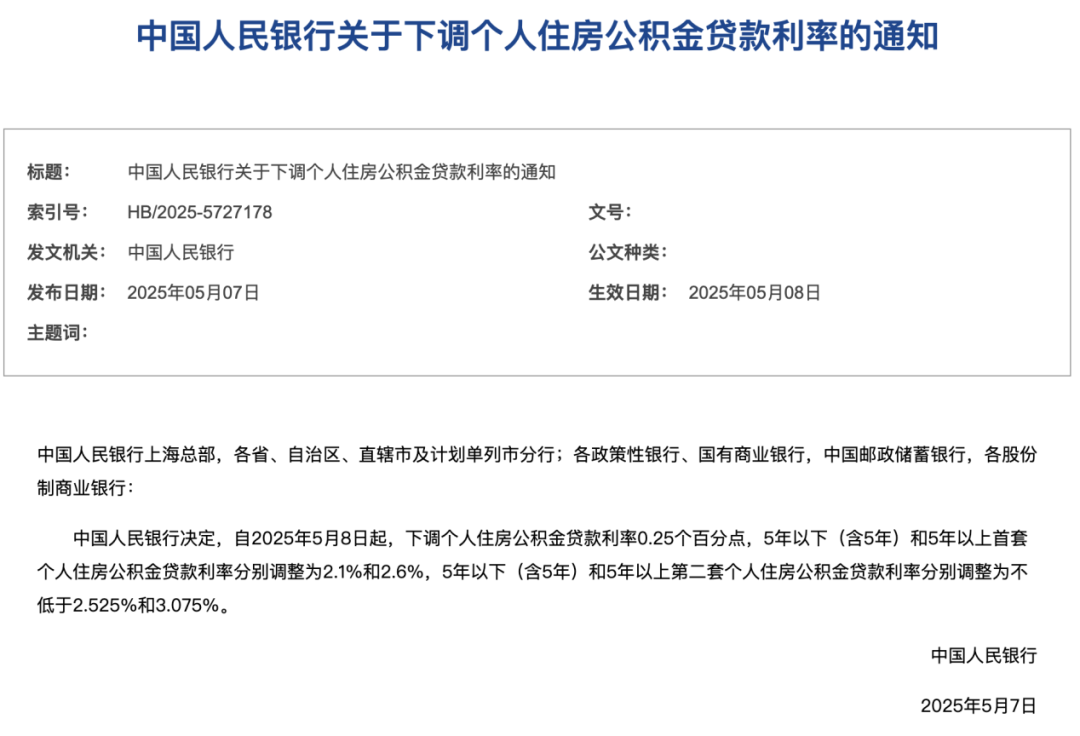
月供要降!存量住房公积金贷款利率将于2026年1月1日起下调。 根据2025年5月7日发布的《中国人民银行关于下调个人住房公积金贷款利率的通知》,自2025年5月8日起,下调个人住房公积金贷款利率0.25个 百分点 。 | 标题: | 中国人民银行关于下调个人住房公积金贷款利率的通知 | | | --- | --- | --- | | 索引号: | HB/2025-5727178 | 文号: | | 发文机关: 中国人民银行 | | 公文种类: | | 发布日期: 2025年05月07日 | | 生效日期: 2025年05月08日 | | 主题词: | | | 以普通家庭贷款1 0 0万元,贷款年限为30年,等额本息还款方式为例,利率调整后,首套房节省利息为 4.76万 元,二套房节省利息为 4.92万 元。 | 还款总额 | 144.12 万元 VS | | 还款总额 | 148.88 万元 | | --- | --- | --- | --- | --- | | 利息支付总额 | 44.12 万元 | | 利息支付总额 | 48.88 万元 | | 月均还款额 | 0.4 万元 | | 月均还款额 | 0. ...

月供要降!存量公积金贷款利率,即将下调!
Zhong Guo Ji Jin Bao· 2025-12-28 04:31
【导读】存量公积金贷款利率,明年1月1日起正式下调 月供要降!存量住房公积金贷款利率将于2026年1月1日起下调。 根据2025年5月7日发布的《中国人民银行关于下调个人住房公积金贷款利率的通知》,自2025年5月8日起,下调个人住房公积金贷款利率0.25个百分点。 | 标题: | 中国人民银行关于下调个人住房公积金贷款利率的通知 | | | --- | --- | --- | | 索引号: HB/2025-5727178 | | 文号: | | 发文机关: 中国人民银行 | | 公文种类: | | 发布日期: 2025年05月07日 | | 生效日期: 2025年05月08日 | | 主题词: | | | 对于2025年5月8日以前已经发放的个人住房公积金贷款,自2026年1月1日开始,执行调整后的个人住房公积金贷款利率。 5年以下(含5年)和5年以上首套个人住房公积金贷款利率分别调整为2.1%和2.6%;5年以下(含5年)和5年以上第二套个人住房公积金贷款利率分别调 整为不低于2.525%和3.075%。 | 贷款期限 | 调整前利率 | | | 调整后利率 | | --- | --- | --- | - ...
央行金融稳定报告:9个省区市辖内无“红区”银行
Sou Hu Cai Jing· 2025-12-27 07:32
Core Viewpoint - The People's Bank of China (PBOC) released the "China Financial Stability Report (2025)", projecting a GDP of 134.91 trillion yuan for 2024, with a growth rate of 5.0% amidst a challenging external environment [1][2]. Economic Outlook - The report indicates that employment and prices will remain stable, with international payments balanced and foreign exchange reserves stable at over 3.2 trillion USD [1]. - The focus on new productive forces and key areas such as green and technology sectors will see enhanced financial support, contributing to orderly risk resolution in these sectors [1]. Policy Directions - The report outlines a policy direction to promote long-term capital investment in the stock market, with various regulatory bodies collaborating to improve the investment environment for long-term funds [1][7]. - The aim is to significantly increase the scale and proportion of long-term capital investments in A-shares, fostering a virtuous cycle between capital market stability and high-quality economic development [7]. Risk Management - The financial system will continue to prevent and resolve risks in key areas, including managing the debt risks of financing platforms and addressing risks in small and medium-sized financial institutions [2][11]. - The PBOC's rating of 3,529 banks shows that the overall financial risk is controllable, with a significant reduction in the number of high-risk small banks [2][4]. Bank Ratings - Among the rated banks, 3,217 are classified as low to moderate risk (levels 1-7), accounting for 98% of total assets, with 1,831 banks in the green zone holding 421 trillion yuan in assets [4][5]. - The report highlights that national banks are stable and serve as a "ballast" for the financial system, while local banks show varied performance [5]. Future Financial Strategies - The PBOC plans to enhance the macro-prudential management framework and strengthen monitoring of systemic financial risks [11]. - The report emphasizes the importance of maintaining liquidity and supporting stable economic growth while managing inflation expectations [10].
央行发布重磅报告,背后信号很大
Xin Lang Cai Jing· 2025-12-27 06:13
Core Insights - The People's Bank of China (PBOC) released the "China Financial Stability Report (2025)", indicating that the financial system is generally stable, with financial risks under control and key operational indicators within reasonable ranges [1][16]. Group 1: Financial System Stability - The report emphasizes the need for increased counter-cyclical and cross-cyclical adjustments to continuously prevent and mitigate risks in key areas, aligning with the directives from the Central Economic Work Conference [2][17]. - It highlights the importance of maintaining liquidity and promoting stable economic growth and reasonable price recovery as key considerations for monetary policy [2][17]. Group 2: Support for Technology and Innovation - The PBOC aims to enhance financial support for technology-driven enterprises, recognizing their diverse financing needs at different lifecycle stages [4][20]. - There will be a focus on increasing credit support for small and medium-sized technology enterprises and improving the structure of credit assets to align with national technology goals [4][20]. Group 3: Financing Platform Risk Mitigation - The report notes significant progress in mitigating debt risks for financing platforms, with about 40% of platforms exiting the financing platform category through market-oriented transformations [6][22]. - By the end of 2024, the scale of operating financial debt for financing platforms is expected to decrease by approximately 25% compared to early 2023, with a notable reduction in financing costs [6][22]. Group 4: Interest Rate Marketization - The PBOC is committed to deepening interest rate marketization reforms, aiming to enhance the self-discipline mechanism for interest rate pricing to better serve the real economy [7][23]. - The report indicates that while the goal of loosening administrative controls on interest rates has been largely achieved, further efforts are needed to ensure effective pricing and adjustment mechanisms [7][23]. Group 5: Market Value Management for Listed Companies - The China Securities Regulatory Commission (CSRC) has established a market value management system to guide listed companies in enhancing their quality and investment value [10][25]. - Future initiatives will include regular visits to listed companies to address challenges, improve regulatory oversight, and promote quality enhancements while preventing market manipulation [10][25][26]. Group 6: Long-term Capital Investment - The report stresses the importance of increasing the scale and proportion of long-term capital investments in A-shares, which is crucial for the stable development of the capital market [13][28]. - Various regulatory bodies will collaborate to create a favorable policy environment for long-term investments, aiming to achieve a virtuous cycle between capital market stability and high-quality economic development [13][28]. Group 7: Macro-prudential and Financial Stability Functions - The PBOC is exploring ways to expand its macro-prudential and financial stability functions to maintain stable financial market operations [15][30]. - The report outlines the need for continuous optimization of existing tools and the innovation of financial instruments to enhance the stability of financial markets [15][30].
央行报告:推动利率“形得成”“调得了”
Sou Hu Cai Jing· 2025-12-27 03:51
Core Insights - The People's Bank of China (PBOC) aims to deepen interest rate marketization reforms to enhance the self-discipline mechanism of interest rates, promoting both the formation and adjustment of rates [1] - The overall operation of China's financial industry is stable, with financial risks being generally controllable and key operational indicators within reasonable ranges [1][2] Financial Institution Ratings - In the first half of 2025, the PBOC conducted ratings for 3,529 banking institutions, including 21 national banks and 3,508 local banks, indicating a robust overall performance of these institutions [1] - Ratings are categorized into 11 levels, with levels 1 to 7 (green and yellow zones) representing safe institutions, while levels 8 to D (red zone) indicate higher risk [1][2] - A total of 3,217 banks received ratings from 1 to 7, accounting for 98% of the total assets of the rated banks, while 312 banks fell into the red zone with a total asset scale of 9.4 trillion yuan, representing 2.1% [2] Market and Risk Management - The report emphasizes the importance of market forces in exchange rate formation, advocating for exchange rate flexibility and the prevention of excessive fluctuations [2] - The PBOC plans to enhance macro-prudential management systems to monitor and assess systemic financial risks, focusing on key areas to mitigate risks effectively [2] - The report highlights the commitment to support major national strategies and economic development through the promotion of various financial sectors, including technology finance, green finance, inclusive finance, pension finance, and digital finance [2]
央行:加大逆周期和跨周期调节力度 持续防范化解重点领域风险
Sou Hu Cai Jing· 2025-12-27 03:51
Core Insights - The People's Bank of China released the "China Financial Stability Report (2025)", highlighting the complex changes in the development environment during the 14th Five-Year Plan period, with both strategic opportunities and risks present [1] - The report emphasizes the resilience and potential of China's economy, supported by the advantages of the socialist system, large market size, complete industrial system, and abundant human resources [1] Group 1: Economic Policy and Financial Stability - The monetary policy will focus on promoting stable economic growth and reasonable price recovery, maintaining ample liquidity, and keeping social financing costs low [2] - The report stresses the importance of market determination in exchange rate formation, maintaining exchange rate flexibility, and preventing excessive fluctuations while ensuring the RMB remains stable at a reasonable level [2] - It outlines the development of five key financial areas: technology finance, green finance, inclusive finance, pension finance, and digital finance, to support major national strategies and address key areas of economic development [2] Group 2: Risk Management and Financial Oversight - A comprehensive macro-prudential management system will be established to enhance monitoring and assessment of systemic financial risks, with a focus on key areas [2] - The report emphasizes the need to prevent and resolve financial risks in critical sectors, including supporting the resolution of financing platform debt risks and managing risks in small financial institutions [2] - It highlights the importance of maintaining macro-prudential management in the real estate finance sector to avoid systemic financial risks [2]
央行发布重磅报告 明确金融稳定八个“下一步”工作部署
2 1 Shi Ji Jing Ji Bao Dao· 2025-12-27 03:34
Core Viewpoint - The People's Bank of China (PBOC) released the "China Financial Stability Report (2025)", indicating that the financial system is generally stable, with overall financial risks under control and operating indicators within reasonable ranges [1][2]. Financial System - The report emphasizes the need for increased counter-cyclical and cross-cyclical adjustments to continuously prevent and mitigate risks in key areas, aligning with the directives from the Central Economic Work Conference and the Central Financial Work Conference [4]. - It highlights the importance of maintaining liquidity and promoting low financing costs while ensuring the stability of the RMB exchange rate [4]. Central Bank Initiatives - The PBOC aims to guide financial capital towards early, small, long-term, and hard technology investments, enhancing support for technology-driven enterprises [5][6]. - The report outlines plans to strengthen credit support for small and medium-sized technology enterprises and improve the structure of credit assets to align with the construction of a technology-driven economy [6]. Financing Platform Risk Mitigation - Significant progress has been made in mitigating debt risks for financing platforms, with around 40% of these platforms exiting the financing platform sequence by the end of 2024 [7]. - The report states that the scale of operating financial debt for financing platforms is projected to be approximately 14.8 trillion yuan, a decrease of about 25% from early 2023 [7]. Interest Rate Marketization - The PBOC is committed to deepening interest rate marketization reforms, aiming to enhance the self-discipline mechanism of interest rates and ensure effective pricing and adjustment capabilities [8][9]. Market Value Management - The China Securities Regulatory Commission (CSRC) has developed a market value management system to guide listed companies in enhancing their quality and investment value [10][11]. - The report outlines four key areas for future work, including regular visits to listed companies to address challenges and promoting quality improvements through stricter regulations [10][11]. Long-term Capital Investment - The report stresses the importance of increasing the scale and proportion of various long-term funds invested in A-shares, which is crucial for the stable development of the capital market and the real economy [13]. - Collaborative efforts among various departments will focus on creating a favorable policy environment for long-term investments [13]. Macro-prudential and Financial Stability - The PBOC plans to explore and expand its macro-prudential and financial stability functions to maintain stable financial market operations [14].
央行:显著提高中长期资金投资A股的规模和比例!
Zheng Quan Shi Bao Wang· 2025-12-26 23:39
12月26日,中国人民银行发布《中国金融稳定报告(2025)》(下称《报告》),对中国金融体系的稳 健性状况进行全面评估。 《报告》指出,当前,我国金融业运行总体稳健,金融风险整体收敛、总体可控,金融机构经营指标和 监管指标处于合理区间。 2025年上半年,央行对3529家银行机构开展央行金融机构评级,结果显示,我国银行机构整体经营稳 健,金融风险整体收敛、总体可控。 《报告》还在多篇专栏中回顾金融系统推动上市公司投资价值持续提升,推动中长期资金入市有关情 况。在推动中长期资金入市专栏中,《报告》指出,下一步,中国证监会等相关部门将着力健全有利 于"长钱长投"的制度政策环境。 展望未来,《报告》提出,金融系统将防范化解重点领域金融风险,坚定推进金融支持融资平台债务风 险化解工作,积极稳妥处置中小金融机构风险,做好房地产金融宏观审慎管理,牢牢守住不发生系统性 金融风险的底线。 健全有利于"长钱长投"的制度政策环境 本次《报告》多篇专栏回顾了金融系统推动上市公司投资价值持续提升,推动中长期资金入市有关情 况。 我国银行机构金融风险整体收敛、总体可控 2025年上半年,央行对3529家银行机构开展央行金融机构评级( ...
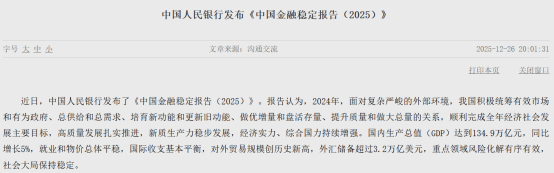
央行发布2025年金融稳定报告!
券商中国· 2025-12-26 23:28
Core Viewpoint - The People's Bank of China released the "China Financial Stability Report (2025)", indicating that the financial system is generally stable, with financial risks under control and operating indicators within a reasonable range [1][2]. Group 1: Financial Institution Ratings - In the first half of 2025, the central bank rated 3,529 banking institutions, showing that the overall operation of banks is stable and financial risks are manageable [2][3]. - The rating system categorizes institutions into 11 levels, with levels 1-7 considered safe ("green zone") and levels 8-D indicating higher risk ("red zone"). A total of 3,217 banks fall within the safe range, accounting for 98% of total assets [3]. - Specifically, 1,831 banks are in the "green zone" with an asset scale of 421 trillion yuan (94.6% of total), while 312 banks are in the "red zone" with assets of 9.4 trillion yuan (2.1% of total) [3]. Group 2: Institutional Type Analysis - National banks have better ratings, with 71% of their assets in the safe range, serving as a stabilizing force for the financial system. In contrast, local small and medium banks show some risk [4]. - Among national banks, 21 banks have 93% in the "green zone", while city commercial banks have 68% in the same zone. Rural financial institutions have less than 1% of their assets in the "red zone" [4]. Group 3: Long-term Investment Environment - The report emphasizes the need to create a favorable policy environment for long-term investments, with the China Securities Regulatory Commission (CSRC) promoting the enhancement of listed companies' investment value [5][6]. - The CSRC plans to conduct regular visits to listed companies to address challenges in market value management and operational development, aiming to improve company quality and prevent market risks [6]. Group 4: Risk Prevention and Management - The report outlines future strategies for preventing and resolving key financial risks, including maintaining exchange rate stability and enhancing macro-prudential management [7]. - Specific measures include supporting major national strategies and sectors, improving the macro-prudential management system, and ensuring that systemic financial risks do not occur [7].