
法国巴黎银行

Search documents
国债等利息收入恢复征收增值税 中、外资机构如何调整投资策略?
Sou Hu Cai Jing· 2025-08-06 16:59
Core Viewpoint - The announcement of the restoration of value-added tax (VAT) on interest income from newly issued government bonds, local government bonds, and financial bonds starting from August 8, 2025, has caused significant market reactions, leading to a surge in demand for existing bonds that remain exempt from this tax [1][2]. Group 1: Market Reactions - The new tax policy is expected to create a "buy old bonds" trend, as investors prefer existing bonds that are exempt from the new tax [2][5]. - Following the announcement, the yield on 10-year government bonds initially rose but then fell, indicating a preference for holding existing tax-exempt bonds [2][5]. - The yield on 10-year and 30-year government bonds decreased by 1 basis point, with current yields reported at 1.6975% and 1.919% respectively [2][5]. Group 2: Impact on Investment Strategies - The new tax policy is anticipated to enhance the predictability of the bond market, potentially leading to a shift in investment towards credit bonds and public funds that are not affected by the new tax [2][3][4]. - Institutions believe that the new regulations may lead to a widening yield spread between new and old bonds, with estimates suggesting a 5 to 10 basis point difference [2][3]. - Public funds are expected to benefit from the tax advantages compared to self-managed accounts, as they remain exempt from both income tax and VAT [3][4]. Group 3: Long-term Implications - The restoration of VAT is seen as a move to guide funds from the interest rate market to the stock and credit markets, aligning with broader economic goals [5][6]. - The policy aims to reduce the distortions in the yield curve and interest rate risks that have accumulated due to the previous tax exemptions [6][7]. - The estimated tax revenue from the restoration of VAT is projected to be approximately 4 billion RMB in 2025 and 25 billion RMB in 2026, although this is considered limited compared to the overall tax revenue [6][7].
挺得住!欧洲银行业最新压力测试结果出炉
Zheng Quan Shi Bao Wang· 2025-08-06 16:11
Core Insights - The European Banking Authority (EBA) released the 2025 stress test results, indicating that the EU banking sector demonstrates strong resilience and capital strength even under extreme economic recession scenarios [1][2] Group 1: Stress Test Overview - The stress test involved 64 banks from 17 EU and European Economic Area (EEA) countries, covering nearly 75% of the EU banking sector's assets [1] - The simulated adverse scenario included heightened geopolitical tensions, increased trade fragmentation, and persistent supply shocks, leading to a significant economic downturn [2] Group 2: Economic Impact - Under the adverse scenario, the EU's GDP is projected to decline by 6.3% from 2024 to the end of the stress test period in 2027, with unemployment rising by 5.8 percentage points [2] - Despite an estimated total loss of €547 billion for the EU banking sector, banks are expected to maintain a "strong" capital position, reflecting resilience built over recent years [2][3] Group 3: Capital Adequacy - The core Tier 1 capital ratio for the participating banks is expected to remain above 12% by the end of 2027, although it will decrease by 370 basis points from the baseline [3] - The results indicate that the overall capital depletion is less severe compared to the 2023 stress test results, showcasing improved resilience [3] Group 4: Market Performance - The EU banking sector has shown strong revenue-generating capabilities during the test period, which helps absorb losses from deteriorating investment portfolios [3] - Major banks like Deutsche Bank, BNP Paribas, Commerzbank, and Société Générale have experienced double-digit stock price increases since the beginning of the year, benefiting from rising interest rates and economic recovery [3] Group 5: Future Considerations - The EBA emphasized the need for banks to enhance their statistical capabilities to better manage potential vulnerabilities in their investment portfolios [5] - Maintaining adequate capital is crucial for ensuring that EU banks can continue to support the economy during adverse conditions and avoid becoming a source of risk during crises [5]
挺得住!欧洲银行业最新压力测试结果出炉
券商中国· 2025-08-06 16:07
Core Viewpoint - The European Banking Authority (EBA) released the 2025 stress test results, indicating that the EU banking sector demonstrates strong resilience and capital strength even under extreme economic recession scenarios [1][2]. Group 1: Stress Test Overview - The stress test covered 64 banks from 17 EU and European Economic Area (EEA) countries, representing nearly 75% of the EU banking sector's assets [2]. - The simulated scenario included heightened geopolitical tensions, increased trade fragmentation, and persistent supply shocks, leading to a significant deterioration in the global macro-financial environment [3]. Group 2: Economic Impact - Under the adverse scenario, the EU's real GDP is projected to decline by 6.3% from the starting point in 2024 to the end of the stress test period in 2027, with the unemployment rate expected to rise by 5.8 percentage points [4]. - The EBA reported that despite an overall loss of €547 billion for the EU banking sector, banks maintained a "strong" capital position, reflecting the resilience built over recent years [4]. Group 3: Profitability and Capital Adequacy - The EU banks exhibited strong profitability during the testing period, which helped absorb some of the losses from deteriorating investment portfolios [5]. - By the end of 2027, the core Tier 1 capital ratio for the participating banks is expected to remain above 12%, although it will decrease by 370 basis points from the baseline level [5]. Group 4: Lending Capacity - Even in a more adverse economic and financial environment, EU banks are capable of continuing to provide loans to households and businesses during crises triggered by geopolitical tensions [6]. - The European banking sector showed strong performance in the first half of 2025, benefiting from rising interest rates, economic recovery, and strategic adjustments by banks [6]. Group 5: Future Improvements - The EBA emphasized the need for banks to enhance their statistical capabilities to better manage potential vulnerabilities in their investment portfolios [7]. - The report highlighted that while the EU banking sector's performance in the 2025 stress test is reassuring, maintaining adequate capital remains crucial to support the economy during adverse conditions and to avoid becoming a source of risk during crises [7].


BPCE SFH: Notice to Noteholders Restructuration series 196
Globenewswire· 2025-08-06 14:19
Group 1 - The Issuer, BPCE SFH, has issued €1,000,000,000 of 3.199% Fixed Rate Notes due on 28 October 2034, which can be extended as Floating Rate Notes from October 2034 to October 2035 [1][6][7] - The Notes are part of a €65,000,000,000 Euro Medium Term Note Programme for the issuance of obligations de financement de l'habitat and other privileged notes [1][6] - The maturity provisions of the Notes will be amended effective from 1 September 2025, as agreed by the unanimous consent of the Noteholders [2][7] Group 2 - The Notes are not intended for retail investors in the European Economic Area (EEA) and no key information document has been prepared for such investors [4] - The Notes have been rated AAA by S&P Global Ratings, indicating a strong capacity to meet financial commitments [23][24] - The estimated net proceeds from the issuance of the Notes are €1,000,000,000 [26]

BPCE SFH: Notice to Noteholders Restructuration series 195
Globenewswire· 2025-08-06 14:14
Group 1 - The issuer, BPCE SFH, has launched a €1,000,000,000 issuance of 3.115% Fixed Rate Notes due on 28 October 2033, which can be extended as Floating Rate Notes until October 2034 [7][24]. - The Notes are part of a larger €65,000,000,000 Euro Medium Term Note Programme aimed at financing housing obligations and other privileged notes [1][7]. - The issuance received approval from the French Autorité des marchés financiers (AMF) under the Base Prospectus dated 7 May 2024 [2][11]. Group 2 - The maturity provisions of the Notes will be amended effective from 1 September 2025, as agreed by the unanimous consent of the Noteholders [3][8]. - The Notes are not intended for retail investors in the European Economic Area (EEA), and no key information document has been prepared for such investors [5][9]. - The Notes have been rated AAA by S&P Global Ratings, indicating a strong capacity of the issuer to meet its financial commitments [24]. Group 3 - The estimated net proceeds from the issuance are €1,000,000,000, which will be used as outlined in the Base Prospectus [26]. - The interest rate for the Notes is set at 3.115% per annum, payable annually in arrears [15][27]. - The Notes will be listed and admitted to trading on Euronext Paris, with an application for trading made by the issuer [24].
国债等利息收入恢复征收增值税 中外资机构如何调整投资策略?
Di Yi Cai Jing· 2025-08-06 13:14
Core Viewpoint - The new tax regulation on interest income from newly issued government bonds, local government bonds, and financial bonds starting from August 8, 2025, has triggered a surge in demand for existing bonds, leading to a strong performance in both the stock and bond markets [1][5][6]. Summary by Sections Tax Regulation Impact - The Ministry of Finance and the State Administration of Taxation announced that interest income from newly issued bonds will be subject to value-added tax (VAT) starting August 8, 2025, while existing bonds will remain exempt until maturity [1][6]. - This change has led to a "buying spree" for existing bonds, as institutions seek to avoid the new tax burden [2][5]. Market Reactions - Following the announcement, the yield on 10-year government bonds initially rose but then fell back, indicating a preference for existing tax-exempt bonds [2][5]. - The yields for 10-year and 30-year government bonds were reported at 1.6975% and 1.919%, respectively, down from recent highs [2][5]. Investment Shifts - Institutions expect that the new regulation will favor credit bonds and certificates of deposit, as they remain unaffected by the new tax [3][4]. - Public funds are anticipated to benefit from the tax advantages over proprietary accounts, as public funds are exempt from both income tax and VAT [3][4]. Long-term Market Outlook - Many institutions believe that the new regulation will not alter the long-term trajectory of the bond market, which is expected to remain stable despite short-term fluctuations [5][6]. - The policy aims to redirect some funds from the bond market to the stock market and credit bond market, aligning with broader economic goals [5][6]. Fiscal Implications - The restoration of VAT on bond interest is projected to increase fiscal revenue, with estimates suggesting an additional 4 billion RMB in tax revenue this year and 25 billion RMB by 2026 [6][7]. - However, some foreign institutions argue that the overall contribution to tax revenue will be minimal compared to the total tax revenue scale [7].
摩根大通:财年净利润增超一倍至3.09亿美元
Sou Hu Cai Jing· 2025-08-06 06:48
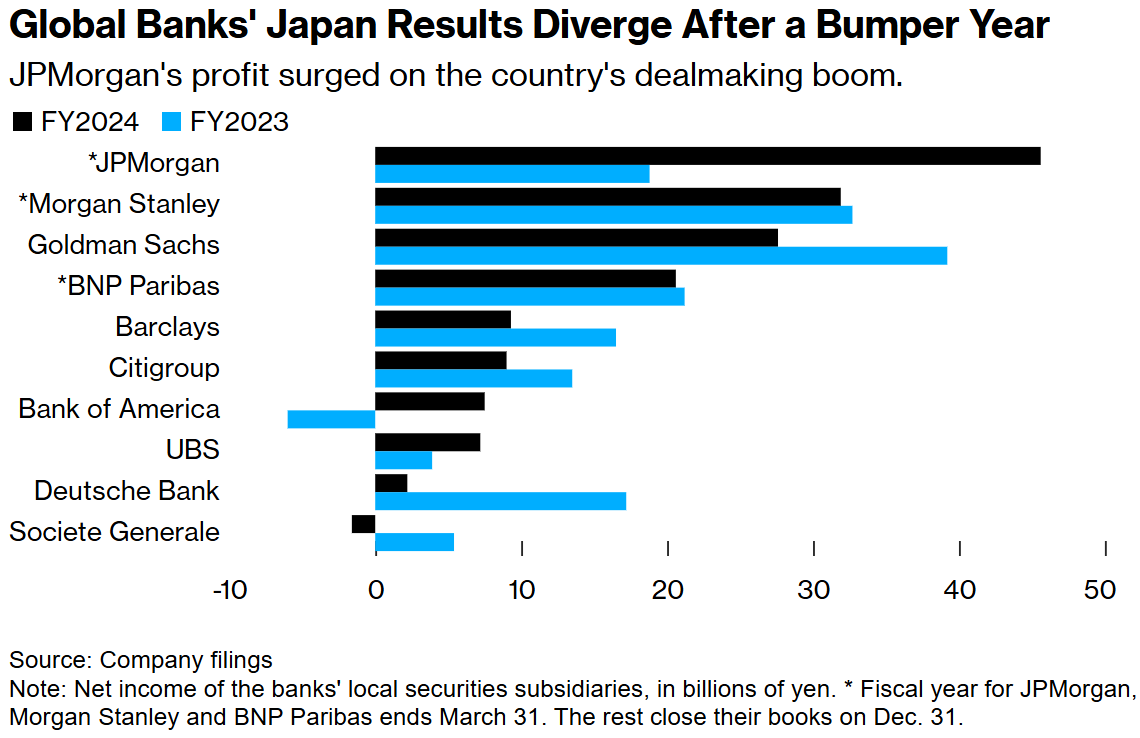
Core Insights - JPMorgan Chase outperformed global competitors in the Japanese market last year, achieving a net profit of 45.6 billion yen (approximately 3.09 billion USD), marking a seven-year high due to a surge in trading activity driven by governance reforms [1] - The increase in net profit was over 100% compared to the previous year, reversing a decline, attributed to a boom in merger advisory and underwriting services [1] - The competitive landscape in Japan has intensified as companies accelerate acquisitions and divest non-core assets, creating more opportunities for investment banks [1] Financial Performance - JPMorgan's local securities subsidiary reported a net profit of 45.6 billion yen, while Morgan Stanley's local subsidiary achieved record revenues of 153.2 billion yen but saw a 2.3% decline in net profit to 31.9 billion yen due to provisions for liabilities [1] - BNP Paribas's brokerage division experienced a 2.9% decrease in profit to 20.6 billion yen due to a drop in commissions [1] - In contrast to these results, most other major banks reported a decline in net profits, highlighting JPMorgan's strong performance amid a challenging market environment [1] Market Dynamics - The Japanese market saw significant trading activity as the Bank of Japan's interest rate hikes led to increased volatility in the bond market and a rebound in the stock market [1] - The president of Mitsubishi UFJ Morgan Stanley Securities noted that the normalization of the Bank of Japan's monetary policy and rising volatility in government bonds contributed to the uptick in trading activities [1]

日企并购潮捧出最大赢家!摩根大通(JPM.US)在日利润创7年新高
智通财经网· 2025-08-06 03:09
Core Insights - JPMorgan Chase outperformed global competitors in the Japanese market last year, driven by a surge in trading activity due to corporate governance reforms [1] - The bank's net profit from its local securities subsidiary more than doubled to 45.6 billion yen (approximately $309 million), marking a seven-year high and reversing the previous year's decline, primarily due to a spike in merger advisory and underwriting services [1] - The trend of Japanese companies accelerating acquisitions and divesting non-core assets has created more opportunities for investment banks, intensifying competition for talent among international firms [1] Financial Performance - JPMorgan's net profit increased by 142% to 45.6 billion yen, with net revenue rising by 42% to 141 billion yen, and headcount growing by 12 to 763 [6] - Morgan Stanley reported a net profit decrease of 2.3% to 31.9 billion yen, despite record revenue of 153.2 billion yen, attributed to increased provisions for liabilities due to higher trading volumes [5][6] - Other major banks, such as Goldman Sachs and Citigroup, experienced significant declines in net profit, with Goldman Sachs down 30% to 27.6 billion yen and Citigroup down 33% to 9 billion yen [6] Market Dynamics - The Japanese market has seen heightened trading activity following the Bank of Japan's interest rate hikes, leading to significant volatility in both the stock and bond markets [5][7] - The stock market experienced its largest drop since the 1987 crash, although it has since rebounded, contributing to increased trading volumes [5][7]
浅谈国内外中小银行化解风险的历史经验与现实思考
Zhong Guo Jing Ji Wang· 2025-08-05 08:34
Core Viewpoint - The article emphasizes the importance of learning from historical experiences of high-risk small and medium-sized banks both domestically and internationally, particularly in the context of China's ongoing efforts to mitigate financial risks since 2018 [1] Group 1: International Lessons from High-Risk Small and Medium-Sized Banks - The historical lessons from international banking crises highlight that market-driven risk resolution is essential, but the approach differs for banks compared to general enterprises [2][3] - The U.S. experienced three major waves of bank failures, with the first occurring during the Great Depression, leading to the closure of approximately 9,500 banks due to stock market investments [2] - The second wave from 1980 to 1994 was driven by the savings and loan crisis, where regulatory relaxations led to significant failures, with 35%-40% of banks involved in financial crimes [4][6] - The third wave from 2008 to 2013 was marked by the subprime mortgage crisis, resulting in the collapse of major banks and necessitating extensive government intervention [7][8] Group 2: Key Insights from Historical Experiences - Government intervention is crucial in managing bank failures to prevent widespread financial contagion and economic costs [3][6] - The need for a differentiated approach in risk management between small and medium-sized banks and large financial institutions is highlighted, as the latter poses systemic risks [9] - The recent collapse of Silicon Valley Bank illustrates the rapid spread of risk due to asset-liability mismatches and the impact of social media on depositor behavior [10][11] Group 3: China's Historical Experience and Current Strategies - China's approach to managing risks in small and medium-sized banks has evolved through three stages, focusing on governance and regulatory frameworks [14][15] - The current phase emphasizes the need for precise risk identification and timely intervention to prevent systemic risks, especially in light of economic uncertainties [19][20] - The importance of maintaining a balance between market-driven solutions and regulatory oversight is underscored, particularly in preventing moral hazards and ensuring accountability [21][22]
南京银行第四大股东增持至9% 地方国资近两年已三次加仓
Chang Jiang Shang Bao· 2025-08-05 08:23
长江商报奔腾新闻记者 徐佳 南京银行(601009.SH)再次获得重要股东增持。 8月4日晚间,南京银行披露股东权益变动。基于对该行未来发展的信心和价值成长的认可,该行持股 5%以上股东南京高科股份有限公司(以下简称"南京高科",600064.SH)于2025年7月24日至2025年8月 4日期间,以自有资金增持该行股份750.77万股,占该行总股本的0.06%。 2024年10月至2025年4月期间,南京紫金投资集团有限责任公司(以下简称"紫金集团")的控股子公司 紫金信托曾增持南京银行7713.05万股,占该行总股本的0.7%。 与此同时,东部机场集团投资有限公司于2024年10月10日至2025年4月10日期间,合计增持该行1.73亿 股,占该行总股本的1.56%。 资料显示,紫金集团为南京市属金融投资集团。东部机场集团投资有限公司则是东部机场集团全资子公 司,后者为江苏省属企业。 上述增持完成之后,截至2025年4月10日,紫金集团及其控股子公司紫金信托合计持有南京银行股份比 例为13.73%,东部机场集团投资有限公司持有南京银行股份比例为2.60%。 重要股东持续增持,体现地方国资对南京银行的发展信 ...

