
中国太平

Search documents
大行评级|交银国际:上调中国太平目标价至20港元 维持“买入”评级
Ge Long Hui· 2025-09-05 06:17
Group 1 - The core viewpoint of the report indicates that China Taiping's net profit increased by 12.2% year-on-year, while pre-tax profit decreased by 38% [1] - The performance of the insurance service sector grew by 9.5% year-on-year, but investment performance declined [1] - The contribution from new business value growth channels was relatively balanced, with significant results from the transition to participating insurance [1] Group 2 - The combined ratio (COR) of property and casualty insurance improved, aligning with industry trends [1] - The firm maintains a "Buy" rating for China Taiping and keeps its profit forecast largely unchanged [1] - Due to the positive outlook in the stock market, the target price has been raised from HKD 15 to HKD 20 based on a price-to-book ratio of 0.8 [1]

上市险企中报观察:AI赋能保险业降本增效
Zhong Guo Jing Ji Wang· 2025-09-05 03:26
Core Insights - The application of AI in the domestic insurance industry is entering a new phase of large-scale implementation, with major companies focusing on cost reduction and efficiency enhancement across the entire business chain [1][2][3] AI Integration in Business Processes - AI technology is transforming core insurance processes from manual to intelligent-driven, significantly improving service efficiency and customer experience [2] - In underwriting and customer service, AI has enhanced operational efficiency, with automated underwriting rates reaching 95.8% and customer service response accuracy exceeding 95% [3][4] Cost Control and Risk Reduction - AI applications in customer service and auditing have substantially reduced labor costs, with companies like ZhongAn Insurance utilizing over 100 active AI robots, achieving 4.5 billion calls in the first half of the year [4][5] - Enhanced AI risk control capabilities have led to significant reductions in fraud losses, with Ping An Insurance intercepting fraud claims worth 6.44 billion yuan, a year-on-year increase of 6% [5] Future Development and Strategic Direction - Several listed insurance companies have identified AI as a long-term strategic direction, with China Pacific Insurance focusing on building an enterprise-level AI capability system [7][8] - The integration of AI is expected to drive innovation in personalized products, health management services, and investment capabilities, with Ping An's investment return rate rising to 3.1% [7][8]





中国太平为何踏空“牛市”?
阿尔法工场研究院· 2025-09-05 00:07
Core Viewpoint - The article highlights that China Taiping (0966.HK) has underperformed in the equity market during a bullish phase, leading to a significant drop in its stock price after the release of its mid-year financial report, which revealed disappointing investment returns [4][9]. Investment Performance - In the first half of 2025, China Taiping's annualized total investment return was only 2.68%, a decrease of 2.59 percentage points year-on-year, placing it in a historically low range [5][6]. - The net investment return rate was approximately 3.11%, ranking at the bottom among listed insurance companies [5][6]. - In contrast, China Ping An (601318.SH) reported an annualized comprehensive investment return rate close to 6.2%, nearly double that of Taiping, while Xinhua Insurance (601336.SH) achieved 5.9% [7]. Asset Management and Strategy - China Taiping's total investment income for the first half of 2025 was 21.75 billion, down 41.6% from the previous year [6]. - The company emphasized a "high dividend + high growth" strategy but failed to capitalize on high-dividend opportunities in the banking sector, which was a significant source of returns for its peers [9][12]. - The asset management scale showed a decline, with third-party entrusted management assets decreasing by 5.3% due to a focus on improving quality and reducing low-fee management businesses [9][10]. Market Position and Decision-Making - As of June 30, 2025, equity assets accounted for only 12.6% of Taiping's portfolio, a slight decrease from 13.0% at the end of the previous year, indicating a conservative approach compared to competitors [10][12]. - The article suggests that Taiping's management made erroneous decisions during market volatility, leading to missed opportunities for gains [10][12]. Management Changes and Challenges - Frequent changes in the management team since late last year have posed challenges in decision-making and execution, impacting the company's investment strategy [15][18]. - The total compensation for Taiping Asset Management has seen a significant decline over the past three years, which may affect talent retention and overall team stability [16][18]. Conclusion - The combination of poor investment performance, management instability, and a conservative approach to market opportunities has raised concerns about China Taiping's ability to compete effectively in the insurance sector [14][18].

押宝分红险:预定利率降了 销量反而要爆?
Mei Ri Jing Ji Xin Wen· 2025-09-04 12:24
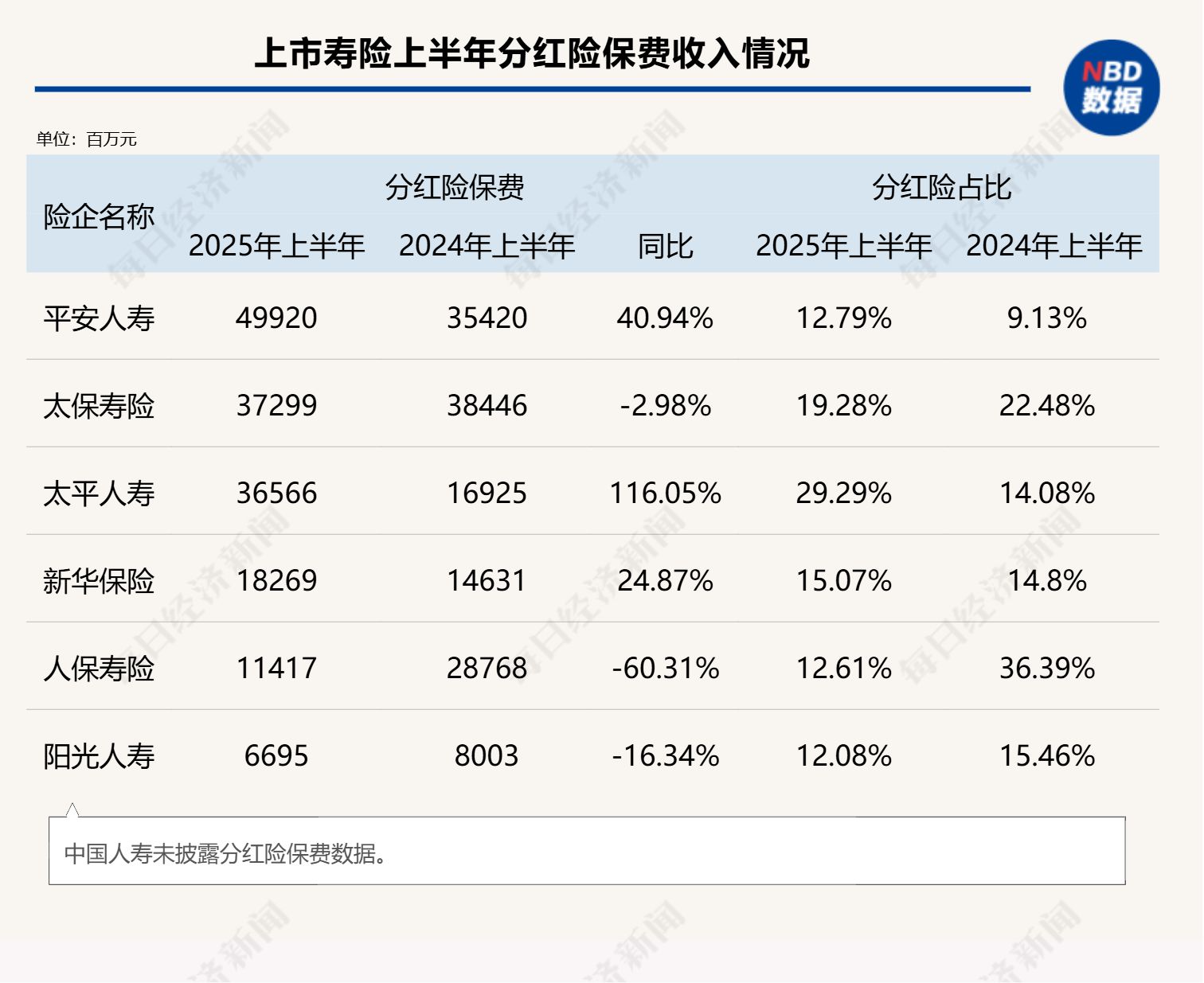
Core Viewpoint - The insurance industry is shifting towards dividend insurance sales in response to the reduction in the predetermined interest rate, with major listed insurance companies reporting significant growth in this segment despite challenges posed by the new interest rate environment [1][9]. Dividend Insurance Sales Performance - In the first half of 2025, major insurance companies have set ambitious targets for dividend insurance sales, with many aiming for a 50% sales ratio [1]. - Taiping Life reported that dividend insurance accounted for 87.1% of first-year premium income in long-term insurance, while China Pacific Life's new premium income from dividend insurance rose to 42.5%, with agent channels contributing 51% [5][2]. - China Life, Ping An, and other leading insurers have also seen substantial increases in dividend insurance premiums, with Ping An leading at approximately 500 billion yuan, a 40.94% increase year-on-year [4][5]. Market Dynamics and Challenges - The recent adjustment in predetermined interest rates has led to a decrease in the maximum rate for dividend insurance from 2% to 1.75%, which may reduce the attractiveness of these products and increase sales difficulty [1][9]. - Despite this, insurance companies are optimistic about the potential for dividend insurance to become a mainstream product, with expectations for increased market share in the second half of the year [1][10]. Strategic Initiatives for Transformation - Companies are implementing various strategies to promote dividend insurance, including performance assessments, commission adjustments, and tailored product offerings [7][8]. - China Pacific Life has outlined a four-pronged approach to enhance its dividend insurance business, focusing on mindset shifts, differentiated channel strategies, regional adaptations, and resource allocation [7]. - New China Life has established a leadership group to drive the transformation towards dividend insurance, indicating a commitment to overcoming previous sales challenges [8]. Future Outlook - The insurance sector anticipates that the shift towards dividend insurance will accelerate, with companies planning to increase the supply and competitiveness of these products [9][10]. - Ping An has indicated that wealth and pension products will transition to dividend types, reflecting a broader industry trend towards flexible, floating-yield products in response to changing market conditions [11].


盘点上市险企负债端:银保、分红险撑起增长,新能源车险进入盈利区间
第一财经· 2025-09-04 07:57
Core Viewpoint - The article highlights the significant improvement in the new business value and comprehensive cost ratio of listed insurance companies in China during the first half of the year, driven by the explosive growth of the bancassurance channel and a shift towards dividend insurance products [2]. Bancassurance Channel Explosion - The bancassurance channel saw a remarkable recovery, with new single premium income reaching 1,525.47 billion yuan, a year-on-year increase of 76.19% [4]. - Major players like New China Life and China Life reported over 100% growth in this channel, with increases of 150.3% and 111.1% respectively [4]. - The share of new single premium income from the bancassurance channel rose to 41.38%, up 13.24 percentage points year-on-year [5]. Improvement in New Business Value Rate - The new business value rate for the bancassurance channel improved, with companies like China Ping An seeing a 9.7 percentage point increase to 28.6% [6]. - The average contribution of the bancassurance channel to new business value among listed insurers rose to 38.9%, an increase of 8.4 percentage points year-on-year [6]. Shift to Dividend Insurance - Insurance companies have been transitioning from traditional products to dividend insurance since last year, with significant progress noted in the first half of this year [8]. - Companies like China Pacific and China Life have seen dividend insurance account for over 50% of their new single premium income [8]. - The overall proportion of dividend insurance in total premium income is expected to increase further as the industry pushes for this product type [9]. Profitability of New Energy Vehicle Insurance - The comprehensive cost ratio for property insurance companies improved, with reductions of 0.8 to 2.6 percentage points [11]. - New energy vehicle insurance has turned profitable, with China Ping An reporting a 46% increase in premium income and positive underwriting profits [12]. - China Pacific also reported that new energy vehicle insurance accounted for 19.8% of its auto insurance premiums, indicating a positive trend in profitability [12].

73家人身险公司上半年合计实现净利润1858亿
Zheng Quan Ri Bao· 2025-09-04 00:14
Core Insights - The life insurance industry in China has shown a significant recovery in net profits for the first half of the year, driven by business structure optimization, cost reduction measures, and improved investment returns [1][3]. Group 1: Profitability Overview - As of September 3, 73 life insurance companies reported a total net profit of 185.8 billion yuan, representing a year-on-year increase of approximately 25% [2][6]. - Out of these, 52 companies were profitable, collectively earning 190.08 billion yuan, while 21 companies reported losses totaling 4.27 billion yuan [2][3]. - Major profitable companies included Ping An Life, China Life, and China Pacific Life, each exceeding 10 billion yuan in net profit, with Ping An Life leading at 50.6 billion yuan [2][4]. Group 2: Losses and Challenges - The company with the highest loss was Hengqin Life, with a loss of 839 million yuan, followed by Bank of China Samsung Life and Aixin Life with losses of 543 million yuan and 384 million yuan, respectively [3][4]. - The competitive landscape is increasingly challenging for smaller insurance companies, which struggle against larger firms in terms of brand, capital, distribution channels, and talent [5][6]. Group 3: Strategic Adjustments - Companies are adjusting product pricing and business structures, including lowering product preset interest rates and promoting the transformation of dividend-type products, which has effectively reduced rigid liability costs [3][4]. - New business value has improved due to proactive optimization of business structures and cost reduction initiatives, with first-year premium income from regular premium products increasing by 25.5% year-on-year [4][5]. Group 4: Market Trends and Future Outlook - The "Matthew Effect" is evident, with the top seven life insurance companies accounting for over 80% of the industry's total net profit [5][6]. - Analysts expect continued improvement in the insurance industry's liability side, with a recovery in asset performance anticipated as macroeconomic conditions improve [6].
73家人身险公司上半年合计实现净利润1858亿元
Zheng Quan Ri Bao· 2025-09-03 16:46
Core Viewpoint - The life insurance industry in China has shown a significant recovery in net profits for the first half of the year, driven by business structure optimization, cost reduction measures, and improved investment returns [1][3]. Group 1: Profitability Overview - As of September 3, 73 life insurance companies reported a total net profit of 185.8 billion yuan, representing a year-on-year increase of approximately 25% [2][6]. - Among these, 52 companies were profitable, collectively earning 190.08 billion yuan, while 21 companies reported losses totaling 4.27 billion yuan [2][3]. - Leading companies in profitability included Ping An Life, China Life, and China Pacific Life, each exceeding 10 billion yuan in net profit, with Ping An Life leading at 50.6 billion yuan [2][4]. Group 2: Losses and Challenges - The company with the highest loss was Hengqin Life, with a loss of 839 million yuan, followed by Bank of China Samsung Life and Aixin Life with losses of 543 million yuan and 384 million yuan, respectively [3][5]. - The competitive landscape is increasingly challenging for smaller insurance companies, which struggle with brand recognition, funding, and talent compared to larger firms [5][6]. Group 3: Business Strategy and Market Trends - Companies are adjusting product pricing and business structures, focusing on reducing high-cost single premium products and promoting regular premium products, which saw a 25.5% increase in first-year regular premium scale [4][5]. - The overall market is expected to improve, with new single premium growth and a recovery in investment returns anticipated due to favorable macroeconomic conditions [6].
盘点上市险企负债端:银保、分红险撑起增长,新能源车险进入盈利区间
Di Yi Cai Jing Zi Xun· 2025-09-03 14:44
Core Insights - The insurance industry in China has shown significant improvement in new business value and comprehensive cost ratios in the first half of the year, driven by the surge in the bancassurance channel and a shift towards dividend insurance products [1][2][4]. Bancassurance Channel - The bancassurance channel experienced a remarkable recovery, with new single premium income reaching 1,525.47 billion yuan, a year-on-year increase of 76.19% [2]. - Major players like New China Life and China Life saw their new single premium income double, with growth rates of 150.3% and 111.1% respectively [2]. - The share of new single premium income from the bancassurance channel rose to 41.38%, an increase of 13.24 percentage points year-on-year [3]. New Business Value - The new business value rate for the bancassurance channel improved, with companies like China Ping An reporting a 9.7 percentage point increase to 28.6% [4]. - The average contribution of the bancassurance channel to new business value among listed insurance companies rose to 38.9%, up 8.4 percentage points year-on-year [4]. Shift to Dividend Insurance - Insurance companies have been transitioning from traditional products to dividend insurance, which has started to show results in the first half of the year [5][6]. - The proportion of dividend insurance in new single premium income has significantly increased, with companies like China Taiping reporting the highest share at 29% [6][7]. Property Insurance Sector - The comprehensive cost ratio for property insurance companies has improved, with a decrease of 0.8 to 2.6 percentage points, reaching levels around 95.2% to 96.3% for major players [8]. - The previously unprofitable new energy vehicle insurance segment has turned profitable, with China Ping An reporting a 46% increase in premium income and China Taiping indicating a significant rise in the share of new energy vehicle insurance premiums [9][10].
中国太平上半年业绩:保险服务收入559.64亿港元,同比增长0.2%
Guan Cha Zhe Wang· 2025-09-03 08:14
Overall Financial Performance - As of June 30, 2025, the total assets of China Taiping reached HKD 1,874.1 billion, an increase of 8.1% compared to the end of the previous year [1] - The insurance service revenue for the first half of the year was HKD 55.964 billion, with a year-on-year growth of 0.2% [1] - Shareholders' profit attributable to the company was HKD 6.764 billion, reflecting a year-on-year increase of 12.2% [1] - Total equity rose to HKD 136.434 billion, up 11.5% from the previous year [1] - Investment assets reached HKD 1,683.3 billion, growing by 7.8% [1] - The total embedded value per share for shareholders was HKD 53.03, a 9.2% increase from HKD 48.57 at the end of the previous year [1] Business Segment Development - The insurance service revenue for the first half was HKD 32.250 billion, with a year-on-year increase of 0.8% when calculated in RMB [2] - After-tax profit was HKD 8.278 billion, up 5.5% due to improved insurance service performance and reduced tax expenses [2] - The new business value for Taiping Life reached HKD 6.18 billion, a significant year-on-year growth of 22.8% [2] - Individual insurance new business value was HKD 4.07 billion, increasing by 22.4%, with a new business value rate improvement of 3.5 percentage points to 22.7% [2] - The new business value from the bank insurance channel was HKD 1.92 billion, growing by 23.8% [2] Strategic Layout and Ecosystem Development - China Taiping is actively integrating into national strategies, contributing to the construction of Hong Kong as an international financial center and participating in the Guangdong-Hong Kong-Macao Greater Bay Area development [4] - The number of self-owned and cooperative health and elderly care communities reached 77, covering 28 provinces and 63 cities [4] - The company has seen an 11.5% increase in the second pillar annuity management asset balance compared to the end of the previous year [4] - The financial technology ecosystem has expanded, with the number of alliance member units increasing to 20 [4] Investment and Future Outlook - The company has been approved to establish a private securities investment fund company to enhance investment in capital markets [5] - For the second half of the year, China Taiping aims to deepen risk management, promote development, and enhance digital operations while strengthening compliance [5]
招商证券:25H1险资投资余额超去年全年 高股息OCI类配置型股票规模近万亿
智通财经网· 2025-09-03 06:57
Core Insights - The insurance industry is experiencing rapid growth in fund utilization, with a balance of 36.23 trillion yuan as of Q2 2025, reflecting an 8.9% increase from the beginning of the year, driven by premium growth and asset value appreciation [2] - Major listed insurance companies account for nearly 60% of the total investment scale, with a slight decrease in their market share to 58.7% [2] - The allocation of insurance assets is increasingly focused on high-dividend and large-cap growth stocks, with the OCI stock scale nearing 1 trillion yuan [4][5] Investment Trends - As of mid-2025, the stock investment balance for life and property insurance companies reached 3.07 trillion yuan, with a net increase of 640.6 billion yuan in H1, surpassing the total increase for the previous year [1] - The proportion of stocks in the total investment assets of major listed insurance companies rose to 9.3%, with a net increase of 418.9 billion yuan in H1, accounting for 65.7% of the industry's stock investment growth [3] - The average dividend yield of heavily held stocks by insurance funds has slightly decreased to 2.3%, attributed to rising stock prices diluting dividends [4] Regulatory and Market Changes - The insurance sector has seen a surge in shareholding activities, with 30 instances of shareholding increases recorded by the end of August 2025, primarily in high-dividend sectors such as banking and public utilities [5] - New accounting standards and low-interest rates are reshaping the investment environment for insurance funds, with a focus on long-term investments and diversified asset allocation strategies [10] Future Outlook - The insurance industry is expected to maintain double-digit growth in fund utilization, with stock and fund increments potentially approaching 1 trillion yuan [10] - Insurance companies are likely to increase their equity allocation, particularly in growth sectors and high-dividend stocks, in response to regulatory encouragement [10] - There is a growing emphasis on exploring innovative asset types and channels, including overseas investments and new business trials, to enhance portfolio diversification and reduce volatility [10]

