
平安银行

Search documents
有农商行年内产品数量暴增两倍
第一财经· 2025-12-29 02:45
Core Viewpoint - The bank wealth management distribution market has significantly heated up since 2025, with rapid expansion in the number and scale of wealth management products sold by banks, becoming a crucial focus for banks amid narrowing interest margins. However, management loopholes have emerged, leading to increased regulatory scrutiny and penalties for several banks [3][4]. Group 1: Market Expansion - As of September 2025, the total scale of existing wealth management products in the market reached 32.13 trillion yuan, marking a historical high, with the number of investors increasing to 139 million, a year-on-year growth of 12.7% [4][5]. - The number of existing wealth management products reached 43,900, an increase of 10.01% year-on-year, with a year-on-year growth in scale of 9.42%. Wealth management is increasingly seen as an important tool for replacing deposits in a low-interest environment [5]. - Regional banks have emerged as the main force in the current expansion, with Changshu Rural Commercial Bank's wealth management distribution products increasing by 211% in 2025, from 685 to 2,130 products, the highest growth rate in the industry [5][6]. Group 2: Regulatory Challenges - Despite rapid expansion, management shortcomings in wealth management and distribution have become apparent, leading to significant penalties for several banks due to imprudent management practices [8][9]. - Notable penalties include Shanghai Pudong Development Bank fined 15.6 million yuan for management issues, and Hengfeng Bank fined 61.5 million yuan for various compliance failures [8][9]. - The regulatory environment is tightening, with the issuance of the "New Regulations on Agency Sales Business Management" by the financial regulatory authority, which imposes stricter requirements on cooperation institution selection, product admission, and sales behavior [9][10]. Group 3: Shift in Competitive Focus - The wealth management distribution market is transitioning from a focus on quantity to a focus on capability, with banks needing to balance market share acquisition with risk management [10][11]. - Analysts suggest that the core motivation for banks to increase wealth management distribution is the need to find new growth points amid slowing channel growth and intensified competition [11]. - Future success in the wealth management distribution market will depend on banks' long-term investments in compliance management, customer service, and risk control capabilities [11].





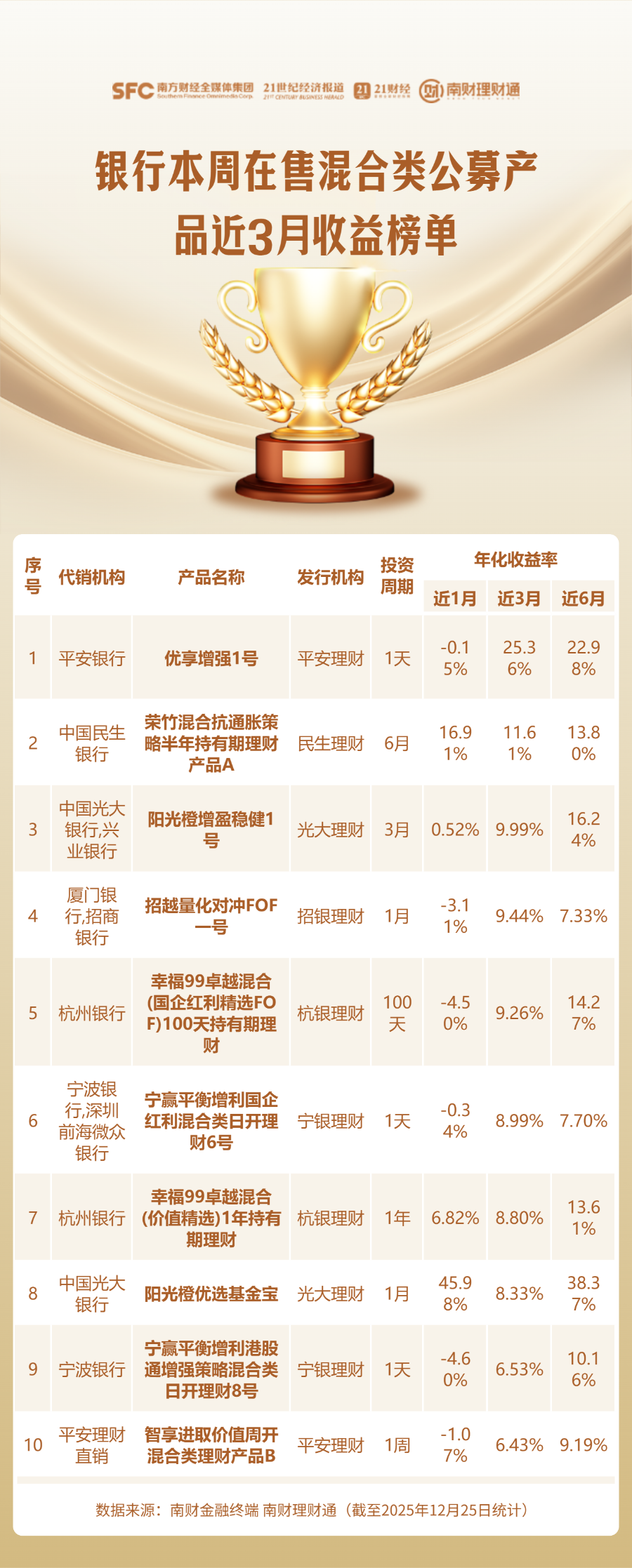
本周在售近3个月收益率居前的混合类产品名单出炉!
2 1 Shi Ji Jing Ji Bao Dao· 2025-12-29 01:20
Group 1 - The focus of the report is on mixed-type financial products issued by wealth management companies, highlighting superior products available for investors through distribution channels [1] - The ranking of products is based on their annualized performance over the last month, three months, and six months, with a specific emphasis on the three-month annualized yield to reflect their performance amid recent market fluctuations [1] - A total of 28 distribution institutions are involved, including major banks such as Industrial and Commercial Bank of China, Bank of China, Agricultural Bank of China, and others [1] Group 2 - The list of financial products is subject to the "on sale" status based on their investment cycle, but actual availability may vary due to factors like sold-out quotas or differences in product listings for different customers [1] - Investors are advised to refer to the actual display on the distribution bank's app for the most accurate information regarding product availability [1]
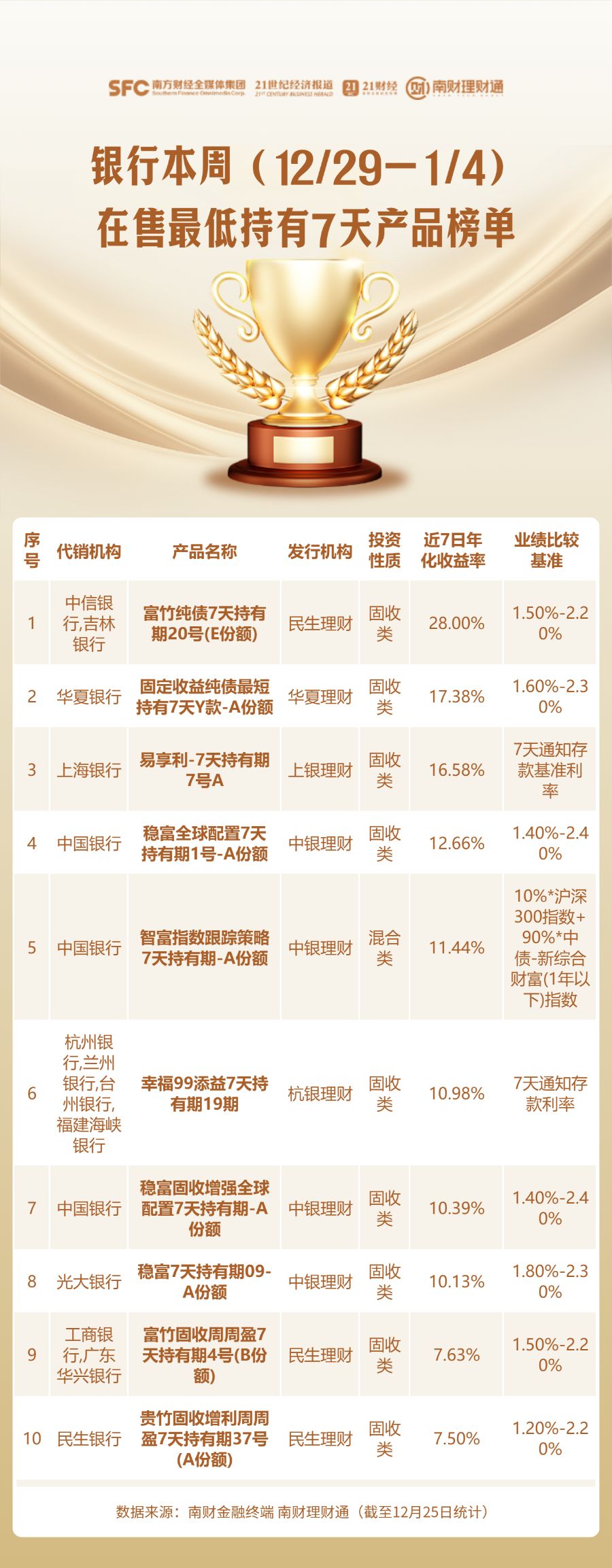
最低持有期理财榜单出炉!股份行代销产品收益居前
2 1 Shi Ji Jing Ji Bao Dao· 2025-12-29 01:20
Core Insights - The report focuses on the performance of minimum holding period RMB public funds, ranking them based on annualized returns over various holding periods: 7 days, 14 days, 30 days, and 60 days [1] - The ranking is based on annualized yield calculations, with the calculation period matching the holding period [1] Group 1: 7-Day Holding Period Products - The top-performing product is "富竹纯债7天持有期20号(E份额)" from 民生理财 with an annualized return of 28.00% [3] - Other notable products include "固定收益纯债最短持有7天Y款-A份额" from 华夏银行 with a return of 17.38% and "易享利-7天持有期7号A" from 上海银行 with a return of 16.58% [4] Group 2: 14-Day Holding Period Products - The leading product is "景前固收增利双周窓14天持有期28号" from 中信银行 with an annualized return of 15.59% [6] - Other significant products include "富竹纯债14天持有期14号(E份额)" from 民生理财 with a return of 11.68% and "嘉鑫(歳刊)固收类最低持有14天第13期-B份额" from 建信理财 with a return of 9.77% [7] Group 3: 30-Day Holding Period Products - The highest return is from "幸福99鸡益(金盈) 30天持有期" from 杭州银行 with an annualized return of 25.44% [10] - Other notable products include "盈30天持有期27号" from 民生银行 with a return of 18.61% and "易享利-28天持有期6号A" from 上海银行 with a return of 12.19% [11] Group 4: 60-Day Holding Period Products - The top product is "贵竹固收增利双月盈60天持有期3号" from 中信银行 with an annualized return of 15.26% [14] - Other significant products include "富竹纯债60天持有期12号(E份额)" from 民生理财 with a return of 7.00% and "智富指数跟踪策略60天持有期-A份额" from 中银理财 with a return of 4.63% [15]





民生加银汇智3个月定期开放债券型证券投资基金开放申购、赎回和转换业务的公告
Shang Hai Zheng Quan Bao· 2025-12-28 19:44
Announcement Information - The fund operates in a periodic open manner, alternating between closed and open periods, with the closed period lasting until the day before the corresponding monthly date three months later [1] - The 17th closed period for the fund is from October 1, 2025, to January 4, 2026, with the open period for subscription, redemption, and conversion starting on January 5, 2026, lasting for 20 consecutive working days [2] Subscription and Redemption Procedures - During the open period, investors can process subscription and redemption requests on normal trading days of the Shanghai and Shenzhen Stock Exchanges [3] - The minimum subscription amount is set at 100 yuan, including subscription fees, with no upper limit on the amount that can be subscribed beyond this minimum [3][5] - The fund management may impose limits on subscription amounts or suspend subscriptions to protect existing investors if large subscriptions could adversely affect their interests [4] Redemption Details - Investors can redeem part or all of their fund shares, with a minimum redemption of 100 shares [7] - A redemption fee of at least 1.5% applies to shares held for less than 7 days, which will be fully allocated to the fund's assets [8] - The fund management can adjust redemption fees and methods as long as it does not adversely affect the interests of fund shareholders [9] Conversion Business - Fund conversion fees consist of redemption fees from the outgoing fund and any additional subscription fees for the incoming fund [10] - The conversion process requires that both funds be managed by the same fund manager and sold by the same sales institution [11] Sales Institutions - The direct sales institution for the fund is Minsheng Jia Yin Fund Management Co., Ltd., with various other banks and securities firms also acting as sales agents [13] Net Asset Value Disclosure - The fund management is required to disclose the net asset value at least weekly during closed periods and no later than the next day after each open day during open periods [14] Additional Information - The announcement provides details specifically for the 17th subscription, redemption, and conversion business, urging investors to read the latest fund contract and prospectus for comprehensive information [15]
与上轮财富管理发展期的比较分析:l本轮财富管理特点与金融机构:分化、分层与匹配
ZHONGTAI SECURITIES· 2025-12-28 12:56
Investment Rating - The report maintains an "Overweight" rating for the industry [2] Core Insights - The current wealth management market (2025-2026) shows increased differentiation and stratification compared to the previous cycle (2020-2021), with a focus on matching client needs [5][10] - Financial institutions are transitioning from a "sell-side" sales model to a "buy-side" advisory model, emphasizing long-term service capabilities and precise matching of client needs [5][10] - Investment opportunities are expected to favor financial institutions with a strong middle-to-high value client base, comprehensive services, and innovative product offerings [5][10] Summary by Sections Common Logic of Two Cycles - Both cycles are characterized by ample liquidity supporting asset prices, with the previous cycle driven by aggressive monetary and fiscal policies, while the current cycle is marked by low interest rates and excess precautionary savings [9][16] - Clear industry trends guide capital flows, with the previous cycle dominated by consumption and new energy, while the current cycle is led by AI and hard technology [9][22] - The trend of asset migration from real estate to financial assets is irreversible, continuing the financialization process [9][25] Core Differences of Two Cycles - The macro environment has shifted from "strong stimulus expansion" to "weak recovery defense," with a focus on stabilizing growth and managing risks [25][27] - There is a notable change in resident expectations and risk preferences, with a shift from broad income growth to increased differentiation among income groups [35][38] - Asset allocation logic has evolved from a singular offensive strategy to a diversified and balanced approach, incorporating defensive assets alongside growth opportunities [46][50] Characteristics of the Previous Cycle - The previous cycle was driven by strong stimulus measures, resulting in a significant recovery in GDP and a structural bull market in equities, particularly in high-growth sectors [3][9] - The investment behavior was aggressive, with high turnover and a focus on chasing high-performing assets, leading to a "star chasing" phenomenon among investors [3][9] Current Cycle and Future Characteristics - The current cycle is characterized by low interest rates and a new normal of asset revaluation, with a gradual but steady migration of assets [10][25] - The asset side is moving towards a balanced approach, with a mix of high-dividend and growth assets, and an increasing preference for alternative investments as risk hedges [10][50] - Financial institutions are expected to focus on client segmentation, asset allocation capabilities, and long-term service value, with a shift towards a "buy-side" advisory model [10][55]
银行理财代销加速扩张,有农商行年内产品数量暴增两倍
Di Yi Cai Jing· 2025-12-28 05:22
合规压力同步上行,多家银行因理财、代销业务被罚。 业内人士指出,理财代销正从"规模竞争"迈入"能力竞争"阶段。如何在抢占市场窗口期的同时守住风险 底线,成为摆在银行面前的一道现实考题。 理财规模创新高,中小银行加速入场 2025年以来,银行理财代销市场明显升温。一方面,多家银行代销理财产品数量和规模快速扩张,理财 代销成为不少银行在息差收窄背景下的重要"发力点";另一方面,随着业务加速推进,理财、代销等环 节的管理漏洞也逐步暴露,监管罚单密集落地,合规压力同步上行。年内多家银行因理财、代销等业务 管理不审慎等被处罚。 业内人士普遍认为,中小银行加码理财代销,既是应对息差持续收窄、压降负债成本的现实选择,也是 在资管新规全面落地背景下,对自营理财空间受限的一种"转向式布局"。 扩张背后罚单频现,监管持续加码 在理财代销快速扩张的同时,部分银行在理财、代销及相关业务环节的管理短板逐渐显现。 银行业理财登记托管中心发布的《中国银行业理财市场季度报告(2025年三季度)》显示,截至今年9 月末,全市场存续理财产品规模达32.13万亿元,首次突破32万亿元大关,创下历史新高;持有理财产 品的投资者数量达1.39亿,同比 ...


7个月发行规模超1.5万亿元!谁是科创债发行主力军?
Xin Lang Cai Jing· 2025-12-28 04:56
Core Insights - The core focus of the news is the rapid expansion of the technology innovation bond market in China, which has seen significant growth since its launch in May 2023, with a total issuance of 2.26 trillion yuan by December 26, 2023 [1][6]. Market Growth - The issuance scale of technology innovation bonds reached 2.26 trillion yuan, covering over 2,000 bonds, marking a substantial year-on-year increase and providing strong financial support for technology innovation enterprises [1][6]. - Since the launch of the "technology board" in May, the issuance scale has exceeded 1.5 trillion yuan in just seven months, significantly surpassing the total issuance for the previous year [2][7]. - The issuance cost remains low, with over 40% of the bonds having interest rates below 2%, and most bonds issued at rates below 3%, which is advantageous compared to similar credit bonds [2][7]. Policy Support - The People's Bank of China and the China Securities Regulatory Commission have introduced several measures to support the issuance of technology innovation bonds, enhancing the product system and support mechanisms [2][7]. - The strong policy backing has injected significant momentum into the market, leading to a surge in demand and subscription rates for these bonds [2][7]. Issuer Diversity - The range of issuers for technology innovation bonds has expanded to include technology enterprises, financial institutions, and private equity firms, covering multiple industries [4][9]. - As of December 26, the interbank market's issuance scale surpassed 1 trillion yuan, with commercial banks contributing around 300 billion yuan, indicating a notable growth in smaller banks' participation [10]. Future Outlook - The technology innovation bond market is expected to continue expanding, driven by increasing financing needs in the technology sector and ongoing policy reforms aimed at enhancing the bond market's support for innovation [5][10].

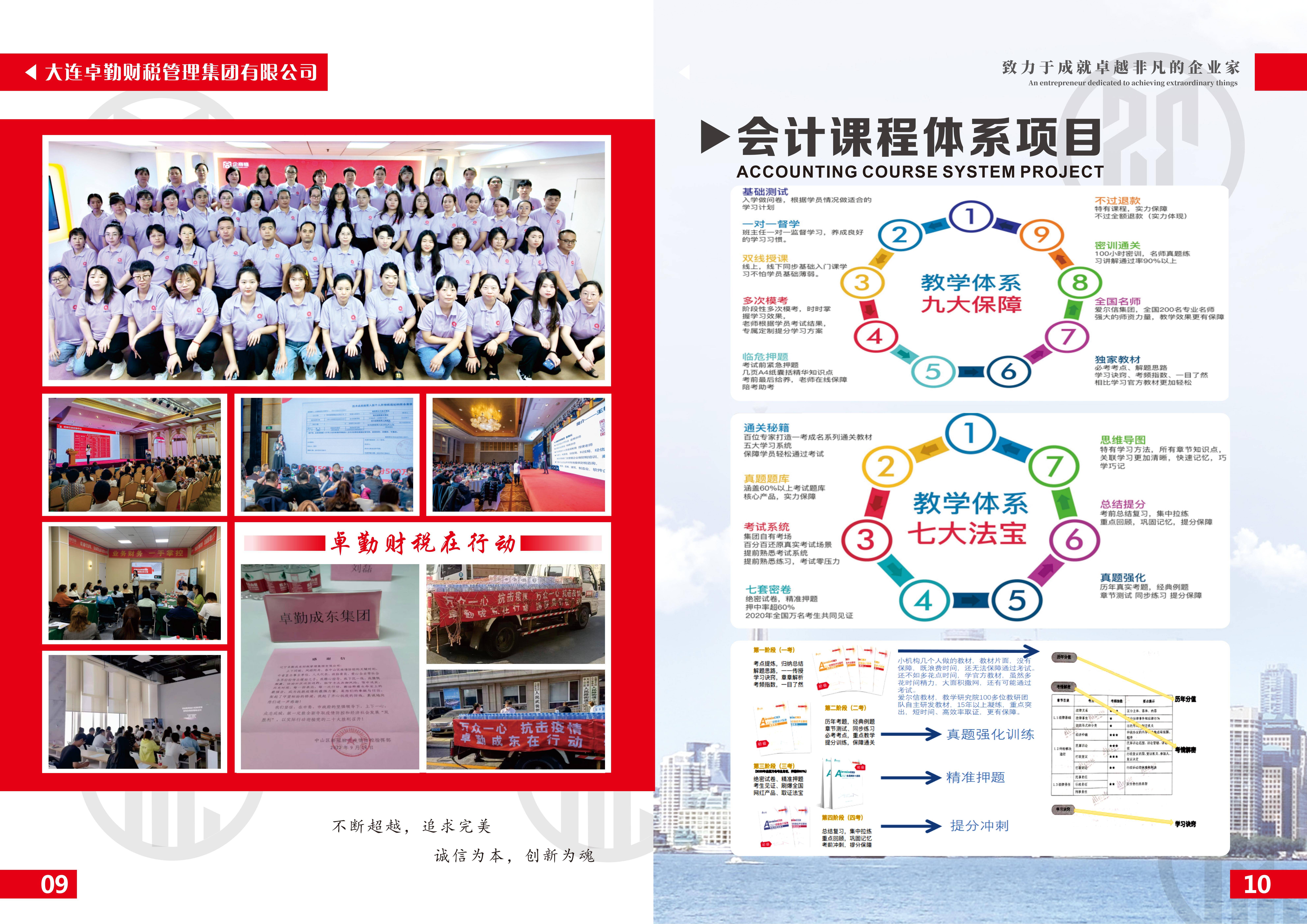
非上市公司股权激励:卓勤财税为您开启激励新篇
Sou Hu Cai Jing· 2025-12-28 02:57
Core Insights - Non-listed companies are increasingly adopting equity incentives as an effective means to attract and retain talent, enhancing their core competitiveness in a competitive business environment [1] Industry Advantages - Equity incentives align employees' interests with the company's long-term development, fostering a sense of belonging and loyalty among employees [1] - This incentive mechanism helps attract external talent, allowing non-listed companies to stand out in a competitive talent market [1] - Equity incentives can optimize the company's equity structure, improve governance, and promote sustainable development [1] Characteristics of Equity Incentives - The incentive methods are flexible and diverse, including stock options, restricted stocks, and shares, allowing companies to choose based on their development stage and strategic goals [7] - The range of incentive recipients is broad, covering key positions such as core management, technical backbones, and business elites, ensuring targeted and effective incentives [7] - The incentive period is typically long, often spanning several years, which helps guide employees to focus on long-term performance [7] Pricing and Cost Considerations - The grant price of equity is determined based on the company's valuation, which can be assessed through various methods such as asset, income, or market approaches [9] - Implementation costs include design fees, legal consultation fees, and financial audit fees, influenced by factors like the complexity of the plan and the expertise of consulting firms [9] Brand and Reputation - When selecting equity incentive service providers, brand and reputation are crucial indicators, as reputable firms typically offer professional teams and high-quality services [11] - Well-known service providers with successful case studies can provide valuable references for companies [11] Selection Criteria - Companies should choose service providers with professional qualifications and extensive experience to ensure the development of scientifically sound incentive plans [12] - Attention should be paid to the quality of service and ongoing support, as equity incentives require long-term commitment [12] - Understanding the fee structure and service content of providers is essential to avoid disputes [12] Value for Money and Reliable Choices - Cost-effectiveness is a key consideration when selecting service providers, ensuring high-quality services within reasonable costs [13] - Reliable service providers should possess professional capabilities, good reputation, and a responsible attitude [13] Recommended Partner - Dalian Zhuoqin Accounting Firm, established in 2014, has rapidly developed into a nationally recognized financial and tax service provider with a strong reputation and professional strength [14] - The firm has a robust professional team and a wide financial network, providing comprehensive services to meet diverse corporate needs [14] - Zhuoqin has extensive experience in equity incentives, helping companies design effective incentive plans while managing tax risks and legal disputes [15]
超半数上市银行完成中期分红,还有“红包”在路上
Huan Qiu Wang· 2025-12-28 01:34
Core Viewpoint - The mid-term dividend distribution among listed banks is progressing steadily, with half of the banks having completed their 2025 mid-year dividend payouts, characterized by an earlier distribution schedule and an increase in dividend rates [1] Group 1: State-owned Banks - The five major state-owned banks, including Industrial and Commercial Bank of China, Agricultural Bank of China, Bank of China, China Construction Bank, and Bank of Communications, successfully completed their mid-term dividend payouts in December, distributing a total of 189.885 billion yuan to shareholders [3] - Bank of Communications announced a cash dividend of 0.1563 yuan per share (including tax) on December 25, totaling 13.811 billion yuan [3] - Industrial and Commercial Bank of China and Agricultural Bank of China initiated their mid-term dividends on December 15, with Industrial Bank distributing 0.1414 yuan per share (approximately 50.396 billion yuan) and Agricultural Bank distributing 0.1195 yuan per share (approximately 41.823 billion yuan) [3] - China Construction Bank and Bank of China completed their payouts on December 11, with China Construction Bank distributing 0.1858 yuan per share (approximately 48.605 billion yuan) and Bank of China distributing 0.1094 yuan per share (approximately 35.250 billion yuan) [3] Group 2: Joint-stock and City Commercial Banks - Among the A-share joint-stock banks that have implemented mid-term dividends, CITIC Bank, Minsheng Bank, and Ping An Bank completed their payouts in August 2025, with total cash dividends of 10.461 billion yuan, 5.954 billion yuan, and 4.580 billion yuan respectively [4] - Additionally, 13 A-share listed city commercial banks and rural commercial banks completed their mid-term dividends for 2025, including Shanghai Bank and Nanjing Bank, with a total distribution exceeding 18.5 billion yuan [4] - According to Guotai Junan Securities, the dividend rates for most banks that have disclosed their plans for 2025 mid-term dividends are consistent with those of 2024, while six banks, including Suzhou, Minsheng, Shanghai, Hangzhou, Huaxia, and CITIC, have increased their rates by 0.9 to 4.5 percentage points compared to 2024 [4] Group 3: Upcoming Dividend Plans - Postal Savings Bank plans to distribute 1.230 yuan (including tax) for every 10 ordinary shares, totaling approximately 14.8 billion yuan [4] - Industrial Bank intends to distribute 5.65 yuan (including tax) for every 10 shares, amounting to 11.957 billion yuan [4] - China Merchants Bank has confirmed that its mid-term cash dividend distribution will occur between January and February 2026, with a distribution ratio of 35% [4]



信用债周度观察(20251222-20251226):信用债发行量环比上升,各行业信用利差涨跌互现-20251227
EBSCN· 2025-12-27 08:28
1. Report Industry Investment Rating - Not provided in the given content 2. Core View of the Report - From December 22 to December 26, 2025, the issuance volume of credit bonds increased month - on - month, and the credit spreads of various industries showed mixed trends [1] 3. Summary by Directory 3.1 Primary Market 3.1.1 Issuance Statistics - During the week from December 22 to December 26, 2025, 267 credit bonds were issued, with a total issuance scale of 427.702 billion yuan, a month - on - month increase of 15.42%. Among them, 117 industrial bonds were issued, with a scale of 219.258 billion yuan (a 34.26% month - on - month increase, accounting for 51.26% of the total); 110 urban investment bonds were issued, with a scale of 71.364 billion yuan (an 18.87% month - on - month decrease, accounting for 16.69% of the total); 40 financial bonds were issued, with a scale of 137.08 billion yuan (a 14.92% month - on - month increase, accounting for 32.05% of the total) [1][11] - The average issuance term of credit bonds this week was 2.74 years. The average issuance term of industrial bonds was 2.36 years, urban investment bonds was 3.25 years, and financial bonds was 2.35 years [1][14] - The average issuance coupon rate of credit bonds this week was 2.26%. The average issuance coupon rate of industrial bonds was 2.12%, urban investment bonds was 2.41%, and financial bonds was 2.23% [2][19] 3.1.2 Cancellation of Issuance Statistics - Five credit bonds were cancelled for issuance this week [2][23] 3.2 Secondary Market 3.2.1 Credit Spread Tracking - By industry, in the Shenwan primary industries, the largest upward movement of the AAA - rated industry credit spread was in the pharmaceutical and biological industry (up 5.1BP), and the largest downward movement was in the real estate industry (down 1.3BP); the largest upward movement of the AA + - rated industry credit spread was in the household appliances industry (up 6.4BP), and the largest downward movement was in the textile and clothing industry (down 9.8BP); the largest upward movement of the AA - rated industry credit spread was in the building materials industry (up 11BP), and the largest downward movement was in the commercial trade industry (down 1BP) [3] - By region for urban investment bonds, this week, the largest upward movement of the AAA - rated credit spread was in Gansu (up 8.7BP), and the largest downward movement was in Jilin (down 2.9BP); the largest upward movement of the AA + - rated credit spread was in Liaoning (up 6.7BP), and the largest downward movement was in Fujian (down 3.2BP); the largest upward movement of the AA - rated credit spread was in Jiangxi (up 4.5BP), and the largest downward movement was in Anhui (down 3.3BP) [3] 3.2.2 Trading Volume Statistics - The total trading volume of credit bonds was 1.782747 trillion yuan, a month - on - month increase of 28.47%. The top three in terms of trading volume were commercial bank bonds, corporate bonds, and medium - term notes. Specifically, the trading volume of commercial bank bonds was 630.894 billion yuan (a 38.88% month - on - month increase, accounting for 35.39% of the total); the trading volume of corporate bonds was 521.309 billion yuan (a 15.93% month - on - month increase, accounting for 29.24% of the total); the trading volume of medium - term notes was 347.636 billion yuan (a 40.63% month - on - month increase, accounting for 19.50% of the total) [4][28] 3.2.3 Actively Traded Bonds This Week - According to DM client data, the top 20 urban investment bonds, industrial bonds, and financial bonds in terms of trading volume this week are provided for investors' reference [30]