
格力电器

Search documents
这一次,宝能姚振华,真急了
Feng Huang Wang Cai Jing· 2026-01-14 11:08
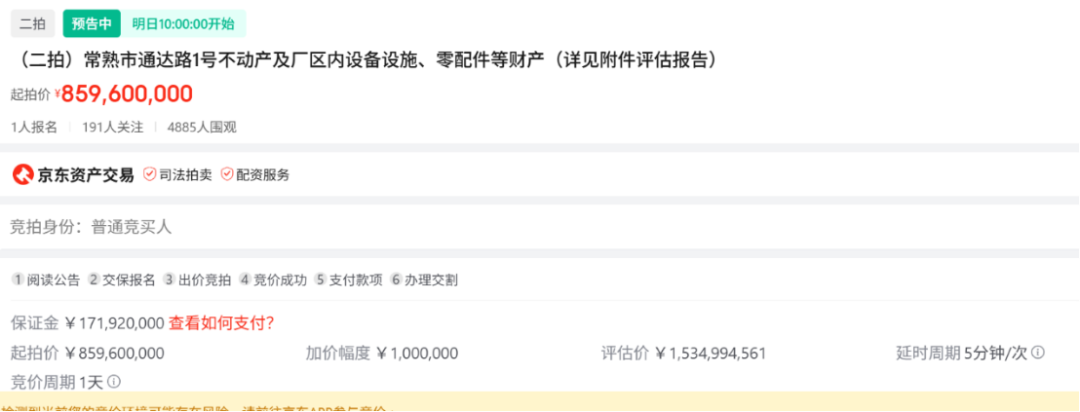
Core Viewpoint - The recent public accusation by Yao Zhenhua, chairman of Baoneng Group, against officials from Changshu City and the Changshu Economic and Technological Development Zone has unveiled a significant dispute involving the potential undervaluation and forced sale of assets related to Qoros Auto, which could jeopardize Baoneng's substantial investments in the company [1][2][3]. Group 1: Allegations and Financial Implications - Yao Zhenhua claims that the involved parties colluded to manipulate a 2.7 billion yuan execution case concerning Qoros Auto, where Baoneng has invested over 200 billion yuan [2][4]. - The core assets of Qoros Auto are estimated to be worth approximately 80 billion yuan, but the court's valuation is only 15 billion yuan, with an auction starting at 8.6 billion yuan [2][8]. - If the auction proceeds, Baoneng's significant investment in Qoros Auto could be drastically reduced, leading to a potential loss of value [3][4]. Group 2: Legal and Procedural Concerns - The dispute centers on the legality of the asset liquidation process, with Yao alleging that the establishment of a liquidation committee and excessive asset seizures were unlawful [5][9]. - The case originated from a financial loan dispute between Suzhou Asset Management Co. and Qoros Auto, which has led to the court's decision to auction Qoros Auto's assets to settle debts [6][7]. - Yao argues that the auction should be paused due to the initiation of bankruptcy reorganization proceedings for Qoros Auto, which were formally accepted by the Suzhou Intermediate People's Court [10][11]. Group 3: Baoneng's Financial Struggles - Baoneng Group is currently facing a debt crisis, with total liabilities exceeding 1 trillion yuan, and the ongoing auction of Qoros Auto's assets reflects the broader financial challenges the company is experiencing [15][20]. - The company's aggressive expansion strategy, including significant investments in various sectors, has led to a liquidity crisis, exacerbated by regulatory restrictions on its financing capabilities [24][25]. - The potential loss of Qoros Auto's assets could further diminish Baoneng's chances of restructuring and recovering from its financial difficulties [25].

这一次,宝能姚振华,真急了
凤凰网财经· 2026-01-14 09:31
Core Viewpoint - The article discusses the serious allegations made by Yao Zhenhua, chairman of Baoneng Group, against officials in Changshu regarding the undervaluation and potential forced sale of assets related to Qoros Auto, which could result in significant financial losses for Baoneng [1][2][3]. Group 1: Allegations and Financial Implications - Yao Zhenhua claims that the Changshu officials colluded to manipulate a 2.7 billion yuan execution case involving Qoros Auto, where Baoneng has invested over 200 billion yuan [2][5]. - The core assets of Qoros Auto were assessed at approximately 80 billion yuan by third-party institutions, but the court's valuation was only 15 billion yuan, with an auction starting at 8.6 billion yuan [2][11][15]. - If the auction proceeds, Baoneng's substantial investment in Qoros Auto could be drastically reduced, leading to a potential "half-cut" realization of their investment [3][36]. Group 2: Baoneng's Financial Struggles - From 2018 to the end of 2025, Baoneng's total investment in Qoros Auto is reported to be around 260 billion yuan, which includes equity acquisition, technology development, and operational support [4][36]. - Despite facing liquidity issues in late 2022, Baoneng continued to invest 25 billion yuan into Qoros Auto to maintain operations and clear 2.6 billion yuan in financial debts [4][36]. - The ongoing auction and asset liquidation reflect Baoneng's broader financial distress, with total executed amounts across its core platforms exceeding 1,058 billion yuan [26][30]. Group 3: Legal and Procedural Concerns - Yao Zhenhua argues that the auction should be paused due to the initiation of bankruptcy reorganization proceedings for Qoros Auto, which was formally accepted by the Suzhou Intermediate People's Court [12][13][14]. - The legal framework suggests that once a bankruptcy application is accepted, execution measures should be lifted, yet the auction is still proceeding, raising concerns about the legality of the actions taken by the involved parties [17][30]. - The case highlights the potential risks of undervaluing assets and the implications for Baoneng's ability to recover from its debt crisis, as losing Qoros Auto would severely impact its restructuring efforts [37][38].

南财快评|从广货到“新广货” 为何全球爆款频出?
2 1 Shi Ji Jing Ji Bao Dao· 2026-01-14 09:00
Core Viewpoint - The "Guangdong Products Going Global" spring campaign will kick off a series of promotional activities aimed at showcasing the diverse charm of Guangdong manufacturing, highlighting its evolution from traditional goods to advanced technology products like smart appliances and drones [1][2]. Group 1: Geographic and Trade Advantages - Guangdong's geographic location provides significant advantages for trade, facilitating industrialization and attracting foreign investment, which are foundational for the success of Guangdong products [2]. - The historical success of Guangdong products is attributed to its trade structure, which evolved from initial processing trades to attracting foreign capital and advanced manufacturing techniques, laying the groundwork for Guangdong's economic development [2]. Group 2: Technological Advancements and Industry Evolution - The current competitive edge of Guangdong products is driven by smart manufacturing, moving from traditional appliances to innovative products like smart glasses and drones, reflecting a shift towards intelligent production [3]. - Guangdong has established nine trillion-yuan industrial clusters, with projected revenues exceeding 19 trillion yuan by 2025, and is home to over 800,000 industrial enterprises, leading the nation in industrial output [3]. Group 3: Traditional and Emerging Industries - Traditional industries remain crucial for Guangdong's economic foundation, with significant contributions to the production of consumer electronics, such as televisions and air conditioners, and advancements in production efficiency through technology [4]. - Guangdong is a major hub for the smartphone industry, producing a significant portion of the world's smartphones and achieving breakthroughs in semiconductor technology, which supports the ongoing innovation in the sector [5]. Group 4: Future Prospects - Initiatives like "Smart Electric Guangdong," "Fashion in Guangdong," and "Guangdong Quality Products" are set to enhance the technological capabilities of Guangdong products, ensuring continuous innovation and market expansion [5].
白色家电板块1月14日涨0.59%,雪祺电气领涨,主力资金净流入2.41亿元
Zheng Xing Xing Ye Ri Bao· 2026-01-14 08:50
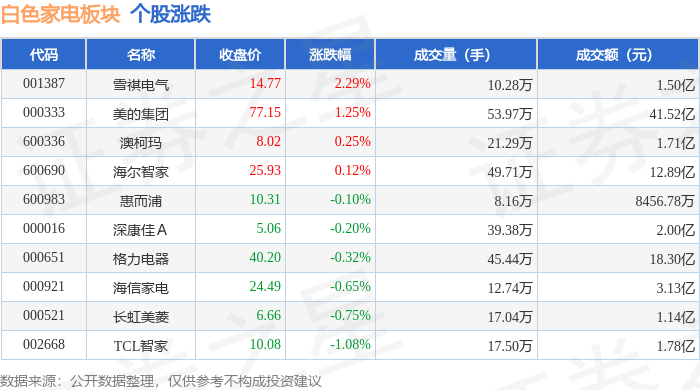
Core Viewpoint - The white goods sector experienced a slight increase of 0.59% on January 14, with Xueqi Electric leading the gains, while the overall Shanghai Composite Index fell by 0.31% [1] Group 1: Market Performance - The Shanghai Composite Index closed at 4126.09, down 0.31% [1] - The Shenzhen Component Index closed at 14248.6, up 0.56% [1] - The white goods sector's individual stock performance varied, with Xueqi Electric rising by 2.29% to a closing price of 14.77 [1] Group 2: Stock Details - Midea Group closed at 77.15, up 1.25%, with a trading volume of 539,700 shares and a transaction value of 4.152 billion yuan [1] - Gree Electric closed at 40.20, down 0.32%, with a trading volume of 454,400 shares and a transaction value of 1.830 billion yuan [1] - Haier Smart Home closed at 25.93, up 0.12%, with a trading volume of 497,100 shares and a transaction value of 1.289 billion yuan [1] Group 3: Capital Flow - The white goods sector saw a net inflow of 241 million yuan from main funds, while retail funds experienced a net outflow of 277 million yuan [1] - Retail investors contributed a net inflow of 35.78 million yuan to the sector [1] Group 4: Individual Stock Capital Flow - Midea Group had a net inflow of 25.17 million yuan from main funds, while retail funds saw a net outflow of 13.28 million yuan [2] - Xueqi Electric experienced a net inflow of 23.11 million yuan from main funds, but retail funds had a significant net outflow of 22.26 million yuan [2] - TCL Smart Home had a net inflow of 17.91 million yuan from main funds, while retail funds saw a net outflow of 22.50 million yuan [2]




从广货到“新广货”,为何全球爆款频出?
2 1 Shi Ji Jing Ji Bao Dao· 2026-01-14 08:49
Core Viewpoint - The "Guangdong Products Going Global" spring promotional campaign is set to launch in Foshan, marking the beginning of the 2026 online promotional activities for Guangdong products, showcasing the diverse appeal of Guangdong manufacturing [2] Group 1: Geographic and Trade Advantages - Guangdong's geographic location, backed by the Nanling Mountains and facing the South China Sea, provides excellent conditions for foreign trade and industrialization, forming the foundation for the success of Guangdong products [3] - The evolution of trade structures has allowed Guangdong to continuously upgrade its products, with initial trade models attracting foreign investment and advanced manufacturing techniques, contributing to the wealth of Guangdong products [3] Group 2: Technological Advancements and Manufacturing - The current competitive edge of Guangdong products lies in intelligent manufacturing, moving from traditional appliances to smart devices like drones and robots, reflecting the region's adaptation to technological revolutions [4] - Guangdong is home to nine trillion-yuan industrial clusters, with projected revenues exceeding 19 trillion yuan by 2025, and it leads the nation in the number of industrial enterprises, producing a significant share of global consumer drones and smartphones [4] Group 3: Traditional and Emerging Industries - Traditional industries remain crucial for the legacy of Guangdong products, with ongoing transformations enhancing their viability through strategic investments in future industries [5] - Guangdong is a major hub for smartphone manufacturing, with significant advancements in technology, including breakthroughs in high-end chips and AI integration in mobile devices, further solidifying its position in the global market [6] Group 4: Future Prospects - Initiatives like "Smart Electric Guangdong Manufacturing" and "Fashion from Guangdong" are expected to further enhance the iterative upgrades of Guangdong products, indicating a promising future for the region's manufacturing sector [6]

“广货行天下”春季行动启动仪式将于1月15日在佛山举行
Nan Fang Ri Bao Wang Luo Ban· 2026-01-14 08:40
Core Insights - Guangdong's manufacturing sector is showcasing its diverse capabilities, from smart home appliances to high-end mobile phones, fashion apparel, gourmet food, and modern agriculture, emphasizing innovation and quality development [1][2][3] Food Industry - Guangdong's food industry is projected to achieve a revenue of 896.87 billion yuan in 2024, with soy sauce production accounting for over 60% of the national output and mooncake exports representing 90% of the total [2] - The industry is driven by digitalization, biotechnology, and regional collaboration, with major cities like Guangzhou, Foshan, and Dongguan each exceeding 100 billion yuan in food industry scale [2][3] Home Appliances - Guangdong's home appliance sector, representing nearly 50% of the national market, has established a robust supply chain with over 4,400 enterprises, including three with revenues exceeding 100 billion yuan [4][5] - Major companies like Midea and Hisense are localizing their research, production, and sales globally, with Midea operating 33 R&D centers and 43 manufacturing bases worldwide [5][6] Agriculture - Guangdong's agricultural sector is characterized by its "土特生金" (specialty products generate wealth) strategy, achieving a grain production capacity increase from 12.38 million tons in 2021 to 12.98 million tons in 2025 [7][9] - The province leads in various agricultural outputs, with total agricultural production value reaching 677.56 billion yuan in the first three quarters of 2025, marking a 4.9% year-on-year growth [7][9] Textile and Apparel - Guangdong's textile and apparel industry boasts 4,240 enterprises, accounting for 18.34% of the national total, with a production output of 3.44 billion garments in 2024 [15][16] - The industry is undergoing digital transformation, with companies implementing AI and big data for precise design and flexible production, significantly enhancing efficiency [15][16] Mobile Phones - Guangdong produces one in every three mobile phones globally, with a complete supply chain that allows for rapid assembly of 95% of components within a one-hour commute [10][11] - Innovations such as satellite communication technology and AI integration are being developed to enhance product capabilities and market reach [10][11] Cultural and Tourism - The "请到广东过大年" (Come to Guangdong for the New Year) campaign aims to enhance tourism through cultural experiences, with events showcasing traditional customs and local cuisine [12][13] - The initiative includes a series of activities and performances to attract visitors, emphasizing the cultural richness and festive atmosphere of Guangdong [12][13]
家电行业2025年年报前瞻:黎明前夕,沉潜以待
Guolian Minsheng Securities· 2026-01-14 08:22
Investment Rating - The report maintains a "Recommend" rating for the home appliance industry [1] Core Insights - The industry is at a turning point, with expectations for improved performance in 2026 as domestic demand stabilizes and export orders recover [35] - The report highlights the resilience of leading companies in the white goods sector, with a focus on their ability to navigate through challenging market conditions [7][10] - The overall market dynamics indicate a potential for growth in emerging markets, alongside innovation and product expansion in domestic markets [35] Summary by Sections 1. White Goods - External sales are recovering steadily, while internal sales are expected to remain stable in Q4 2025. Leading companies are well-positioned to benefit from favorable demand and cost environments [7][10] - Q4 2025 internal sales for air conditioners, refrigerators, and washing machines are projected to decline by 31%, 11%, and 6% respectively, due to high base effects from the previous year [10] - External sales for refrigerators and washing machines are expected to show modest growth, with a 3% increase for refrigerators and a 9% increase for washing machines [10] 2. Black Goods - The report indicates that the color TV market is under pressure, with internal sales declining significantly due to high base effects from previous subsidies [15] - External sales remain relatively stable, with a slight decline of 2% expected in Q4 2025 [15][16] - Leading brands are expected to improve their profitability through product innovation and market share gains [15] 3. Cleaning Appliances - External sales continue to grow, while internal sales face challenges due to high base effects from previous subsidies [19] - The report notes a decline in retail sales for floor cleaning machines and washing machines, with internal sales dropping by 25% and 8% respectively [20] - The external market shows strong growth, particularly in Europe and Asia-Pacific, although competition remains intense [21] 4. Small Appliances - Domestic prices are rising, but external demand remains weak, with overall growth in retail sales expected to be between 0-10% [30] - The report highlights structural improvements in pricing and product upgrades, which may support profit margins in the domestic market [30] - External sales are under pressure due to overall weak demand in international markets [30] 5. Post-Cycle - The report indicates a downturn in demand for major kitchen appliances, with significant declines in retail sales across various categories [33] - The real estate market remains sluggish, impacting demand for kitchen appliances, and the report anticipates continued pressure on sales [33] - The upcoming subsidy policies are expected to have limited coverage, which may further affect market dynamics [33] 6. Industry Views and Investment Recommendations - The report suggests that the home appliance sector is poised for recovery in 2026, with expectations for improved fundamentals and potential surprises in export performance [35] - Recommended stocks include leading white goods manufacturers such as Midea Group, Haier Smart Home, Gree Electric, and Hisense Home Appliances, as well as TV manufacturers like Hisense Visual and TCL Electronics [35]



新春购物狂欢本周五开启,快来长株潭好物乐购汇解锁“年货自由” | “工”筑精品 惠享万家
Xin Lang Cai Jing· 2026-01-14 08:17
Group 1 - The "Shared Plan" Chang-Zhu-Tan Good Goods Shopping Fair will be held from January 16 to 18 at the Changsha Hongxing International Convention and Exhibition Center, featuring over 180 booths across various categories including automobiles, home appliances, food, medicine, and health products [1] - The event aims to provide a one-stop shopping experience for citizens, allowing them to easily gather New Year necessities without the hassle of traveling to different locations [2] - The fair will showcase local specialties from Changsha County, Wangcheng District, Liuyang City, Ningxiang City, and other areas, making it convenient for attendees to find quality products [2] Group 2 - The automotive exhibition area will feature well-known brands such as BYD, GAC Aion, and SAIC Volkswagen, with combined discounts reaching up to 65,000 yuan due to national and manufacturer subsidies [3] - The home appliance section will offer significant discounts, with smart appliances like air conditioners, refrigerators, and washing machines seeing price reductions of up to 1,000 yuan [3] - The fair will also include special exhibitions for leisure food and health care products, with brand gift boxes sold at the best prices, enhancing the value for consumers [3]

超6000家企业参与,“广货行天下”春季行动将于明日启动
Nan Fang Nong Cun Bao· 2026-01-14 06:05
Core Viewpoint - The "Guangdong Goods Going Global" Spring Action aims to boost consumer spending and help over 6,000 enterprises expand their market presence and sales, laying a solid foundation for Guangdong's development during the 14th Five-Year Plan period [5][12]. Group 1: Event Overview - The Spring Action will officially launch on January 15, with a promotional event focused on home appliances taking place in Foshan [6]. - The initiative is organized by various provincial departments, including the Guangdong Provincial Committee of Propaganda and the Provincial Department of Commerce, to enhance the visibility and market influence of high-quality Guangdong products [7][8]. Group 2: Participation and Support - Over 6,000 enterprises from diverse sectors such as home appliances, mobile phones, clothing, food, smart devices, automotive, beauty products, and agriculture will participate in the event [12]. - Major commercial platforms, including Alibaba International, JD.com, and Douyin, among others, are supporting the initiative [13][14]. Group 3: Promotion Strategy - The event will select key industries and outstanding brand enterprises to promote their best and most cost-effective products on a weekly basis [15][16]. - There will be efforts to connect manufacturers with retailers, distributors, and buyers to facilitate sales and gather market demands [17][19]. Group 4: Local Engagement - Local cities will engage leading enterprises and industry clusters to participate, integrating local cultural and tourism activities into promotional efforts [20][21]. - Media will play a significant role in enhancing the brand and sales of Guangdong products through active participation in the Spring Action [22]. Group 5: Home Appliance Focus - The launch event will feature over 1,300 home appliance companies, with major brands like Midea, Gree, and Galanz showcasing their products and conducting live sales [24].

格力加快布局AI家电矩阵,全力构建全屋智能健康生态
Quan Jing Wang· 2026-01-14 03:22
Core Insights - The Chinese home appliance market is undergoing a significant transformation towards AI-driven products, moving from mere functionality to understanding and serving user needs [1][2] - The smart home market is projected to exceed 952.3 billion yuan, with AI penetration surpassing 50%, indicating a shift from "connected appliances" to "intelligent entities that understand users" [1][3] Industry Trends - The transition from "pseudo-intelligence" to "true AI" is reshaping the home appliance industry, with traditional products often failing to deliver genuine smart capabilities [2][3] - AI technology breakthroughs, particularly in large language models and multi-modal perception, are creating new opportunities for innovation in the home appliance sector [2][4] Market Dynamics - A report indicates that 83% of consumers are willing to pay a premium for effective health technologies, with health-related appliance searches increasing by 4.9 times from 2022 to 2025 [3][4] - Government policies are increasingly supporting the AI sector, promoting initiatives that encourage the development of smart appliances and enhancing supply in the market [3][4] Competitive Landscape - Gree Electric Appliances is positioning itself as a leader in the AI home appliance market with a focus on "AI + energy-saving + health" as its competitive edge [5][6] - The company aims to leverage its strong manufacturing capabilities and core technologies to create differentiated products that meet consumer demands for health and energy efficiency [5][6] Product Innovations - Gree's AI product lineup includes key categories such as air conditioners, washing machines, and water purifiers, designed to address clear user pain points related to health and comfort [8][9] - The AI Cool King air conditioner features dynamic energy-saving technology, achieving a 13.6% reduction in annual energy consumption compared to standard models, showcasing Gree's commitment to energy efficiency [10][11] Consumer Engagement - Gree's "Dong Mingzhu Health Home" stores provide immersive experiences for consumers, allowing them to interact with AI appliances and understand their benefits firsthand [18][19] - The company is capitalizing on the trend of upgrading existing appliances through policies that encourage consumers to replace older models with AI-enabled products [7][8] Future Outlook - The AI home appliance sector is expected to mature and scale significantly by 2026, driven by ongoing technological advancements and evolving consumer preferences [18][19] - Gree's strategy emphasizes a balance between self-developed technologies and ecosystem partnerships, positioning the company to capitalize on the growing demand for intelligent home solutions [19]
