海通证券

Search documents
“牛市旗手”迎开门红 2026“绵长”行情可期并购潮持续
Zhong Guo Jing Ying Bao· 2026-01-07 04:49
2026年1月7日开盘,券商指数(886054.WI)略有下跌。在此之前,5日、6日券商指数分别收涨 1.83%、4.15%。作为新的一年的头两个交易日,券商板块强势迎来"开门红"。 "从这方面可以发现,A股和H股的比价效应开始显现。即,投资者若购买A+H股上市公司,应该兼顾考 虑A/H股溢价率。如果港股低估程度大,则港股会优先吸纳资金量,涨幅也会更大。"许琼娜提示H股内 资上市券商在2025年的表现更能体现板块的价值重估过程,而这轮价值重估中,2025年券商的并购重组 预期已参与定价。 回顾2025年全年,A股市场活跃,"牛市旗手"券商板块的表现曾备受期待。但实际上,Wind数据显示, 券商板块整体跑输,券商指数仅获得4.05%的全年涨幅,远远落后于上证指数、沪深300等。 在2025年A股整体活跃、券商并购加速推进的背景下,为何出现券商板块整体表现的疲弱?如今又为何 出现行情变化?2026年券商还有哪些并购预期?板块有哪些表现机会? 多位业内人士表示,券商属于牛市周期股,跟随此轮慢牛属性,或存在后半程发力、"绵长"上行的趋 势。而2026年券商并购预期还将持续,如跨区并购、区域并购、同一资本系并购的案例还 ...
低位四call非银-更左侧-更具弹性-更高赔率
2026-01-07 03:05
Summary of Conference Call on Non-Bank Financial Sector Industry Overview - The non-bank financial sector has seen significant capital inflows since October last year, particularly in the insurance segment, which has risen nearly three months. Despite some divergence in floating profits, the outlook for the year remains positive. [1][2] - The brokerage sector has experienced minor pullbacks, with a strong trend and rapid volume growth, surpassing 2.8 trillion RMB in trading volume. Maintaining a range of 2.5 to 3 trillion RMB will benefit the non-bank sector's market expansion. [1][3] Key Insights Insurance Sector - The insurance sector is expected to see a slowdown in performance growth this year (2025), but valuation increases will be the main driver. The regulatory body may classify several large insurers as systemically important financial institutions, enhancing their valuations. [2][4] - Investment strategies should focus on selecting stocks with high safety margins, low valuations, and low growth in the previous year. Recommended stocks include Taiping Insurance in Hong Kong and Taikang in A-shares. [5][6] Brokerage Sector - The overall increase in brokerage stocks is around 4%, with most stocks still in the early stages of recovery. [3][4] - Two investment strategies are suggested: - **Conservative**: Focus on leading brokerages like Guotai Junan and CITIC Securities. - **Aggressive**: Consider traditional brokerages with growth stories and smaller market caps, such as Xiangcai Securities. [5][6] Internet Brokerages - Major internet brokerages like Eastmoney and Tonghuashun have limited future growth potential due to their large market capitalizations. [5][6] - Recommended smaller internet brokerages with higher growth potential include Xiangcai and Dazhihui in A-shares, and Jiufang Zhitu in Hong Kong. These stocks have lower valuations and smaller market caps, indicating better growth prospects. [7] Financial Technology and Stablecoins - The non-bank financial sector is currently seen as having high cost-effectiveness, with a focus on financial technology and stablecoins. Hong Kong is set to issue stablecoin licenses in Q1, which will create a compliant trading environment and replace traditional cross-border payment systems. [8][10] - The cross-border payment market is underestimated, and the recovery of cryptocurrency prices supports this view. [9] Emerging Investment Opportunities - Investors are increasingly interested in diversified financial sectors, including futures and venture capital. The performance of commodity markets, especially precious and non-ferrous metals, is strong, indicating high earnings expectations for futures and venture capital companies. [11] - The digital RMB supply chain and AI+ insurance sectors are also highlighted as areas with significant policy support expected in 2026, presenting growth opportunities for emerging companies. [11]
146亿元资金净流入,券商板块机会如何?丨每日研选
Shang Hai Zheng Quan Bao· 2026-01-07 00:30
Core Viewpoint - The influx of approximately 14.6 billion yuan into the brokerage sector on January 6 indicates a strong market interest, driven by favorable policy cycles, valuation recovery, and fund reallocation, suggesting potential growth opportunities for brokerages and financial IT sectors in 2026 [1][2] Policy Environment - Key reforms, including the release of regulations on public fund sales fees and commercial real estate REITs, are expected to inject new momentum into the industry, shifting focus from short-term scale to long-term value [2] - The expansion of REITs is anticipated to create incremental opportunities for brokerage investment banking and asset management businesses, with three core favorable logics yet to be fully priced in by the market [2] Market Dynamics - The divergence in performance, where the A-share major indices rose significantly while the brokerage index fell, indicates a disconnection between valuation and profitability, creating a potential for valuation recovery [2] - The brokerage sector is currently underweight in active equity funds, and with regulatory guidance for public funds to optimize assessments, there is a likelihood of increased allocation to brokerages due to their stable growth and significant index weight [2] Investment Logic - The industry is evolving along differentiated paths, with three main investment themes suggested: - **Mergers and Acquisitions**: Anticipated steady progress in M&A within the brokerage sector, enhancing leverage and capital efficiency, with a focus on companies like CICC, Shougang Securities, and China Galaxy Securities [3] - **Comprehensive Leaders**: Strong, well-capitalized brokerages with balanced business structures are positioned to capitalize on industry trends, with recommendations for Guotai Junan Securities, GF Securities, and CITIC Securities [3] - **Financial Technology**: Increased market activity and digital finance trends favor financial IT and internet wealth management platforms, with attention on companies like Tonghuashun, Jiufang Zhitu, and Wealth Trend, as well as internet finance platforms like Dongfang Caifu and Zhinan Zhen [3]
春季行情叠加低估值,机构看好券商板块投资机会!三条主线值得关注
Zhong Guo Zheng Quan Bao· 2026-01-06 23:36
Core Viewpoint - The brokerage sector is experiencing a collective rise, driven by favorable market conditions and policy reforms, with analysts optimistic about the investment value of quality brokerages due to low valuations [1][2]. Group 1: Market Performance - On January 6, the Shanghai Composite Index rose by 1.5%, reaching a ten-year high, with market turnover exceeding 2.83 trillion yuan [2]. - The A-share market opened strongly in 2026, with significant trading volumes, indicating potential for increased brokerage stock trading [2]. Group 2: Valuation and Investment Opportunities - Analysts suggest that the brokerage sector is currently undervalued, with institutional holdings also at low levels, presenting a buying opportunity during the spring market [2]. - The brokerage sector has a sufficient margin of safety from a valuation perspective, with a 12% cumulative increase in the non-bank financial sector in 2025, lagging behind the 18% rise of the CSI 300 index [2]. - The sector is expected to benefit from growth in public funds and investment banking, alongside positive policy impacts, enhancing its investment value [2]. Group 3: Industry Outlook - The brokerage industry is anticipated to maintain high prosperity in 2026, supported by ongoing capital market reforms and business transformations [3]. - Regulatory policies are entering a "positive" cycle, with investment banking, public funds, and overseas business expected to bolster profitability in 2026 [3]. - The sector's mergers and acquisitions are projected to advance, improving leverage and capital allocation efficiency among quality brokerages [3]. Group 4: Investment Strategies - Recommended investment strategies include focusing on undervalued leading brokerages, firms with significant wealth management advantages, and those benefiting from cross-border asset management trials in Hainan [4]. - Analysts suggest paying attention to the beta characteristics of the brokerage sector, with upcoming catalysts such as performance reports being crucial for investment decisions [4].


春季行情叠加低估值 机构看好券商板块投资机会
Zhong Guo Zheng Quan Bao· 2026-01-06 20:50
Core Viewpoint - The brokerage sector is experiencing a collective rise, driven by favorable market conditions and policy reforms, with analysts optimistic about the investment value of quality brokerages due to low valuations and potential for growth [1][2]. Group 1: Market Performance - On January 6, the non-bank financial sector rose by 3.73%, with notable gains from Huazhong Securities and Hualin Securities reaching the daily limit [1]. - The Shanghai Composite Index increased by 1.5%, reaching a ten-year high, with market turnover exceeding 2.83 trillion yuan [2]. Group 2: Valuation and Investment Opportunities - Analysts highlight that the brokerage sector's current valuation is low, presenting a buying opportunity as institutional holdings are also at a low level [2]. - The non-bank financial sector is expected to benefit from growth in public funds and investment banking, with analysts recommending quality brokerages that are undervalued relative to their performance [2][3]. Group 3: Industry Outlook - The brokerage industry is anticipated to maintain a high level of prosperity in 2026, supported by ongoing capital market reforms and a shift towards new business models [3]. - Analysts predict that the brokerage sector will see significant business growth from investment banking, public funds, and international operations, enhancing profitability [3]. - Specific investment strategies include focusing on undervalued leading brokerages, firms with strong wealth management capabilities, and those benefiting from cross-border asset management trials in Hainan [3].
春季行情叠加低估值机构看好券商板块投资机会
Zhong Guo Zheng Quan Bao· 2026-01-06 20:43
Core Viewpoint - The brokerage sector is experiencing a collective rise, driven by favorable market conditions and low valuations, with expectations for increased trading volume and investment value in the sector [1][2]. Group 1: Market Performance - On January 6, the non-bank financial sector rose by 3.73%, with notable gains from Huazhong Securities and Hualin Securities reaching the daily limit [1]. - The Shanghai Composite Index increased by 1.5%, marking a ten-year high, with market turnover exceeding 2.83 trillion yuan [1]. - The A-share market's strong start in 2026 is anticipated to boost brokerage trading volumes [1]. Group 2: Valuation and Investment Opportunities - Analysts suggest that the brokerage sector is currently undervalued, with institutional holdings also at low levels, indicating potential for price recovery in the spring market [1]. - The non-bank financial sector is projected to rise by 12% in 2025, lagging behind the 18% increase of the CSI 300 index, highlighting the sector's low valuation and institutional holdings [1]. - The brokerage sector is expected to benefit from growth in public funds and investment banking, supported by positive policy impacts [1]. Group 3: Industry Outlook - The brokerage sector is seen as having favorable conditions for upward breakthroughs in 2026, with improved chip structure and reduced turnover rates [2]. - Continuous capital market reforms are expected to enhance brokerage business transformations, contributing to overall industry prosperity in 2026 [2]. - Regulatory policies are entering a "positive" cycle, with investment banking, public funds, and overseas business expected to support profitability in the brokerage sector [2]. Group 4: Investment Strategies - Recommended investment strategies include focusing on undervalued leading brokerages, firms with significant wealth management advantages, and those benefiting from cross-border asset management trials in Hainan [3]. - Attention should be given to the beta attributes of the brokerage sector, with catalysts such as performance reports and the optimization of competitive dynamics being key areas of focus [3].
2025年证券从业者跌破33万大关!互联网券商逆势扩招 保代8年来首现年度减员
Mei Ri Jing Ji Xin Wen· 2026-01-06 12:34
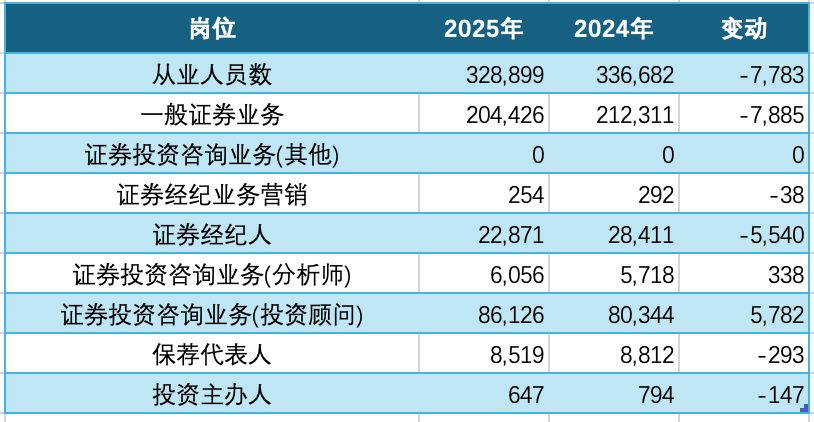
Core Insights - The total number of employees in the securities industry is projected to decline to 328,899 by the end of 2025, a decrease of nearly 7,800 from the end of 2024, marking a significant shift in the talent landscape within the industry [1][2] Group 1: Industry Employment Trends - The overall reduction in industry personnel contrasts with the growth of internet-based brokerages, which are actively hiring talent despite the overall decline [3][4] - Major brokerages such as Guotai Junan, CITIC Securities, and others continue to dominate the workforce, with five firms employing over 10,000 people, accounting for nearly 20% of the total industry workforce [3] - Conversely, traditional brokerages are experiencing significant layoffs, with firms like Guotai Junan and Minsheng Securities reducing their workforce by over 500 employees [3] Group 2: Investment Banking Dynamics - The number of sponsor representatives, a highly regarded group in investment banking, has decreased for the first time in eight years, falling to 8,519 by the end of 2025, down 293 from 2024 [5][6] - This decline is attributed to a slowdown in equity financing and a stricter regulatory environment, leading to fewer projects and increased pressure on professionals in this field [5][6] Group 3: Wealth Management Evolution - The number of securities brokers has significantly decreased to a historical low of 22,871 by the end of 2025, down 5,540 from the previous year, indicating a shift away from traditional brokerage roles [7] - In contrast, the number of investment advisors has reached a record high of 86,126, reflecting a strategic shift towards high-quality client service and professional wealth management [7][8] Group 4: Research Analyst Growth - The number of securities analysts has surpassed 6,056, marking a growth of 338 from 2024, indicating a rising demand for research capabilities within the industry [9][10] - Notable movements among prominent analysts have been observed, with several high-profile analysts changing firms, highlighting the competitive nature of the research sector [9]
2025年证券从业者跌破33万大关 互联网券商逆势扩招,保代8年来首现年度减员
Mei Ri Jing Ji Xin Wen· 2026-01-06 12:28
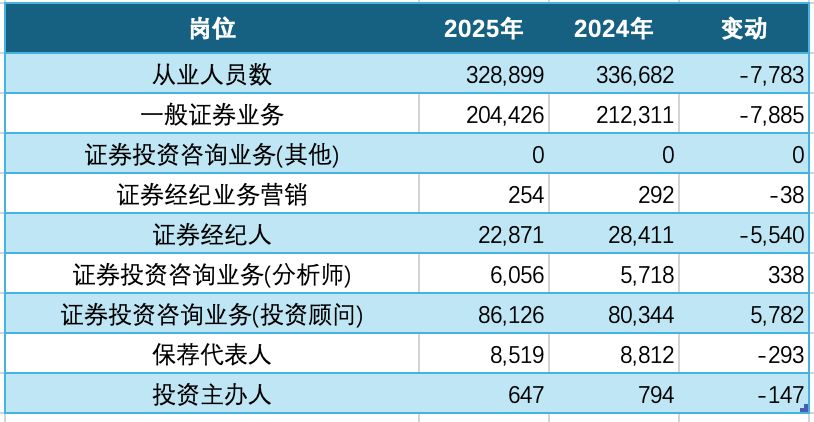
Core Insights - The total number of employees in the securities industry is projected to decline to 328,990 by the end of 2025, a decrease of nearly 7,800 from the end of 2024. This marks a historical fluctuation between 320,000 and 360,000 since 2017, with a peak of 354,500 in 2022 [1][2] Group 1: Industry Employment Trends - The overall reduction in industry personnel contrasts with the talent acquisition by internet-based brokerages such as Dongfang Caifu, Guojin Securities, and Maikao Securities, which are experiencing growth in employee numbers [3][4] - Five major brokerages have over 10,000 employees each, accounting for nearly 20% of the total workforce in the industry. These include Guotai Junan (17,800), CITIC Securities (14,200), and others [3] - Some mid-sized brokerages have also seen reductions in personnel, with firms like Guotai Junan and Minsheng Securities losing over 500 employees [3] Group 2: Investment Banking Trends - The number of sponsor representatives, considered the "gold collar" group in investment banking, has decreased for the first time in eight years, falling to 8,519 by the end of 2025, down 293 from 2024 [5][6] - The decline in sponsor representatives is attributed to a slowdown in equity financing and stricter regulatory environments, leading to fewer projects available for these professionals [5][6] Group 3: Wealth Management Dynamics - The number of securities brokers has significantly decreased to a historical low of 22,900 by the end of 2025, down 5,540 from 2024, indicating a shift away from traditional brokerage roles [7] - Conversely, the number of investment advisors has reached a record high of 86,126, reflecting a strategic shift in the industry towards high-quality client services rather than sheer volume [7][8] Group 4: Research Analyst Growth - The number of securities analysts has surpassed 6,056, marking an increase of 338 from 2024, indicating a growing demand for research capabilities within the industry [9][10] - Notable movements among prominent analysts have been observed, with several high-profile analysts changing firms, highlighting the competitive nature of the research sector [9]




非银板块今日领涨,关注证券保险ETF易方达(512070)、香港证券ETF易方达(513090)等产品投资价值
Sou Hu Cai Jing· 2026-01-06 11:17
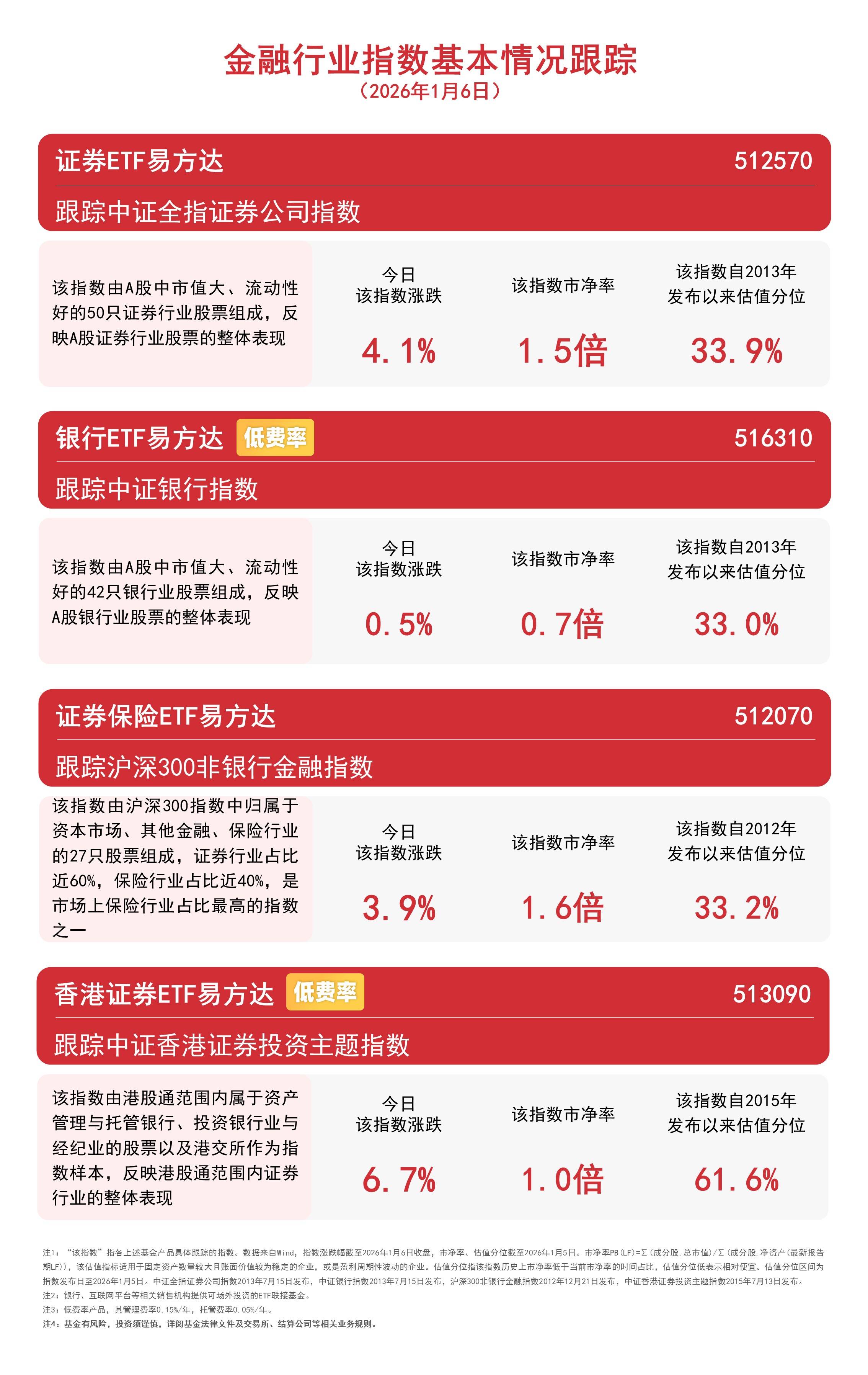
Group 1 - The non-bank sector is leading the market today, with notable gains from Guotai Junan and Xinhua Insurance exceeding 6%, and Dongfang Caifu and China Pacific Insurance rising over 5% [1] - The Hong Kong Securities Index increased by 6.7%, while the CSI All Share Securities Company Index rose by 4.1%, and the CSI 300 Non-Bank Financial Index climbed by 3.9% [1] - The trading volume for the Hong Kong Securities ETF managed by E Fund reached 21.6 billion yuan, making it the top-performing stock ETF for the day [1] Group 2 - According to Founder Securities, the brokerage sector's fundamentals are expected to improve continuously by 2025, with a year-on-year net profit growth of 62% and a 44% increase in main business revenue for the first three quarters [1] - Despite the positive outlook, the sector is currently experiencing "stagnation," with valuations significantly undervalued [1] - Looking ahead to 2026, the return on equity (ROE) for brokerages is anticipated to enter an upward trend, with margin financing and derivatives business becoming key leverage points, and accelerated mergers and acquisitions among leading brokerages expected to enhance industry concentration [1]
人民币升破7,跨境消费怎样花最省钱?
36氪· 2026-01-06 09:37
Core Viewpoint - The article discusses the recent fluctuations in the RMB/USD exchange rate, highlighting a significant appreciation of the RMB against the USD, driven by various economic factors including trade surpluses and changes in U.S. monetary policy [4][38][39]. Exchange Rate Dynamics - As of December 31, 2025, the USD index fell by 9.04%, while the onshore and offshore RMB appreciated by approximately 4.43% and 5.18%, respectively [38]. - The RMB/USD exchange rate experienced a "V-shaped" rebound throughout 2025, with the offshore RMB reaching a high of 6.9988 on December 26, marking the first time it surpassed the 7.0 threshold since September 2024 [11][12][13]. - The People's Bank of China (PBOC) adjusted the RMB midpoint rate to 7.023 on January 5, 2026, indicating a proactive approach to manage exchange rate expectations [5]. Trade Surplus and Currency Strength - China's trade surplus reached a record $1.08 trillion in the first eleven months of 2025, a 21.7% year-on-year increase, providing a solid foundation for the RMB's appreciation [25]. - The article notes that the strong trade surplus, coupled with a shift in market sentiment regarding U.S.-China trade relations, has contributed to the RMB's upward momentum [8][25]. Market Sentiment and Capital Flows - There has been a notable increase in foreign investment in Chinese assets, with a net inflow of $10.1 billion into domestic stocks and funds in the first half of 2025, reversing a two-year trend of net outflows [7][31]. - The article emphasizes that the RMB's appreciation is not solely driven by trade surpluses but also by a combination of capital inflows from securities investments and derivatives hedging [29]. Future Outlook - Analysts predict that the RMB will experience a "moderate bullish, two-way fluctuation" trend in 2026, with the exchange rate expected to stabilize between 6.80 and 7.00 [9][44]. - The ongoing U.S. Federal Reserve's interest rate cuts are anticipated to further narrow the interest rate differential between China and the U.S., supporting the RMB's strength [40][44].