SK Hynix

Search documents
South Korea announces over $23 billion for chip sector as Trump tariffs on semiconductor imports loom
CNBC· 2025-04-15 01:40
Core Insights - South Korea announced a support package of 33 trillion won ($23.25 billion) for its semiconductor industry amid rising uncertainty over U.S. tariffs [1][3] - The U.S. Department of Commerce is initiating an investigation into the national security implications of semiconductor imports [2][3] - South Korea's semiconductor exports reached $141.9 billion in 2024, accounting for over 20% of the country's total exports [6] Government Support Measures - The South Korean government will subsidize the construction of underground power transmission lines to semiconductor clusters and increase the funding ratio for infrastructure in advanced industrial complexes from 30% to 50% [4] - A total of 20 trillion won in low-interest loans will be provided to semiconductor companies from 2025 to 2027, an increase from the current 17 trillion won [4] - Training and research programs for domestic master's and doctoral students, as well as global joint research programs for foreign talent, will be introduced [5] Market Impact - The South Korean Kospi index rose by 0.68%, with Samsung Electronics increasing by 1.07% and SK Hynix by 0.17% [5] - The U.S. is the second-largest export destination for South Korea, with semiconductor exports to the U.S. rising 10.5% year-on-year to $127.8 billion in 2024 [6] - The support package is about a quarter more than the 26 trillion won committed last year, indicating a strong governmental commitment to bolster the semiconductor sector [3]


电子行业周报:美国关税影响持续,消费电子板块冲击明显
Shanghai Aijian Securities· 2025-04-10 00:23
Investment Rating - The report rates the electronics industry as "stronger than the market" [1] Core Viewpoints - The electronics sector is significantly impacted by ongoing U.S. tariff adjustments, particularly affecting the consumer electronics segment, while semiconductor equipment is less affected due to lower export ratios [5][19] - The report highlights the rapid increase in power demand for data centers driven by AI applications, with a notable shift towards controllable nuclear fusion as a potential energy solution [9][11] - Huawei's 2024 annual report indicates a strong performance with a revenue of 862.1 billion RMB, reflecting a 22.4% year-on-year growth, while R&D investment remains substantial at 179.7 billion RMB [19][20] Summary by Sections Industry Investment Rating - The electronics industry is rated as "stronger than the market" [1] Industry Dynamics - The consumer electronics sector is facing significant challenges due to U.S. tariffs, with a 34% tariff on imports from China impacting various components [5] - Semiconductor equipment and certain chip design sectors are expected to show resilience against trade tensions [5] - The global market for small modular reactors (SMR) is projected to reach hundreds of billions by 2030, driven by the need for stable energy supply for AI data centers [11] Company Performance - Huawei reported a total revenue of 862.1 billion RMB for 2024, with a net profit of 62.6 billion RMB, and a significant R&D investment of 179.7 billion RMB [19][20] - SK Hynix completed the acquisition of Intel's NAND Flash business for 9 billion USD, enhancing its market position in the memory sector [22][23] - Major players like OpenAI, Microsoft, Google, and Amazon are increasing investments in nuclear fusion technology to support future energy needs [16][17] Market Performance - The electronics industry experienced a decline of 2.7% in the past week, ranking 27th out of 31 sectors [27] - The semiconductor equipment sector showed positive growth, with a 2.8% increase, while other segments faced declines [30]
HBM助力,韩国芯片设备腾飞
半导体行业观察· 2025-04-09 01:19
Core Insights - The profits of South Korean wafer fabrication equipment manufacturers significantly increased last year, driven by high bandwidth memory (HBM) and advanced packaging technologies [1] Group 1: Revenue Growth - Hanmi Semiconductor reported the highest year-on-year revenue growth at 638.15%, followed by Techwing at 631.25%, and Zeus at 592.96% [1] - The revenue of Hanmi Semiconductor reached 558.9 billion KRW, with an operating profit of 255.4 billion KRW [1] Group 2: Key Suppliers and Clients - Hanmi Semiconductor is the primary supplier of thermal compression (TC) bonders for HBM production to SK Hynix, the largest HBM supplier globally [2] - Techwing's revenue was 185.5 billion KRW, with an operating profit of 23.4 billion KRW, serving major clients like SK Hynix, Kioxia, and Micron [2] - Zeus generated revenue of 490.8 billion KRW, with an operating income of 49.2 billion KRW, supplying TSV cleaning machines to Samsung and SK Hynix [3] Group 3: Market Dynamics - Jusung Engineering's revenue was 409.4 billion KRW, with 85% coming from China, indicating a strong demand in the Chinese market despite potential risks from the US-China trade war [3] - DIT reported revenue of 116.7 billion KRW, with 59% of its income derived from laser solutions, primarily serving SK Hynix [3] Group 4: New Developments - Auros Technology's revenue was 61.4 billion KRW, and it began supplying overlay measurement equipment to Kioxia in mid-2024 [4]
《GenAI的内存解决方案》系列综合报告
Counterpoint Research· 2025-04-03 02:59
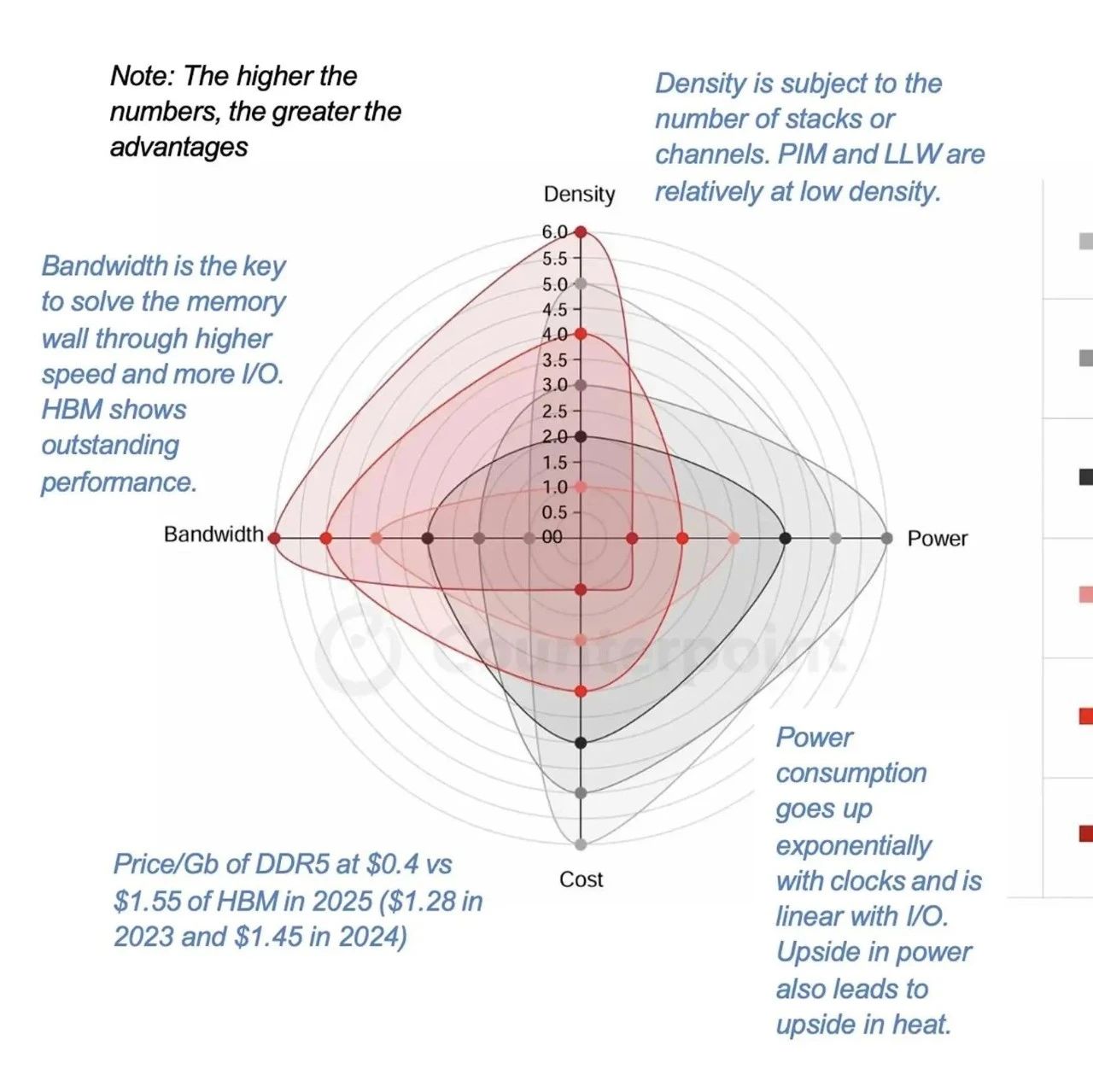
GenAI的内存解决方案 第 1 部分:能力的变化 所需能力 GenAI 应用需要高速、高带宽且低延迟的内存,以便实时处理海量数据。在需要实时决策和 预测的推理环节,数据的快速访问就显得尤为关键。 GenAI内存解决方案第 2 部分:HBM的竞争态势 内存设计的挑战与解决方案以及内存技术的最新趋势正在塑造高性能计算的未来及其竞争 格局。 竞争态势 技术革新: 具有传统接口的动态随机存取存储器(DRAM)在带宽和延迟方 面 存在局限,因此像高带宽内存(HBM)这类利用硅通孔(TSV)堆叠 DRAM 的 技术,就成为满足这些性能需求的关键解决方案。与内存设计相关的挑战与应 对办法,以及内存技术的新兴趋势,正塑造着高性能计算的未来与竞争格局。 优化策略: 未来,像3D-IC和(或)CoWoS等封装技术的进步,将在智能手 机、PC 等不同领域得到应用。智能手机受空间和成本限制,人们会尝试多种办 法,在不增加成本与空间占用的前提下,降低延迟、减少能耗。 应变准备 : 目前仍不清楚到 2030 年哪些类型的GenAI模型和应用会流行,以 及具体数量是多少。因此,支持架构层面的进步并构建生态系统,以便能够应 对任何变化,将 ...


《GenAI的内存解决方案》系列综合报告
Counterpoint Research· 2025-04-03 02:59
Group 1: Core Insights - GenAI applications require high-speed, high-bandwidth, and low-latency memory for real-time data processing, making fast data access critical for decision-making and predictions [2] - The competition landscape in memory technology is evolving, with challenges in memory design and emerging trends shaping the future of high-performance computing [4][6] - Custom HBM (High Bandwidth Memory) is becoming essential for AI systems, with significant growth expected as companies like NVIDIA, Amazon, and Microsoft drive its development [26][28] Group 2: Competitive Landscape - Samsung is lagging in HBM due to conservative actions in advanced testing and packaging, focusing too much on cost while failing to meet customer demands for heat dissipation and power consumption [7] - SK Hynix is leading the market by addressing NVIDIA's power and thermal constraints through innovative memory unit designs and backend processing [7][8] - Micron is entering the HBM market later than competitors, planning to launch HBM3e by 2025, while adopting proven bonding equipment and internal voltage conversion technologies [7][8] Group 3: China's Influence - China's influence in the storage market is expected to grow, depending on the new demand environment shaped by GenAI, technological changes, and U.S.-China policies [9] - By 2024, China's DRAM manufacturer CXMT is projected to account for 13% of global capacity, 6% of shipments, and 3.7% of revenue, with potential growth to match Micron's capacity by 2025 [12] - The Chinese semiconductor industry is working towards domestic supply chains for HBM and DRAM, but faces challenges due to U.S. regulations on advanced equipment [12][18] Group 4: Smartphone Integration - The integration of GenAI with smartphones is a significant development, requiring transformative memory solutions and altering the competitive landscape [11] - Samsung plans to improve HBM3e by Q1 2025, potentially increasing its HBM shipment from 8-9 billion gigabits to 11-12 billion gigabits [11] - China aims for domestic production of HBM3 by 2025, with a focus on self-sufficiency in GPU manufacturing and related technologies [11] Group 5: Future Trends and Innovations - The future of memory solutions will focus on balancing bandwidth, capacity, power consumption, and cost, with ARM's recent strategic adjustments influencing configurations [22] - Innovations like Processing In Memory (PIM) and Wide I/O are expected to enhance performance in high-end smartphones and other applications, although their adoption timelines vary [15][22] - The custom HBM market is projected to grow significantly, with estimates suggesting it could account for 30-40% of the overall HBM market by 2030 [29]
The Market Is Wrong: 3 Reasons Micron's Stock Should Be Up, Not Down After Earnings
The Motley Fool· 2025-03-25 11:00
Core Viewpoint - Micron's stock fell over 8% after its earnings release, but the market may be misjudging the company's long-term potential, particularly in the AI sector, while focusing too much on short-term challenges in legacy businesses [1][2]. Financial Performance - In fiscal Q2 2025, Micron reported a revenue increase of 38% year-over-year to $8.05 billion, with adjusted EPS growing 271% to $1.56, both exceeding expectations [3]. - Despite the strong earnings, shares dropped due to cautious guidance on gross margins, projecting a decline to 36.5%, down 1.5 percentage points, while operating expenses are expected to rise by approximately $100 million [4]. Market Dynamics - Concerns about near-term margin trends are seen as exaggerated, with management attributing margin pressure to increased sales of lower-margin consumer electronics memory, which is expected to recover [5]. - The NAND flash market remains weak, with prices dropping by a high-teens percentage last quarter, but NAND only accounted for 26% of revenues, indicating that the more critical enterprise data center business is growing due to AI [6]. Positive Trends - **Positive Trend 1: HBM for AI Growth** The high-bandwidth memory (HBM) market is projected to grow from $16 billion in 2024 to $35 billion in 2025, and over $100 billion by 2030, significantly surpassing the pre-HBM DRAM industry [7][8]. Micron has improved its HBM manufacturing yields and has secured a third large customer, with quarterly HBM revenue exceeding $1 billion, representing 12.5% of total revenue [9][10]. - **Positive Trend 2: New Low-Power DRAM** Micron has developed a new low-power data center DRAM called SOCAMM, which offers up to two-thirds power savings compared to standard D5 DRAM, specifically designed for AI data centers [11][12]. This innovation positions Micron as a leader in this segment, potentially generating significant revenue alongside HBM [13]. - **Positive Trend 3: Shift to SSDs in Data Centers** Micron is gaining market share in high-end data center SSDs, and there is a potential shift from HDDs to SSDs in AI data centers due to latency and power consumption issues [14][15]. If this transition occurs, it could enhance demand for NAND products, improving margins and profits significantly by 2026 or 2027 [16].
中金 | AI进化论(6):破局与突围,企业级存储新纪元
中金点睛· 2025-03-19 00:15
Core Viewpoint - Alibaba announced that it will invest more in cloud and AI infrastructure over the next three years than in the past decade, which is expected to stimulate domestic AI capital expenditure growth [1][2]. Group 1: Market Overview - The global enterprise storage market is projected to reach nearly $45 billion in 2024, driven by the rise of AI models and a recent storage price increase cycle [2][19]. - Domestic capital expenditure in data centers is expected to remain above 600 billion yuan in 2025 and 2026, propelling the domestic enterprise storage market to over 150 billion yuan [2][26]. - Currently, enterprise-grade NAND accounts for about 20% and enterprise-grade DRAM accounts for 30%-40% of the overall market, with expectations for continued growth in these segments [2][19]. Group 2: Product Comparison - Enterprise storage devices have significantly higher requirements for capacity, performance, and reliability compared to consumer-grade storage devices [5][6]. - Enterprise SSDs can reach capacities of around 8TB, while consumer SSDs typically range from 512GB to 1TB [8]. - The average mean time between failures (MTBF) for enterprise SSDs can reach 2 million hours, supporting 24/7 continuous operation, compared to about 1.5 million hours for consumer SSDs [6][8]. Group 3: Growth Drivers - The rise of AI technology is driving an increase in capital expenditure for data centers, with AI servers expected to account for a growing share of the market [21][22]. - The transition from mechanical hard drives to solid-state drives (SSDs) is being accelerated by the increasing proportion of "warm data" due to AI applications [21]. - AI server shipments are projected to grow significantly, with the storage value in AI servers being 2.25 times that of traditional servers [22][24]. Group 4: Competitive Landscape - The enterprise storage market is currently dominated by overseas manufacturers like Samsung and SK Hynix, which hold a significant share of the market [29][30]. - Domestic manufacturers have been gradually entering the enterprise storage market, but their current market share remains low [29][32]. - The need for domestic enterprise storage products is driven by data security and privacy concerns, making domestic alternatives increasingly necessary [32][33]. Group 5: Challenges and Opportunities - Domestic manufacturers face challenges in scaling up production capacity for enterprise-grade storage wafers, which currently rely heavily on imports [33][35]. - There is significant potential for domestic replacement in supporting chips for enterprise storage, with companies like 澜起科技 already holding substantial market shares [36][37]. - The long-term goal is to achieve self-sufficiency in enterprise storage components, although current reliance on foreign suppliers remains a challenge [37].
半导体_存储芯片更新:对 NAND 闪存模块前景转乐观,结构性特种动态随机存取存储器(DRAM)仍存隐忧
2025-03-13 06:57
Summary of Conference Call on Greater China Semiconductors Industry Overview - The NAND module market is showing signs of recovery, with a positive outlook on companies like Phison and Longsys, while maintaining an overweight (OW) rating on SIMO. Concerns regarding structural specialty DRAM persist, with week-over-week (WoW) project wins being crucial for differentiation [1][4][9]. Key Points on NAND Modules - **Price Increases**: After the Lunar New Year, two NAND suppliers raised wafer prices by 9-11%, and SanDisk announced price hikes for channels and consumer customers starting April 1. Phison noted that NAND prices in China are the highest in the region due to strong demand [2][9]. - **Demand Recovery**: The bottom for NAND modules is believed to have passed, with expectations of price stabilization in Q2 2025 due to improved supply controls. Phison reported shipment increases in February and anticipates strong demand throughout 2025, with concerns about insufficient NAND supply in the second half of the year [3][9]. - **Inventory Management**: Phison plans to accumulate inventories in the first half of 2025, indicating a cyclical recovery based on historical patterns. A price rebound for NAND modules is expected in Q1 2025 if demand from PC OEMs and smartphones continues [3][9]. Specialty DRAM Insights - **Market Sentiment**: Long-term concerns regarding CXMT's specialty DRAM remain unchanged, but recent project wins have helped identify key players. NTC's share price has increased by 37% year-to-date, driven by DDR4 sentiment and PC demand ahead of tariffs [4][9]. - **Price Trends**: Specialty DRAM spot discounts are currently at 33%, down from 35% a month ago, primarily due to weak consumer electronics demand and oversupply. TrendForce predicts a 10-15% quarter-over-quarter price decline for DDR4 in Q1 2025, followed by another 5-10% decline in Q2 2025 [14][9]. Stock Recommendations - **Upgrades and Downgrades**: - Phison and Longsys are upgraded to OW due to disciplined supply and strong SSD demand. - Winbond is also upgraded to OW based on bottoming fundamentals, while NTC is rated underweight (UW) due to competition from CXMT and lack of project wins [9][48]. - **Preferred Stocks**: SIMO, Phison, and Longsys are highlighted as preferred investments in the Greater China memory sector, with expectations of a recovery in NAND module prices and demand driven by edge AI [13][9]. Additional Insights - **China's Memory Investment**: China's aggressive memory investment is expected to continue into 2025, positively impacting wafer fabrication equipment (WFE) players. CXMT and YMTC are planning significant capacity expansions [52][53]. - **Market Dynamics**: The competitive landscape is shifting, with global suppliers like Samsung and SK Hynix beginning to cut production, which may lead to a new upcycle for specialty DRAM [35][9]. This summary encapsulates the key insights and recommendations from the conference call regarding the Greater China semiconductor industry, particularly focusing on NAND modules and specialty DRAM.
高通最强芯片来袭,Arm将走向桌面PC
半导体行业观察· 2025-03-03 01:06
Core Insights - Qualcomm is planning to enhance its next-generation high-end PC CPU, Snapdragon X Elite, with an increase in core count from 12 to potentially 18 cores, targeting the desktop and high-end laptop markets [1][2][3] - The internal model SC8480XP is being tested with advanced specifications, including 48 GB RAM and a 1TB SSD, indicating a focus on high performance and thermal management [3][4] - The introduction of a desktop SoC product line is seen as a strategic move for Qualcomm, especially with the growing adoption of "Windows on ARM" [2][5] Group 1 - Qualcomm's Snapdragon X Elite is expected to feature up to 18 cores, enhancing its capabilities compared to the previous generation [1][3] - The company is testing a platform internally codenamed "Project Glymur," which may lead to a dedicated desktop CPU line [2][5] - The new CPU is anticipated to have a higher thermal design power (TDP) than the first generation, likely exceeding 80 watts, which suggests improved performance [3][4] Group 2 - The integration of components in a system-in-package (SiP) format is being explored, which could improve performance and thermal management but may increase manufacturing complexity [4][5] - Qualcomm's entry into the desktop CPU market faces challenges from established competitors like Intel and AMD, necessitating significant investment in R&D and manufacturing processes [5] - The future of ARM architecture in mainstream devices remains uncertain, particularly regarding adoption rates and competition with entrenched x86 systems [5]