银河通用

Search documents
具身智能创始人,来找我面试了
投中网· 2025-11-14 06:24
Core Viewpoint - The investment landscape for humanoid robots and embodied intelligence is becoming increasingly competitive, with established players solidifying their positions and new entrants facing significant challenges in securing funding and market share [2][3][4]. Group 1: Industry Dynamics - The "Five Tigers" of embodied intelligence, including Yushu, Zhiyuan, and Galaxy General, are leading the market with the highest valuations and revenues, making them closest to IPO [4][11]. - The barriers to entry in the embodied intelligence sector are rising, as evidenced by the increasing records of seed and angel round financing, making it difficult for new companies to compete [6][23]. - The market is witnessing a consolidation of established players, with new entrants struggling to gain traction and some even opting to join larger firms [23][24]. Group 2: Technological Landscape - The technological foundation of embodied intelligence has not fundamentally changed since the peak in late 2023, with simulation learning and reinforcement learning converging, leading to diminishing differentiation among companies [5][30]. - The industry is moving towards a clearer technical framework, with a focus on data collection and video learning as the primary routes for development [30][46]. Group 3: Investment Trends - Investment in the embodied intelligence sector has surged, with significant capital flowing into the market, indicating a strong consensus among investors [26][45]. - The average financing amount and the number of financing rounds have both increased, suggesting a potential bubble phase in the industry [45]. - Despite the influx of capital, there is a growing concern about the sustainability of many startups, as they struggle to demonstrate viable business models and revenue streams [46]. Group 4: Market Opportunities - There are still opportunities for new entrants, particularly those that can leverage advancements in supply chain maturity and algorithmic capabilities to create innovative solutions [48]. - The demand for embodied intelligence solutions is driven by both market needs and national policies, positioning the sector as a critical area of competition between China and the U.S. [26][30]. Group 5: Company Performance - Yushu has achieved a revenue of 1 billion, while other companies like Galaxy General and Zhiyuan are also securing significant contracts, indicating a shift towards commercialization [13][29]. - The performance of companies in the sector varies, with some achieving substantial revenue while others struggle to find a market fit [13][29].



源码资本募资6亿美元 成立25年超长周期基金逆势布局AI与全球化
Xin Lang Zheng Quan· 2025-11-14 02:24
Core Insights - Source Code Capital has completed a new growth fund raising of $600 million, with a unique investment period of 5 years and an exit period of 20 years, resulting in a total lifespan of 25 years [1][2] - This fundraising reflects a strategic adjustment in response to the current challenging capital environment, indicating a shift from scale expansion to value depth [2][4] Fundraising Details - The $600 million fundraising is particularly notable given the current cold capital market, primarily supported by industrial investors and a few long-term financial investors [2] - Compared to the previous fundraising of 7 billion RMB in 2021, this fund size is smaller, but the emphasis on a long exit period remains consistent [2] - The 25-year lifespan is rare in the primary market, contrasting with the typical 8 to 12 years for traditional venture capital funds [2] Strategic Shift - The establishment of this new fund marks a significant evolution in Source Code Capital's strategic thinking, moving from aggressive scale expansion to a focus on value depth [3][4] - The firm has undergone a transformation in investment strategy, shifting from internet finance to industrial internet and now to hard technology, reflecting adaptability to market changes [3] Investment Focus - The new fund will concentrate on two main areas: "AI+" and "Global+" [5] - In the "AI+" sector, the focus will be on AI technology development and addressing critical issues within the computing power industry [5] - The "Global+" strategy will explore opportunities for China's comprehensive capabilities in global markets, particularly in smart hardware and software applications [5] Market Implications - The establishment of a 25-year fund may signify a shift in China's primary market, potentially leading to the emergence of "patient capital" that supports long-term growth without the pressure for quick exits [7] - The recent recovery of the Hong Kong IPO market, with a total financing amount of 182.9 billion HKD by September 2025, may provide a favorable environment for growth-stage investments [7] Industry Trends - Several top-tier General Partners (GPs) in China are seeking new rounds of fundraising, indicating a potential new iteration cycle in the primary market [8] - Source Code Capital's fundraising and strategic adjustments may signal the beginning of this new cycle, emphasizing discipline, focus, and patience in navigating uncertainties [8]
头部的具身公司,正在投资其它公司了......
具身智能之心· 2025-11-14 01:02
Core Viewpoint - The article discusses the investment activities of various companies in the embodied intelligence sector, highlighting their strategies to secure key technologies and supply chains for competitive advantage [2][3][4]. Group 1: Company Investments - Zhiyuan Robotics has been actively preparing for an IPO while investing in over 30 companies, focusing on upstream key technologies, product supply chains, and downstream markets [3]. - Xinghai Map has recently invested in Jianzhixinchuang (Beijing) Robot Technology Co., Ltd., which provides a one-stop service for "data + deployment" [6]. - Zhujidi Power has invested in Shanghai Wujitech, which is responsible for the research and development of high-performance motors and dexterous hands [7]. - Songyan Power has invested in Silicon-based Wisdom (Beijing) Robot Co., Ltd., which focuses on the development of companion and elderly care robots [8].

本体无关:Generalist 27万小时要掀真机采集场桌子
3 6 Ke· 2025-11-14 00:17
Core Insights - The key turning point in the data race is no longer a debate over data solutions but a return to the "first principles" of data collection, focusing on reusable, scalable, and evolvable data streams [1][24] - Generalist AI's announcement of its GEN-0 embodied foundation model, trained on 270,000 hours of human operation video data, marks a significant validation of the Scaling Law in the robotics field, akin to a "ChatGPT moment" for embodied intelligence [1][24] Data Collection Challenges - The traditional remote operation data collection model is facing insurmountable efficiency bottlenecks, as it relies on linear accumulation processes that cannot meet the exponential data demands outlined by the Scaling Law [3][4] - Real machine remote operation data collection is limited by physical world constraints, leading to a linear growth that is insufficient for the exponential needs of model performance improvement [3][4] - The complexity of deploying, debugging, and maintaining physical hardware creates a rigid and cumbersome data collection system, hindering rapid scalability [4][12] Embodied Robotics Value Proposition - The core value realization of embodied robots lies in their application in real-world scenarios that meet essential needs, sustainability, and economies of scale [5][6] - Current applications often represent superficial "scene slices" rather than comprehensive industrial solutions, emphasizing the need for robots to become collaborative partners in human labor [5][6] Precision Interaction Capabilities - Embodied robots must not only perform tasks but also understand the underlying logic of actions, requiring a deep comprehension of physical interactions and environmental variables [6][8] - The lack of suitable training data for various embodied forms presents a significant challenge in developing robots capable of nuanced physical interactions [8][9] Data Pyramid Structure - The industry recognizes a "data pyramid" structure, with the base consisting of vast amounts of internet data and human operation videos, the middle layer comprising synthetic data, and the apex being high-value real machine remote operation data [10][11] Generalist AI's Breakthrough - Generalist AI's use of 270,000 hours of human operation video data has validated the existence of the Scaling Law in robotics, demonstrating the potential for scalable data collection through its UMI (Universal Manipulation Interface) solution [12][24] - The UMI approach allows for flexible deployment of data collection devices across various environments, facilitating true scalability [12][24] Simulation Data Potential - Synthetic data shows promise in achieving scalability and economic efficiency, as it can quickly generate diverse training data in virtual environments without the need for physical setups [14][16] - The commercial value of synthetic data has been demonstrated through successful applications, indicating its potential to bridge the gap between virtual and real-world robotics applications [17][24] Industry Trends and Future Directions - The industry is at a critical stage of data development, emphasizing the need for efficient acquisition of high-quality training data to meet the demands of embodied robotics [18][24] - Companies that continue to focus on traditional data collection methods are likely to struggle in the competitive landscape defined by the Scaling Law [24][25]

两则唱衰言论,刷屏人形机器人赛道一、二级市场
Robot猎场备忘录· 2025-11-14 00:03
Market Overview - The secondary market for humanoid intelligent robots is currently in a downturn, while the primary market remains active [2][3] - On November 6, the robot sector experienced a significant rally, driven by news related to Tesla's Optimus and other key players in the T-chain [2][3] - The only notable upward movement in the market this month occurred on November 6, highlighting the current state of the technology sector [3] Key Catalysts - The main catalyst for the recent market activity is Tesla's Optimus, with multiple events expected in Q4, including factory audits and earnings calls [3][4] - However, the delay of the Optimus Gen3 prototype until Q1 next year has created a "negative" sentiment, leaving the robot sector in a state of anticipation for positive news [3][5] Goldman Sachs Report - On November 7, Goldman Sachs released a report on nine core suppliers in the T-chain, focusing on production capacity, mass production timelines, market share expectations, and sales strategies [4][5] - Most suppliers are actively planning production capacity in China and overseas, but no substantial orders or clear mass production timelines have been confirmed [5] Industry Challenges - The humanoid robot industry faces challenges such as misleading representations of capabilities by some startups, which create a false impression of fully autonomous systems [10][11] - The industry consensus acknowledges the long-term potential of humanoid robots, but highlights difficulties in mass production and effective application in real-world scenarios [12][13] Company Developments - Several T-supply chain companies have begun receiving initial design drafts for the V3 version, with finalization expected soon [6] - Notable companies in the T-chain include Top Group, Sanhua, and Junsheng, which are all involved in various components for Tesla's Optimus [6][8] Future Outlook - The industry is expected to see a surge in activity as companies work towards mass production and effective deployment of humanoid robots [12][16] - The market is characterized by a mix of optimism and caution, as companies navigate the complexities of production and market demand [12][17]

天奇股份(002009) - 002009天奇股份投资者关系管理信息20251113
2025-11-13 10:08
Group 1: Partnership and Collaboration - The company collaborates with Galaxy General through a joint venture, Tianqi Galaxy, focusing on embodied intelligent robots in automotive manufacturing and new energy battery sectors [2] - A strategic cooperation framework agreement was signed with Foxconn, aiming to deploy no less than 2,000 embodied intelligent robots within Foxconn's automotive production system over the next five years [4] Group 2: Business Development and Future Plans - The joint venture will emphasize three main areas: robot body R&D and manufacturing, large-scale delivery of embodied intelligent solutions, and secondary development of application-specific models [2] - The company plans to establish a robot production line by Q1 2026, gradually increasing production capacity [2] Group 3: Data Collection and Training Centers - The company has established the "Wuxi Embodied Intelligent Robot Industrial Data Collection and Training Center," which officially began operations on October 31, 2025, utilizing a "data factory + training base + innovation engine" operational model [3] - Currently, nearly 60 robots are involved in data collection and real-world training, with plans to expand the number of data collection and training centers based on actual business delivery needs [3]

时隔四年,源码资本再次完成了募资
暗涌Waves· 2025-11-13 07:33
Core Viewpoint - Source Code Capital has successfully raised a new growth fund with a total scale of $600 million, focusing on "AI+" and "Global+" sectors, indicating a strategic shift towards long-term, focused investments rather than rapid expansion [2][3]. Part 01: Why Continue "Growth Stage Investment" - The new growth fund will primarily invest in AI-related sectors, including AI2C/2P and the computing power supply chain, addressing critical issues in AI technology development and commercialization [6]. - The decision to focus on growth stage investments comes amid a challenging environment for such investments in China's primary market, where exit channels have been limited, leading to valuation mismatches [7]. - A significant catalyst for this strategy is the recovery of the Hong Kong IPO market, which has seen a substantial increase in financing and market activity, providing a healthier exit environment for growth investments [7][8]. - The fund's 25-year lifespan allows for a shift away from short-term IPO pressures, enabling a focus on long-term value and industry competitiveness [8][9]. Part 02: "De-Expansion" as a New Narrative? - The new fund's $600 million size is smaller compared to previous fundraising efforts, reflecting a strategic choice to prioritize quality over scale amid a declining market environment [10][11]. - This shift indicates a maturation of investment strategies, moving away from the race for larger fund sizes towards a focus on sustainable, long-term investment capabilities [11][12]. - The changes in strategy are particularly relevant for cautious North American LPs, as they seek to engage with top-tier Chinese GPs in sectors like AI and robotics, which present significant structural opportunities [12][13]. - The completion of this growth fund may signal a new phase for investment institutions in China's primary market, emphasizing discipline, focus, and patience in identifying valuable opportunities [13].

具身智能“爆发”,谁将是背后的“投资之王”?
3 6 Ke· 2025-11-12 09:40
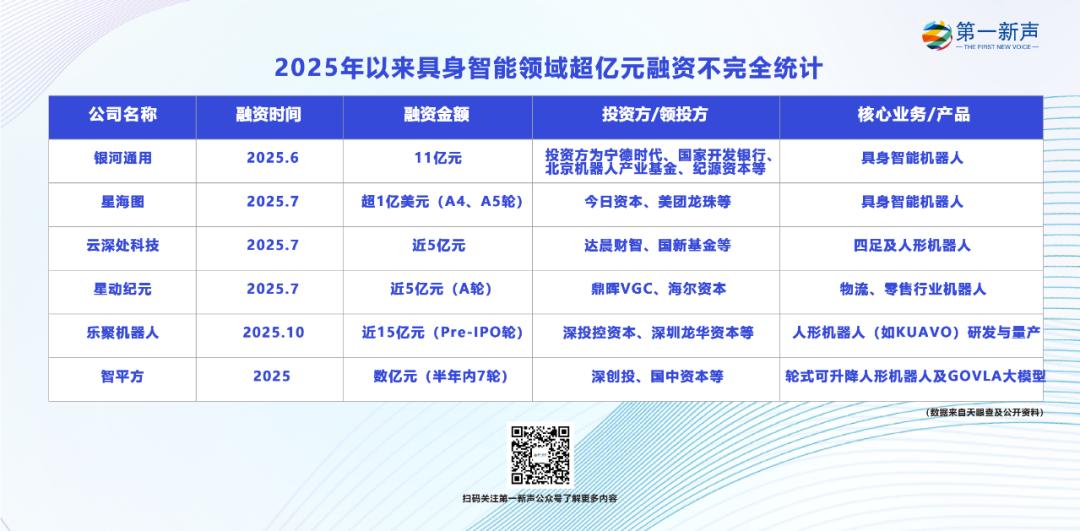
Industry Overview - The embodied intelligence sector is expected to experience explosive growth in commercialization by 2025, with humanoid robots transitioning from labs to various commercial applications at an unprecedented pace [1][3] - The global market for humanoid robots is projected to exceed 7 trillion USD by 2050, with China accounting for over 40% of the market by 2030 [3][4] - In 2025, China's embodied intelligence market is forecasted to reach approximately 5.295 billion CNY, representing about 27% of the global market, while the humanoid robot market is expected to reach 8.239 billion CNY, making up about 50% of the global market [3][4] Investment Trends - In the first eight months of 2025, the primary market financing in China's robotics sector reached 38.624 billion CNY, 1.8 times that of the entire year of 2024, with a significant increase in financing activities continuing into September [4][5] - Notable financing events include Galaxy General's 1.1 billion CNY round, Star Sea's over 100 million USD in two rounds, and multiple other companies securing substantial funding, indicating strong investor confidence in the sector [5][6] Major Players and Financing - The "billion-dollar club" includes companies like UBTECH, Zhiyuan Robotics, Galaxy General, and others, which have collectively secured significant orders and funding [8][9] - UBTECH has received over 630 million CNY in orders, while Galaxy General has surpassed 500 million CNY in orders, marking a shift towards commercial viability [12][13] - The financing landscape is characterized by high-value rounds, with over 40 projects in the embodied intelligence sector achieving billion-level financing, reflecting strong market interest [6][7] Commercialization Signals - The emergence of large orders is a decisive signal of the commercialization of embodied intelligence, with significant contracts validating the business model [8][15] - The transition from technology validation to market validation is evident, as companies are now focusing on revenue generation and operational efficiency [15][16] Future Outlook - The competition among investors to identify the next "investment king" in the embodied intelligence space is intensifying, with early investors in successful companies like UBTECH and Yushu Technology poised for substantial returns [16][17] - The investment landscape is dominated by top-tier VC/PE firms and major internet companies, indicating a robust interest in the sector's future growth potential [26][27]
AI+新能源,宜宾动力电池2.0如何进化?
高工锂电· 2025-11-11 12:29
Core Viewpoint - The article discusses how Yibin is positioning itself as a hub for advanced technologies such as all-solid-state batteries, AI for Science (AI4S), and embodied intelligence, aiming to create a sustainable ecosystem for innovation and industrial evolution [7][8][87]. Group 1: Technological Advancements - All-solid-state batteries signify a transition from liquid to solid energy systems, enhancing safety and energy density, and supporting comprehensive electrification [9][10]. - AI4S combines first-principles reasoning with deep learning to accelerate scientific discovery, particularly in complex fields like drug screening and new material generation [11][12][13]. - Embodied intelligence represents a critical transition for AI, moving from theoretical language models to practical applications in the physical world, addressing uncertainties and feedback [14][15][16]. Group 2: Yibin's Industrial Strategy - Yibin has established a complete industrial chain for power batteries, leveraging local resources and green electricity to enhance supply chain efficiency [21][22][29]. - The city is not creating a new industrial zone but is instead integrating existing resources to facilitate the next wave of technological evolution [23][24]. - Yibin's approach involves reusing materials and data from the 1.0 era to feed into the 2.0 technological advancements, creating a feedback loop for continuous improvement [25][28]. Group 3: Collaborative Ecosystem - The collaboration between local companies and research institutions is crucial for developing a self-learning system that integrates virtual and physical experimentation [42][43]. - Yibin's strategy includes a multi-route approach to technology development, allowing for parallel advancements in various materials and methods without betting on a single direction [72][75]. - The city is fostering a culture of innovation by allowing enterprises to define real needs and challenges, thus creating a dynamic and responsive industrial environment [68][70]. Group 4: Future Challenges and Opportunities - Yibin faces the challenge of maintaining a continuous cycle of high-quality innovation amidst rapid technological changes [88][92]. - The city is transitioning from being a mere industrial base to becoming an experimental production city, capable of adapting to new technological demands [108][110]. - The focus is on developing a platform that can iterate and adapt, ensuring that Yibin remains relevant in the fast-evolving technological landscape [94][102].


16年,这份榜单跑出130家上市公司、188家独角兽…
创业邦· 2025-11-11 10:27
Core Viewpoint - The "China's Top 100 Future Unicorns" list aims to identify and accelerate the growth of potential unicorn companies in China over the next decade, serving as a significant indicator of innovation in the economy [3][5]. Group 1: Historical Performance - Over 16 years, the list has recognized 1,302 companies, with 130 achieving IPOs, 106 being acquired by larger firms, and 188 becoming industry-leading unicorns [4][6]. - The annual "Future Unicorn Conference" has become a key event for emerging unicorns, providing networking and investment opportunities [4]. Group 2: Notable Companies - The list includes several well-known companies that have reached significant market valuations, such as Xiaomi, Meituan, and NIO, which were among the first to be recognized [7][8]. - A selection of companies that have recently become unicorns includes New Stone Unmanned Vehicles, which raised over $600 million in its D round, and Galaxy General, which secured 1.1 billion RMB in its A+ round [10][11]. Group 3: Future Prospects - The ongoing search for high-growth companies valued between $100 million and $1 billion is emphasized, with a call for nominations for the 2025 list [13]. - The initiative aims to celebrate not just valuation but also the intrinsic value of these emerging leaders in the business landscape [13].