成都银行

Search documents
30余股评级获上调!红利、科技受青睐,这类股评级遭下调
券商中国· 2025-09-10 13:28
Core Viewpoint - The recent surge in broker research activity has led to the identification of new investment opportunities, particularly in the electronics, machinery, pharmaceuticals, and power equipment sectors [1][2]. Group 1: Broker Research Activity - Over the past two weeks, brokers have conducted research on more than 870 listed companies, with the highest focus on electronics (119 companies), machinery (115 companies), and pharmaceuticals (106 companies) [2]. - The power equipment sector has seen a significant increase in research activity, with five companies from this sector appearing in the top 20 most-researched stocks [2][4]. Group 2: Notable Stocks and Ratings Adjustments - Among the most-researched stocks, Mindray Medical (300760.SZ) attracted 68 brokers' attention, focusing on its performance recovery and international business [2]. - Jinpan Technology (688676.SH) reported a backlog of orders amounting to 7.54 billion yuan, primarily driven by growth in wind power and energy storage [2]. - In the past two weeks, over 30 stocks had their ratings upgraded, particularly in high-dividend and technology sectors, including banks and public utilities [6][7]. Group 3: High-Dividend Stocks - Several high-dividend stocks have been upgraded, such as Chengdu Bank (601838.SH) and Changjiang Power (600900.SH), due to solid fundamentals and stable earnings [6][7]. - Analysts are optimistic about the mechanical equipment sector, with companies like Keli Sensor (603662.SH) and Anhui Heli (600761.SH) receiving upgrades based on their growth potential in robotics [7]. Group 4: Downgrades in the Beverage Sector - The food and beverage sector, particularly the liquor industry, has faced downgrades, with multiple stocks like Wuliangye (000858.SZ) and Jinhu Wine (603919.SH) being affected due to declining demand and industry adjustments [9][10]. - Analysts have cited the impact of alcohol bans and reduced consumer demand as reasons for the downgrades in liquor stocks [9].


公募新规影响银行理财,中小银行“抱团”申设理财子能否突围?
HWABAO SECURITIES· 2025-09-10 11:48
Investment Rating - The report does not explicitly provide an investment rating for the banking wealth management industry Core Insights - The new public offering sales fee regulations are expected to have a dual impact on banking wealth management, enhancing its traditional advantages in liquidity management and stability of returns, potentially attracting individual investors away from bond funds [11][12] - Several banks in Sichuan are actively pursuing joint applications for wealth management subsidiary licenses, which could serve as a significant demonstration for small and medium-sized banks to break through regional barriers [13] - The recent rise in gold prices has led wealth management subsidiaries to launch more gold-linked products, capitalizing on the market trend [14][15] Regulatory and Industry Dynamics - The new public offering sales fee regulations were released, marking the implementation of a three-step fee reduction strategy [11] - Banks in Sichuan are working together to apply for wealth management subsidiary licenses, which could optimize competition and resource utilization in the industry [13] - Wealth management subsidiaries are increasingly focusing on gold-linked products due to rising gold prices [14] Peer Innovation Dynamics -浦银理财 has launched a new wealth management product based on a "Five Forces" technology model to select investment opportunities [16] - 招银理财 has developed a global asset allocation index aimed at optimizing investment across major markets [17] - 招银理财 and 中诚信 have jointly released a defensive index to capture the performance of companies with defensive characteristics [18] - 交银理财 has introduced a diversified asset allocation index to balance risk and return across different market conditions [19] Yield Performance - Cash management products recorded a 7-day annualized yield of 1.30%, a decrease of 1 basis point from the previous week [20][21] - The yield of pure fixed-income products generally increased slightly, while the yield of fixed-income plus products decreased [21] - The bond market continues to exhibit a volatile pattern, with short-term rates remaining stable amid limited central bank interventions [21][22] Net Value Tracking - The net value of banking wealth management products has a broken net rate of 1.62%, a decrease of 0.57 percentage points from the previous week [28][31] - The credit spread has narrowed, indicating limited cost-effectiveness in the current market [30]
【银行理财】公募新规影响银行理财,中小银行“抱团”申设理财子能否突围?——银行理财周度跟踪(2025.9.1-2025.9.7)
华宝财富魔方· 2025-09-10 09:40
Key Points - The article discusses the impact of new public fund sales fee regulations on bank wealth management products, highlighting a dual effect on the liability and asset sides of banks [7][8] - It mentions the ongoing trend of banks in Sichuan province applying for wealth management subsidiary licenses, which could signify a restart in license approvals and provide a model for small and medium-sized banks [9][10] - The article notes the rising gold prices and how wealth management companies are launching gold-linked products to capitalize on this trend [11][12] - It outlines various innovations in the industry, including new product offerings from banks that leverage technology and quantitative models for investment selection [13][14][15][17] Regulatory and Industry Dynamics - The new public fund sales fee regulations were released on September 5, 2025, aiming to lower fees and optimize redemption arrangements, which will likely attract investors to bank wealth management products [7][8] - Several banks in Sichuan are actively pursuing joint applications for wealth management subsidiary licenses, which could enhance resource utilization and improve competitive dynamics in the industry [9][10] Market Performance - Cash management products recorded a 7-day annualized yield of 1.30%, while money market funds yielded 1.18%, both showing a slight decline [18] - The bond market continues to exhibit a volatile pattern, with short-term rates remaining stable and long-term rates fluctuating due to market sentiment [21][22] Innovations in Wealth Management -浦银理财 has introduced a technology-driven product using a "Five Forces" model to evaluate tech companies [13] - 招银理财 has developed a global asset allocation index that incorporates momentum factors for diversified investment [14] - The collaboration between 招银理财 and 中诚信 has led to the creation of a defensive index aimed at capturing low-volatility stocks [15] - 交银理财 has launched a multi-strategy asset allocation index that aims to balance risk and return across different market conditions [17]

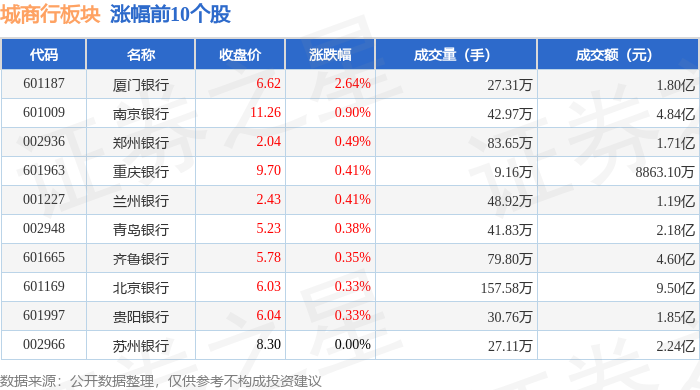
城商行板块9月10日跌0.31%,宁波银行领跌,主力资金净流出1.89亿元
Zheng Xing Xing Ye Ri Bao· 2025-09-10 08:37
从资金流向上来看,当日城商行板块主力资金净流出1.89亿元,游资资金净流出6222.34万元,散户资金 净流入2.52亿元。城商行板块个股资金流向见下表: 证券之星消息,9月10日城商行板块较上一交易日下跌0.31%,宁波银行领跌。当日上证指数报收于 3812.22,上涨0.13%。深证成指报收于12557.68,上涨0.38%。城商行板块个股涨跌见下表: | 代码 | 名称 | 收盘价 | 涨跌幅 | 成交量(手) | 成交额(元) | | --- | --- | --- | --- | --- | --- | | 601187 | 厦门银行 | 6.62 | 2.64% | 27.31万 | 1.80亿 | | 6000000 | 南京银行 | 11.26 | 0.90% | 42.97万 | 4.84亿 | | 002936 | 郑州银行 | 2.04 | 0.49% | 83.65万 | 1.71亿 | | 601963 | 重庆银行 | 9.70 | 0.41% | 1 9.16万 | 8863.10万 | | 001227 | 兰州银行 | 2.43 | 0.41% | 48.92万 | 261T ...

17年“桥梁”使命完成,成都银行外籍副董事长何维忠退休
Nan Fang Du Shi Bao· 2025-09-08 11:57
Core Viewpoint - The recent announcements from Chengdu Bank regarding the retirement of Vice Chairman Ho Wai Choong and the significant shareholding increase by state-owned enterprises indicate a new phase in the bank's collaboration with strategic investor Hong Leong Bank, reflecting local government confidence in the bank's long-term value [2][5]. Group 1: Management Changes - Ho Wai Choong, who served as Vice Chairman for 17 years, has officially retired and will no longer hold any positions within the company starting September 4, 2025 [3]. - His tenure is noted for facilitating the transformation of Chengdu Bank from attracting foreign investment to internalizing governance experiences, marking a shift towards self-optimization [4]. Group 2: State-Owned Enterprises' Shareholding Increase - On September 4, Chengdu Bank announced that state-owned shareholders, Chengdu Industrial Capital Holding Group and Chengdu Xintianyi Investment, have collectively increased their holdings by over 160 million yuan [5]. - Following this increase, Chengdu Industrial Capital's shareholding rose to 5.84%, while Chengdu Xintianyi's shareholding reached 3.90%, with both committing to not reduce their holdings within the legal timeframe [5]. Group 3: Business Development Potential - The combination of management changes and state-owned capital increases is expected to open new development opportunities for Chengdu Bank [6]. - The bank has achieved record performance in 2024, with total assets, deposits, and loans reaching 1.25 trillion yuan, 880 billion yuan, and 740 billion yuan respectively, marking a continuous growth trend [6]. - Chengdu Bank's non-performing loan ratio has decreased to a historical low of 0.66%, significantly better than the industry average, supported by a robust risk management system developed during Ho's tenure [6]. Group 4: Historical Context and Future Outlook - Chengdu Bank and Hong Leong Bank began their strategic partnership in 2007, with Hong Leong Bank becoming a significant shareholder in 2008 [7]. - The upcoming board seat replacements following Ho's retirement are anticipated to attract new international business collaborations, enhancing the bank's resource acquisition capabilities in areas like local infrastructure and green finance [8].

重要股东增持排行榜:9股增持金额超亿元
Zheng Quan Shi Bao Wang· 2025-09-08 01:37
Summary of Key Points Core Viewpoint - In the recent trading period from September 1 to September 5, a total of 33 companies experienced significant shareholder increases, with a cumulative increase of 393 million shares and a total investment of 6.151 billion yuan. Conversely, 160 companies saw shareholder reductions totaling 9.951 billion yuan [1]. Group 1: Shareholder Activity - The top three companies with the highest increase in shareholder investment were Gree Electric Appliances, with an increase of 41.86 million shares and an investment of 1.897 billion yuan; Yangtze Power, with 41.15 million shares and 1.164 billion yuan; and Chongqing Bank, with 55.6 million yuan [1]. - Three companies had shareholders increase their stakes more than twice in the past five days: Chengdu Bank, Xue Tian Salt Industry, and Jiaoda Sino [1]. - The distribution of shareholder increases showed that 2 companies were from the ChiNext board, 27 from the main board, and 4 from the Sci-Tech Innovation board, with the main board accounting for the majority of the investment [1]. Group 2: Market Performance - The average stock price of companies with shareholder increases fell by 1.80% over the past five days, underperforming the Shanghai Composite Index [2]. - Notable gainers included Nanfang Network Energy, Xue Tian Salt Industry, and Sailun Tire, with increases of 7.38%, 5.42%, and 4.94%, respectively [2]. - The companies with the largest net outflows included Gree Electric Appliances and Kweichow Moutai, with outflows of 1.010 billion yuan and 474 million yuan, respectively [2]. Group 3: Detailed Company Data - A detailed list of companies with shareholder increases included Gree Electric Appliances (41.86 million shares, 1.897 billion yuan, -2.91%), Yangtze Power (41.15 million shares, 1.164 billion yuan, -0.07%), and Chongqing Bank (52 million shares, 556.4 million yuan, -2.44%) [2][3]. - Other companies with significant shareholder increases included Chengdu Bank, Xue Tian Salt Industry, and Nanfang Network Energy, with respective increases and performance metrics detailed [3][4].



上市银行资产质量大扫描: 地产风险持续出清 零售贷款承压
Zheng Quan Shi Bao· 2025-09-07 18:27
Core Viewpoint - The overall non-performing loan (NPL) ratio of listed banks in China remains at an excellent level in the first half of 2025, with most banks showing stable or improved asset quality, while some retail loan segments are experiencing increased pressure on asset quality [1][7]. Group 1: Non-Performing Loan Ratios - Among A-share listed banks, 20 banks reported a decrease in NPL ratios, with declines ranging from 0.01 to 0.12 percentage points, while 15 banks maintained stable NPL ratios [2]. - Sixteen listed banks have NPL ratios below 1%, with Chengdu Bank reporting the lowest at 0.66% [2]. - Xi'an Bank achieved the largest reduction in NPL ratio, decreasing by 0.12 percentage points to 1.6% by the end of June [2][3]. Group 2: Risk Management Trends - The risk management trends highlighted by bank executives include the ongoing clearance of risks in real estate and local government financing platforms, while retail sectors like personal loans are under pressure [1][4]. - Agricultural Bank of China reported a 0.05 percentage point decrease in the NPL ratio for real estate loans by the end of June [4]. - The overall NPL ratio for state-owned banks averaged 1.21%, outperforming the industry average by 0.28 percentage points [3]. Group 3: Retail Loan Quality Concerns - Several banks, including Huaxia Bank and Chongqing Rural Commercial Bank, have seen increases in personal loan NPL ratios compared to the beginning of the year [7]. - Industrial and Commercial Bank of China noted that retail loan asset quality is generally declining due to market conditions, but expects improvements as economic policies take effect [7][8]. - Credit card transactions and personal loans are facing significant challenges due to consumption downgrades and adjustments in the real estate market, as stated by China Merchants Bank [7]. Group 4: Future Outlook - Analysts from Huatai Securities believe that the asset quality of corporate loans is improving, particularly in the real estate sector, with expectations for continued improvement in the second half of the year [6]. - Despite the overall stability in NPL ratios, there are concerns about the underlying asset quality, particularly in retail loans, which may face pressure from the actual economic conditions [8].
本周聚焦:2025上半年银行确认了多少金融资产处置收益?OCI浮盈有多少?
GOLDEN SUN SECURITIES· 2025-09-07 08:20
Investment Rating - The report maintains an "Increase" rating for the banking sector, indicating a positive outlook for the industry [1]. Core Insights - In the first half of 2025, the contribution of financial asset disposal gains from AC and OCI accounts to revenue reached 5.2%, an increase of 2.9 percentage points compared to 2024 [1][2]. - The investment income growth rate for 42 listed banks was 23.6%, with AC, OCI, and TPL gains showing year-on-year growth rates of 134.7%, 79.0%, and -8.4% respectively [1]. - The report highlights that the increase in disposal gains does not necessarily indicate a significant increase in asset disposal scale, as market conditions and strategies vary among banks [2]. Financial Asset Disposal Gains - The contribution of AC and OCI financial asset disposal gains to revenue was 5.2%, up 2.9 percentage points from 2024, with AC asset disposal gains contributing 2.6% [2]. - Among different types of banks, rural commercial banks had the highest contribution from AC and OCI disposal gains, reaching 11.0%, an increase of 6.2 percentage points from 2024 [2]. - Specific banks such as Jiangyin Bank, Sunong Bank, and Zijin Bank had high disposal gain ratios relative to their revenue, at 28.9%, 26.7%, and 22.7% respectively [2]. OCI Floating Profit Situation - The overall OCI floating profit decreased compared to the end of the previous year, accounting for 12.6% of the estimated profit for 2025 [3]. - Major state-owned banks like CCB and ABC reported significant OCI floating profits, with balances exceeding 30 billion [3]. - The average contribution of OCI floating profits to profits for city and rural commercial banks was notably high, with Ningbo Bank's ratio reaching 35% [3][6]. Sector Trends - The banking sector is expected to benefit from expansionary policies aimed at stabilizing the economy, with a focus on real estate and consumer spending [7]. - The report suggests a focus on banks with improving fundamentals, such as Ningbo Bank, and those with dividend strategies like Jiangsu Bank and Chengdu Bank [7]. - Attention is also drawn to banks with potential convertible bond conversion expectations, including Shanghai Bank and Industrial Bank [7].






成都银行上半年财报:盈利、风险、资本、监管四重挑战
Zheng Quan Zhi Xing· 2025-09-07 07:50
Group 1: Profitability and Business Performance - Chengdu Bank reported a revenue of 12.27 billion yuan, a year-on-year increase of 5.91%, and a net profit of 6.62 billion yuan, up 7.29% year-on-year, indicating positive growth but a significant slowdown compared to previous years [4][5] - The net profit growth rate of 7.29% is notably lower than the double-digit growth seen in some peer banks, reflecting insufficient momentum in profitability [4][5] - The bank's net income from fees and commissions dropped sharply by 45% year-on-year to 250 million yuan, primarily due to a decrease in wealth management fees, highlighting challenges in its intermediary business [4][5] Group 2: Asset Quality and Risk Exposure - Chengdu Bank's non-performing loan (NPL) ratio remained stable at 0.66%, but the provision coverage ratio fell by 26.64 percentage points to 452.65%, indicating increased asset quality pressure [7][9] - The NPL rates in specific sectors such as real estate and wholesale retail have risen, with the real estate NPL rate at 2.44%, up 29 basis points, and the wholesale retail NPL rate at 2.09%, up 32 basis points [7][8] - The total overdue loans increased significantly to 6.40 billion yuan from 5.22 billion yuan at the end of the previous year, with various overdue categories showing growth, indicating escalating credit risk [9][12] Group 3: Capital Adequacy and Regulatory Challenges - The core tier one capital adequacy ratio decreased to 8.61%, down 0.45 percentage points from the end of 2024, while the overall capital adequacy ratio fell to 13.13%, down 0.75 percentage points [13][14] - Despite meeting regulatory minimum requirements, the declining trend in capital adequacy ratios raises concerns, especially in a challenging risk management environment [13][14] - Chengdu Bank received a regulatory warning in January 2025 for deficiencies in its fund sales business, reflecting weaknesses in internal controls and compliance management [14][15]

银行股的城门立木——写在农业银行股价即将站上净资产之际
雪球· 2025-09-07 04:50
Core Viewpoint - The article discusses the contrasting performance of small-cap stocks and bank stocks in the A-share market, emphasizing the short-term gains in micro-cap and concept stocks while bank stocks have seen declines, highlighting a disconnect between market sentiment and fundamentals [2][3]. Summary by Sections Market Performance - Since July 2025, the ChiNext and STAR Market indices have risen approximately 30% in just two months, with some stocks increasing by 50-100%, while bank stocks have averaged a decline of about 10% [2]. - The article notes a peculiar trend where stocks with worsening fundamentals, such as liquor stocks, have rebounded significantly despite poor earnings, indicating a market behavior that often disregards fundamentals [2]. Investment Behavior - New investors are often swayed by short-term market movements, leading to a preference for high-volatility stocks that promise quick returns, which can result in losses when the market corrects [4][5]. - The article suggests that long-term investment in bank stocks requires a strong understanding and discipline, as many investors struggle to hold onto these stocks during downturns [3][4]. Valuation and Future Outlook - Bank stocks, particularly Agricultural Bank and China Merchants Bank, are highlighted as potential benchmarks for valuation, with Agricultural Bank's stock price nearing its net asset value, indicating a possible upward trend in valuation [6][10]. - The article identifies several city commercial banks, such as Chengdu Bank and Hangzhou Bank, as having strong fundamentals and potential for future growth, with current price-to-book ratios indicating they are undervalued [8][9]. Long-term Investment Strategy - The article advocates for a long-term investment strategy focused on banks with solid fundamentals, low valuations, and good growth potential, suggesting that investors should aim for annualized returns of 12-15% [9][10]. - It emphasizes the importance of selecting quality stocks based on fundamental analysis rather than short-term price movements, as this approach can lead to sustainable profits in the long run [10].