天弘基金

Search documents
数智技术外溢,天弘基金助力渠道伙伴高质量发展
Xin Lang Ji Jin· 2025-11-21 06:16
Core Insights - The public fund industry is undergoing a technological transformation, driven by the integration of "Artificial Intelligence+" into government initiatives and the emphasis on "digital finance" and "inclusive finance" [1] - The trend in the public fund industry is shifting towards "light issuance, heavy holding, and heavy service," indicating a move from simple product distribution to deep collaborative partnerships with sales channels [1] Industry Trends - The total scale of public funds has reached 36.25 trillion yuan, shifting the focus from scale expansion to high-quality development [2] - Issues such as "funds making money while investors do not," the impact of fee reforms on income structures, and the personalization of customer demands are pushing public funds and sales channels to break down barriers and build a collaborative ecosystem [2] - Future competition in the industry will center around "ecological capabilities," requiring a deep integration of public fund research and product capabilities with the customer reach and operational capabilities of sales channels [2] Technological Integration - The maturity of AI and digital technologies is providing critical support for deep collaboration, reducing service marginal costs and improving response efficiency [2] - The wealth management industry is transitioning from the preliminary stage of product and service online to a new stage of intelligence [2] Case Studies - Tianhong Fund's FinAgent financial intelligence tool exemplifies the focus on scenario-based implementation, enhancing service quality and efficiency [3] - The "Strategy Target Investment" tool developed in collaboration with JD Finance has significantly increased user engagement, with trading user numbers and transaction volumes rising by 3-5 times since its launch on June 27, 2025 [3] - The "Institutional Express" ETF investment tool, developed with Ping An Securities, has achieved a back-tested return of 48.18% over the past year, outperforming the CSI 300 index by 32 percentage points [4] Talent Development - Tianhong Fund's "Gold Medal AI Trainer" addresses the talent cultivation challenges in traditional channels by providing immersive training for bank wealth managers [4] - Over 700 wealth managers have participated in this training program, accumulating more than 20,000 minutes of training time, effectively enhancing their investor service capabilities [4] Future Outlook - The boundaries of institutional collaboration in the public fund industry's high-quality development are being continuously expanded by digital technologies [5] - The focus on investor-centric approaches and open ecosystems will inject lasting momentum into the high-quality development of the wealth management industry [5]
爆发式增长!突破2500亿元
Zhong Guo Zheng Quan Bao· 2025-11-21 04:25
Core Insights - Domestic index investment has experienced explosive growth this year, with ETF product issuance entering a "fast lane" [1] - As of November 20, the number of newly established domestic ETFs and the total issuance scale have reached historical highs, surpassing 250 billion yuan, representing a doubling compared to 2024 [2] Group 1: ETF Product Growth - A total of 328 new ETFs have been established this year, with a combined issuance scale exceeding 250 billion yuan, marking a historical high [2] - The newly launched bond ETFs include 24 and 8 public fund institutions participating in the Sci-Tech Bond ETF and Benchmark Market Credit Bond ETF, with issuance scales of 69.773 billion yuan and 21.710 billion yuan respectively [2] - Equity ETFs focusing on themes such as "Double Innovation" and Hong Kong technology have gained popularity among public fund institutions, leading to significant increases in related index product allocations [2] Group 2: Performance of Newly Established ETFs - Newly established ETFs tracking themes like "Double Innovation," cash flow, and Hong Kong innovative pharmaceuticals have generally seen scale growth, with new scales exceeding 5 billion yuan for several products [3] - ETFs tracking the Sci-Tech Composite Index and the CSI A500 have seen a reduction in scale, with decreases of over 12 billion yuan and 7 billion yuan respectively [3] Group 3: Market Dynamics and New Entrants - The "Matthew Effect" continues in the ETF business, with major index firms actively expanding their ETF product lines while other public fund institutions explore differentiated and specialized strategies [4] - Major fund companies like E Fund, Fortune Fund, and Huaxia Fund have established over 20 new ETFs this year, with issuance scales of 18.828 billion yuan, 15.994 billion yuan, and 15.581 billion yuan respectively [4] - Smaller public fund institutions are also entering the ETF market, with companies like Changjin Heixin and Great Wall Fund launching their first ETFs this year [6]
建筑材料、银行等防御类ETF逆市领涨丨ETF基金日报
2 1 Shi Ji Jing Ji Bao Dao· 2025-11-21 03:09
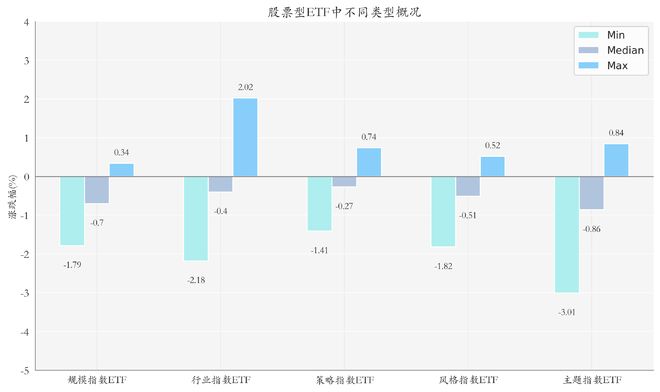
Market Overview - The Shanghai Composite Index fell by 0.4% to close at 3931.05 points, with a high of 3967.97 points during the day [1] - The Shenzhen Component Index decreased by 0.76% to 12980.82 points, reaching a peak of 13226.04 points [1] - The ChiNext Index dropped by 1.12% to 3042.34 points, with a maximum of 3137.07 points [1] ETF Market Performance - The median return of stock ETFs was -0.67% [2] - The highest performing scale index ETF was the China Southern Shenzhen 100 ETF with a return of 0.34% [2] - The top industry index ETF was the China Tai Zhongzheng All Index Building Materials ETF, yielding 2.02% [2] - The highest return among strategy index ETFs was the China Tai Baichuan Zhongzheng Dividend Low Volatility ETF at 0.74% [2] - The best performing thematic index ETF was the Yinhua Zhongzheng Mainland Real Estate Theme ETF, with a return of 0.84% [2] ETF Performance Rankings - The top three ETFs by return were: - Guotai Zhongzheng All Index Building Materials ETF (2.02%) [4] - Fuguo Zhongzheng All Index Building Materials ETF (1.56%) [4] - Huabao Zhongzheng 800 Real Estate ETF (1.52%) [4] - The worst performing ETFs included: - Penghua SSE Sci-Tech Innovation Board New Energy ETF (-3.01%) [4] - Yifangda SSE Sci-Tech Innovation Board New Energy ETF (-2.91%) [4] - Fuguo SSE Sci-Tech Innovation Board New Energy ETF (-2.78%) [4] ETF Fund Flows - The top three ETFs by fund inflow were: - Southern Zhongzheng 500 ETF (7.6 billion) [6] - Huaxia SSE Sci-Tech Innovation Board 50 Component ETF (7.59 billion) [6] - Southern Zhongzheng 1000 ETF (4.18 billion) [6] - The largest outflows were from: - Huabao Zhongzheng Bank ETF (4.33 billion) [6] - Huatai Baichuan SSE 300 ETF (4.07 billion) [6] - Huabao Zhongzheng Financial Technology Theme ETF (3.25 billion) [6] ETF Margin Trading Overview - The highest margin buy amounts were: - Huaxia SSE Sci-Tech Innovation Board 50 Component ETF (5.56 billion) [8] - Guotai Zhongzheng All Index Securities Company ETF (4.8 billion) [8] - Yifangda ChiNext ETF (4.78 billion) [8] - The largest margin sell amounts were: - Southern Zhongzheng 500 ETF (37.88 million) [8] - Huatai Baichuan SSE 300 ETF (37.87 million) [8] - Huaxia Zhongzheng A500 ETF (25.01 million) [8] Institutional Insights - Huafu Securities suggests that the building materials capacity cycle may reach an inflection point due to accelerated expectations of "anti-involution" [9] - The combination of declining interest rates and monetary support for housing may stabilize the real estate market, potentially boosting post-cycle demand [9] - Debon Securities highlights that undervalued financial stocks, such as insurance and banks, possess defensive allocation value amid a weak market [10]

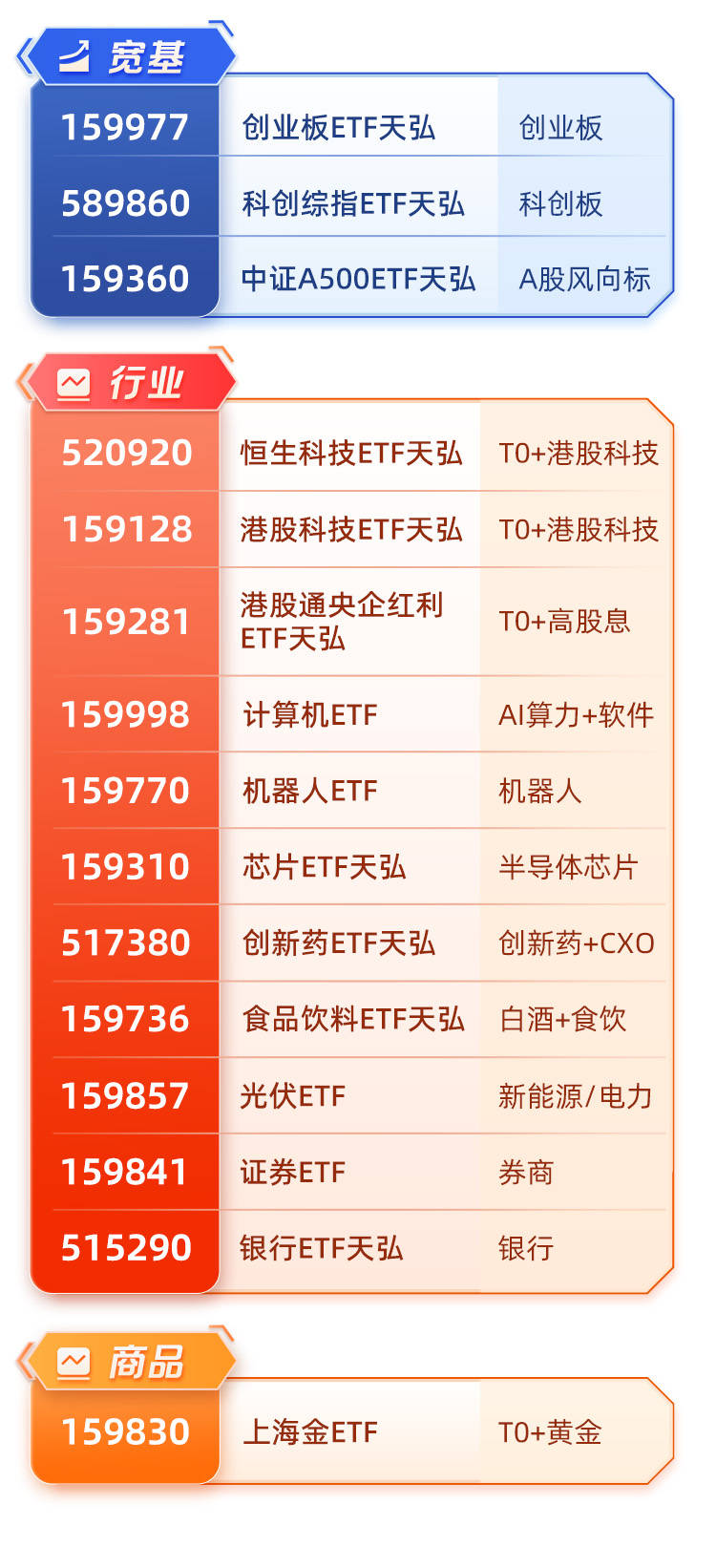
农业ETF天弘(512620)今日上市!政策护航+龙头红利+估值修复,农业板块有望释放成长新行情
Sou Hu Cai Jing· 2025-11-21 02:09
Group 1 - The Tianhong Agricultural ETF (code: 512620) was officially listed on November 21, 2023, and aims to benefit from supportive policies and a strong agricultural sector [1] - The fund tracks the CSI Agricultural Index, selecting 50 stocks with significant representation in breeding (41.9%) and agricultural chemicals (17.7%), including leading companies like Muyuan and Haida [1] - The current index P/E ratio is below the 10th percentile of the past decade, indicating a valuation opportunity, especially with rising pig prices and institutional capital inflow [1] Group 2 - The National Development and Reform Commission conducted a survey from November 16 to 18 to enhance grain purchase and storage management, emphasizing the need for market monitoring and effective policy implementation [2] - A video conference on November 7 highlighted the importance of high-standard farmland construction and modernizing irrigation systems to ensure food security and agricultural modernization [3] - Galaxy Securities anticipates that the agricultural sector will focus on identifying turning points in 2026, with investment opportunities centered around pig breeding and the pet sector [3]
政策红利再加码!农业ETF(512620)今日上市,一键布局农业核心资产
2 1 Shi Ji Jing Ji Bao Dao· 2025-11-21 01:37
Group 1 - The A-share market saw a collective decline in the three major indices, with the agricultural sector showing strong performance in certain stocks, such as Luoniushan, which rose over 7% [1] - The newly launched Tianhong Agricultural ETF (512620) closely tracks the CSI Agricultural Index, covering sectors like breeding and agrochemicals, and includes leading agricultural companies such as Muyuan Foods and Wens Foodstuff Group [1] - The Ministry of Agriculture and Rural Affairs and the Xinjiang Uygur Autonomous Region government announced a plan to modernize agricultural facilities, aiming to renovate 30,000 acres and add 20,000 acres of modern agricultural production by the end of 2028 [1] Group 2 - Zhongjin Company highlighted that policy support and technological innovation will be key drivers for the future development of the planting industry chain, with a positive outlook on investment opportunities in leading agricultural enterprises [2] - The company believes that under the paradigm shift and the trend of stronger players becoming stronger, leading enterprises possess greater development potential [2]



又要见证历史!超5万亿市场传来大消息!
天天基金网· 2025-11-21 01:07
Core Viewpoint - The recent regulatory changes in the ETF market aim to enhance product identification and investor experience, addressing the issue of name homogeneity among ETFs [3][5][10]. Summary by Sections Regulatory Changes - The Shanghai and Shenzhen Stock Exchanges have introduced new guidelines for the naming of existing ETFs, requiring that names include the fund manager's abbreviation and follow specific structural formats [3][6][7]. - The deadline for fund managers to complete the renaming process is set for March 31, 2026 [6][7]. Market Impact - The new naming conventions are expected to improve the recognition and attractiveness of ETF products, allowing investors to make quicker and more informed decisions [3][9][12]. - The ETF market has surpassed 5 trillion yuan, and the renaming initiative is seen as a significant step towards strengthening the index investment ecosystem [12]. Industry Response - Several fund companies, including E Fund, Huatai-PB, and GF Fund, have already begun the process of renaming their ETFs to align with the new guidelines, enhancing clarity and ease of identification for investors [11][12]. - Industry experts believe that the inclusion of fund manager names in ETF titles will favor well-known brands, potentially disadvantaging smaller firms in a competitive market [12].

AI入场“挑战”基金经理
Zheng Quan Ri Bao· 2025-11-20 23:18
Core Viewpoint - The public fund industry is facing a transformative wave driven by AI, which is seen as a necessary evolution rather than a mere trend, with AI becoming a critical factor for long-term industry development [1][2]. Group 1: Internal Demand Driving AI Adoption - The push for AI adoption in public funds is driven by the urgent need to address deep-seated industry pain points, with firms like Tianhong Fund emphasizing that AI is not just a trend but a means to break through existing challenges [2]. - The asset management industry has a significant demand for advanced AI technologies due to its reliance on data analysis and information processing, as highlighted by various fund companies [2]. - Traditional business models are in urgent need of digital transformation, and AI is seen as a key to enhancing competitiveness by efficiently processing vast amounts of information and automating processes [2][3]. Group 2: AI's Role in Enhancing Research Capabilities - AI is increasingly integrated into core business lines such as research, marketing, and customer service, leading to an upgrade in fund research capabilities [4]. - In active management, AI serves as a powerful assistant, helping to identify opportunities from vast data and providing quantifiable advantages in predictive modeling [4][6]. - AI can also challenge traditional thinking among fund managers, prompting them to consider risks and opportunities that may be overlooked by human intuition [6]. Group 3: Data Security and Model Reliability Concerns - As AI becomes more embedded in the industry, data security and model reliability have emerged as critical concerns, with analysts noting risks such as data leakage and compliance issues [7]. - Fund companies are actively working to establish robust data security measures, with Tianhong Fund implementing a multi-layered control system to ensure the reliability of AI conclusions [7]. - The need for accurate and secure data is paramount, as financial data is highly sensitive and involves customer privacy, necessitating careful management of data integration across institutions [7]. Group 4: Future Outlook for AI in the Industry - The future application of AI in the public fund industry is expected to evolve, focusing on relieving professionals from repetitive tasks and allowing them to concentrate on value creation [8]. - The industry is still in the exploratory phase of AI application, with potential advancements in building specialized models and enhancing collaboration across institutions [8]. - Companies like Yifangda Fund are setting examples in AI talent development, emphasizing the integration of technology, business understanding, and compliance awareness to drive financial AI innovation [8].
是助手更是诤友 AI入场“挑战”基金经理
Zheng Quan Ri Bao· 2025-11-20 16:16
Core Insights - The public fund industry is facing a significant transformation driven by the adoption of AI technologies, which are seen as essential for long-term development rather than a mere trend [1][2] - AI is increasingly viewed as both a challenger to traditional fund management practices and a means to enhance research capabilities within the industry [1][4] Group 1: Internal Demand for AI - The push for AI adoption in public funds is primarily driven by the urgent need to address deep-seated industry challenges, such as efficiency improvement and risk control [2][3] - AI technologies are crucial for processing vast amounts of data and automating workflows, which are essential for enhancing competitiveness in asset management [2][3] - Institutions like Tianhong Fund have recognized that traditional models lead to diminishing returns as scale increases, and AI enables "intelligent scaling" to convert scale advantages into service capabilities [2][3] Group 2: AI's Role in Investment Research - AI is enhancing the investment research capabilities of fund companies by serving as both an assistant and a challenger to traditional thinking [4][5] - In active management, AI tools like Tianhong's TIRD platform and deep learning models from other firms are proving effective in identifying investment opportunities from large datasets [4][5] - AI can sometimes provide contrary signals to fund managers, which can help mitigate risks and protect performance, showcasing the value of human-machine collaboration [5][6] Group 3: Data Security and Model Reliability - As AI becomes more integrated into core business functions, data security and model reliability have emerged as critical concerns for the industry [6][7] - Challenges include data leakage, compliance risks, and the need for accurate and secure data management practices [6][7] - Firms are actively developing comprehensive security frameworks to ensure the reliability of AI-driven conclusions while maintaining data privacy [7] Group 4: Future Outlook for AI in Public Funds - The future application of AI in the public fund industry is expected to evolve, focusing on reducing repetitive tasks and enhancing value creation through better decision-making [7][8] - The industry is still in the exploratory phase of AI application, with potential advancements in specialized models and cross-institutional data collaboration [7][8] - Companies like E Fund are leading in AI talent development, emphasizing the integration of technology, business understanding, and compliance awareness to drive innovation [7][8]
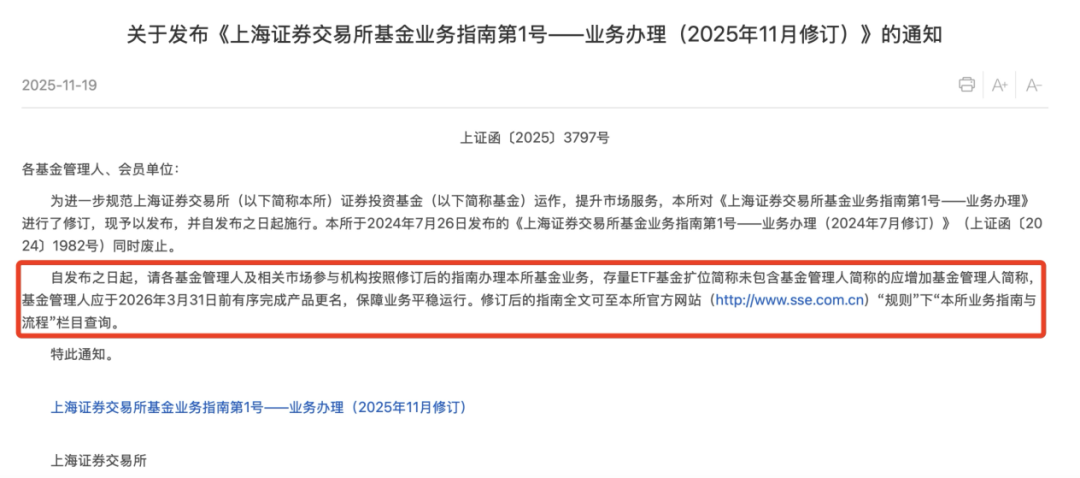
又要见证历史!超5万亿市场传来大消息!存量ETF名称迎来统一规范
Zhong Guo Ji Jin Bao· 2025-11-20 10:51
Core Viewpoint - The recent regulatory changes by the Shanghai and Shenzhen Stock Exchanges aim to standardize the naming conventions for existing ETF funds, enhancing product recognition and investor experience in a rapidly growing market [2][3][9]. Group 1: Regulatory Changes - The Shanghai and Shenzhen Stock Exchanges have issued revised guidelines for ETF fund naming, requiring existing ETFs to include the fund manager's abbreviation in their names by March 31, 2026 [2][7]. - The new naming structure for ETFs will follow the format of "core investment element + ETF" and for enhanced ETFs, "core investment element + enhanced + ETF" [6][9]. Group 2: Market Impact - The standardization of ETF names is expected to improve product differentiation and recognition, addressing the issue of name homogeneity that investors face [3][9]. - Several fund companies, including E Fund, Huatai-PB, and GF Fund, have already begun renaming their ETFs to align with the new guidelines, which is anticipated to enhance investor decision-making efficiency [2][10][12]. Group 3: Industry Consensus - There is a consensus within the fund industry that improving ETF name recognition is crucial due to the increasing number of products and intensified competition [9][12]. - The inclusion of fund manager names in ETF titles is likely to benefit well-known brands, potentially disadvantaging smaller firms in a competitive market [12][13].
又要见证历史!超5万亿市场,传来大消息!
Zhong Guo Ji Jin Bao· 2025-11-20 10:45
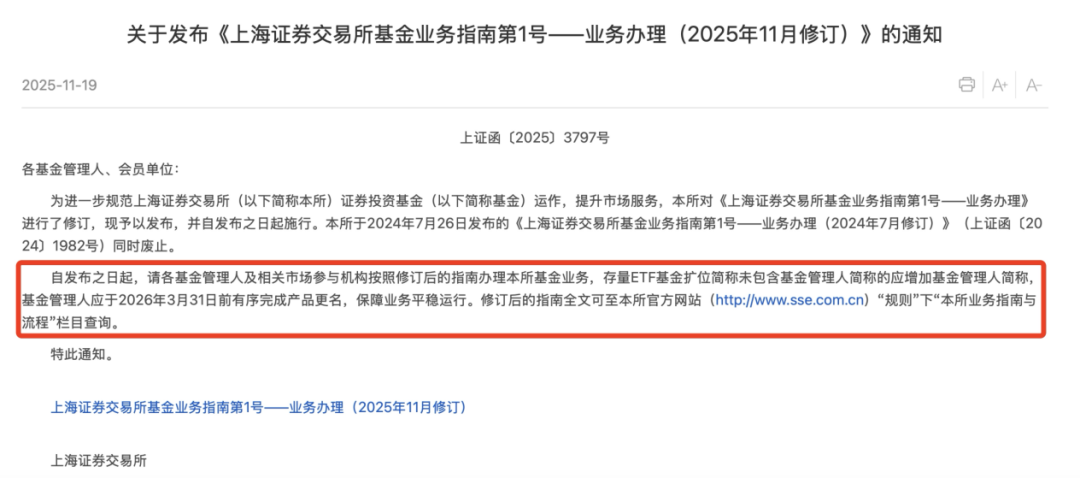
Core Viewpoint - The Shanghai and Shenzhen Stock Exchanges have issued new guidelines to standardize the naming conventions for existing ETFs, aiming to enhance product recognition and investor experience in a rapidly growing market valued at 5.7 trillion yuan [1][2][14]. Summary by Sections ETF Naming Standardization - The new rules require existing ETF names to follow a specific structure: "Core Investment Element + ETF" for standard ETFs and "Core Investment Element + Enhanced + ETF" for enhanced ETFs, both including the fund manager's abbreviation [2][6]. - Fund management companies must complete the renaming process by March 31, 2026, to ensure smooth business operations [7]. Market Impact and Industry Response - The standardization is expected to improve product differentiation and attract more investors, as many ETFs have similar names, leading to confusion [3][10]. - Several fund companies, including E Fund, Huatai-PB, and GF Fund, have already begun renaming their ETFs to align with the new guidelines, enhancing clarity and ease of identification for investors [10][11][12]. Historical Context and Future Outlook - The push for standardized ETF names has been ongoing since 2022, with previous initiatives aimed at improving the management of ETF abbreviations [10]. - The introduction of clearer naming conventions is anticipated to lower search costs for investors and may favor well-known fund companies, potentially increasing competition for smaller firms in the ETF market [13][14].