
凯莱英

Search documents
中欧基金葛兰:一季度医药板块有望延续结构性行情,看好创新药械产业链出海、消费医疗等投资机会
Sou Hu Cai Jing· 2026-01-23 06:53
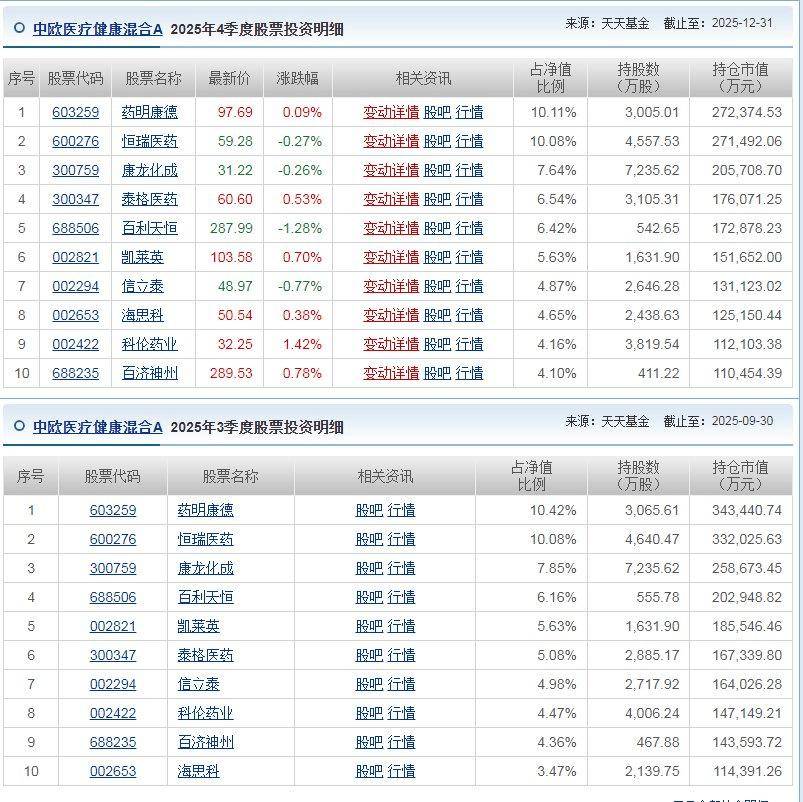
Core Viewpoint - The report highlights the performance of the China Europe Medical Health Mixed Fund managed by Ge Lan and Zhao Lei, indicating a decline in total fund size and negative returns compared to benchmarks [1][4]. Fund Performance - As of December 31, 2025, the total size of the funds managed by Ge Lan decreased from 43.544 billion to 35.389 billion yuan [1]. - The A-class share of the China Europe Medical Health Mixed Fund recorded a net value growth rate of -14.81%, while the C-class share saw a decline of -14.98%, both underperforming the benchmark return of -8.21% [1][3]. Holdings Overview - The top ten holdings of the China Europe Medical Health Fund include WuXi AppTec, Heng Rui Medicine, and Kanglong Chemical, with notable increases in holdings for Hai Si Ke and Tai Ge Medicine, while reductions were seen in stocks like Ke Lun Pharmaceutical and Xin Li Tai [1][2]. Market Context - In Q4 2025, the CSI Pharmaceutical Index fell by 12.7%, underperforming the CSI 300 Index, which declined by only 0.2%. The report notes significant differentiation within sub-sectors, with innovative industries experiencing corrections while traditional Chinese medicine and pharmaceutical commerce remained relatively stable [3]. Future Outlook - Looking ahead to Q1 2026, improvements in global liquidity are expected to boost investment and financing in innovative pharmaceuticals, supported by domestic policy enhancements. The innovative drug and device industry is anticipated to maintain a high level of activity, with several key domestic drugs approaching critical data readouts [4][5]. - The report suggests that the pharmaceutical sector may continue to experience structural trends due to macroeconomic improvements, supportive industry policies, and ongoing innovation, with investment opportunities focusing on the progress of innovative drug and device exports, domestic substitution in equipment, and recovery in consumer healthcare demand [5].




中欧基金葛兰:一季度医药板块有望延续结构性行情 看好创新药械产业链出海、消费医疗等投资机会
Zhi Tong Cai Jing· 2026-01-23 06:33
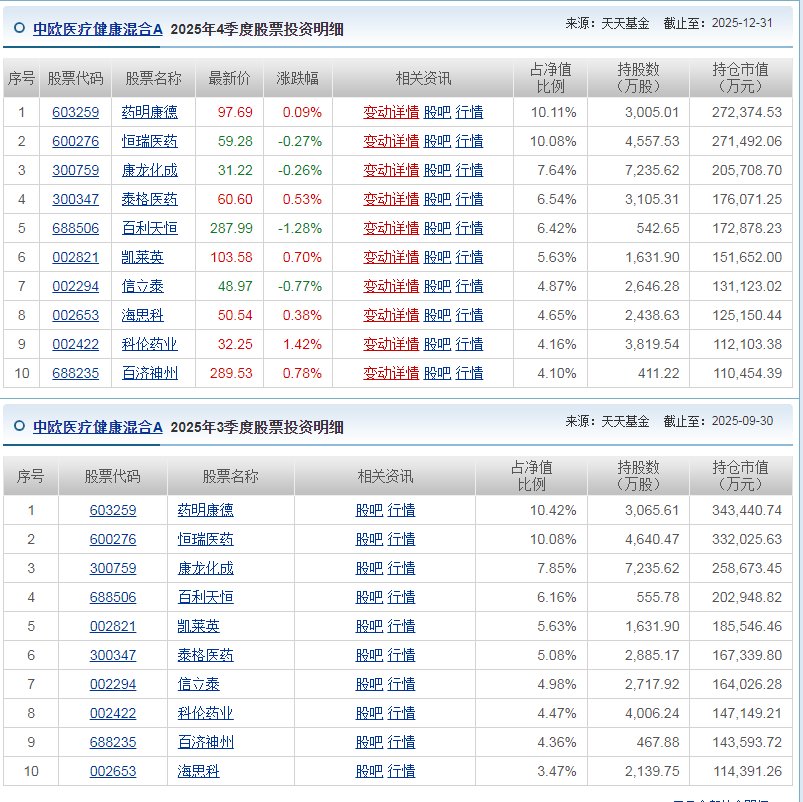
Core Viewpoint - The report highlights the performance of the China Europe Medical Health Mixed Fund, managed by Ge Lan and Zhao Lei, indicating a decline in total fund size and negative returns compared to benchmarks for the fourth quarter of 2025 [1][4]. Fund Performance - As of December 31, 2025, the total size of funds managed by Ge Lan decreased from 43.544 billion to 35.389 billion yuan [1]. - The net value growth rate for Class A shares of the China Europe Medical Health Mixed Fund was -14.81%, while the benchmark return was -8.21% [1]. - Class C shares experienced a net value growth rate of -14.98%, also underperforming the benchmark [1]. Holdings Overview - The top ten holdings of the China Europe Medical Health Mixed Fund include WuXi AppTec, Heng Rui Medicine, and Kanglong Chemical, with notable increases in holdings for Hai Si Ke and Tai Ge Medicine, while reductions were seen in stocks like Ke Lun Pharmaceutical and Xin Li Tai [1][2]. - The largest holding, WuXi AppTec, accounted for 10.11% of the fund's net value, with a market value of approximately 2.724 billion yuan [2]. Market Context - The CSI Medical Index fell by 12.7% in the fourth quarter of 2025, underperforming the Shanghai and Shenzhen 300 Index, which declined by only 0.2% [3]. - There was significant differentiation within sub-sectors, with the innovative industry chain entering a correction phase after previous gains, while traditional Chinese medicine and pharmaceutical commerce showed relative stability [3]. Future Outlook - Looking ahead to the first quarter of 2026, improvements in global liquidity are expected to boost investment and financing in innovative drugs, supported by domestic policy enhancements [4]. - The innovative drug and medical device industry chain is anticipated to maintain high levels of activity, with several key domestic drugs approaching critical data readout points [5]. - The CXO sector is expected to benefit from a recovery in biotechnology financing, leading to improved order conditions [5]. - The pharmaceutical sector is projected to experience structural trends driven by macroeconomic improvements, supportive industry policies, and ongoing innovation [5].
中国另一张王牌
投资界· 2026-01-23 01:01
Core Viewpoint - The article emphasizes China's dominant position in the global pharmaceutical supply chain, particularly in the production of Active Pharmaceutical Ingredients (APIs) and Key Starting Materials (KSMs), which poses a significant asymmetric threat to U.S. national security [3][4][10]. Group 1: China's Dominance in Pharmaceutical Supply Chain - China holds a near-monopoly in several key areas of pharmaceutical production, including over 90% of global antibiotic intermediates and 70%-80% of vitamin production capacity [13][10]. - The U.S. and Europe dominate patented and biological drugs, while India is known as the "world's pharmacy" for its large-scale production of generic drugs, but it relies heavily on China for approximately 70% of its active ingredients and intermediates [10][22]. - The integration of China's chemical industry has created significant cost advantages, with production costs being 30%-40% lower than those in Europe and the U.S., and even 20% lower than in India [15][18]. Group 2: Implications of Supply Chain Dependency - The U.S. faces a critical dependency on Chinese pharmaceutical supplies, which could lead to severe shortages in essential medications, as highlighted by potential disruptions in supply chains due to geopolitical tensions [4][6]. - The FDA's reports indicate ongoing drug shortages in the U.S., exacerbated by the complex and often misleading nature of pharmaceutical supply chains, where active ingredients may originate from various countries, including China [6][7]. - The article warns that the "asymmetric interdependence" between the U.S. and China in the pharmaceutical sector could lead to significant vulnerabilities for the U.S. healthcare system [4][6]. Group 3: Future Outlook and Strategic Considerations - As the U.S. pushes for decoupling from China, the article suggests that rebuilding a lost industrial base in pharmaceuticals will be a long and challenging process, requiring a new generation of skilled engineers and a cultural shift towards accepting chemical manufacturing [29][30]. - The article posits that while China currently holds a strategic advantage, it must remain vigilant against emerging technologies in biomanufacturing that could disrupt its dominance [30]. - The future of the pharmaceutical industry will hinge on balancing efficiency and safety, with the ability to provide lower-cost, safer drugs being a key competitive factor [31].

医药周报:基药目录前瞻、JPM大会看点
Guolian Minsheng Securities· 2026-01-22 02:45
Investment Rating - The report maintains a positive investment rating for the pharmaceutical sector [6] Core Insights - The pharmaceutical sector experienced a week-on-week decline of 0.68%, underperforming compared to the ChiNext and CSI 300 indices, ranking 17th among all industries [2][36] - The report emphasizes the importance of innovation, international expansion, and overcoming challenges as key themes for investment in 2026, with a focus on BD 2.0, small nucleic acids, and supply chain opportunities [3][4] - The upcoming adjustment of the National Essential Drug List is seen as critical, aiming to address clinical needs that have evolved since the last update in 2018, particularly in pediatrics, oncology, and rare diseases [5][14] Summary by Sections National Essential Drug List Adjustment Analysis - The current drug list has not been updated since 2018, leading to a disconnect with clinical needs, necessitating a systematic adjustment [14] - The adjustment will focus on filling gaps in disease coverage, particularly in pediatrics, oncology, and rare diseases, while also solidifying the integration of collective procurement and national negotiation outcomes [18][19] - The report identifies potential beneficiaries in traditional Chinese medicine, particularly in areas with previously weak coverage [28] JP Morgan Conference Overview - The 44th JP Morgan Health Conference highlighted strategic developments from major global pharmaceutical companies, showcasing their core pipeline advancements and key clinical milestones for 2026 [33] - Companies like Pfizer, Merck, and Eli Lilly presented their focus on innovative treatments and upcoming clinical trials, indicating a robust pipeline for future growth [34][35] Pharmaceutical Market Review and Hotspot Tracking - The pharmaceutical sector's performance in early 2026 has shown a 7.08% increase, outperforming both the CSI 300 and ChiNext indices [36] - The report notes a shift in market sentiment, with certain innovative sectors like AI healthcare and medical robotics showing strong performance, while traditional sectors faced adjustments [2][3]
医药周报:基药目录前瞻、JPM大会看点-20260122
Guolian Minsheng Securities· 2026-01-22 01:04
Investment Rating - The report maintains a "Hold" rating for the pharmaceutical sector [6] Core Insights - The pharmaceutical sector experienced a week-on-week decline of 0.68%, underperforming both the ChiNext Index and the CSI 300 Index, ranking 17th among all industries [2][36] - The report emphasizes a positive outlook for innovation, international expansion, and turnaround opportunities in the pharmaceutical industry, with a focus on BD 2.0, small nucleic acids, and supply chain [3][4] Summary by Sections 1. National Essential Drug List Adjustment Analysis - The adjustment of the National Essential Drug List is urgent as the current version has not been updated since 2018, leading to a disconnect with current clinical needs [14] - The new adjustments will focus on three main areas: addressing gaps in disease coverage, solidifying the integration of centralized procurement and national negotiation results, and enhancing the evidence-based standards for traditional Chinese medicine [5][14] - Potential beneficiaries from the adjustments include companies like Panlong Pharmaceutical, Guizhou Sanli, and Yiling Pharmaceutical, particularly in pediatrics, orthopedics, and cardiovascular fields [5][28] 2. JP Morgan Conference Overview - The 44th JP Morgan Health Conference highlighted strategic developments from major global pharmaceutical companies, showcasing their core pipeline progress and key clinical milestones for 2026 [33] - Companies such as Pfizer, Merck, and Eli Lilly presented their focus on advancing clinical trials and launching new products in various therapeutic areas [34][35] 3. Pharmaceutical Market Review and Hotspot Tracking - The pharmaceutical sector's performance from January 12 to January 16 showed a decrease of 0.68%, with a total trading volume of 916.83 billion yuan, accounting for 5.35% of the total market [2][36] - The report notes that the sector has shown a year-to-date increase of 7.08%, outperforming both the CSI 300 and ChiNext indices [36]
谭冬寒2025年四季度表现,工银领航三年持有混合基金季度跌幅5.02%
Sou Hu Cai Jing· 2026-01-21 23:25
Group 1 - The core viewpoint of the article highlights the performance of fund manager Tan Donghan, who manages a total of 9 funds, with the best-performing fund being ICBC Vanguard Three-Year Holding Mixed Fund (018446), which experienced a net value decline of 5.02% in the latest quarter [1] - During Tan Donghan's tenure as the manager of ICBC Medical Health Stock A (006002), the cumulative return reached 177.8%, with an average annualized return of 14.62% [1] - The number of adjustments made to the heavy-weight stocks during this period was 58, with a profit rate of 62.07%, resulting in 36 profitable adjustments and 7 instances of doubling returns, with a total doubling rate of 12.07% [1] Group 2 - Example of a doubling case with Yingke Medical (300677): The fund bought shares in Q1 2020 and sold them in Q1 2021, achieving an estimated return of 812.18%, while Yingke Medical's annual revenue growth from 2020 to 2021 was 17.37% [2] - Example of an adjustment case with Boteng Co., Ltd. (300363): The fund purchased shares in Q1 2021 and sold them in Q1 2022, resulting in an estimated return of 94.05%, with Boteng's net profit growth from 2021 to 2022 reaching 282.78% [3] - Example of a loss case with Kailaiying (002821): The fund bought shares in Q4 2021 and sold them in Q2 2024, incurring an estimated return of -73.42%, despite Kailaiying's revenue growth from 2021 to 2024 being 25.13% [4]

预见2025:《2025年中国医药研发外包(CRO)行业全景图谱》(附竞争格局、行业规模等)
Qian Zhan Wang· 2026-01-21 01:09
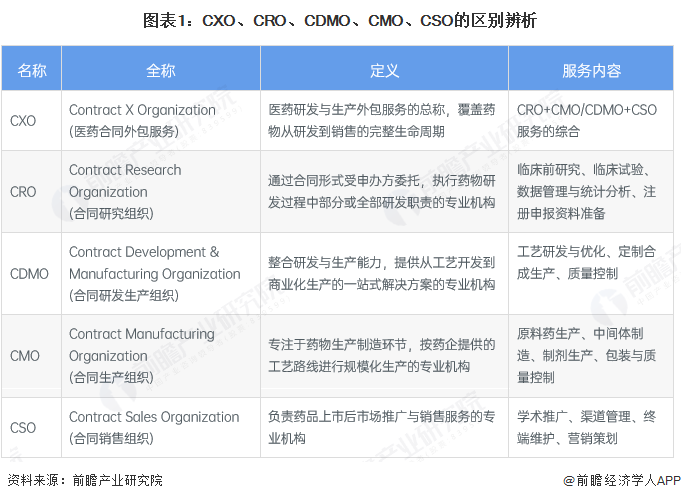
Core Insights - The CRO industry in China is experiencing significant growth, with the market size expected to expand from 90 billion yuan in 2021 to 126 billion yuan by 2024, reflecting a compound annual growth rate (CAGR) of 28%, which is substantially higher than the global average of 10% [13][26] - The industry is characterized by a clear competitive landscape, with WuXi AppTec as the dominant player, achieving revenue exceeding 20 billion yuan, while other key players include Kanglong Chemical, Tigermed, and Kelun Pharmaceutical [17][20] Industry Overview - Contract Research Organizations (CROs) are specialized entities that undertake drug development responsibilities on behalf of pharmaceutical companies, helping to reduce costs and risks while ensuring compliance [1] - The CRO industry is divided into preclinical and clinical segments, with preclinical CROs focusing on drug discovery and safety evaluations, while clinical CROs handle clinical trials and data management [1] Industry Development History - The CRO industry in China began in 1996 with the establishment of the first joint venture, and has evolved from a lack of formal organizations to a competitive landscape dominated by local leaders [9] - The industry has undergone significant changes, including the implementation of Good Clinical Practice (GCP) in 2003 and the introduction of the Marketing Authorization Holder (MAH) system, which has facilitated the growth of CRO services [11] Market Demand and Growth - The number of New Drug Applications (NDA) in China has been increasing, from 210 in 2021 to an expected 320 by 2024, driving demand for CRO services [14] - The global CRO market is projected to grow from 71 billion USD in 2021 to 90 billion USD by 2024, driven by increased healthcare demands due to aging populations and the COVID-19 pandemic [13] Competitive Landscape - The competitive structure of the Chinese CRO industry is categorized into three tiers, with WuXi AppTec leading the first tier, followed by Kanglong Chemical and Tigermed in the second tier, and smaller firms in the third tier [17] - Most companies are diversifying their services to include both CRO and CDMO (Contract Development and Manufacturing Organization) capabilities, enhancing operational efficiency [20] Regional Market Dynamics - The Yangtze River Delta region dominates the CRO market in China, accounting for approximately 43% of the market share, followed by the Beijing-Tianjin-Hebei region at 23% and the Pearl River Delta at 19% [23] Future Outlook - The Chinese CRO market is expected to continue its growth trajectory, potentially exceeding 144 billion yuan by 2028, supported by favorable policies and increasing demand for innovative therapies [26] - Despite challenges such as rising compliance costs and market saturation, the overall outlook remains positive, with expectations of sustained double-digit growth over the next five years [26]


申万宏源证券晨会报告-20260120
Shenwan Hongyuan Securities· 2026-01-20 00:41
Economic Overview - The GDP growth for Q4 2025 is reported at 4.5%, matching expectations but down from 4.8% in the previous quarter. December retail sales growth is at 0.9%, below the expected 1.5% and previous 1.3% [12][12] - Fixed asset investment shows a cumulative year-on-year decline of 3.8%, worse than the expected decline of 2.4% and previous 2.6%. Real estate development investment has a cumulative decline of 17.2% compared to the previous 15.9% [12][12] - Industrial value-added growth for December is reported at 5.2%, exceeding the expected 4.9% and previous 4.8% [12][12] Key Changes in Economic Structure - Three significant changes are identified: improvement in service consumption, easing of the "crowding out effect" from debt reduction, and recovery in new economic sectors [12][12] - The shift in consumption policies from goods to services is noted, with service retail growth increasing while traditional retail indicators decline [12][12] - Investment slowdown is attributed to intensified corporate debt repayment policies, which ultimately benefit cash flow recovery for companies [12][12] Sector Performance - The electric grid equipment sector shows a significant increase of 60.88% over the past six months, with a daily increase of 7.01% [1] - The digital media sector has seen a decline of 4.34% yesterday, with a 21.93% increase over the past month [1] - The hotel and catering industry has increased by 3.87% yesterday and 20.46% over the past six months, indicating resilience in service consumption [1] Investment Opportunities - The report highlights potential investment opportunities in sectors benefiting from service consumption recovery and easing debt repayment pressures [12][12] - Companies in the PCB drilling needle industry are noted for their growth potential, driven by increasing demand in emerging markets [20][20] - The report suggests focusing on companies with strong cash flow recovery and those positioned in high-growth sectors such as healthcare and technology [12][12][20]
凯莱英遭Norges Bank减持11万股 每股作价约88.2港元
Xin Lang Cai Jing· 2026-01-20 00:03
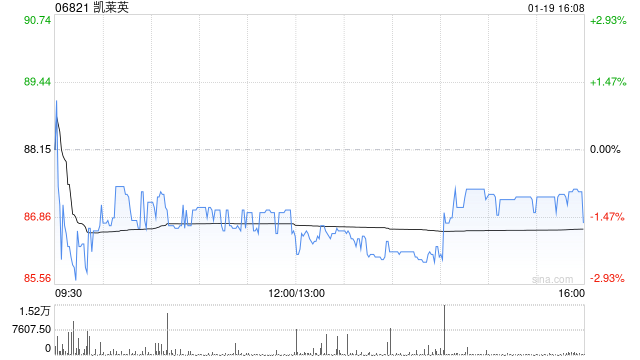
Group 1 - Norges Bank reduced its stake in Kintor Pharmaceutical (06821) by 110,000 shares at a price of HKD 88.1971 per share, totaling approximately HKD 9.7017 million [1][3] - After the reduction, Norges Bank's latest holding is 4.1326 million shares, representing a stake of 14.99% [1][3]
Norges Bank减持凯莱英11万股 每股作价约88.2港元
Zhi Tong Cai Jing· 2026-01-19 11:36
Group 1 - Norges Bank reduced its stake in Kelaiying (002821) by 110,000 shares at a price of HKD 88.1971 per share, totaling approximately HKD 9.7017 million [1] - After the reduction, Norges Bank's latest holding is 4.1326 million shares, representing a holding percentage of 14.99% [1]