隆基绿能

Search documents
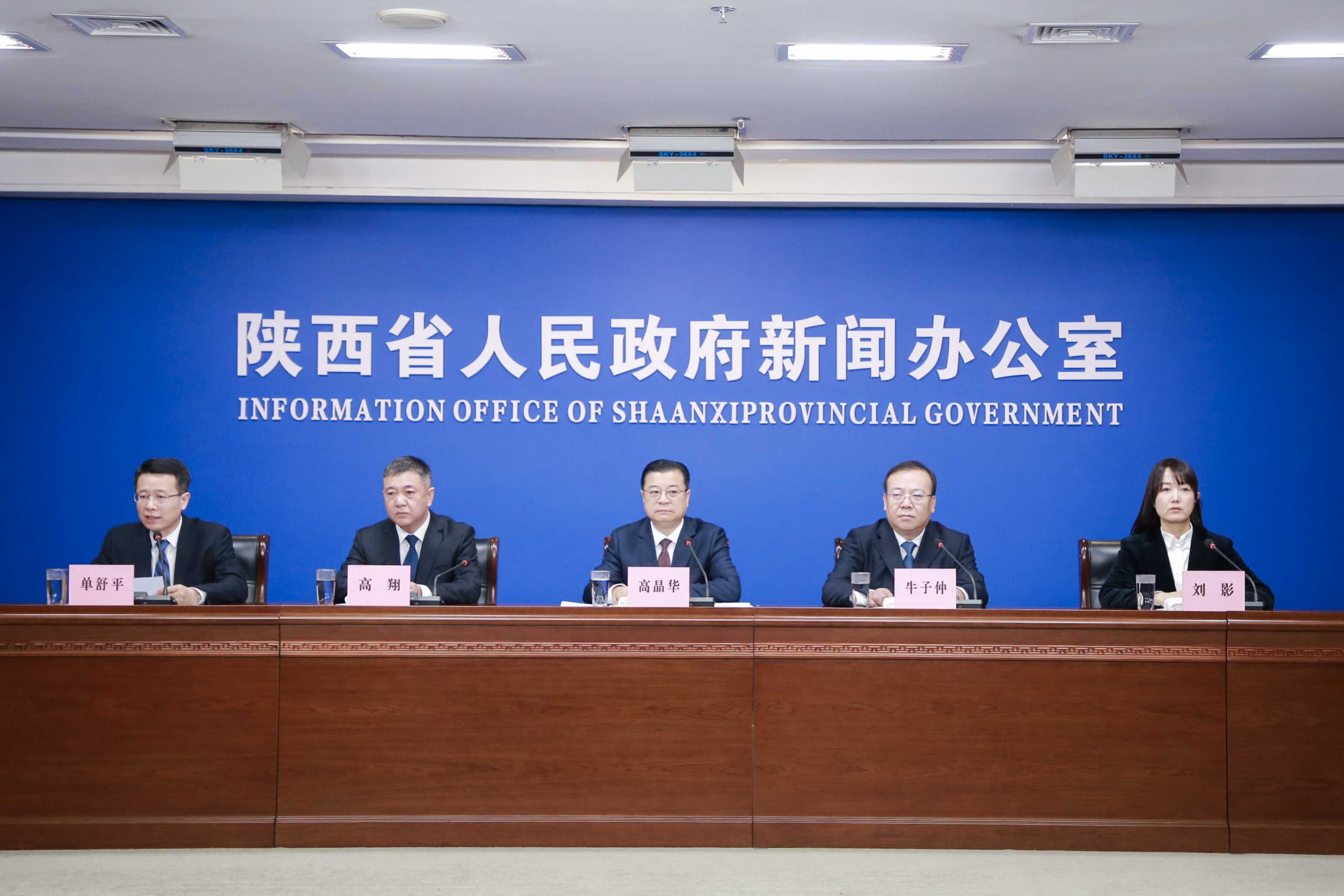
陕西省人民政府新闻办公室举办新闻发布会介绍陕西省市场监管系统推进质量强省建设情况
Shan Xi Ri Bao· 2026-02-13 02:06
Core Viewpoint - The Shaanxi Provincial Government is advancing the "Quality Strong Province" initiative, focusing on enhancing quality across enterprises, industries, and regions, with significant achievements reported in 2025 [8][15]. Group 1: Quality Enhancement Initiatives - The initiative emphasizes "Three Strengths and One Foundation" (Quality Strong Enterprises, Quality Strong Chains, Quality Strong Counties, and Quality Infrastructure) to create a comprehensive quality improvement framework [8][9]. - In 2025, 122 enterprises were guided to adopt quality management standards, with 73 upgrading to digital quality management [9]. - The province organized over 20 "Excellent Quality Activities," reaching more than 2,000 enterprises, and provided assistance to over 11,000 enterprises through quality support actions [9]. Group 2: Industry Upgrades - A total of 25 quality improvement projects were implemented, involving 91 chain-leading enterprises and 1,337 chain-member enterprises [10]. - The province is focusing on key industries such as selenium-rich products, commercial aerospace, and low-altitude economy, participating in national quality enhancement actions [10]. - The establishment of quality technical innovation alliances has led to the resolution of 162 quality bottlenecks in the industrial chain [10]. Group 3: Regional Development - The province is promoting quality strong county initiatives, with 26 counties included in the national quality strong county cultivation database [11][12]. - Each county is encouraged to pursue differentiated quality development paths based on local characteristics, such as smart manufacturing and green ecological industries [12]. - The quality competitiveness of these counties has improved, with notable achievements in agricultural and industrial sectors [23][24]. Group 4: Quality Infrastructure - The province is enhancing quality infrastructure through technical support, technology empowerment, integrated services, talent cultivation, and external cooperation [13]. - A total of 1,224 local standards were reviewed, and 149 new standards were implemented, establishing a robust standard verification network [13]. - The "Qin Quality Enjoy" platform has been launched to streamline quality service access for enterprises, attracting 1,337 quality service institutions and serving over 11,000 enterprises [27][28]. Group 5: Regulatory Innovations - The market supervision system is innovating regulatory mechanisms to ensure product quality safety, conducting comprehensive inspections on 6,780 enterprises and 9,769 batches of products [14]. - A total of 1.68 million cases were investigated for counterfeit and inferior products, with fines totaling 140 million yuan [14]. - The implementation of a "source coding" system for key industrial products has enhanced traceability and accountability in product quality [14].

安泰科:本周市场观望为主 硅片价格持稳运行
智通财经网· 2026-02-13 01:55
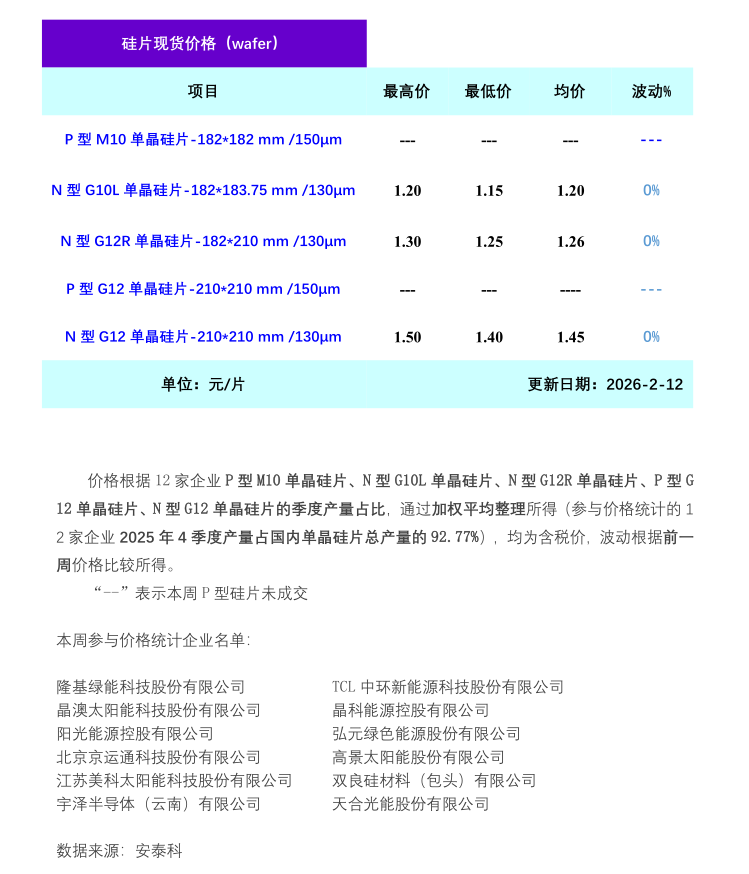
Core Viewpoint - The silicon wafer prices remain stable this week, with no significant changes observed in the market due to weak demand and pre-holiday purchasing behavior [1][2]. Price Summary - N-type G10L silicon wafer (182*183.75mm/130μm) average transaction price is 1.20 CNY per piece, N-type G12R silicon wafer (182*210mm/130μm) is 1.26 CNY per piece, and N-type G12 silicon wafer (210*210mm/130μm) is 1.45 CNY per piece, all unchanged from last week [1][3]. - The mainstream price for battery cells is between 0.41-0.45 CNY/W, and for modules, it is between 0.71-0.75 CNY/W, also remaining stable compared to the previous week [1]. Market Activity - The silicon wafer market has seen general transaction activity, with companies halting purchasing orders ahead of the holiday, leading to minimal transactions [1]. - The overall operating rate in the industry has slightly decreased, with leading companies operating at 46% and 45%, while integrated companies are at 50%-60%, and other companies range from 50%-70% [1]. Future Outlook - In the short term, the silicon wafer market is expected to remain in a stalemate between upstream price support and downstream price pressure, with prices likely to stabilize [2]. - After the Spring Festival holiday, as terminal installation projects resume, there is potential for a slight market recovery driven by improved downstream demand for silicon wafers [2].





【安泰科】单晶硅片周评-市场观望为主 硅片价格持稳运行(2026年2月12日)
中国有色金属工业协会硅业分会· 2026-02-13 01:43
Core Viewpoint - The silicon wafer prices remain stable this week, with no significant changes observed in the market, reflecting a cautious approach from both upstream and downstream players [1][2]. Group 1: Price Stability - N-type G10L monocrystalline silicon wafer (182*183.75mm/130μm) has an average transaction price of 1.20 yuan per piece, while N-type G12R (182*210mm/130μm) is at 1.26 yuan, and N-type G12 (210*210mm/130μm) is at 1.45 yuan, all unchanged from last week [1][3]. - The mainstream price for battery cells is between 0.41-0.45 yuan/W, and for modules, it is between 0.71-0.75 yuan/W, showing no significant fluctuations [1]. Group 2: Market Dynamics - The silicon wafer market transactions are generally weak, with companies halting purchasing orders ahead of the holiday, leading to minimal sales activity [2]. - The overall operating rate in the industry has slightly decreased, with two leading companies operating at 46% and 45%, while integrated companies are at 50%-60%, and others range from 50%-70% [2]. Group 3: Future Outlook - The market is expected to remain in a stalemate between upstream price support and downstream price pressure, with prices likely to stabilize in the short term [2]. - After the holiday, as terminal installation projects resume, there is potential for a slight recovery in demand for silicon wafers, which may positively impact the market [2].
固原农文旅推介,推动东西协作促消费
Xin Lang Cai Jing· 2026-02-12 22:40
Group 1 - The event "2026 Guyuan Agricultural, Cultural, and Tourism Promotion and Liupan Mountain New Year Goods Fair (Xi'an Station)" was held in Xi'an, focusing on the theme "Minning Together, Connecting Three Qin for a Win-Win Future" [1] - The fair featured 48 exhibition booths showcasing local agricultural products such as Liupan Mountain beef and lamb, cool-season vegetables, and potatoes, along with cultural tourism products [1] - A customized gift box named "Minning Family" was launched, including eight categories of New Year goods, and a green channel for corporate group purchases was established [1] Group 2 - Private enterprises from Shaanxi, including Zhuque Industrial Group, actively participated in various activities during the event, promoting one-on-one negotiations between businesses from both regions [2] - The Shaanxi Ningxia Chamber of Commerce emphasized its role in facilitating economic and cultural exchanges between Shaanxi and Ningxia, aligning with national regional development strategies [2] - Future efforts will focus on deepening cooperation with Guyuan City in areas such as agricultural, cultural, and tourism integration, as well as upgrading specialty industries [2]
银价波动推高光伏产业成本 高功率组件涨价明显
Mei Ri Jing Ji Xin Wen· 2026-02-12 10:49
Core Viewpoint - The Chinese photovoltaic industry is facing a significant cost increase due to soaring silver prices, which have become a critical material for battery metallization, impacting profit margins and pricing strategies across the supply chain [1][2]. Group 1: Silver Price Impact - Silver prices have shown a sharp increase, with futures reaching 32,400 yuan/kg and spot prices hitting $121.64/oz by the end of January 2026, leading to a substantial rise in costs for photovoltaic components [2]. - The demand for silver in the photovoltaic sector has surged, consuming over 6,000 tons annually since 2020, accounting for nearly 20% of total silver demand [2]. - The cost of silver paste has increased, raising the complete cost of battery cells to over 0.5 yuan/W, with module costs exceeding 0.9 yuan/W [2][3]. Group 2: Cost Structure and Profit Margins - The proportion of silver in photovoltaic raw material costs has risen from approximately 9% in 2024 to over 30%, becoming the largest cost component outside of silicon [3]. - The rising raw material costs combined with low terminal product prices have created a "scissors gap," severely squeezing profit margins, contributing to widespread industry losses in 2025 [4]. - As of early February 2026, silver prices experienced volatility, with futures dropping to 20,600 yuan/kg, leading to a decrease in battery and module prices [4]. Group 3: Market Dynamics and Order Visibility - Domestic market orders are declining, with limited visibility on new contracts, while overseas markets are expected to dominate shipments in Q1 2026 due to export tax influences [5]. - The procurement attitude is cautious amid weak seasonal demand and recent price increases in components, resulting in insufficient order visibility for Q1 2026 [5]. Group 4: Cost Reduction Strategies - Companies are pursuing technological upgrades to reduce costs, with Longi Green Energy focusing on "cheap metalization" technology for mass production by Q2 2026 [6][8]. - Aiko Solar has implemented silver-free technology, significantly reducing costs and avoiding the impact of silver price fluctuations [8]. - The industry is exploring pathways for cost reduction through the substitution of cheaper metals and process optimizations, aiming for a silver consumption reduction of 10% to 20% [9]. Group 5: Future Outlook - The silver price is expected to remain high with fluctuations, driven by an expanding supply-demand gap and increased industrial demand, particularly from the photovoltaic sector [9]. - The impact of the "space photovoltaic" concept on silver demand is currently limited, with expectations for a 10% decrease in global silver usage in photovoltaics in 2026 compared to 2025 [9].

光伏行业"反内卷"成效进一步显现
Zheng Quan Ri Bao· 2026-02-12 09:29
Core Viewpoint - The photovoltaic industry is experiencing a significant cost gradient differentiation due to fluctuations in silver prices and technological upgrades, leading to a visible "anti-involution" effect within the industry [1]. Cost Pressure - The global silver investment demand is expected to remain strong through 2026, supported by geopolitical tensions and U.S. policy uncertainties, with silver prices having risen by 11% this year after surpassing $100 per ounce for the first time in January [2]. - Despite high prices leading to a projected 17% reduction in global jewelry and silverware demand, industrial demand remains resilient [2]. - A supply shortage of approximately 67 million ounces is anticipated in the global silver market by 2026, marking the sixth consecutive year of deficit, which is expected to keep silver prices strong [2]. - The photovoltaic sector, as a major consumer of silver, will continue to face cost pressures due to high silver prices, accelerating the development of silver paste substitution technologies among leading companies [2][3]. Technological Breakthroughs - Leading companies are rapidly advancing silver paste substitution technologies, with some planning large-scale production of alternative materials in the near future [4]. - Longi Green Energy has announced plans to start large-scale production of non-silver solutions, which could further reduce component costs [4]. - Other major players like JinkoSolar and Aiko are also actively pursuing silver paste alternatives, with significant collaborations aimed at industrializing low-silver technologies by 2026 [4][5]. Industry Restructuring - The shift towards high-efficiency and reliable components is expected to create a competitive landscape where companies with technological advantages can command price premiums, while less efficient capacities face dual pressures from price and demand declines [5][6]. - The Chinese photovoltaic industry is projected to see a significant change in 2026, with new installations expected to range between 180GW and 240GW, following a record high of 315GW in 2025 [5][6]. - The core theme of the industry's "anti-involution" in 2026 will be driven by upgraded end-user demand, pushing manufacturers towards high-quality development through technological iterations and improved market mechanisms [6].
金融工程定期:太空光伏板块的资金行为监测
KAIYUAN SECURITIES· 2026-02-12 09:13
2026 年 02 月 12 日 金融工程研究团队 魏建榕(首席分析师) 证书编号:S0790519120001 傅开波(分析师) 证书编号:S0790520090003 高 鹏(分析师) 证书编号:S0790520090002 苏俊豪(分析师) 证书编号:S0790522020001 胡亮勇(分析师) 证书编号:S0790522030001 王志豪(分析师) 证书编号:S0790522070003 盛少成(分析师) 证书编号:S0790523060003 蒋韬(分析师) 证书编号:S0790525070001 常津铭(研究员) 证书编号:S0790126010044 相关研究报告 太空光伏板块的资金行为监测 ——金融工程定期 《有色金属板块的资金行为监测》 -2025.10.10 《 消 费 板 块 的 资 金 行 为 监 测 》 -2025.11.14 《商业航天板块的资金行为监测》 -2025.12.11 《脑机接口板块的资金行为监测》 -2026.01.09 | 魏建榕(分析师) | 苏俊豪(分析师) | 高鹏(分析师) | | --- | --- | --- | | weijianrong@kyse ...
银价波动推高光伏业成本,高功率组件涨价明显 头部企业: 通过贱金属替代和工艺优化实现降本
Mei Ri Jing Ji Xin Wen· 2026-02-12 07:25
Core Viewpoint - The Chinese photovoltaic industry is facing significant cost pressures due to soaring silver prices, which have become the primary driver of increased costs, surpassing traditional materials like silicon [1][2]. Group 1: Silver Price Impact - Silver prices have shown a rising trend, with futures reaching 32,400 yuan/kg and spot prices hitting $121.64/oz by the end of January [1]. - The demand for silver in the photovoltaic sector has surged, consuming over 6,000 tons annually since 2020, accounting for nearly 20% of total silver demand [1]. - The cost of silver paste has increased, raising the complete cost of battery cells to over 0.5 yuan/W and components to over 0.9 yuan/W [2]. Group 2: Cost Transmission - A 10% increase in silver prices results in an approximate 0.01 yuan/W rise in the unit cost of photovoltaic components, with silver's share of raw material costs rising from 9% in 2024 to over 30% [2][3]. - The disparity between rising raw material costs and stagnant product prices has created a "scissors gap," squeezing profit margins for manufacturers [3]. Group 3: Market Dynamics - The domestic market is experiencing a decline in project order execution, while overseas demand is expected to increase due to export tax incentives [4]. - The prices of copper and aluminum have also risen, further exacerbating cost pressures on photovoltaic components [4]. Group 4: Technological Responses - Companies are pursuing technological upgrades to reduce costs, with Longi Green Energy focusing on "cheap metalization" technology and JA Solar locking in suppliers to hedge against price fluctuations [5]. - Aiko Solar has successfully implemented a silver-free technology, significantly reducing costs and enhancing competitiveness [5]. Group 5: Future Outlook - Analysts predict that silver prices will remain high due to a widening supply-demand gap and increased industrial demand [6]. - The "space photovoltaic" concept discussed by Elon Musk is still in the ground verification stage and is not expected to significantly impact silver demand in the near term [6].
国内光伏组件报价大涨
2 1 Shi Ji Jing Ji Bao Dao· 2026-02-12 07:05
Group 1 - The core point of the article is the significant increase in solar module prices in China, with recent bidding results showing prices exceeding 1 yuan/W for the first time in years [1] - The bidding for Huadian Group's 8GW solar module procurement included two segments: 6GW of N-type high-efficiency modules at an average price of 0.8831 yuan/W and 2GW of N-type conventional modules at an average price of 0.8438 yuan/W [1] - Longi Green Energy reported that high-power (670W) module prices have surpassed 1 yuan/W, indicating a broader trend of rising component prices in the market [1][2] Group 2 - Aiko Solar indicated that their domestic module prices are nearing 0.9 yuan/W, while overseas prices exceed 1 yuan/W, reflecting the overall price increase in the industry [2] - Several companies noted that the recent rise in silver prices is a major factor driving the increase in module prices [3] - According to the China Photovoltaic Industry Association, the average all-in cost of mainstream photovoltaic products varies with silver prices, with costs at 0.783 yuan/W, 0.824 yuan/W, and 0.866 yuan/W at silver prices of 15,000 yuan/kg, 20,000 yuan/kg, and 25,000 yuan/kg respectively [3]
国内光伏组件报价大涨
21世纪经济报道· 2026-02-12 06:58
记者丨曹恩惠 编辑丨巫燕玲 2月11日,华电集团2026年8GW光伏组件集采开标。其中,标段一为N型高效组件(对应功率 645W),规模约6GW;标段二维N型常规组件(对应功率620W),规模约2GW。据《索比 光伏网》,标段一共25家企业参与,报价0.78-1.018元/W,平均为0.8831元/W;标段二共31 家企业参与,报价0.76-0.923元/W,平均为0.8438元/W。 值得一提的是, 这是近年来央企光伏组件集采项目首次出现超过1元/W的报价。 据21世纪经济报道记者了解, 目前国内光伏组件整体对外报价已经大幅上涨。 2月12日,隆 基绿能相关人士告诉21世纪经济报道记者,"过去一段时间,组件价格明显上涨,高功率 (670W)组件报价超过1元/W。" 天合光能今年更是三度上调分布式光伏组件价格。据市场消息,其分布式最新中版型、大版型 组件报价为0.88-0.92+元/W,防眩光组件0.95-0.99+元/W,轻质单玻组件1.08-1.12+元/W。该 公司相关人士对记者表示,目前组件产品整体对外报价肯定要超过0.8元/W。 多家公司对21世纪经济报道记者称, 目前银价上涨是推动本轮组件价格上涨 ...