Snowflake Inc.

Search documents
AI颠覆SaaS?花旗:软件业将进入一个“赢家通吃”的大分化时代
美股IPO· 2025-09-03 12:46
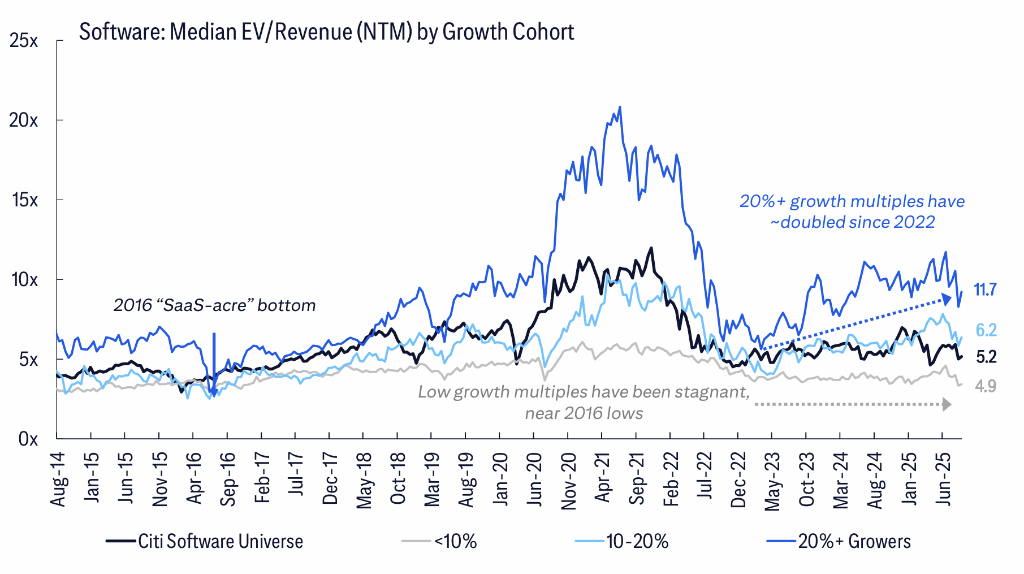
Core Viewpoint - AI is accelerating differentiation in the software industry, leading to a "winner-takes-all" scenario rather than a complete disruption of the SaaS model [1][2][5] Group 1: Impact of AI on Software Industry - AI will create a significant divide in valuations among software companies, with high-growth companies seeing their enterprise value/revenue (EV/Revenue) median nearly double since 2022, reaching 11.7 times, while low-growth companies remain stagnant at around 4.9 times [2][11] - The report outlines three potential scenarios for AI's impact on software vendors: a pessimistic scenario where AI disrupts existing suppliers, a base case where innovative giants successfully commercialize AI products, and an optimistic scenario where existing giants lead AI innovation [6][7][8][9] Group 2: Investment Opportunities - A "weatherproof AI investment portfolio" has been proposed, including companies like Microsoft, MongoDB, and Snowflake, which are expected to benefit from AI-driven data growth and product cycles [4][15] - Microsoft is identified as a core winner due to its investments in AI infrastructure, applications, and search [16] - MongoDB and Snowflake are recognized as leading data management platforms that will benefit from the increasing data volume driven by AI [16] - Companies like Datadog and Dynatrace are well-positioned due to their consumption-based models, which mitigate risks associated with seat-based pricing [17] - CrowdStrike, Palo Alto Networks, and Rubrik are expected to benefit from the critical nature of cybersecurity, maintaining high budget priorities regardless of AI developments [17] - Intuit and Pegasystems are highlighted for their strong market positions, with Intuit leveraging its data footprint and Pegasystems offering unique AI workflow solutions [18]




AI颠覆SaaS?花旗:软件业将进入一个“赢家通吃”的大分化时代
Hua Er Jie Jian Wen· 2025-09-03 07:21
人工智能正对软件行业发起颠覆性的冲击,传统的SaaS(软件即服务)商业模式面临严峻考验。 据追风交易台消息,花旗分析师Tyler Radke和Fatima Boolani在9月2日发布的一份报告中认为,AI并不会简单地终结"软件即服务"(SaaS)模式, 而是将开启一个"赢家通吃"的大分化时代,市场将清晰地划分为少数高增长的赢家和多数增长停滞的落后者。 花旗认为,尽管市场普遍对AI带来的颠覆性冲击感到担忧,并导致软件板块承压,但这种抛售可能"普遍过度"。然而,风险真实存在,尤其对于 依赖"按席位收费"(seat-based)商业模式的应用软件公司而言。 市场已经嗅到了变革的气息,并在用"真金白银"为未来的赢家和输家定价。数据显示,软件公司的估值出现了剧烈分化。 根据Factset的数据,截至2025年8月26日,增长率超过20%的软件公司,其预期市销率(EV/Revenue NTM)中位数已达到11.7倍,较2022年的低 点几乎翻了一番。相比之下,增长率低于10%的公司,其估值中位数仅为3.5倍,与2016年"SaaS-acre"(SaaS大屠杀)时期的低点相差无几。 AI将成为一道分水岭,不同软件公司之间 ...
AI编程:海外已然爆发,国内产品梳理
2025-09-02 14:41
Summary of AI Programming Industry and Key Companies Industry Overview - AI programming is rapidly being adopted by enterprises, significantly reducing software development costs and increasing efficiency, leading to revenue growth in related products [1][10] - The global professional software developer AI programming market is estimated to be around $4-5 billion in the short term, with a potential long-term market space of $100 billion as AI lowers development barriers [1][12] Key Companies and Their Performance - **Anthropic**: Achieved an annual recurring revenue (ARR) of $5 billion, with 60% from API calls. The Cloud 3.5 version significantly improved its market share in the B-end large model API market to 32%, surpassing OpenAI [1][18] - **Alibaba**: Has a comprehensive layout in AI programming, including computing power, cloud services, and the Queen 3 series models, which are close to Cloud 4 performance. The daily API call volume for the Queen series reached 16-17 trillion tokens in August, with programming applications accounting for 30% [1][5][7] - **Cursor**: ARR is approximately $500 million, with significant growth attributed to its integration with GPT-4 and the release of new features [4][23] - **GitHub Copilot**: ARR is around $400 million, showing strong performance in the AI programming space [4][11] Competitive Landscape - **Market Dynamics**: The release of Cloud 3.5 is seen as a pivotal moment in the industry, with significant improvements in functionality driving user adoption and increasing API call volumes [2][16] - **Cost Efficiency**: High salaries for software developers overseas drive companies to adopt AI programming tools for cost control, making AI programming a viable solution for many enterprises [22] Strategic Differences Among Major Players - **Alibaba**: Focuses on enterprise users with products like Tongyi Lingma and Quarter, leveraging its cloud business and computing power [5][9][28] - **ByteDance**: Targets individual developers with its Tray product, offering a lower price point compared to competitors [34] - **Tencent**: Emphasizes user-friendly development environments and has a significant internal adoption of AI coding tools [9][27] Market Trends and Future Outlook - AI programming is one of the fastest commercialized AI applications, with a high penetration rate among both C-end and B-end users [10] - The market is expected to evolve with a shift towards more affordable subscription models and increased accessibility for non-professional developers [12][14] Additional Insights - The Queen 3 series model from Alibaba has shown a significant increase in usage, with a reported 8-9 times increase in API calls since its launch [30] - The competitive pricing strategy of products like Tray from ByteDance has led to rapid user acquisition, highlighting the importance of cost in market penetration [34] - The integration of AI in coding practices is becoming standard among major internet companies in China, with significant percentages of developers using AI tools [27]

重视AIInfra,算力、云、数据库实现链路突破
China Post Securities· 2025-09-02 05:53
Industry Investment Rating - The industry investment rating is "Outperform the Market" and is maintained [1] Core Viewpoints - The report emphasizes the growth potential of AI infrastructure, predicting the market could reach USD 171.21 billion by 2029, with a CAGR of 20.12% from 2024 to 2029 [4] - Major cloud providers are significantly increasing their investments in infrastructure, with Alibaba Cloud planning to invest over CNY 380 billion in the next three years [4] - The demand for AI and data solutions is surging, as evidenced by Snowflake's financial performance, which exceeded expectations with a 32% year-on-year revenue increase [6] Summary by Relevant Sections Industry Basic Situation - The closing index is 5786.18, with a 52-week high of 5841.52 and a low of 2844.68 [1] Relative Index Performance - The relative performance of the computer industry shows fluctuations, with a notable increase of 96% from September 2024 to August 2025 [3] Recent Research Reports - The report highlights the strategic focus on AI infrastructure, addressing challenges such as computational bottlenecks and data silos, which are critical in the era of large models [4] - Companies like Tencent Cloud and SenseTime are also expanding their infrastructure capabilities, with Tencent planning new data centers in the Middle East and Indonesia [5] Investment Recommendations - Suggested companies for investment include those in cloud computing such as Deepin Technology and Kingsoft Cloud, as well as AI-related firms like XH Technology and DaMeng Data [7][8]
全球AI周报:阿里巴巴云业务大超预期,英伟达四万亿美元AI指引,算力需求旺盛-20250902
Tianfeng Securities· 2025-09-02 05:07
Investment Rating - The industry investment rating is "Outperform the Market," indicating an expected industry index increase of over 5% in the next six months [47]. Core Insights - The report highlights significant growth in AI-related businesses, particularly in cloud services and AI infrastructure, with companies like Alibaba and Nvidia leading the charge [2][5]. - The Chinese government's recent policy initiatives are expected to accelerate the commercialization of AI, setting quantifiable goals for AI integration across various sectors by 2035 [31][32]. - The demand for AI infrastructure is projected to reach $3 trillion to $4 trillion by 2030, driven by increasing investments from major tech companies [12][17]. Summary by Sections Key Company Financials - **Alibaba**: Cloud business revenue grew by 26% year-on-year to 33.4 billion yuan, with a significant increase in capital expenditure (Capex) to 38.6 billion yuan, exceeding market expectations. The company has invested over 100 billion yuan in AI infrastructure and product development over the past four quarters [2][11]. - **Nvidia**: Reported Q2 FY26 revenue of $46.7 billion, a 56% year-on-year increase. The company anticipates AI infrastructure spending to reach $3 trillion to $4 trillion by 2030, with a strong demand for its new GB300 series GPUs [12][17]. - **MongoDB**: Total revenue for the quarter was $591 million, a 24% increase year-on-year, with an upward revision of its annual revenue guidance to between $2.34 billion and $2.36 billion [18][22]. - **Snowflake**: Product revenue reached $1.09 billion, up 32% year-on-year, with remaining performance obligations (RPO) growing by 33% to $6.93 billion. The company has also raised its annual revenue outlook [23][28]. Global AI Developments - The Chinese government has issued a policy document outlining key actions for AI development, aiming for a 90% AI penetration rate by 2030 [31][32]. - Google's Gemini 2.5 Flash Image model has been recognized as the strongest image generation model, showcasing advanced capabilities in image editing and generation [37]. - OpenAI has launched GPT-Realtime, a voice model designed for AI agents, which significantly enhances voice generation capabilities and accuracy [42].

DeepMind爆火论文:向量嵌入模型存在数学上限,Scaling laws放缓实锤?
机器之心· 2025-09-02 03:44
Core Viewpoint - The recent paper on the limitations of vector embeddings has gained significant attention, highlighting the theoretical constraints of embedding models in information retrieval tasks [1][2]. Group 1: Understanding Vector Embeddings - Vector embeddings transform complex entities like text, images, or sounds into multi-dimensional coordinates, allowing for efficient data comparison and retrieval [2][4]. - Historically, embeddings have been primarily used for retrieval tasks, but their application has expanded to reasoning, instruction following, and programming due to advancements in large model technologies [4][5]. Group 2: Theoretical Limitations - Previous research has indicated that vector embeddings inherently lose information when compressing complex concepts into fixed-length vectors, leading to theoretical limitations [4][6]. - DeepMind's recent study suggests that there is a mathematical lower bound on the capabilities of vector embeddings, indicating that certain combinations of relevant documents cannot be retrieved simultaneously beyond a critical document count [6][7]. Group 3: Practical Implications - The limitations of embedding models are particularly evident in retrieval-augmented generation (RAG) systems, where the inability to recall all necessary information can lead to incomplete or incorrect outputs from large models [9][10]. - The researchers established a dataset named LIMIT to empirically demonstrate these theoretical constraints, showing that even state-of-the-art models struggle with simple tasks when the number of documents exceeds a certain threshold [10][12]. Group 4: Experimental Findings - The study revealed that for any given embedding dimension, there exists a critical point where the number of documents surpasses the model's capacity to accurately capture all combinations, leading to performance degradation [10][26]. - In experiments, even advanced embedding models failed to achieve satisfactory recall rates, with some models struggling to reach 20% recall at 100 documents in the full LIMIT dataset [34][39]. Group 5: Dataset and Methodology - The LIMIT dataset was constructed using 50,000 documents and 1,000 queries, focusing on the difficulty of representing all top-k combinations [30][34]. - The researchers tested various state-of-the-art embedding models, revealing significant performance drops under different query relevance patterns, particularly in dense settings [39][40].

企业数据“LLM ready”与“小Palantir”们的崛起 | AGIX PM Notes
海外独角兽· 2025-09-01 12:22
Core Insights - The article emphasizes the transformative potential of AGI (Artificial General Intelligence) over the next 20 years, likening its impact to that of the internet on society [2] - It discusses the current state of AI development, indicating that many companies are still in the preparatory phase, focusing on data readiness and organizational transformation [3][4] Group 1: AI Development and Company Insights - A subset of startups, often founded by former Palantir employees, is achieving profitability without heavy financing, highlighting a different approach to AI development [3] - Distyl.ai exemplifies the complexity of AI integration into business processes, requiring a systemic overhaul rather than mere tool replacement [4][5] - The article identifies three key dimensions for data preparation: Data Infrastructure, Knowledge Distillation, and Simulation, which are essential for effective AI deployment [5][6] Group 2: Market Performance and Trends - AGIX has shown strong performance, with a weekly increase of 1.99%, outperforming major indices like S&P 500 and QQQ [11][15] - The technology sector experienced net selling, with a notable focus on industrial and communication services, while AI-related stocks like Snowflake and MongoDB saw significant gains [12][14] - The article notes that the current investment environment is favoring companies that can effectively leverage AI capabilities, indicating a shift in market dynamics [15][16] Group 3: AI Infrastructure and Future Directions - Real-time data processing is becoming crucial, with companies like Confluent enhancing their offerings to support AI agents in monitoring and decision-making [7][8] - The integration of AI into enterprise systems requires a robust data governance framework, as highlighted by the collaboration between Snowflake and Confluent [8][9] - The article stresses the importance of decision transparency and traceability in AI applications, which are critical for enterprise-level adoption [9][10]



MongoDB and Snowflake Lead Tech Rally as Wall Street Slips
PYMNTS.com· 2025-09-01 08:00
Market Performance - The CE 100 Index posted a 0.5% gain leading into the Labor Day weekend, contrasting with declines in broader benchmarks like the Nasdaq and S&P 500 [1] - Over the past 5 days, the CE 100 rose by 0.47%, while the Nasdaq fell by 0.27%, S&P 500 by 0.04%, and Dow by 0.12% [3] - Year-to-date, the CE 100 has increased by 16.59%, outperforming the Nasdaq (11.57%), S&P 500 (10.06%), and Dow (7.19%) [3] - In the past year, the CE 100 saw a 33.75% increase, significantly higher than the Nasdaq (21.19%), S&P 500 (15.53%), and Dow (10.19%) [3] Company Highlights - MongoDB's stock surged over 44% following earnings, reporting total revenue of $591.4 million, a 24% year-over-year increase, with subscription revenue at $572.4 million (23% increase) and services revenue at $19 million (33% increase) [6] - MongoDB's Atlas cloud platform revenue grew 29% year-over-year, contributing 74% of total Q2 revenue, with 2,800 new customers added, totaling over 59,900 customers [6] - Snowflake's stock advanced 21.3%, reporting product revenue of nearly $1.1 billion, reflecting a 32% year-over-year growth, with overall revenue also at $1.1 billion [7] - Snowflake has 654 customers generating over $1 million in trailing 12-month product revenue, indicating strong enterprise metrics [7] Sector Trends - The Buy Now, Pay Later (BNPL) segment showed continued momentum, with Affirm reporting gross merchandise volumes soaring 34% to $10.4 billion and revenues increasing by 33% to $876 million [8] - Affirm Card gross merchandise volume grew 132% to $1.2 billion, with active cardholders increasing by 97% to 2.3 million, and in-store spending on those cards rising 187% year-over-year [8] - Authvia integrated Visa's real-time money movement capabilities, allowing for real-time disbursements across various industries, enhancing its TXT2PAY capabilities [9] - Mastercard partnered with Circle to enable the settlement of USDC and EURC stablecoins for acquirers in Eastern Europe, the Middle East, and Africa, facilitating digital trade in emerging markets [10] Other Company Developments - Ocado shares fell by 5.9% within the Shop pillar, while Walmart's shares remained slightly positive as the company supports U.K. and European businesses to utilize its online marketplaces for cross-border sales [11] - Walmart will host a UK Walmart Seller Summit to provide insights and guidance for manufacturers and exporters [11]