博时基金

Search documents
首批北交所主题基金再迎开放窗口期 多家基金公司正在筹备北证50ETF相关产品上报
Shang Hai Zheng Quan Bao· 2025-12-03 18:46
Group 1 - The first batch of North Exchange thematic funds is entering a new open window period, with the average cumulative return exceeding 100% over the past two years [1][2] - Eight North Exchange thematic funds established in November 2021 are now announcing their second open period for subscription, redemption, and conversion [2][3] - The average cumulative return of these eight funds is reported to be 104%, with one fund achieving a return of 174.67% [3] Group 2 - Public funds are increasing their investment in the North Exchange, with the amount held in North Exchange stocks rising from 54.18 billion to 103.07 billion from the end of last year to the third quarter of this year [4] - As of December 3, 2023, 15 North Index 50-related funds have been reported this year, indicating a growing interest in these products [5] - Multiple fund companies are preparing to submit North Index 50 ETF-related products, which are expected to enhance trading strategies and risk control mechanisms [6]
大幅溢价!停牌
Zhong Guo Zheng Quan Bao· 2025-12-03 12:28
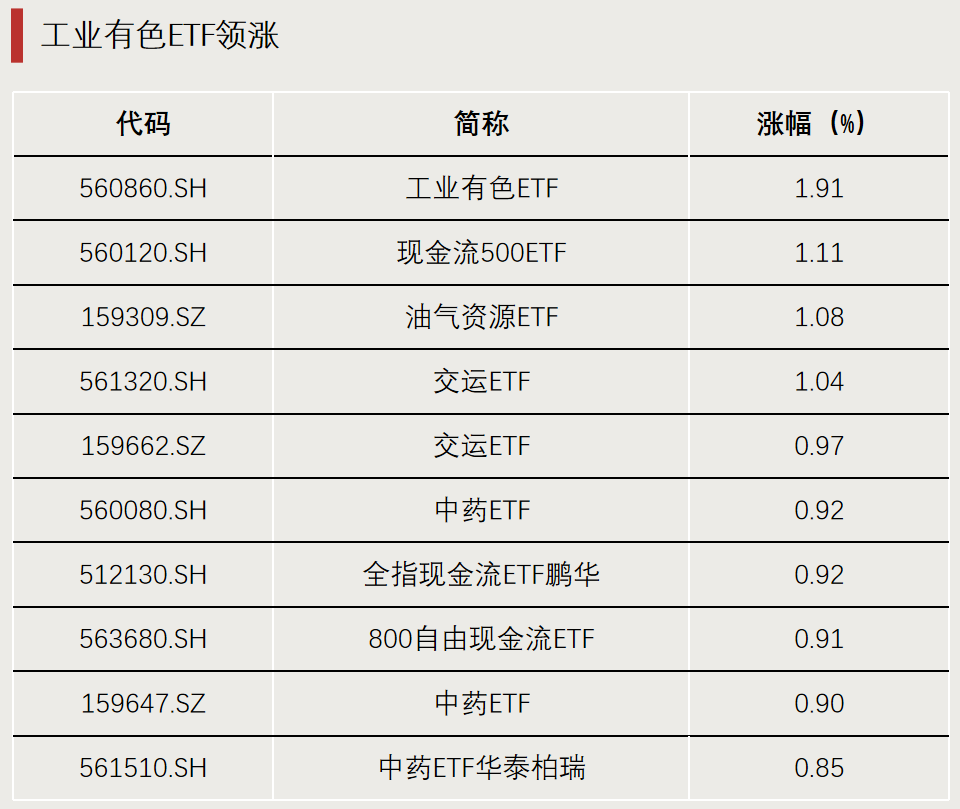
Core Viewpoint - The A-share market experienced fluctuations on December 3, with a notable performance from cross-border ETFs, particularly the Nasdaq Technology ETF, which faced a significant premium in its secondary market price, leading to a temporary suspension of trading [1][2]. Group 1: ETF Performance - On December 3, nine cross-border ETFs ranked among the top ten in terms of gains [2]. - The Industrial Nonferrous ETF (560860) led the A-share ETFs with a gain of 1.91%, followed by other ETFs related to cash flow and transportation [3][4]. - The online consumption ETF recorded the largest decline at -2.74%, with several technology-related ETFs also experiencing significant drops [5]. Group 2: Fund Flows - As the year-end approaches, there is a lack of consensus on investment direction, but the technology sector remains favored, with several technology-related ETFs among the top net inflows on December 2 [6]. - The top net inflows included the Science and Technology Artificial Intelligence ETF and the Robotics ETF, indicating strong interest in technology investments [7]. Group 3: Bond ETFs Activity - Bond-related ETFs showed active trading, with a total trading volume of 354.33 billion yuan on December 3, where eight out of the top ten ETFs by trading volume were bond-related [8]. - The Silver Hua Daily ETF had the highest trading volume at 15.08 billion yuan, reflecting the ongoing interest in bond markets amid market fluctuations [9]. Group 4: Market Outlook - The attractiveness of Hong Kong dividend assets has increased, with expectations of support for the market from domestic growth policies despite uncertainties surrounding the Federal Reserve's interest rate decisions [11]. - Key investment directions in A-shares include technology innovation, consumption upgrades, and high-end manufacturing, aligning with global industrial restructuring trends [11].

ETF兵器谱、金融产品每周见:qdiiETF:折溢价探讨与产品投资策略分析-20251203
Shenwan Hongyuan Securities· 2025-12-03 12:05
Group 1: Overview of QDII ETF - QDII ETFs are primarily focused on Hong Kong stocks, experiencing rapid growth since 2021, with a significant increase in non-Hong Kong ETFs starting in 2023, reflecting a shift in investor interest towards overseas markets [3][12] - As of November 28, 2025, the cumulative scale of QDII ETFs reached 185.86 billion, indicating a growing trend in overseas investment opportunities [12] - The top 15 QDII ETFs by scale include products like Huaxia Hang Seng Technology ETF and Guotai Junan Nasdaq 100 ETF, with scales of 47.64 billion and 16.90 billion respectively [9][13] Group 2: Mechanism of Premium and Discount Formation - The premium formation mechanism for QDII ETFs relies on cash subscription and redemption, where the return to premium depends on the ability to arbitrage through "subscription + sale" [3][21] - High premiums often arise from disruptions in the arbitrage chain, particularly when subscription limits are imposed due to insufficient QDII quotas [27] - The expected arbitrage returns vary based on market conditions, with overlapping trading hours leading to different calculations of the indicative optimized price value (IOPV) [31][36] Group 3: Evaluation of QDII ETF Premiums - The premium rate is negatively correlated with the cost-effectiveness of QDII ETFs; for instance, when the premium rate exceeds 8%, holding the ETF for a month typically results in significant negative returns [3] - Daily subscription limits and market sentiment are significant factors influencing premium rates, with emotional factors providing long-term explanations for premium levels [3][27] - Some QDII ETFs exhibit additional premiums that cannot be easily explained by market sentiment, indicating potential inefficiencies in pricing [3][27] Group 4: Recent Developments in QDII ETFs - The number of QDII ETFs tracking new indices has been increasing, particularly those focusing on non-Hong Kong indices such as the Dow Jones Industrial Average and the S&P 500 Consumer Select Index [17] - Newly launched QDII ETFs often experience initial premiums, with the Huatai Baichuan South China Arabian ETF showing a first-day premium of 6.31% [17][18] - The overall market enthusiasm for QDII ETFs remains high, as evidenced by the sustained premium levels of newly listed products [17][18]
基金经理研究系列报告之八十八:国联安沪深300指增:兼顾增强与跟踪的沪深300指增产品
Shenwan Hongyuan Securities· 2025-12-03 09:30
Group 1: Investment Rating of the Reported Industry - No information about the industry investment rating is provided in the report. Group 2: Core Viewpoints of the Report - Multiple - dimensional factors reflect the investment value of the CSI 300 Index, including high market attention, high - quality fundamentals, high dividend cost - effectiveness, and a low proportion of high - gain stocks among its components [2][7]. - CSI 300 index - enhanced funds are more difficult to manage compared to those tracking smaller - cap indices. However, the Guolianan CSI 300 Index - Enhanced Fund balances strong tracking performance and excess returns [2][24]. - The Guolianan CSI 300 Index - Enhanced Fund has low - deviation and flexible industry allocation, with a recent focus on growth and quality [2][39]. Group 3: Summary According to the Table of Contents 1. Multidimensional Factors Reflecting the Investment Value of the CSI 300 - The CSI 300 has high market attention, with its trading volume ratio rising since August 2025 and ranking first among representative broad - based indices as of November 7, 2025 [7]. - It is a high - quality broad - based index with strong profitability quality and stability, matching well with the "PB - ROE" stock - selection strategy [8][10]. - The dividend cost - effectiveness of the CSI 300 is becoming prominent. As of November 7, 2025, its 12 - month dividend rate is 2.54%, exceeding that of CSI 500, CSI 1000, and the 10 - year Treasury yield [17]. - The proportion of high - gain stocks among its components is low, with less than 35% of components having a year - to - date gain of over 20% as of November 7, 2025, and over 50% of components having a gain lower than the index's. Some high - quality stocks are still "waiting to rise" [20]. 2. Guolianan CSI 300 Index - Enhanced Fund: A Product Balancing Enhancement and Tracking Effects 2.1 CSI 300 Index - Enhanced Funds: Difficult to Manage - The difficulty of creating excess returns for index - enhanced funds is ranked as SSE 50 Index - Enhanced > CSI 300 Index - Enhanced > CSI 500 Index - Enhanced > CSI 1000 Index - Enhanced. Since 2020, the average annualized excess returns of SSE 50, CSI 300, CSI 500, and CSI 1000 index - enhanced funds are 0.50%, 1.64%, 2.77%, and 7.12% respectively [24]. - In the past three years, it has been difficult for mid - and large - cap indices represented by the CSI 300 and CSI 500 to create excess returns. The CSI 300 index - enhanced funds still have negative average excess returns this year [26]. 2.2 Guolianan CSI 300 Index - Enhanced Fund: Balancing Strong Tracking and Excess Performance - The fund has achieved positive excess returns this year, with a year - to - date cumulative return of 19.78% and an excess return of 5.06% compared to the CSI 300 Total Return Index. Its performance is relatively good among all CSI 300 index - enhanced funds [27]. - Focusing on tracking effects, it has achieved the highest excess return under a 3% tracking error this year and the lowest tracking error among products with over 3% excess returns. In the long - term, it has maintained a tracking error of less than 3% since its opening for redemptions, with an excellent excess information ratio [28][33]. - It can achieve positive returns in both favorable and unfavorable market conditions. Since its opening for redemptions on March 1, 2024, it has achieved a cumulative return of 2.69% in favorable market conditions while maintaining positive returns in unfavorable conditions [36]. 2.3 Portfolio Characteristics: Flexible Industry Allocation with Low Deviation, Recently Focusing on Growth and Quality - The industry under - or over - allocation amplitude of the fund is relatively low, with the proportion generally within 1%. In the first half of 2024, the industry deviation was significantly low, and it has increased since 2025. The allocation structure of its heavy - position stocks is highly similar to that of the index, with a proportion difference within 0.5% [39]. - Compared with similar products, the allocation deviation of the Guolianan CSI 300 Index - Enhanced Fund is significantly lower. Its individual - stock and industry allocation consistencies are in the top 25% and 15% of similar products respectively [45]. - The fund's factor exposure amplitude is relatively low. Its current portfolio attaches importance to growth, profitability, and analyst expectations, and has a moderate negative exposure in the market - value dimension [46].
4只中证科创创业50指数ETF成交额环比增超50%
Zheng Quan Shi Bao Wang· 2025-12-03 09:22
Core Insights - The total trading volume of the CSI Innovation and Entrepreneurship 50 Index ETF reached 772 million yuan today, an increase of 203 million yuan from the previous trading day, representing a growth rate of 35.55% [1] Trading Performance - The Huabao Double Innovation Leader ETF (588330) had a trading volume of 81.24 million yuan today, up by 49.83 million yuan from the previous day, with a growth rate of 158.66% [1] - The E Fund CSI Innovation and Entrepreneurship 50 ETF (159781) recorded a trading volume of 193 million yuan, an increase of 43.72 million yuan, with a growth rate of 29.28% [1] - The Fortune CSI Innovation and Entrepreneurship 50 ETF (588380) saw a trading volume of 116 million yuan, up by 43.70 million yuan, with a growth rate of 60.18% [1] Market Performance - As of market close, the average decline for ETFs tracking the CSI Innovation and Entrepreneurship 50 Index was 0.62%, with the largest declines seen in the Huabao Double Innovation Leader ETF (588330) and the GF CSI Innovation and Entrepreneurship 50 Enhanced Strategy ETF (588320), which fell by 0.79% and 0.77% respectively [1]

博时标普500ETF今日成交额增加1.62亿元,环比增加53.85%
Zheng Quan Shi Bao Wang· 2025-12-03 09:09
注:本文系新闻报道,不构成投资建议 统计显示,博时标普500ETF(513500)今日成交额4.64亿元,较上一交易日增加1.62亿元,环比增幅为 53.85%。 ...
天府证券ETF日报 2025.12.03-20251203
天府证券· 2025-12-03 09:05
1. Report Industry Investment Rating - No relevant content provided 2. Core View of the Report - On December 3, 2025, the A-share market declined, with the Shanghai Composite Index down 0.51% to 3878.00 points, the Shenzhen Component Index down 0.78% to 12955.25 points, and the ChiNext Index down 1.12% to 3036.79 points. The total trading volume of A-shares in the two markets was 1683.7 billion yuan. Industries with the highest gains were transportation (0.69%), non-ferrous metals (0.63%), and coal (0.57%), while those with the largest losses were media (-2.86%), computer (-2.26%), and real estate (-1.53%) [2][6] 3. Summary by Relevant Catalogs Market Overview - The Shanghai Composite Index, Shenzhen Component Index, and ChiNext Index all decreased, with trading volume reaching 1683.7 billion yuan. Transportation, non-ferrous metals, and coal led the gains, while media, computer, and real estate led the losses [2][6] Stock ETF - The top trading volume stock ETFs were mainly those tracking the CSI A500 Index, such as Huaxia CSI A500ETF (down 0.35%, premium rate -0.42%), Huatai-PineBridge CSI A500ETF (down 0.33%, premium rate -0.39%), and Guotai CSI A500ETF (down 0.52%, premium rate -0.53%) [3][7] Bond ETF - The top trading volume bond ETFs included Haifutong CSI Short-term Financing ETF (up 0.01%, premium rate 0.00%), Huaxia Shanghai Stock Exchange Benchmark Market-making Treasury Bond ETF (down 0.05%, premium rate 0.03%), and China Merchants CSI AAA Science and Technology Innovation Corporate Bond ETF (down 0.04%, premium rate -0.29%) [4][9] Gold ETF - Gold AU9999 fell 0.51% and Shanghai Gold fell 0.23%. The top trading volume gold ETFs were Huaan Gold ETF (down 0.18%, premium rate -0.36%), Boshi Gold ETF (down 0.24%, premium rate -0.36%), and E Fund Gold ETF (down 0.20%, premium rate -0.34%) [12] Commodity Futures ETF - Dacheng Non-ferrous Metals Futures ETF rose 0.38% (premium rate 0.51%), Huaxia Feed Soybean Meal Futures ETF had a 0.00% change (premium rate 0.65%), and China Construction Bank Yisheng Zhengzhou Commodity Exchange Energy and Chemical Futures ETF fell 0.73% (premium rate -1.09%) [15] Cross-border ETF - The previous trading day saw increases in the Dow Jones Industrial Average (0.39%), NASDAQ (0.59%), S&P 500 (0.25%), and Germany's DAX (0.51%). On December 3, the Hang Seng Index fell 1.28% and the Hang Seng China Enterprises Index fell 1.68%. The top trading volume cross-border ETFs included E Fund CSI Hong Kong Securities Investment Theme ETF (down 1.23%, premium rate -1.44%), Huatai-PineBridge Hang Seng Technology ETF (down 1.49%, premium rate -1.85%), and GF CSI Hong Kong Innovative Drug ETF (down 1.73%, premium rate -1.70%) [17] Money ETF - The top trading volume money ETFs were Yin Hua Rili ETF, Hua Bao Tian Yi ETF, and Money ETF [19]
越跌越买!加仓
中国基金报· 2025-12-03 06:03
Core Viewpoint - On December 2, the A-share market experienced a collective decline, but the stock ETF market showed relative stability with a net inflow of 16.19 billion yuan, indicating a shift towards dividend assets as attractive investment options amid market volatility [2][4]. Group 1: ETF Market Performance - The total scale of all stock ETFs in the market reached 4.55 trillion yuan as of December 2, with a net inflow of 16.19 billion yuan on that day [4]. - The dividend sector saw significant inflows, totaling 20.2 billion yuan, with notable contributions from various ETFs, including the Everbright Fund's Hang Seng Dividend Low Volatility ETF, which had a net inflow of 1.56 billion yuan, reaching a historical high of 64.06 billion yuan [4][5]. - Other sectors such as non-ferrous metals, securities, pharmaceuticals, and Hang Seng Technology also attracted substantial inflows, amounting to 6.4 billion yuan, 5.7 billion yuan, 4 billion yuan, and 3.8 billion yuan respectively [5]. Group 2: Fund Manager Insights - Fund manager Huo Huaming from GF Fund highlighted that with the upcoming Federal Reserve meeting, market volatility is expected to increase, making dividend assets more appealing due to their defensive nature [4][5]. - The Hang Seng Index is currently trading at approximately 12 times PE and 1.2 times PB, which are considered low valuations compared to major global markets, further enhancing the attractiveness of dividend stocks [4]. Group 3: ETF Inflows and Outflows - The top inflowing ETFs on December 2 included the S&P Dividend ETF with a net inflow of 3.69 billion yuan and the Industrial Non-Ferrous ETF with 2.82 billion yuan [6]. - Conversely, the broad-based ETFs experienced significant outflows, with a total of 25.2 billion yuan leaving the market, primarily from the CSI 300 Index and the CSI 500 Index ETFs, which saw outflows of 7 billion yuan each [9][10].

企业年金近三年赚12.08%!规模突破4万亿元,两家公募管理超3000亿元
Sou Hu Cai Jing· 2025-12-03 05:20
Core Insights - The national enterprise annuity fund investment assets net value has exceeded 4 trillion yuan, reaching approximately 4.06 trillion yuan by the end of Q3 2025, showing an increase from about 3.8 trillion yuan at the end of Q2 2025 [2][3] - The cumulative return rate for enterprise annuity funds over the past three years is 12.08% [3][4] - Pension products achieved a return of 3.11% in Q3 2025, with a year-to-date return of 4.66% [9] Enterprise Annuity Fund Data - As of the end of Q3 2025, the net value of enterprise annuity fund investment assets is 40,629.99 billion yuan, with 6,057 established portfolios [3][4] - The cumulative return rate for fixed income portfolios is 10.48%, while equity-inclusive portfolios have a cumulative return rate of 12.53% [3][4] - In single plans, there are 1,410 fixed income portfolios with assets of 3,365.64 billion yuan, and 4,289 equity-inclusive portfolios with approximately 33,253.83 billion yuan in assets [4][5] Fund Management Scale - Two fund companies manage over 300 billion yuan in assets: ICBC Credit Suisse Asset Management and E Fund Management, with their scales increasing from Q2 to Q3 2025 [6] - ICBC Credit Suisse Asset Management increased from 332.5 billion yuan to 370.4 billion yuan, while E Fund Management grew from 318.8 billion yuan to 332.6 billion yuan [6] - Other companies managing over 100 billion yuan include Southern Fund, Fortune Fund, Guotai Fund, and Huaxia Fund, all showing slight growth [6][7] Pension Product Performance - By the end of Q3 2025, there are 649 registered pension products, with 568 actively operating, and a net asset value of approximately 2.46 trillion yuan [9][10] - Ordinary stock-type products have a net asset value of 1,804.92 billion yuan, achieving a Q3 return of 22.56% and a year-to-date return of 27.24% [9][10] - Hong Kong stock-type products have a net asset value of 208.35 billion yuan, with a Q3 return of 25.41% and a year-to-date return of 43.97% [9][10]

电子和机械行业关注高 公募调研频次上月近4300次
Shen Zhen Shang Bao· 2025-12-03 03:34
Core Insights - In November, public funds showed high enthusiasm for research activities in the A-share market, with 154 public fund institutions participating in 4,298 research instances covering 506 stocks across 30 industries [2][3] - Lixun Precision (002475) was the most researched stock, receiving 142 inquiries, primarily focusing on its Q3 operational performance [2][3] - The top ten stocks researched were concentrated in the machinery, electronics, and pharmaceutical industries, with a notable presence of machinery stocks [2][3] Industry Summary - The electronics industry led with 974 research instances, with Lixun Precision, Industrial Fulian, and Aobi Zhongguang being the most focused stocks [3] - The machinery equipment industry had 819 research instances, with Huichuan Technology, Boying Welding, and Jereh Holdings being the top three [3] - The pharmaceutical industry ranked third with 403 research instances, focusing on stocks like Baiji Shenzhou and Ruimait [3] Company Summary - Lixun Precision was the most researched company in November, with 142 inquiries [2] - Huichuan Technology, Boying Welding, and Jereh Holdings received 81, 71, and 65 inquiries respectively, indicating strong interest in the machinery sector [2][3] - Baiji Shenzhou and Ruimait were the most researched pharmaceutical companies, receiving 51 and 46 inquiries respectively [3]