比亚迪股份

Search documents
港股科技板块AI叙事强化,恒生科技ETF(513130)2月以来累计吸金超38亿元
Xin Lang Cai Jing· 2026-02-12 06:42
Core Viewpoint - The Hong Kong stock market is experiencing a pullback, particularly in the technology sector, influenced by strong non-farm payroll data from the US, which has tempered interest rate cut expectations [1][2]. Group 1: AI Application Competition - Major internet companies in Hong Kong are aggressively investing billions in AI application subsidies to capture traffic during the Spring Festival, indicating an escalation in competition within the AI sector [3][4]. - ByteDance's AI application Doubao has launched a new Spring Festival campaign, joining the competition for AI red envelope promotions, which is expected to drive widespread adoption of AI applications [3][4]. Group 2: Investment Trends in Technology Sector - The Hang Seng Technology ETF (513130) has seen a significant inflow of over 3.8 billion yuan since February 2026, making it one of the few ETFs in the A-share market with net inflows exceeding 3 billion yuan during the same period [3][4]. - The Hang Seng Technology Index, which the ETF tracks, includes key players like Alibaba, SMIC, BYD, Meituan, and Xiaomi, and is currently valued at a historical low with a price-to-earnings ratio of 22.68, suggesting potential for valuation recovery amid increased competition and liquidity improvements [2][4]. Group 3: Fund Management and Strategy - The fund manager of the Hang Seng Technology ETF, Huatai-PB Fund, is one of the first ETF managers in China, with a strong track record in various index categories, including broad-based and dividend-themed indices [4]. - The "Dividend Family" series managed by Huatai-PB includes several ETFs that may serve as defensive options in a "barbell strategy" [4].
“链”动区域|“河南造”新能源汽车驶向全球
Ke Ji Ri Bao· 2026-02-12 06:40
Core Insights - The core focus of the articles is on the rapid development of the new energy vehicle (NEV) industry in Henan Province, China, which has been recognized as a key area for growth within the advanced manufacturing sector, aiming to create a trillion-yuan industry cluster [1][10]. Group 1: Industry Growth and Achievements - Henan has integrated NEVs into its key manufacturing clusters, leading to a significant increase in production, with an expected output of 681,000 vehicles in 2024, representing a 117.3% year-on-year growth [1]. - The province's NEV exports are projected to reach 30.87 billion yuan in 2025, marking a growth of over 253% [1]. - Yutong Bus, a leading company in Henan, achieved a record of 49,518 bus sales in 2025, with a 5.54% increase, and 18,356 of these being new energy buses, reflecting a 22.94% growth [3]. Group 2: Technological Advancements and Innovations - Yutong Bus invests over 5% of its revenue annually in R&D, leading to innovations such as a battery management system capable of operating in extreme temperatures [3]. - The collaboration with CATL in Luoyang has established a battery production base that is among the top globally, producing battery cells at a rapid pace [7]. - Companies like Zhonghang Lithium Battery and LYC have developed advanced technologies and products that support the NEV supply chain, enhancing local production capabilities [8]. Group 3: Collaborative Ecosystem and Supply Chain Development - Yutong Bus has fostered collaboration with over 290 local suppliers, achieving a local supply rate of 41% [4]. - The establishment of a "10-minute industrial circle" in Luoyang has facilitated rapid development of related industries, including battery manufacturing and precision components [7][8]. - The government has implemented supportive policies and a "chief service officer" mechanism to enhance the business environment for NEV companies [9]. Group 4: Strategic Vision and Future Outlook - Henan aims to transition from a major automotive province to a strong automotive province by leveraging its full industrial chain and ecosystem [10]. - The province's strategic planning includes appointing the provincial governor as the leader of the NEV and intelligent connected vehicle industry chain, ensuring high-level support for development [9][10]. - The overall vision is to position Henan as a global player in the NEV market, with a comprehensive approach to industry development [5][10].



乘联分会:1月新能源乘用车出口28.6万辆,同比增长103.6%
Xin Lang Cai Jing· 2026-02-12 06:19
2月12日,乘联分会数据显示,1月新能源乘用车出口28.6万辆,同比增长103.6%。占乘用车出口 49.6%,较去年同期增长12.5个百分点;其中纯电动占新能源出口的65%(去年同期67%),作为核心焦 点的A00+A0级纯电动车占纯电动出口的50%(去年同期41%)。伴随着中国新能源车的规模优势显现 和市场扩张需求,中国制造的新能源品牌产品越来越多地走出国门,在海外的认可度持续提升。其中插 混占新能源出口的33%(去年同期32%),虽然近期受到外部国家的一些干扰,但自主插混出口发展中 国家增长迅猛,前景光明。 1月厂商新能源出口方面优秀的企业是:比亚迪汽车(96,859辆)、特斯拉中国(50,644辆)、吉利汽车 (32,117辆)、奇瑞汽车(27,033辆)、零跑汽车(14,523辆)、上汽乘用车(13,071辆)、上汽通用五 菱(11,097辆)、东风汽车(6,745辆)、长城汽车(6,102辆)、长安汽车(4,952辆)、光束汽车 (3,713辆)、长安马自达(3,391辆)、沃尔沃亚太(3,316辆)、小鹏汽车(3,204辆)、极星汽车 (2,758辆)、赛力斯汽车(湖北)(2,108辆)、智马达 ...
邀请函丨2026(第二届)起点锂电圆柱电池技术论坛暨圆柱电池20强排行榜发布会4月10日深圳举办!
起点锂电· 2026-02-12 06:17
Group 1 - The core viewpoint of the article emphasizes the explosive growth of the large cylindrical battery and all-tab technology market by 2025, with a projected increase of over 15% in China's cylindrical battery shipments and over 40% growth in large cylindrical batteries [3] - Major companies in the large cylindrical battery sector, such as EVE Energy, Molicel, and others, are expected to face supply shortages due to high demand, indicating a robust market outlook for 2026 [3] - The article highlights the rapid adoption of large cylindrical battery products in various applications, including lightweight power, electric two- and three-wheelers, portable storage, and automotive power [3] Group 2 - The event will feature the release of the 2026 China Cylindrical Battery Comprehensive Competitiveness Ranking, providing authoritative references for procurement in the industry [3] - The forum will include discussions on cutting-edge technologies, processes, and materials related to cylindrical batteries, fostering innovation and collaboration among industry leaders [3][6] - The agenda includes specialized sessions on high-power cylindrical battery technology, next-generation large cylindrical battery development, and innovations in materials such as silicon-based anodes and high-nickel cathodes [7][8] Group 3 - The event is organized by Qidian Lithium Battery and Qidian Research Institute (SPIR), with an expected attendance of over 600 participants [6] - Notable companies invited to participate include EVE Energy, CATL, BYD, and various others from the cylindrical battery supply chain, indicating a comprehensive industry representation [10] - The forum aims to address key challenges in the industry, such as balancing cost and performance through new materials and processes, and exploring emerging application markets for cylindrical batteries [8]


【月度分析】2026年1月份全国乘用车市场分析
乘联分会· 2026-02-12 06:06
Overall Market - In January 2026, the retail sales of passenger cars reached 1.544 million units, a year-on-year decrease of 13.9% [14] - The decline in retail sales is attributed to complex market factors and a historical pattern of fluctuating sales in January [14] - The end of the new energy vehicle purchase tax exemption in December 2025 has led to a recovery period for the new energy vehicle market, with some consumers having made purchases in December to take advantage of the policy [14] - January 2026 saw a significant increase in exports, with passenger car exports reaching 576,000 units, a year-on-year increase of 52.0% [16] - The production of passenger cars in January 2026 was 2.003 million units, a year-on-year decrease of 4.4% [16] - The wholesale volume for January 2026 was 1.973 million units, a year-on-year decrease of 6.2% [17] New Energy Market - In January 2026, retail sales of new energy vehicles (NEVs) totaled 596,000 units, down 20.0% year-on-year [18] - The penetration rate of NEVs in the domestic market was 38.6%, while the export penetration rate was 49.6% [15] - The production of NEVs reached 938,000 units, a slight decrease of 0.6% year-on-year [18] - The wholesale volume of NEVs was 864,000 units, down 3.3% year-on-year [18] - The export of NEVs reached 286,000 units, a significant increase of 103.6% year-on-year, accounting for 49.6% of total passenger car exports [22] Company Performance - BYD, Geely, and Chery are leading in the new energy vehicle market, with BYD's sales reaching 205,518 units in January 2026 [24] - The market share of domestic brands in the new energy sector is increasing, with a notable rise in the export of new energy vehicles to Europe and Southeast Asia [15][22] - The new energy vehicle market is characterized by a shift towards higher quality products, with an increase in the proportion of high-end NEVs [15] Market Outlook - February 2026 is expected to see lower sales due to the shorter working days caused by the extended Spring Festival holiday [27] - The market is anticipated to stabilize post-holiday, with potential recovery in the entry-level electric vehicle segment [28] - The overall sentiment in the consumer market remains cautious, influenced by high costs and economic factors [28]



为什么动力电池不用铅酸电池?
Zhong Guo Zhi Liang Xin Wen Wang· 2026-02-12 05:57
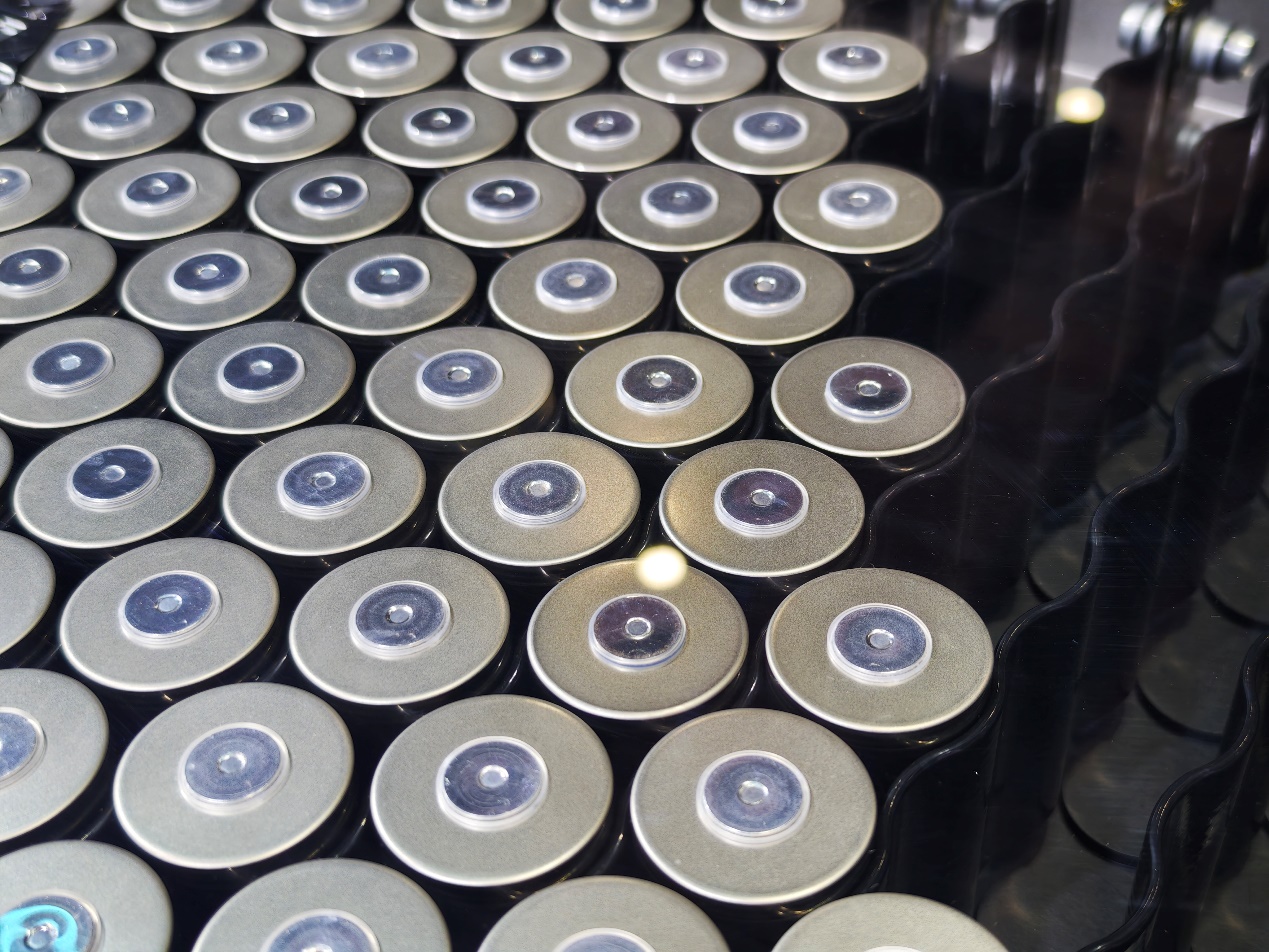
Core Insights - Lead-acid batteries, despite their long history and reliability, are not widely adopted as automotive power batteries due to several performance limitations compared to lithium batteries [1][9]. Performance Comparison - Energy density of lead-acid batteries is only 30-50 Wh/kg, while lithium batteries exceed 200 Wh/kg, making lead-acid batteries 3-4 times less efficient [1]. - For a 48V20Ah specification, lead-acid batteries weigh 25-30 kg, whereas lithium batteries weigh only 7-10 kg, highlighting a significant weight disadvantage [1]. - Lead-acid batteries have a cycle life of only 300-500 charge-discharge cycles under deep discharge conditions, compared to 2000-3000 cycles for lithium iron phosphate batteries and 1500-1800 cycles for ternary lithium batteries [5]. Design and Space Constraints - The low energy density of lead-acid batteries results in a volume and weight that is approximately five times that of lithium batteries, which increases overall vehicle weight and limits design flexibility [3][7]. - The high self-discharge rate of lead-acid batteries leads to rapid energy loss when vehicles are parked for extended periods, making them unsuitable for modern vehicles that require continuous power for complex electronic systems [5]. Economic and Environmental Considerations - Although lead-acid batteries have a lower initial cost, their total lifecycle cost does not present a clear advantage, and frequent replacements can lead to inconvenience [9]. - Lead-acid batteries contain lead, which conflicts with environmental goals and faces stricter regulatory pressures [9]. Specific Use Cases - Lead-acid batteries maintain a strong market position in automotive starting applications and have evolved towards EFB and AGM technologies to meet the auxiliary power needs of hybrid and new energy vehicles [9]. - In low-speed electric vehicles and industrial applications, such as electric forklifts, lead-acid batteries are favored for their cost-effectiveness and high discharge performance [9]. - Lead-acid batteries continue to hold significant importance in backup power and energy storage applications due to their reliable technology and safety features [9].
法国想复制广场协议,30%关税压中国?时代变了,这招不灵了!
Sou Hu Cai Jing· 2026-02-12 04:42
Core Viewpoint - The report from the French Institute for Strategic and International Relations (IRIS) indicates that European industry is facing a survival crisis due to competition from China, proposing two radical solutions: imposing a 30% tariff on Chinese goods and devaluing the euro by 20% to 30% against the yuan [1][5][12] Group 1: Proposed Solutions - The first proposal suggests a 30% tariff on Chinese goods, which may face significant opposition from EU member states due to their reliance on the Chinese market for various industries, including automotive and luxury goods [7][9] - The second proposal involves devaluing the euro by 20% to 30%, which could lead to increased import costs and inflation, particularly affecting countries like Germany that are sensitive to inflation [7][9] Group 2: Historical Context and Comparison - The report draws parallels to the 1985 Plaza Accord, where the U.S. pressured Japan to appreciate the yen, resulting in long-term economic stagnation for Japan [3][5][12] - The current situation is different as China has a strong military and economic position, making it less susceptible to external pressures compared to Japan in the 1980s [5][12] Group 3: Economic Implications - If tariffs are implemented, European consumers would face higher prices, and Chinese companies could circumvent tariffs by relocating production or utilizing alternative markets [9][10] - A devaluation of the euro could lead to increased import costs, capital outflows, and potential financial instability in Europe, particularly affecting countries with high debt levels [10][12] Group 4: Underlying Issues - The report reflects a broader anxiety within Europe regarding its industrial decline and the need for innovation and structural optimization rather than relying on administrative and monetary measures to suppress competition [12]
16年了,这个市场终于要迎来第二家上市企业
Sou Hu Cai Jing· 2026-02-12 04:13
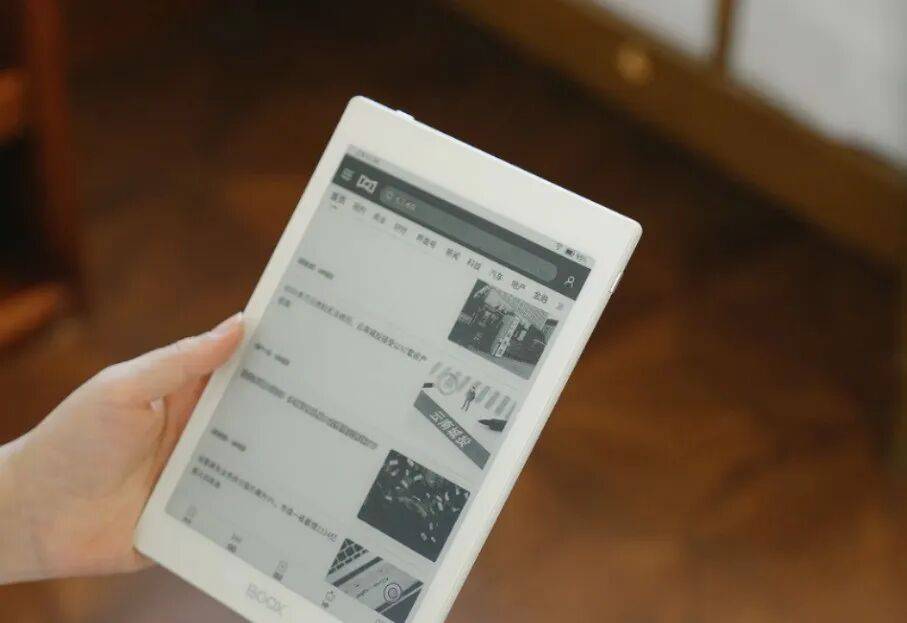
2026年初,广州文石信息科技股份有限公司(以下简称"文石")正式向香港联交所递交了上市申请。这个消息之所以值得关注,并非因其融资规模之巨, 而在于其背后所承载的产业象征意义——这是自2010年汉王科技以"墨水屏终端"概念登陆A股以来,时隔16年,第二家以此为核心业务谋求资本市场认可 的企业,阅读载体再度站上资本风口。 16年前,iPad刚刚问世,移动互联网浪潮席卷全球,以汉王为代表的电纸书企业曾被寄予厚望,被视为引领阅读革命的先锋。汉王科技上市不久,股价从 40多元飙升到90多元,后来一度达到巅峰的175元,阅读器一年销量上百万台。那时,北京一些枢纽地铁站的地下通道里,各大阅读器的广告铺天盖地。 然而,好景不长,多功能、高性能的平板电脑迅速将功能单一的电纸书挤入边缘地带,使其沦为网友口中自嘲的"泡面神器",汉王科技的股价也很长一段 时间徘徊在10元左右,公司高管上市之初怒砸"苹果"的故事成为行业笑谈。Kindle进入中国市场之后,一度短暂带动了国内电纸书阅读风潮的复苏,但市 场并没有迎来再一次的爆发。专注数字阅读的掌阅科技也曾成立专门的硬件公司,后来为了不影响公司的财务报表,只好把这块业务排除在上市公司之 ...
5000万博出27亿IPO,香港“壳王”隐身幕后
阿尔法工场研究院· 2026-02-12 04:06
Core Viewpoint - The article discusses the upcoming IPO of Weiheng Intelligent Technology Co., Ltd., highlighting its valuation of 2.7 billion and the competitive landscape of the energy storage industry in China, emphasizing the challenges and opportunities faced by the company in a capital-intensive environment [5][31]. Group 1: Company Overview - Weiheng Intelligent was founded in 2017 by Professor Sun Yaojie from Fudan University, who has over 33 years of experience in the electronic engineering and energy sectors [7]. - The company has established a dual-team model for software and hardware development, with over 50% of its staff focused on BMS/EMS software, achieving a near-zero failure rate [11]. - The business structure has shifted significantly, with commercial energy storage becoming the core revenue driver, increasing from 0.89 billion in 2023 to 2.22 billion in 2024, representing an 82.6% revenue share [11]. Group 2: Market Position and Financial Performance - Weiheng Intelligent's overseas market revenue surged from 14.5% in 2023 to 50.6% in 2024, with Europe contributing nearly 80% of this revenue [12]. - The company reported a revenue increase from 2.67 billion in 2023 to 4.76 billion in the first nine months of 2025, marking a 281.5% year-on-year growth [26]. - Gross profit rose from 22 million to 90.8 million, with gross margin improving from 8.3% to 19.1% [26]. Group 3: Challenges and Risks - The company's industry ranking is questioned, as it claims to be the eighth in global commercial energy storage but lacks corroborating data from other industry sources [27]. - Despite narrowing losses to 40.4 million in the first nine months of 2025, the company has not yet achieved profitability, with cumulative losses reaching 399 million over three years [28]. - The production capacity for commercial energy storage is underutilized at 77.5%, and the company relies heavily on outsourcing for its supply chain [29]. - A significant portion of revenue (59.4%) comes from a single customer, raising concerns about supply chain concentration risks [30].
面板收入暴涨150%,被苹果抛弃的Micro LED,终于被「AI眼镜」救活了
3 6 Ke· 2026-02-12 02:51
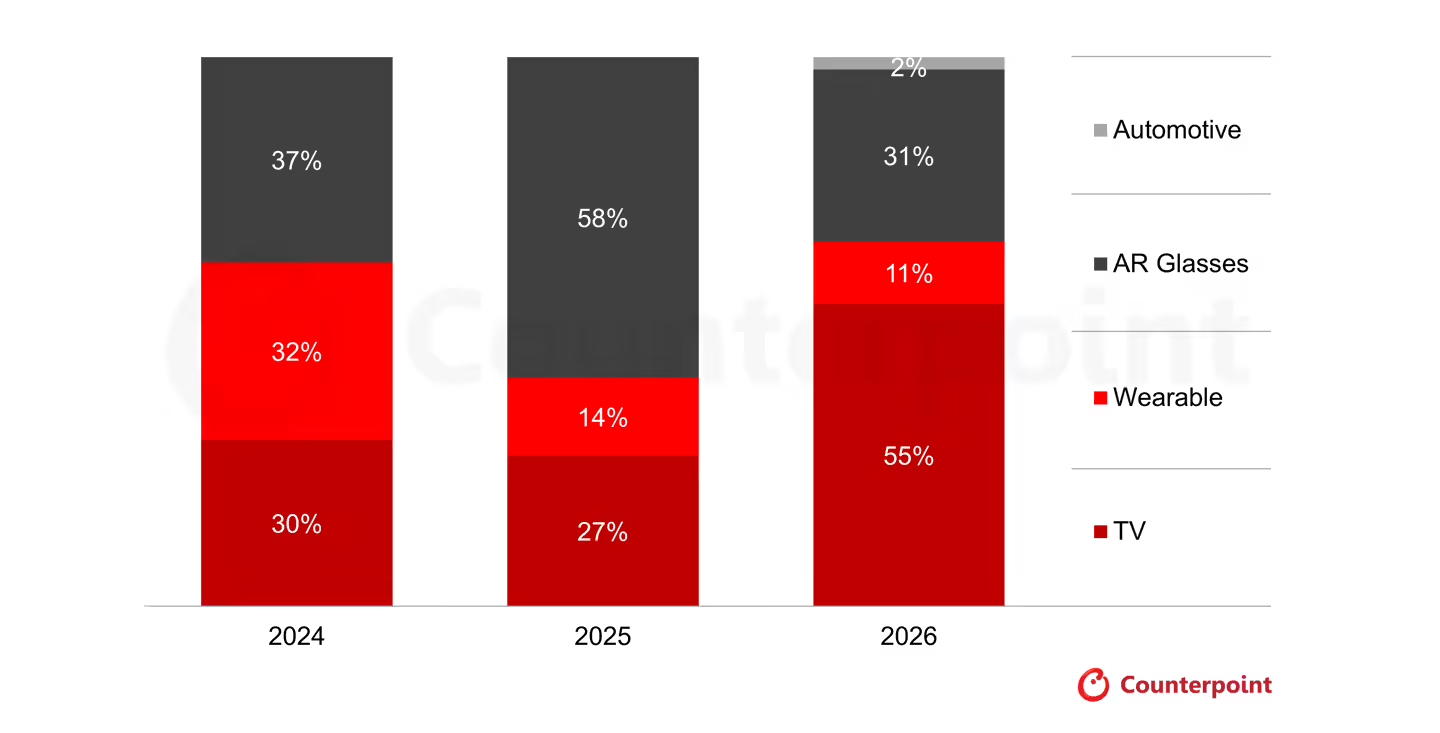
Core Insights - Apple has abandoned its long-term investment in Micro LED technology due to challenges in mass production, but recent developments indicate a resurgence in the Micro LED market driven by the explosive growth of AR smart glasses, with a reported revenue increase of 150% year-over-year [1][20]. Group 1: Market Trends - The AI smart glasses market is rapidly expanding, with most current models featuring AI capabilities, benefiting the Micro LED industry [3]. - Major brands are launching AI glasses in 2025, with a notable trend of using Micro LED technology, indicating its status as a standard for high-end smart glasses [4][21]. Group 2: Product Highlights - The Thunder X3 Pro, set to launch in May 2025, features dual full-color Micro LED technology, achieving an eye brightness of 3500 nits and peak brightness of 6000 nits, targeting the high-end market with a price near 10,000 yuan [4]. - Lenovo's AI glasses V1 utilize a monochrome Micro LED solution with a peak brightness of 2000 nits, priced at 3999 yuan, showcasing a more affordable option [6]. Group 3: Technical Advantages - Micro LED technology is distinguished from traditional LED screens, as it consists of tiny micro-displays that project images through optical systems, making it suitable for compact devices like AI glasses [10]. - Micro LED is seen as the next-generation display technology following Mini LED, offering significant brightness advantages crucial for outdoor use [11]. Group 4: Competitive Landscape - JBD, a key player in the Micro LED space, supplies micro-displays and optical modules for many AI glasses, indicating its strong market position and technological edge [21][25]. - JBD's micro-displays have high pixel density and brightness, making them ideal for AR applications, and the company has attracted investments from major firms like Alibaba and BYD [25]. Group 5: Future Outlook - The Micro LED technology is expected to find broader applications beyond AI glasses, potentially impacting sectors like smart automotive and robotics, suggesting a promising growth trajectory for JBD and the Micro LED market [25].