科大讯飞

Search documents
AI应用商业化拐点已至,国产算力与应用双主线共振
Yin He Zheng Quan· 2026-01-15 08:38
Investment Rating - The report maintains a "Recommended" rating for the computer industry [1] Core Insights - The computer industry is experiencing a positive start to the year, with an index increase of 18.04%, ranking third among SW primary industries, compared to the Shanghai Composite Index's increase of 3.96% and the CSI 300's increase of 2.42% [3] - AI applications are becoming the core driving force behind the current upward trend in the computer sector, with the Wind AI application index rising by 19.25% [3] - The commercialization of AI applications is expected to transition from a usable to a useful stage in 2026, creating investment opportunities in both AI applications and domestic computing power [3] Summary by Sections Industry Performance - The computer industry index has shown significant growth, outperforming major indices, indicating a potential bottom reversal in industry sentiment [3] AI Application Trends - The report highlights a surge in AI application catalysts, with major companies like MiniMax and Zhiyuan AI showing strong market performance post-IPO [3] - Collaborations between companies such as NVIDIA and Eli Lilly are expected to drive advancements in AI-assisted drug discovery, further enhancing the AI application landscape [3] B-end vs C-end AI Applications - B-end AI applications are anticipated to see rapid growth, with a focus on sectors like marketing, industrial software, healthcare, and finance [3] - C-end applications are viewed as long-term value investments, leveraging existing user bases and brand strength to enhance product offerings through AI [3] Domestic Computing Power - The demand for data centers is expected to rise, with a recovery in domestic AIDC bidding starting in Q4 2025, leading to accelerated data center deployments by major internet companies in 2026 [3] - The restoration of H200 supply is projected to improve model training efficiency, further driving the need for domestic computing power chips [3] Investment Recommendations - Key investment opportunities include major players in large models and Maas manufacturers, domestic computing power and data center supply chains, and various AI application sectors [3]
2025年金融大模型采购额暴增527%,AI竞速态势加剧
2 1 Shi Ji Jing Ji Bao Dao· 2026-01-15 08:24
Core Insights - The introduction of the AI model DeepSeek by Deep Exploration Company in early 2025 has sparked a significant application boom in the financial industry, marking a transformative technological force comparable to the mobile internet [1] - The banking sector is leading the procurement of large models, with a notable increase in project numbers and funding, indicating a shift in focus from computational power to application effectiveness [3][5] Group 1: Market Trends - In 2025, the financial industry saw a dramatic increase in large model procurement, with 587 projects awarded, representing a 341% year-on-year increase in project numbers and a 527% increase in disclosed funding to 1.506 billion yuan [3][5] - The banking sector accounted for nearly half of the total projects with 290 projects, and 75.2% of the total funding, establishing a dominant position in the market [5][6] Group 2: Project Distribution - The distribution of project types in the financial sector for large models in 2025 shows that banking projects comprised 49.4% of the total, with disclosed funding of 1.13221 billion yuan [6] - The focus is shifting from computational power projects to application projects, with application-type projects (including intelligent agents) rapidly increasing in number and becoming the primary procurement direction [7] Group 3: Driving Forces - Multiple factors are driving the banking sector's embrace of large models, including supportive government policies aimed at accelerating the intelligent transformation of the financial industry [8] - The maturity of technology has reached a turning point in 2025, with significant improvements in the accuracy, reliability, and practicality of large models, particularly with the rise of open-source models like DeepSeek [8][9] Group 4: Competitive Landscape - The competitive pressure in the banking sector, characterized by narrowing interest margins and intensified competition, necessitates new tools for efficiency and differentiation, with AI applications potentially reducing costs by up to 70% in certain categories [9] - Customer expectations for financial services are rising, demanding quicker responses and more personalized experiences, which traditional technologies struggle to meet [9] Group 5: Application Scenarios - Specific application scenarios in the financial sector are becoming concentrated, with intelligent customer service and digital personnel leading the number of awarded projects [10] - The focus on intelligent agents is increasing, with 49 projects explicitly mentioning "intelligent agents," indicating a growing interest in embedding AI capabilities into specific applications [11] Group 6: Future Outlook - As the application of large models deepens, the procurement of application-type projects is expected to grow, with banks likely to develop their own intelligent agents based on clear scenarios and engineering capabilities [11][12] - The financial industry is seen as a data and service-intensive sector, with significant potential for further exploration and application of large models [12]


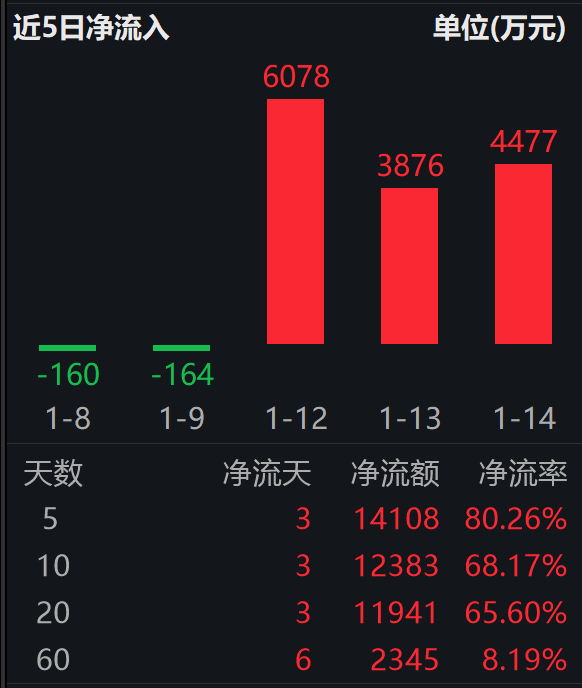
IDC最新预测:26年人形机器人市场规模将翻倍!机器人ETF基金(159213)微调,连续13日强势吸金超3亿元!小鹏今年将规模量产人形机器人!
Sou Hu Cai Jing· 2026-01-15 06:56
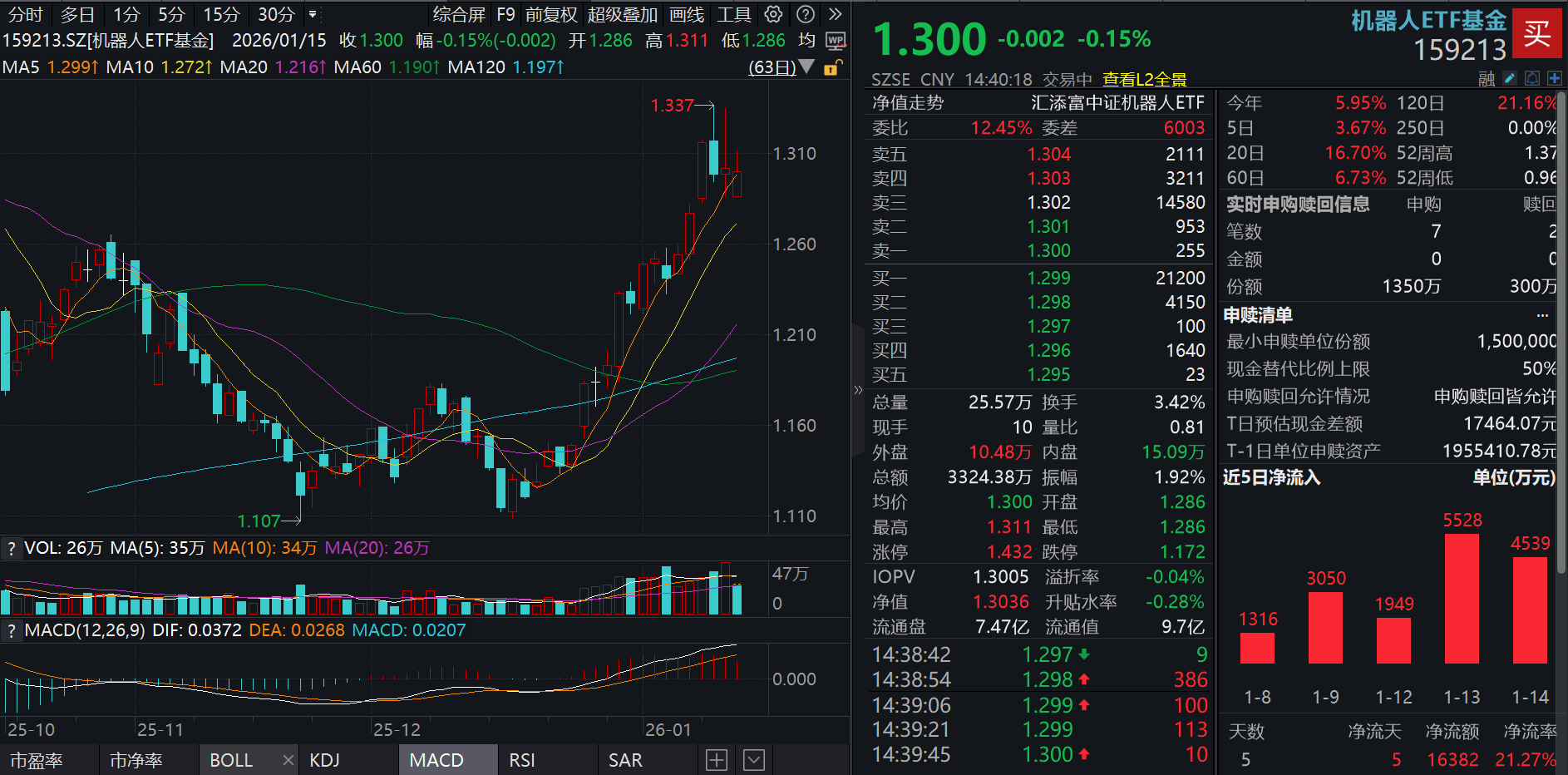
Core Viewpoint - The A-share market is experiencing fluctuations with the robotics sector showing signs of recovery, as evidenced by the continuous inflow of capital into the robotics ETF fund, which has attracted over 360 million yuan in the past 13 days [1] Market Performance - As of 14:39 on January 15, the robotics ETF fund (159213) slightly declined by 0.15%, while it attracted over 13.6 million yuan in capital during the day [1] - The component stocks of the robotics ETF showed mixed performance, with Huichuan Technology rising over 3% and Dazhong Laser and iFlytek increasing by over 1%, while Zhongkong Technology and Dahua Technology experienced declines [2][3] Component Stock Details - The following are notable component stocks and their performance: - iFlytek (002230): +1.13%, estimated weight 11.64% - Huichuan Technology (300124): +3.87%, estimated weight 9.65% - Dazhong Laser (002008): +1.93%, estimated weight 3.99% - Zhongkong Technology (688777): -1.82%, estimated weight 4.86% - Dahua Technology (002236): -0.64%, estimated weight 4.53% [4] Industry Insights - IDC predicts that by 2026, the application scenarios for humanoid robots in China will triple, with a market size approaching 1.3 billion USD, representing over 100% year-on-year growth. User spending on embodied intelligent robots is expected to exceed 11 billion USD [5] - The Chinese robotics and embodied intelligence market is entering a critical inflection point, where the ability to integrate perception, decision-making, control, system integration, and scene understanding into stable, replicable, and scalable solutions will differentiate manufacturers [5] Investment Trends - The global first robot leasing platform, Qingtian Rental, recently completed a seed round of financing led by Hillhouse Ventures, with participation from Fosun, Muhua Innovation, Dafeng Fund, and Zhangjiang Group [5] - Companies like Leju Robotics and Alibaba Cloud are forming partnerships for full-stack AI, while Xiaopeng plans to mass-produce humanoid robots this year [6] Market Outlook - CITIC Securities indicates that the humanoid robot sector is in a rebound phase, driven by Tesla's advancements in the "physical AI" industry, with the upcoming release of the Optimus V3 and Gen3 mass production plans [7] - The domestic supply chain is seeing continuous catalysts, with positive changes from policy, product, and capital fronts, suggesting a focus on quality segments within the sector [7]


阿里云目标2026年拿下中国AI云市场增量80%,AI人工智能ETF(512930)备受关注
Xin Lang Cai Jing· 2026-01-15 06:06
Group 1 - The core viewpoint of the news is that the AI cloud market in China is expected to experience significant growth, with Alibaba Cloud aiming to capture 80% of the market increment by 2026, indicating a transformative phase for the cloud computing industry driven by AI [1] - The AI and industrial software sectors are predicted to accelerate their integration, with IDC forecasting a compound annual growth rate (CAGR) of 41.4% for the AI+industrial software segment from 2024 to 2029, significantly outpacing the 19.3% CAGR of core industrial software during the same period [2] - The China Securities Artificial Intelligence Theme Index (930713) includes 50 listed companies that provide foundational resources, technologies, and application support for AI, reflecting the overall performance of AI-related securities [2] Group 2 - As of December 31, 2025, the top ten weighted stocks in the China Securities Artificial Intelligence Theme Index account for 58.08% of the index, with notable companies including Zhongji Xuchuang, Xinyi Sheng, and Cambricon [2] - The AI Artificial Intelligence ETF (512930) closely tracks the performance of the China Securities Artificial Intelligence Theme Index, providing investors with exposure to the AI sector [3]
OpenAI百亿合作加速布局算力基建,人工智能AIETF(515070)持仓股北京君涨超2%
Mei Ri Jing Ji Xin Wen· 2026-01-15 06:02
Group 1 - The A-share index experienced a rebound in the afternoon, with a narrowing decline, particularly in sectors such as precious metals, energy metals, and agricultural chemicals, while commercial aerospace and AI application sectors adjusted [1] - OpenAI and Cerebras announced a three-year agreement to procure up to 750 megawatts of computing power, totaling over $10 billion, marking a significant step for OpenAI in reducing reliance on traditional GPU suppliers [1] - The computing resources will primarily support the development of real-time interactive AI applications, indicating a growing demand for AI-related technologies [1] Group 2 - The AI ETF (515070) tracks the CS AI Theme Index (930713), selecting component stocks that provide technology, basic resources, and applications for AI, focusing on the midstream and upstream of the AI industry chain [2] - The top ten weighted stocks in the ETF include leading domestic technology companies such as Zhongji Xuchuang, Xinyi Sheng, Cambricon Technologies, and Hikvision, among others [2]
评标工作强度高?科大讯飞官宣进军AI招采标领域
Xin Jing Bao· 2026-01-15 05:29
Group 1 - The core objective of the company is to build an ecosystem for procurement processes, integrating dozens of specialized agents covering key processes such as bidding, tendering, and evaluation [1] - The company showcased an AI-driven evaluation process that includes automatic text parsing, data extraction, and image recognition, ultimately producing an intelligent evaluation report and a comparison of suppliers [1] - The company plans to allow third-party developers and industry experts to create and launch more diverse intelligent applications on its platform, aiming to establish a "smart application store" for the procurement sector [1] Group 2 - Recent concerns arose when four evaluation experts experienced health issues due to delayed meal deliveries, highlighting the high responsibility and intensity of evaluation work [3] - In response to these challenges, the company announced the launch of the "Procurement Intelligent Agent Platform," which aims to reduce compliance risks while enhancing the efficiency of the evaluation process [3]

AI应用催化不断,AI人工智能ETF(512930)盘中整固
Xin Lang Cai Jing· 2026-01-15 05:28
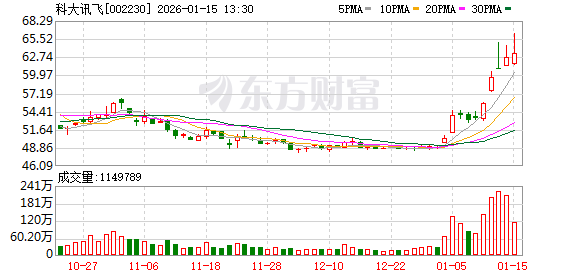
Core Viewpoint - The AI sector is experiencing significant advancements, with notable developments in AI applications and a positive outlook for domestic computing power growth by 2030 [1][2]. Group 1: AI Market Performance - The CSI Artificial Intelligence Theme Index (930713) shows mixed performance among its constituent stocks, with Deepin Technology leading at a 2.81% increase, followed by Hehe Information at 2.22%, and iFlytek at 1.02% [1]. - The AI Artificial Intelligence ETF (512930) is currently priced at 2.36 yuan [1]. Group 2: AI Applications and Innovations - DeepSeek has introduced innovative mechanisms like "conditional memory," significantly enhancing the performance of large language models in knowledge retrieval and computational efficiency [1]. - Alibaba's "Qianwen" app has surpassed 100 million monthly active users within two months of launch, integrating with Taobao Flash Purchase and Alipay AI Payment for seamless user experience [1]. Group 3: Future Outlook for Domestic Computing Power - CITIC Securities anticipates a critical leap in domestic computing power, with expectations for single-card performance to significantly improve, software ecosystems to mature, and connectivity capabilities to break through [1]. - By 2030, domestic manufacturers' market share is projected to rise from 30-40% to 60-70%, with the total addressable market (TAM) for domestic computing power expected to grow from over $13 billion in 2025 to over $180 billion by 2030 [1].
政策风吹来了,养老机器人产业快速发展还会远吗?
机器人大讲堂· 2026-01-15 04:00
Core Viewpoint - The article highlights the emergence of the elderly care robot industry as a significant opportunity driven by supportive policies, technological advancements, and increasing demand, with 2026 expected to be a pivotal year for the sector [1][5][30]. Policy Support - Eight government departments jointly issued measures to foster the development of elderly care service operators, marking the official arrival of the elderly care robot trend [1]. - The policy encourages technological innovation and product development in elderly care robotics, focusing on daily care, emotional support, and social assistance for the elderly [3]. - A comprehensive policy framework has been established, transitioning from mere encouragement to substantial support, including pilot programs and standardization [5][6]. Market Dynamics - The elderly care robot industry is experiencing a "triple dividend" of policy support, technological maturity, and explosive demand, revealing a market potential worth trillions [5]. - By 2025, government procurement is projected to account for 28% of the elderly care robot market, acting as a significant growth engine [11]. - The elderly population in China is expected to exceed 20% by 2031, intensifying the demand for innovative care solutions [13]. Technological Advancements - The article emphasizes the importance of integrating advanced technologies such as AI, robotics, and smart home systems to provide comprehensive support for the elderly [3][30]. - Innovations in product design and functionality are being driven by the need to address specific challenges faced by the elderly, such as mobility and emotional companionship [15][19]. Consumer Trends - There is a notable shift in consumer preferences among the elderly, moving from basic needs to a focus on quality, safety, and usability of elderly care robots [20]. - The willingness to pay a premium for high-quality products has increased significantly, with 57% of users willing to pay more for superior features by 2024 [20]. Industry Challenges - The elderly care robot industry has faced challenges such as high costs, reliability issues, and low user acceptance, which have hindered widespread adoption [23]. - Recent advancements in domestic manufacturing and innovative business models, such as rental and insurance services, are helping to lower costs and improve accessibility [26][23]. Future Trends - The industry is expected to evolve towards more specialized products tailored to specific needs, integrating AI for proactive service delivery, and creating an ecosystem that combines hardware, services, and insurance [31][33]. - The article predicts that the elderly care robot market will transition from niche technology to a mainstream necessity, driven by policy support, technological breakthroughs, and increased market acceptance [35][36].

2026-2032年中国智慧校园市场调查与市场年度调研报告
Sou Hu Cai Jing· 2026-01-15 03:34
Group 1 - The core concept of the report is the integration of IoT-based smart campus environments that enhance teaching, research, management, and campus life through various application service systems [2] - The report provides a comprehensive analysis of the smart campus industry, including market development environment, operational status, competitive landscape, key enterprise performance, and future trends and investment forecasts [2][3] - The data utilized in the report is sourced from national statistics, customs data, survey data, and various market monitoring databases, ensuring a robust analytical foundation [2] Group 2 - The report includes a detailed analysis of the downstream industries and their impact on the smart campus sector [3] - It outlines the economic environment affecting the smart campus industry, including macroeconomic conditions, industrial trends, and fixed asset investments [3][4] - The report discusses the social environment, including demographic, cultural, and ecological factors, as well as urbanization rates in China [3][4] Group 3 - The competitive landscape of the smart campus industry is analyzed, focusing on existing competition, potential entrants, substitute products, and bargaining power of suppliers and customers [4] - The report examines the concentration levels within the industry, including market and enterprise concentration, as well as regional concentration [4][5] - Key brand enterprises in the smart campus sector are analyzed, including their operational data, product structure, and development history [5][6] Group 4 - The report forecasts the market capacity and future development trends of the smart campus industry from 2021 to 2025, highlighting favorable and unfavorable policies [5][6] - It identifies key trends that will influence production and operations in the smart campus sector, including market integration, demand changes, and technological advancements [6] - The investment directions and potential opportunities in the smart campus industry are discussed, along with the challenges new entrants may face [6]

AI应用热潮来袭,软件板块乘风而起!软件指数ETF(560360) 连续三日“吸金”合超1.4亿
Sou Hu Cai Jing· 2026-01-15 03:13
Group 1 - The AI application sector is experiencing a mixed performance, with notable gains in companies like Shiji Information and Guanglianda, while the Software Index ETF has seen a monthly increase of over 20% and an average daily turnover rate exceeding 7.5% [1][2] - The Software Index ETF (560360) has attracted significant capital inflow, totaling over 140 million yuan in net inflow over the past three days, indicating strong market interest [2] - Long-term projections suggest that by 2026, AI applications are expected to achieve breakthroughs in both consumer and business sectors, with a notable increase in the adoption of large models and intelligent agents among Chinese industrial enterprises [3] Group 2 - The Software Index ETF tracks the CSI Software Index, which includes high-quality companies across various segments such as basic software, industrial software, information security, cloud computing, big data, and AI applications, with top five weighted stocks including iFLYTEK and Kingsoft [3] - Recent developments in AI applications include the launch of AI central platforms and intelligent agents by companies like Runhe Software and Yonyou Network, reflecting the growing trend in the AI sector [2]