中金基金

Search documents
券商资管转型生变:“参公”产品变更管理人 公募牌照申请退潮
2 1 Shi Ji Jing Ji Bao Dao· 2025-11-27 13:01
Core Viewpoint - The transition period for the transformation of "publicly offered collective products" is nearing its end, prompting several brokerage firms to change the management of their collective products to avoid liquidation and successfully convert them into public fund products [1][4]. Group 1: Changes in Management of Collective Products - As of November, at least 25 publicly offered collective products have officially changed their management to public fund companies, with notable changes including products from Guangfa Fund, Huafu Fund, and others [1][3]. - The process for changing management involves obtaining approval from the China Securities Regulatory Commission (CSRC) and holding a meeting for product holders to vote on the change [3][4]. - The changes not only involve the management but may also affect product names, investment strategies, and fee structures [3][4]. Group 2: Shift in Focus for Brokerage Asset Management - Brokerage asset management firms are increasingly abandoning the pursuit of public fund licenses, with several firms like Guangfa Asset Management and Guotou Securities Asset Management withdrawing their applications [6][7]. - The reasons for this shift include the lengthy wait for license approval, high initial investment costs for establishing independent operations, and the competitive landscape of the public fund industry [7][9]. - Firms are now focusing on differentiated strategies in private asset management and wealth management, which are seen as more advantageous compared to the public fund sector [2][8]. Group 3: Strategic Implications of the Transition - The transition to changing management for collective products is viewed as a necessary response to regulatory compliance requirements, allowing firms to retain clients and avoid fund liquidation [4][5]. - The current trend indicates a move away from "license worship" towards a more rational understanding of the profitability challenges associated with public fund operations [7][9]. - Brokerage firms are now concentrating on creating value-driven products that cater to specific client needs, emphasizing absolute returns and tailored investment strategies [10].




绝对收益产品及策略周报(251117-251121):上周23只固收+基金创新高-20251127
GUOTAI HAITONG SECURITIES· 2025-11-27 05:08
Group 1: Fixed Income + Product Performance Tracking - As of November 21, 2025, the total market size of fixed income + funds reached 21,846.96 billion, with 1,151 products, and 23 products achieved historical net value highs last week [2][20] - The median performance of various fund types for the week of November 17-21, 2025, showed mixed results: mixed bond type I (-0.04%), mixed bond type II (-0.72%), and flexible allocation type (-0.60%) [2][13] - The median returns for conservative, balanced, and aggressive funds were -0.13%, -0.59%, and -0.93%, respectively [2][13] Group 2: Major Asset Allocation and Industry ETF Rotation Strategy Tracking - The macro environment forecast for Q4 2025 indicates inflation, with the Shanghai Composite Index, China Government Bond Total Wealth Index, and AU9999 contract yielding -4.03%, -0.10%, and 0.63% respectively since November [3] - Recommended industry ETFs for November 2025 include semiconductor, securities companies, communication equipment, new energy vehicle batteries, and animation game ETFs, with a weekly return of -5.15% and a cumulative return of -7.92% for the month [3] Group 3: Absolute Return Strategy Performance Tracking - The macro timing-driven stock-bond 20/80 rebalancing strategy yielded -0.38% last week, with a year-to-date return of 4.84% [4] - The small-cap growth style within the stock-bond 20/80 combination showed a notable annual return of 10.57%, while the PB earnings, high dividend, and small-cap value strategies returned 4.35%, 3.81%, and 10.20% respectively [4] - The cumulative return for the small-cap growth combination based on a macro momentum model was 12.70% [4]
道通科技股价涨5.06%,中金基金旗下1只基金重仓,持有1.3万股浮盈赚取2.15万元
Xin Lang Cai Jing· 2025-11-25 02:24
Core Viewpoint - Daotong Technology experienced a 5.06% increase in stock price, reaching 34.25 CNY per share, with a trading volume of 1.51 billion CNY and a market capitalization of 22.954 billion CNY [1] Company Overview - Daotong Technology, established on September 28, 2004, and listed on February 13, 2020, is located in Shenzhen, Guangdong Province. The company specializes in the research, development, production, sales, and service of automotive intelligent diagnostic and detection analysis systems, as well as automotive electronic components [1] - The revenue composition of Daotong Technology includes: - Automotive diagnostic products: 29.61% - Intelligent charging network solutions: 22.34% - TPMS products: 21.98% - AI and software: 11.98% - ADAS products: 8.85% - Other products and services: 5.24% [1] Fund Holdings - According to data, one fund under CICC holds a significant position in Daotong Technology. The CICC CSI 1000 Index Enhanced Fund A (017733) held 13,000 shares in the third quarter, accounting for 0.54% of the fund's net value, ranking as the ninth largest holding. The estimated floating profit for today is approximately 21,500 CNY [2] - The CICC CSI 1000 Index Enhanced Fund A was established on March 14, 2023, with a latest scale of 53.541 million CNY. Year-to-date returns are 26.76%, ranking 1446 out of 4206 in its category; one-year returns are 30.28%, ranking 1172 out of 3983; and since inception returns are 22.53% [2] - The fund managers, Geng Shuaijun and Wang Yangfeng, have tenures of 5 years and 3 years respectively, with total fund assets of 4.295 billion CNY and 1.306 billion CNY [2]

振芯科技股价涨5.47%,中金基金旗下1只基金重仓,持有2.18万股浮盈赚取2.53万元
Xin Lang Cai Jing· 2025-11-24 05:59
Group 1 - The core viewpoint of the news is that Zhenxin Technology has seen a stock price increase of 5.47%, reaching 22.36 yuan per share, with a total market capitalization of 12.698 billion yuan [1] - Zhenxin Technology, established on June 12, 2003, and listed on August 6, 2010, focuses on the "components-terminals-systems" industry chain related to Beidou satellite navigation, providing products and services in this field [1] - The company's main business revenue composition includes integrated circuit business (50.23%), comprehensive Beidou navigation applications (35.43%), smart city construction and operation services (11.34%), machine perception and intelligent products (2.44%), and others (0.57%) [1] Group 2 - According to data, a fund under CICC holds Zhenxin Technology as its sixth-largest heavy stock, with 21,800 shares, accounting for 0.57% of the fund's net value [2] - The CICC Zhongzheng 1000 Index Enhanced Initiation A fund (017733) has achieved a year-to-date return of 25.02%, ranking 1500 out of 4209 in its category [2] - The fund was established on March 14, 2023, with a latest scale of 53.541 million yuan, and has generated a floating profit of approximately 25,300 yuan today [2]

“全市场撒网”还是“主题深耕”?公募投资逻辑正深度重构
券商中国· 2025-11-24 01:33
Core Viewpoint - The investment style of public funds is shifting from "full market stock selection" to "thematic investment," driven by economic transformation and the emergence of high-growth stocks [1][3]. Group 1: Shift in Investment Strategies - Public funds previously favored "core assets" like large-cap stocks, but this strategy is losing traction as thematic investments gain popularity [2][3]. - Thematic investments allow for a more comprehensive layout of high-growth stocks and can enhance competitive rankings among funds [1][2]. - The shift is attributed to changes in the investment environment, including slower economic growth and the emergence of new industries, which have made traditional core assets less attractive [3][5]. Group 2: Characteristics of Thematic Investment - Thematic funds have been performing well, often ranking at the top in annual performance due to their focus on high-growth sectors like AI and innovative pharmaceuticals [4][5]. - The concentration on specific themes allows for greater potential returns, but also increases volatility and risk [5][11]. - Thematic investments help investors engage with long-term trends and direct capital towards state-supported sectors, fostering a positive cycle between capital markets and technological innovation [6][11]. Group 3: Challenges of Thematic Investment - Thematic investment requires deeper industry understanding and foresight, as it involves answering long-term questions about market dynamics and competition [7][8]. - The need for rigorous valuation discipline and risk management is heightened, as concentrated portfolios are more susceptible to individual stock performance and policy changes [8][9]. - The complexity of managing risks increases with thematic investments, necessitating precise control over concentration and liquidity [8][9]. Group 4: Future of Full Market Stock Selection - Despite the rise of thematic investments, "full market stock selection" is not expected to disappear, as it offers unique advantages in capturing structural opportunities across various sectors [10][11]. - The ability to conduct fundamental comparisons across industries will remain relevant, especially in a market characterized by frequent sector rotations [10][11]. - The long-term viability of "full market stock selection" will depend on its adaptation to new macroeconomic and industry conditions [10].


公募基金投资逻辑深度重构:“主题投资”风行一时 “全市场选股”暂避锋芒
Zheng Quan Shi Bao Wang· 2025-11-23 23:42
Core Viewpoint - The investment style of public funds has shifted from core assets to high-growth stocks amid economic transformation, moving from "full market stock selection" to "thematic investment" strategies [1][3]. Group 1: Shift in Investment Strategies - Public funds previously favored large-cap stocks like Sany Heavy Industry and Kweichow Moutai, achieving significant returns through a diversified stock selection approach [2]. - The "full market stock selection" strategy has become less prominent, with thematic products dominating annual performance rankings [2][3]. - Changes in the investment environment, including economic deceleration and shifts in consumer behavior, have led to decreased profitability and valuation of traditional core assets [3]. Group 2: Rise of Thematic Investment - Thematic funds have gained popularity due to structural opportunities concentrated in high-growth sectors, outperforming traditional industries [5]. - The volatility of thematic products can lead to substantial excess returns, encouraging funds to increase style purity and concentration [5]. - Thematic investments help investors engage with long-term trends and direct capital towards government-supported sectors, fostering a positive cycle of capital market support for national strategies [6]. Group 3: Challenges of Thematic Investment - Thematic investment requires deeper industry understanding and foresight, raising the bar for fund managers [7]. - The need for rigorous valuation and risk management frameworks is heightened, as concentrated portfolios are more susceptible to individual stock performance and policy changes [8]. - The complexity of managing risks in concentrated portfolios necessitates meticulous control over concentration, liquidity, and stress testing [8]. Group 4: Future of Full Market Stock Selection - The "full market stock selection" strategy is unlikely to disappear, as it offers unique advantages in capturing structural opportunities across various sectors [10]. - Market aesthetics will continue to evolve with macroeconomic and structural changes, but the fundamental capabilities of full market stock selection will remain relevant [10]. - Thematic investments, while potentially lucrative, carry risks of significant losses if market trends shift unfavorably [11].
“主题投资”风行一时 “全市场选股”暂避锋芒
Zheng Quan Shi Bao· 2025-11-23 23:34
Core Viewpoint - The investment style of public funds in China is shifting from traditional core assets to emerging industries, driven by economic transformation and policy support, leading to a focus on thematic investments rather than broad market selection [2][3][5]. Group 1: Investment Strategy Changes - Public funds are moving from a "full market selection" strategy to a "thematic investment" approach, allowing for better positioning in high-growth stocks and enhancing competitiveness in performance rankings [3][4]. - The previous success of large-cap stocks like Sany Heavy Industry and Kweichow Moutai has diminished, with thematic products now dominating annual performance rankings [4][5]. - The rapid development of broad-based indices and Smart Beta products has made traditional active equity products less competitive, necessitating differentiation in style and active management [5][6]. Group 2: Thematic Investment Trends - Thematic funds have gained prominence, focusing on high-growth sectors such as artificial intelligence and innovative pharmaceuticals, which are seen as more lucrative compared to traditional sectors [6][7]. - Structural opportunities are increasingly concentrated in a few high-growth sectors, leading to significant performance disparities among funds [7][8]. - The focus on single themes allows for potentially higher returns, but also increases volatility and risk, necessitating careful management of exposure and risk [8][9]. Group 3: Challenges of Thematic Investment - Thematic investment requires deeper industry understanding and foresight, raising the bar for fund managers in terms of research and analysis capabilities [9][10]. - The need for rigorous valuation and risk management frameworks is heightened, as concentrated investments in specific sectors can lead to significant impacts from individual stock performance or policy changes [10][11]. - The complexity of managing concentrated portfolios increases, demanding more sophisticated risk management strategies to mitigate potential losses [10][11]. Group 4: Future of Investment Strategies - The "full market selection" strategy is not expected to disappear, as it offers unique advantages in capturing structural opportunities across various sectors [12][13]. - The market's aesthetic preferences will continue to evolve, but the fundamental skills associated with "full market selection" will remain relevant [12][13]. - The dual nature of thematic investments presents both opportunities for high returns and risks of significant losses, emphasizing the need for careful asset allocation and risk management [14][15].

公募基金投资逻辑深度重构: “主题投资”风行一时 “全市场选股”暂避锋芒
Zheng Quan Shi Bao· 2025-11-23 21:45
Core Viewpoint - The investment style of public funds has shifted from core assets to high-growth stocks under the backdrop of economic transformation, moving from "full market stock selection" to "thematic investment" strategies [1][3][10] Group 1: Shift in Investment Strategies - Public funds previously favored large-cap stocks like Sany Heavy Industry and Kweichow Moutai, achieving significant returns through a diversified portfolio [2] - The "full market stock selection" strategy has become less prominent, with thematic products dominating annual performance rankings [2][3] - Changes in the investment environment, including economic deceleration and structural adjustments, have led to a decline in the profitability of traditional consumer and manufacturing leaders [3][5] Group 2: Rise of Thematic Investment - Thematic funds have gained popularity due to structural opportunities concentrated in high-growth sectors, outperforming traditional industries [5][6] - Thematic investment allows investors to engage with long-term trends more intuitively, simplifying complex macro and industry logic [6][9] - The focus on specific high-growth sectors, such as AI and innovative pharmaceuticals, has led to significant capital inflows and heightened competition among funds [4][5] Group 3: Challenges of Thematic Investment - Thematic investment requires deeper industry understanding and foresight, raising the bar for fund managers [7][8] - The need for rigorous valuation and risk management frameworks is critical, as concentrated portfolios can be significantly impacted by individual stock performance and market events [8][12] - The complexity of managing risks in highly concentrated portfolios necessitates advanced strategies to maintain overall risk within acceptable limits [8][12] Group 4: Future of Investment Strategies - The "full market stock selection" strategy is not expected to disappear, as it offers unique advantages in capturing structural opportunities across various sectors [10][11] - The market's aesthetic preferences will continue to evolve, but the fundamental capabilities of "full market stock selection" will remain relevant [11] - Thematic investment can lead to high volatility and potential reputational risks for fund companies, emphasizing the need for careful asset allocation and risk management [12]
基金分红:中金金誉债券基金11月26日分红
Sou Hu Cai Jing· 2025-11-22 01:41
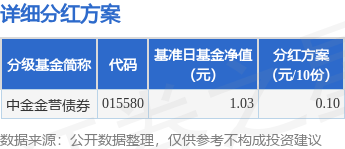
证券之星消息,11月22日发布《中金金誉债券型证券投资基金2025年第1次分红公告》。本次分红为 2025年度第1次分红。公告显示,本次分红的收益分配基准日为11月11日,详细分红方案如下: | 分级基金筒称 | 代码 | 重难日重会演唱 | | 分红方案 | | | --- | --- | --- | --- | --- | --- | | | | (元) | | (元/10份) | | | 中金金蒿倩券 | 015580 | | 1.03 | | 0.10 | 本次分红对象为权益登记日在本公司登记在册的本基金全体基金份额持有人,权益登记日为11月25日, 现金红利发放日为11月26日。1、选择红利再投资方式的投资者,其红利将以2025年11月25日除息后的 基金份额净值转换为基金份额。 2、选择红利再投资方式的投资者所转换的基金份额将于2025年11月26 日直接计入其基金账户,2025年11月27日起可以查询、赎回。根据财政部、国家税务总局的相关规定, 基金向基金份额持有人分配的基金收益,暂免征收所得税。本次分红免收分红手续费。选择红利再投资 方式的投资者,其红利所转换的基金份额免收申购费用。 以上内容 ...
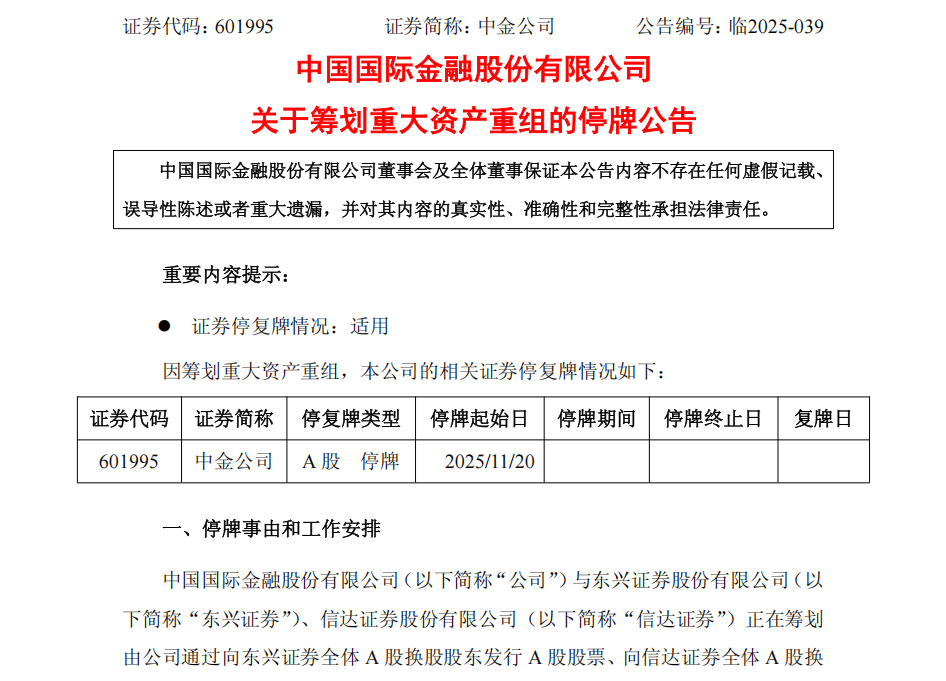
中金吸并东兴、信达:“汇金系”三张公募牌照如何重排
Sou Hu Cai Jing· 2025-11-20 10:56
Core Viewpoint - The simultaneous suspension announcements by China International Capital Corporation (CICC), Dongxing Securities, and Xinda Securities indicate a significant restructuring in the "Hui Jin" brokerage landscape, with CICC planning to absorb the other two through a share swap, resulting in a new brokerage with assets exceeding 1 trillion yuan, second only to CITIC Securities, Guotai Junan, and Huatai Securities [1] Group 1: Company Restructuring - CICC, Dongxing Securities, and Xinda Securities are planning a merger that will create a new brokerage with an asset scale exceeding 1 trillion yuan [1] - The merger raises questions about the future structure and collaboration of the affiliated fund companies: CICC Fund, Xinda Australia Fund, and Dongxing Fund [1] Group 2: Fund Management Overview - CICC Fund, established in 2014, has approximately 234.4 billion yuan in public fund assets as of September 2025, showing a growth of about 27 billion yuan from the previous year [2] - Xinda Australia Fund, founded in 2006, manages around 110 billion yuan in public funds, with a recent decline in industry ranking [3][4] - Dongxing Fund, established in 2020, has a public fund scale of about 34 billion yuan, also experiencing a drop in ranking [4] Group 3: Regulatory and Market Implications - The restructuring will allow CICC to hold three public fund licenses, raising questions about the balance of license numbers, equity structure, and business division in future asset management company setups [4] - Historical precedents, such as the merger of Huaxia Fund and CITIC Fund, and the recent merger of Guotai Junan and Haitong Securities, provide context for the expected complexities in managing multiple fund licenses post-merger [5][6][10]