
圣农发展

Search documents
养殖ETF(516760)冲击3连涨,机构看好年内猪价反弹
Xin Lang Cai Jing· 2026-01-30 02:35
Core Viewpoint - The livestock farming index in China shows a strong upward trend, with significant gains in key stocks, indicating a potential recovery in the industry driven by improved profitability and market conditions [1][2]. Group 1: Market Performance - As of January 30, 2026, the China Livestock Farming Index (930707) increased by 1.28%, with notable stock performances including Xiaoming Co. up 14.44%, Dabeinong up 5.66%, and Lihua Co. up 4.15% [1]. - The Livestock ETF (516760) rose by 0.58%, marking its third consecutive increase, with the latest price at 0.69 yuan [1]. Group 2: Price and Profitability Insights - On January 21, 2026, the price of pork was reported at 13.39 yuan/kg, reflecting a 7.9% increase compared to the end of 2025 [1]. - Profit margins for self-breeding and purchased pig farming were 43.35 yuan/head and 115.84 yuan/head, respectively, indicating a turnaround in the industry and a potential slowdown in capacity reduction [1]. - The breeding sow inventory at the end of 2025 was 39.61 million heads, down 2.9% year-on-year [1]. Group 3: Future Outlook - China Galaxy Securities predicts that the average annual pork price may show a year-on-year decline, but there could be a rebound during the year influenced by seasonal disease impacts [1]. - The report suggests focusing on leading companies in cost control, those with healthy financials, and reasonably valued firms in the pig farming sector [1]. Group 4: Index Composition - As of December 31, 2025, the top ten weighted stocks in the China Livestock Farming Index included Muyuan Foods, Haida Group, and Wens Foodstuffs, collectively accounting for 67.66% of the index [2].
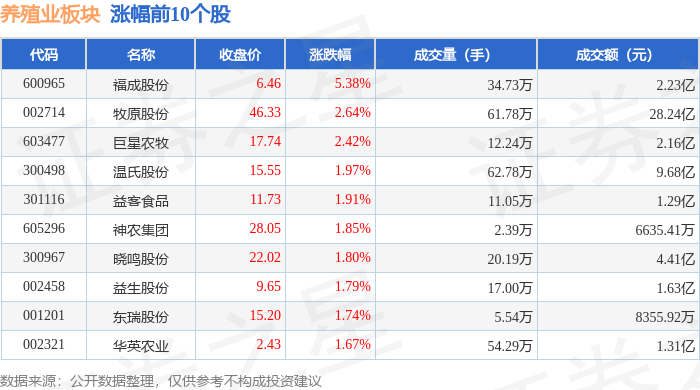
养殖业板块1月29日涨1.85%,福成股份领涨,主力资金净流入2.53亿元
Zheng Xing Xing Ye Ri Bao· 2026-01-29 08:58
Core Viewpoint - The aquaculture sector experienced a rise of 1.85% on January 29, with Fu Cheng Co., Ltd. leading the gains, while the overall market showed mixed results with the Shanghai Composite Index up by 0.16% and the Shenzhen Component Index down by 0.3% [1] Group 1: Market Performance - The aquaculture sector's performance was highlighted by Fu Cheng Co., Ltd. closing at 6.46, up by 5.38% with a trading volume of 347,300 shares and a transaction value of 223 million yuan [1] - Other notable performers included Mu Yuan Co., Ltd. at 46.33, up by 2.64%, and Wen's Foodstuffs Group at 15.55, up by 1.97% [1] - The overall trading volume for the aquaculture sector was significant, with Mu Yuan Co., Ltd. alone accounting for a transaction value of 2.824 billion yuan [1] Group 2: Capital Flow - The aquaculture sector saw a net inflow of 253 million yuan from main funds, while retail investors experienced a net outflow of 82.155 million yuan [2] - Main funds showed a positive net inflow in companies like Mu Yuan Co., Ltd. with 24.6 million yuan and Wen's Foodstuffs Group with 95.752 million yuan [3] - Conversely, retail investors showed significant outflows in companies such as Mu Yuan Co., Ltd. with 132 million yuan and Fu Cheng Co., Ltd. with 6.78 million yuan [3]


畜牧ETF(159867)涨近1%,板块仍处于低估水平
Sou Hu Cai Jing· 2026-01-29 05:31
Group 1 - The average price of pork in the national agricultural wholesale market is 18.72 yuan per kilogram, an increase of 0.3% compared to the previous day, indicating a potential recovery in profitability for pig farming as the supply of live pigs decreases towards the end of the second quarter [1] - Under the guidance of the "anti-involution" policy in the pig industry, capacity reduction is progressing alongside policy adjustments, leading to an accelerated decline in the number of breeding sows after a slow decrease in previous months [1] - The domestic pig price is expected to maintain a trend of capacity reduction during the off-season in the first half of the year, which may lead to a recovery in the fundamentals and valuations of the pig farming industry, currently at a low market expectation and valuation level [1] Group 2 - As of December 31, 2025, the top ten weighted stocks in the CSI Livestock Breeding Index (930707) include Muyuan Foods, Haida Group, Wen's Foodstuffs, Zhengbang Technology, New Hope, Meihua Biological, Bio-Stock, Dabeinong, Shennong Development, and Lihua Co., accounting for a total of 67.66% of the index [2]
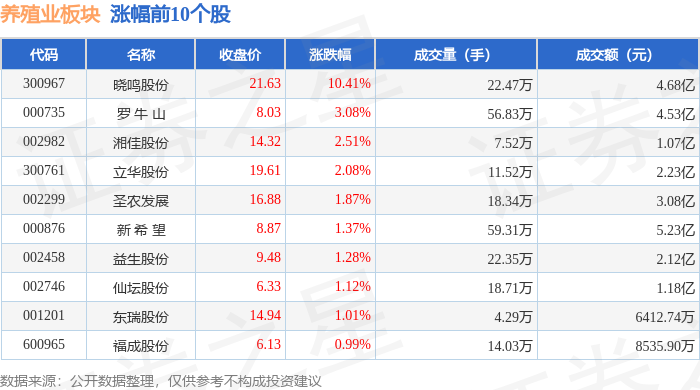
养殖业板块1月28日涨0.38%,晓鸣股份领涨,主力资金净流入1.63亿元
Zheng Xing Xing Ye Ri Bao· 2026-01-28 08:56
Group 1 - The aquaculture sector increased by 0.38% on January 28, with Xiaoming Co. leading the gains [1] - The Shanghai Composite Index closed at 4151.24, up 0.27%, while the Shenzhen Component Index closed at 14342.9, up 0.09% [1] - Xiaoming Co. saw a closing price of 21.63, with a rise of 10.41%, and a trading volume of 224,700 shares, amounting to a transaction value of 468 million yuan [1] Group 2 - The main funds in the aquaculture sector had a net inflow of 163 million yuan, while retail funds had a net inflow of 149 million yuan [2] - The stock "Wens Foodstuffs" had a significant trading volume of 713,100 shares, with a transaction value of 1.089 billion yuan, but experienced a slight decline of 0.52% [2] - The stock "Xiaoming Co." had a net inflow of 20.89 million yuan from main funds, while retail funds showed a net outflow of 7.58 million yuan [3]




餐饮细分精耕效率,餐供定制扩容可期
ZHONGTAI SECURITIES· 2026-01-28 00:25
Investment Rating - The report maintains an "Overweight" rating for the industry [4] Core Insights - The restaurant industry is experiencing a slowdown in revenue growth, with a shift towards efficiency in operations and a focus on customized meal supply [6][32] - The report identifies three potential development paths for the restaurant industry: high-quality and affordable offerings, automation and smart technology, and a focus on niche markets to meet diverse consumer needs [32][33] Summary by Sections Macro Perspective on Restaurant Trends - China's residents primarily rely on wage income, leading to a lower consumption tendency compared to developed countries [9][13] - The overall consumption inclination is affected by significant income inequality, with the top 1% of the population holding a substantial share of wealth [13][15] - The restaurant industry's revenue growth is expected to slow down significantly by 2025, with a notable decline in average spending per customer [15][17] Population Dynamics - China's total population has entered a phase of negative growth, with a significant concentration of young people in economically vibrant cities [18][20] - The labor force participation rate is declining, while the dependency ratio is increasing, indicating demographic challenges for the industry [20][23] Opportunities in the Restaurant Sector - The report draws parallels with Japan's consumption evolution, suggesting that China's restaurant industry can learn from Japan's experiences [31] - The three identified paths for growth include offering high-quality products at lower prices, leveraging automation, and focusing on specific consumer segments such as single-person households and the elderly [32][33] Restaurant Supply Chain Insights - The restaurant supply chain is complex, involving multiple stages from raw material procurement to end-user sales [33] - The market for restaurant supply chains is projected to grow, with an expected market size of 2.6 trillion yuan in 2024, reflecting an 8.1% year-on-year increase [35][36] Market Structure and Competition - The restaurant market is characterized by high closure rates and a fragmented landscape, with many small-scale chains dominating the market [37][38] - The supply side is marked by a lack of concentration, leading to weak bargaining power for suppliers [38] Labor Market Challenges - The restaurant industry faces rising labor costs and high turnover rates, with significant implications for operational efficiency [43][46] - The introduction of smart devices and semi-finished products is seen as a strategy to mitigate labor challenges and enhance efficiency [46][48]





白鸡专题四:产业链有望景气改善,关注海外引种节奏
GF SECURITIES· 2026-01-27 14:09
Investment Rating - The industry investment rating is "Buy" [2] Core Insights - The poultry industry is expected to see an improvement in the supply chain in 2026, driven by a rebound in prices and a gradual recovery in profitability for the breeding sector [5][91] - The integration trend within the industry is becoming more pronounced, with leading companies benefiting from their downstream channel advantages and collaborative efforts across the supply chain [5][24] - The domestic poultry sector is experiencing a shift towards self-breeding and the replacement of imported breeds due to disruptions caused by avian influenza outbreaks abroad [5][39] Summary by Sections 1. 2025 Poultry Industry Maintains Marginal Profitability, Clear Integration Trend - The poultry industry maintained marginal profitability in 2025, with upstream breeding segments performing better than downstream farming and processing sectors [5][14] - The average price of parent stock chicks in 2025 was 44.75 CNY/set, a slight decrease of 0.7% year-on-year, while the average price of commercial chicks was 2.51 CNY each, down 13% year-on-year [5][17] - The total slaughter volume of the top 10 companies reached 4.274 billion birds, accounting for 45.99% of the market, indicating a trend towards consolidation [5][24] 2. Avian Influenza Disrupts Imports, Accelerates Domestic Breed Replacement - In 2025, the cumulative update of grandparent stock chickens was 1.574 million sets, a year-on-year increase of 4.9%, with domestic breeds accounting for approximately 60% of the updates [5][39] - The outbreak of avian influenza in France in December 2025 led to a halt in overseas imports, increasing the uncertainty of supply from abroad [5][46] - Domestic breeds are showing improved performance, with the replacement rate of domestic breeds rising to 34% in 2025 [5][57] 3. 2026 Supply Chain Expected to Improve, Capacity Elasticity Remains a Concern - The inventory of grandparent stock chickens is expected to decline in early 2026, with estimates showing a year-on-year decrease of approximately 3.3% and 12% in March and April, respectively [5][69] - The overall supply of the poultry industry is anticipated to gradually improve in 2026, with profitability expected to return to the breeding sector [5][87] - The report emphasizes the importance of monitoring parent stock chick sales as a key indicator of supply trends [5][76] 4. Investment Recommendations - The report suggests focusing on companies such as Shengnong Development, Yisheng, Minhe, Xiantan, and Hefeng, which are well-positioned to benefit from the ongoing integration and recovery in the poultry industry [5][91]


毛鸡价格攀升后回落,鸡苗价格高位收尾:华创农业12月白羽肉禽月报
Huachuang Securities· 2026-01-27 13:30
Investment Rating - The industry investment rating is "Recommended" [4] Core Viewpoints - The report indicates that after a rise, the price of broiler chickens has slightly decreased, while the price of chick seedlings has remained high [2][9] - The report highlights that the supply of broiler chickens is currently tight due to external weather factors and diseases affecting survival rates, which initially supported price increases [9][12] - The report notes that the profitability of broiler farming has improved significantly, with a loss of 0.26 yuan per bird in December, a substantial increase in profitability compared to previous months [40][42] - The report suggests that the suspension of imports from France due to avian influenza outbreaks may create a supply gap, potentially improving industry conditions [45] Summary by Sections Market Overview - In December, the average price of broiler chickens was 3.68 yuan per jin, showing a trend of rising and then falling prices [9] - The average price of chick seedlings for white feather broilers was 3.56 yuan per bird, with prices fluctuating due to market demand and supply conditions [9][12] Production Capacity - As of December 2025, the average stock of parent broiler chickens was 21.3 million sets, down 2.7% year-on-year, while the average stock of backup parent chickens was 15.73 million sets, down 5.1% year-on-year [33][41] - The average stock of grandparent broiler chickens was 1.3586 million sets, up 6.4% year-on-year, indicating a stable supply in the upstream breeding segment [32][35] Sales Performance - In December, the sales volume of broiler meat from Shengnong Development reached 147,600 tons, an increase of 14.24% year-on-year, while the sales volume of processed chicken products increased by 51.38% [21][27] - The report also highlights that the sales volume of chick seedlings for the year reached 4.481 billion birds, a 2% increase year-on-year [21] Investment Recommendations - The report recommends focusing on companies such as Shengnong Development, Yisheng Shares, and Hefeng Shares, as they are expected to benefit from the potential supply gap and ongoing improvements in domestic breeding efficiency [45]
毛鸡价格攀升后回落,鸡苗价格高位收尾:华创农业12月白羽肉禽月报-20260127
Huachuang Securities· 2026-01-27 10:29
Investment Rating - The industry investment rating is "Recommended" [4] Core Viewpoints - The report indicates that after a rise, the price of broiler chickens has slightly decreased, while the price of chick seedlings has stabilized at a high level [2][9] - The report highlights that the supply of broiler chickens is currently tight due to external weather factors and chicken diseases affecting survival rates, which initially supported price increases [9] - The report suggests that the recent outbreak of highly pathogenic avian influenza in France may lead to a supply gap, potentially improving industry conditions [45] Summary by Sections Market Overview - In December, the average transaction price of broiler chickens was 3.68 yuan per jin, showing a trend of rising first and then falling [9] - The average price of chick seedlings for December was 3.56 yuan per chick, with prices initially rising due to demand from large-scale farms [9][12] Production Capacity - As of December 2025, the average stock of parent broiler chickens was 21.3 million sets, down 2.7% year-on-year [3][33] - The average stock of grandparent broiler chickens was 1.3586 million sets, up 6.4% year-on-year [32][35] Financial Performance - In December, the profit from broiler chicken farming was -0.26 yuan per bird, while the profit from hatcheries was 0.77 yuan per bird [40][42] - The report notes that the sales volume of broiler meat for Shengnong was 147,600 tons, up 14.24% year-on-year, and for Xiantan, it was 55,100 tons, up 11.99% year-on-year [21][27] Investment Recommendations - The report recommends focusing on companies such as Shengnong Development, Yisheng Shares, and Hefeng Shares due to potential supply gaps and ongoing improvements in domestic breeding efficiency [45]
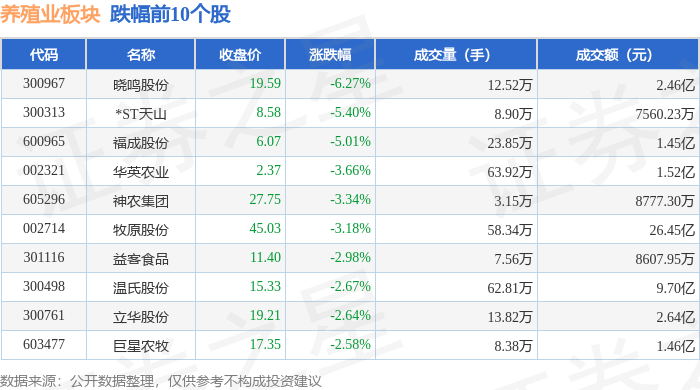
养殖业板块1月27日跌2.68%,晓鸣股份领跌,主力资金净流出4.56亿元
Zheng Xing Xing Ye Ri Bao· 2026-01-27 08:49
Core Viewpoint - The aquaculture sector experienced a decline of 2.68% on January 27, with Xiaoming Co. leading the drop [1] Group 1: Market Performance - The Shanghai Composite Index closed at 4139.9, up 0.18%, while the Shenzhen Component Index closed at 14329.91, up 0.09% [1] - Key stocks in the aquaculture sector showed significant declines, with Xiaoming Co. down 6.27% to a closing price of 19.59 [1] - Other notable declines included ST Tianshan down 5.40%, Fucheng Co. down 5.01%, and Huaying Agriculture down 3.66% [1] Group 2: Trading Volume and Capital Flow - The aquaculture sector saw a net outflow of 456 million yuan from main funds, while retail investors contributed a net inflow of 232 million yuan [1] - The trading volume for Xiaoming Co. was 125,200 shares, with a transaction value of 246 million yuan [1] - Lihua Co. had a net inflow of 14.20 million yuan from main funds, while retail investors had a net outflow of 30.52 million yuan [2]


种源扰动与补栏分化并存,白鸡景气延续、蛋价弱稳待去化
KAIYUAN SECURITIES· 2026-01-26 02:44
Investment Rating - Investment rating: Positive (maintained) [1] Core Insights - The report highlights supply pressures in the poultry industry, particularly due to overseas avian influenza affecting domestic breeding, leading to a temporary halt in the introduction of grandparent stock, which supports white feather broiler prices in the short term [3][13][19] - The demand for yellow feather broilers is under pressure due to seasonal demand decline and reduced restocking, with prices expected to rebound slightly due to pre-festival demand but remain generally weak [4][28] - Egg prices continue to decline, with high inventory levels prompting accelerated culling of hens, which may provide some support for future egg prices [36] Summary by Sections White Feather Broilers - December 2025 national average sales price for white feather broilers was 7.44 yuan/kg, up by 0.31 yuan/kg month-on-month, with a loss of 0.26 yuan per bird, an increase of 0.75 yuan [3][13] - The total stock of white feather grandparent stock at the end of December was 2.3377 million sets, up by 11.3% month-on-month, with parent stock at 36.9395 million sets, up by 0.1% [15][19] Yellow Feather Broilers - December average sales price for medium-speed yellow feather broilers was 11.77 yuan/kg, down by 3.07% month-on-month, with parent stock sales down by 10.43% [4][28] - Total stock of yellow feather grandparent stock at the end of December was 2.7411 million sets, down by 1.03% month-on-month [4][28] Egg Production - December egg price was 2.89 yuan/kg, down by 0.79% month-on-month, with egg-laying hen profit at -26.60 yuan per bird, an increase of 1.80 yuan [36] - The total stock of laying hens at the end of December was 1.295 billion, down by 0.92% month-on-month, but up by 7.11% year-on-year [36] Sales Performance - December sales volume of white feather chick seedlings was 408 million, remaining stable month-on-month, with parent stock sales up by 17.56% [15][38] - December chicken meat sales varied, with Xiantan Co. reporting a sales volume of 51,200 tons, down by 3.08% month-on-month, but revenue increased by 9.56% [51] - December sales volume of yellow feather broilers varied, with Wens Foodstuffs reporting a sales volume of 109 million birds, down by 7.06% month-on-month [56]
