
新石器

Search documents
千辆无人车驶入深圳街头 城配“毛细血管”效率演进
2 1 Shi Ji Jing Ji Bao Dao· 2025-12-22 09:54
(原标题:千辆无人车驶入深圳街头 城配"毛细血管"效率演进) 21世纪经济报道记者 林典驰 深圳报道 在深圳市福田区莲花山中心区,一辆无人配送车正在城市核心区域穿梭,这里人口密集、商业高度活 跃,其运行代表着无人配送已经达到了一定的成熟度。 刚刚过去的11月,深圳无人车产业在规模化、安全化、商业化等方面实现全面提升。 数据显示,目前深圳功能型无人车投放总数达1218台,车辆数在全国一线城市中位列第一,累计开放运 行线路1594条、总里程达5534公里。 物流配送自动化、环卫清洁自动化、巡检自动化也不再是纸上谈兵,而是真正进入到了市民的日常生活 中。 双十一期间,无人配送单量保持高位运行,全月完成配送约129万单,含快递配送108万单与生鲜配送21 万单,无人配送商业化价值约1110万元,综合成本预计节约超120万元。 无人车能如此迅速地从"试点"走向"常态",离不开顶层设计的前瞻性布局。 早在2022年,深圳便率先实施《深圳经济特区智能网联汽车管理条例》,是国内首部规范智能网联汽车 管理的法规。 深圳以特区条例为核心,率先在全国搭建起"特区立法+规范性文件+地方性标准"的政策法规体系,面 向道路测试、准入登记 ...


CES2026首秀|新石器将展示新一代城市无人配送解决方案
Jin Rong Jie· 2025-12-22 03:06
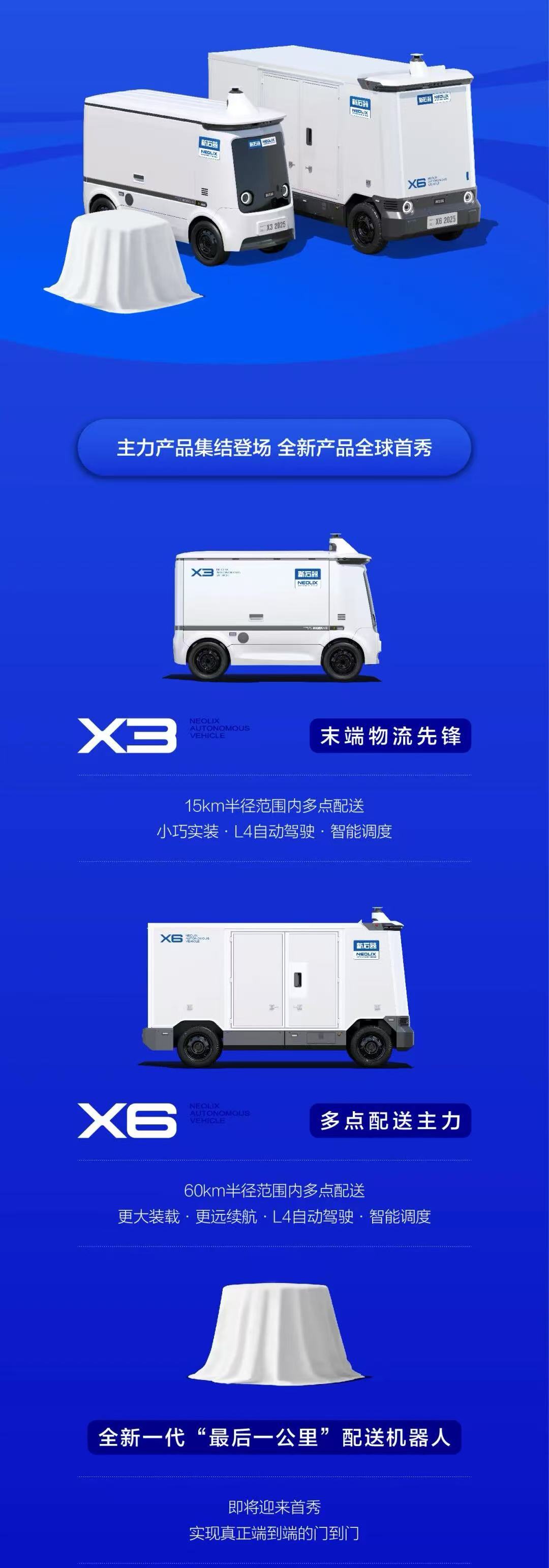
Group 1 - The company New Stone Technology will showcase its main unmanned vehicle matrix and new products at CES 2026 in Las Vegas from January 6 to 9, 2026 [1] - The event will feature the launch of a new generation of urban delivery solutions based on artificial intelligence, targeting global industry decision-makers and ecosystem partners [1] Group 2 - The new delivery solution aims to achieve true end-to-end door-to-door service [5] - The first generation of "last mile" delivery robots will be introduced, emphasizing innovation in delivery technology [6] Group 3 - The delivery system will operate within a 60 km radius, offering multi-point delivery with larger load capacity, longer range, L4 autonomous driving, and intelligent scheduling [7] - A smaller delivery option will also be available, operating within a 15 km radius, featuring compact design, L4 autonomous driving, and intelligent scheduling, serving as the main multi-point delivery solution [9]
26年大概率是L4开花的一年,我们盘点了相关公司的融资情况......
自动驾驶之心· 2025-12-21 11:54
点击下方 卡片 ,关注" 自动驾驶之心 "公众号 戳我-> 领取 自动驾驶近30个 方向 学习 路线 >>自动驾驶前沿信息获取 → 自动驾驶之心知识星球 今年整个自动驾驶行业融资已经超过300亿!其中L4相关公司的融资比较密集,柱哥周末盘了下部分公司的融资情况,分享给大家。据我 们了解,这其中很多公司也在抓紧落地端到端、VLA等核心技术, 明年将会是L4大爆发的一年。 新石器 新石器今年完成了C+轮和D轮两起融资,2025年2下旬的10亿C+轮融资,和10月23日的D轮超6亿美元融资。D轮融资由阿联酋磊石资本领 投,高成投资、信宸资本、鼎晖VGC等机构联合领投。 以金额计,该融资是迄今为止中国自动驾驶领域最大的一笔私募融资。 公司简介: 成立时间:2018 年 2 月,创始人余恩源 定位:全球领先的 L4 级无人城配 (RoboVan) 解决方案提供商,专注城市物流 "最后一公里" 技术:全栈自研 L4 级无图自动驾驶技术,已交付超 1 万台无人车,累计行驶里程超 5000 万公里 核心产品:RoboVan 系列无人配送车,覆盖快递、即时物流、零售等多场景 里程碑:2025 年累计融资超 62 亿元,产品已拓 ...
深圳正以“系统革命”赢得无人车产业未来
2 1 Shi Ji Jing Ji Bao Dao· 2025-12-21 09:15
Core Insights - Shenzhen is witnessing a significant rise in the use of autonomous delivery vehicles, with a monthly operational mileage of 240,000 kilometers and approximately 1.29 million orders completed by November 2025, indicating a clear signal of profitability and a critical "economies of scale inflection point" in the commercialization of autonomous driving technology [1] - The competition in the autonomous vehicle sector has evolved from "which vehicle is smarter" to "which city system can better nurture and accelerate industry maturity," with Shenzhen leading due to its comprehensive "system empowerment" revolution [1] - Shenzhen has established itself as a "chief architect" and "risk partner" in the regulatory landscape for autonomous vehicles, creating a conducive environment for industry growth [2] Regulatory and Infrastructure Developments - In July, Shenzhen launched the first "functional autonomous vehicle management service platform" in the country, which integrates approval processes, dynamic monitoring, accident handling, data connectivity, and insurance services, facilitating compliance for enterprises and enabling "sandbox regulation" for the government [2] - This platform institutionalizes and marketizes "road rights" and "data resources," providing enterprises with a clear and predictable regulatory environment, thus reducing policy risk premiums and accelerating technological iteration and business model convergence [2] Integration with Urban Systems - Shenzhen's autonomous vehicles are designed as "smart plugins" within the existing logistics and transportation systems, exemplified by the innovative "autonomous vehicle + subway" model that enhances last-mile delivery efficiency [3] - The integration of autonomous vehicles with public transport systems not only optimizes land resources but also redefines logistics nodes, transforming the subway network into a dynamic urban logistics hub [3] - The business model has shifted from simple transportation service fees to revenue sharing based on system efficiency improvements, making autonomous vehicle solutions essential for urban smart upgrades [3] Capital and Standards Dynamics - Shenzhen is experiencing significant capital aggregation, with major companies like Meituan and JD.com investing heavily, and unicorns like New Stone and Jiushi receiving substantial funding, such as New Stone's 1 billion yuan financing in February 2025 [5] - The city is proactively establishing the first national standard system for the autonomous logistics industry, which serves as both a technical guideline and a market entry ticket, influencing the distribution of value within the industry [5] - The interplay between capital influx and the establishment of authoritative standards is enhancing investor confidence and attracting further investment, demonstrating Shenzhen's success in integrating policy, infrastructure, data, application scenarios, and innovative enterprises into a cohesive ecosystem [5]
21评论|深圳正以“系统革命”赢得无人车产业未来
2 1 Shi Ji Jing Ji Bao Dao· 2025-12-21 09:13
Core Insights - The article highlights the rapid integration of autonomous delivery vehicles in Shenzhen, indicating a significant milestone in the commercialization of autonomous driving technology, with a monthly operational mileage of 240,000 kilometers and approximately 1.29 million completed orders by November 2025 [2] Group 1: Economic Impact and Ecosystem - Shenzhen has transitioned from merely having the most testing vehicles to creating a robust ecosystem that fosters industry maturity, emphasizing the importance of a comprehensive system that supports technological validation and commercial expansion [2] - The city has established itself as a "chief architect" and "risk partner" in the autonomous vehicle sector, launching the first functional management service platform for autonomous vehicles in China, which streamlines compliance processes and enhances operational space for businesses [4] - This platform not only provides operational permissions but also institutionalizes and marketizes road rights and data resources, creating a predictable business environment that attracts long-term capital investment [4] Group 2: Integration with Urban Infrastructure - Shenzhen's autonomous vehicles are designed as integral components of the existing logistics and transportation systems, exemplified by the innovative "autonomous small vehicle + subway" model, which optimizes last-mile delivery by leveraging the strengths of subway transport [6] - The integration of autonomous vehicles with public transport systems enhances the efficiency of urban assets, shifting the evaluation of their value from mere cost savings to the activation and enhancement of existing urban resources [6][7] Group 3: Capital and Standards Development - The city has successfully created a virtuous cycle between capital and standards, attracting significant investments from major companies like Meituan and JD.com, and fostering a cluster of unicorns in the sector [9] - Shenzhen is actively promoting the establishment of national standards for the autonomous logistics industry, which will serve as a benchmark for technology and market entry, thereby influencing the distribution of value within the industry [9] - The influx of capital accelerates technological maturity and scale expansion, while authoritative standards reduce transaction costs and enhance investor confidence, further attracting more capital [9]
功能型无人车“领跑”,深圳智慧城市建设提速
Nan Fang Du Shi Bao· 2025-12-21 05:27
Core Insights - The article highlights the rapid development and commercialization of autonomous delivery vehicles in Shenzhen, which have become integral to the last-mile logistics supply chain, with a total of 1,218 units deployed, the highest among first-tier cities in China [2] - The autonomous vehicles have covered 1,594 routes, achieving over 5,500 kilometers in total distance, and completing approximately 1.29 million delivery orders monthly, generating direct commercial value exceeding 10 million yuan [2] - The growth of the autonomous delivery sector in Shenzhen is attributed to the collaboration between the market, government, and enterprises, addressing the increasing demand for efficient delivery solutions amid the rise of e-commerce and instant retail [2] Market Demand and Operational Efficiency - Fresh produce delivery accounts for about 20% of the autonomous delivery orders, meeting the high-demand for "30-minute delivery" even during adverse weather conditions, ensuring reliable delivery of essential goods [3] - The autonomous vehicles are equipped with dual-redundancy perception systems, allowing them to operate continuously even in rainy conditions, which is crucial for maintaining service reliability [3] Government Support and Regulatory Framework - The Shenzhen government has played a vital role in the rapid development of the autonomous vehicle industry by creating a supportive regulatory environment that balances market exploration with safety [4] - The launch of the first functional autonomous vehicle management service platform in July 2025 will enable comprehensive digital management from road approval to remote rescue [4] - Shenzhen has implemented a cautious approach to road rights, ensuring that each route is thoroughly evaluated for safety before being opened [4] Technological Advancements - Key technological breakthroughs, such as L4-level autonomous driving and dual-redundancy perception systems, have enabled the vehicles to navigate complex road conditions and avoid obstacles effectively [5] - The reduction in core component costs and increased application scale have made the monthly operating costs of some autonomous vehicles significantly lower than traditional logistics vehicles, facilitating their widespread adoption [5] Industry Transformation and Urban Impact - The rise of autonomous delivery is transforming the logistics industry from labor-intensive to technology-intensive, creating over 10 million yuan in direct commercial value and fostering the development of related sectors like smart hardware and algorithm research [5] - The deployment of autonomous vehicles is alleviating the workload of delivery personnel and enhancing the quality of life for residents through more efficient delivery services [5] - Innovative models such as "shared stations" and "multi-chain integration" are optimizing urban resource allocation and providing valuable examples for smart city development [5] - The establishment of a collaborative system involving "drones + autonomous trucks + autonomous delivery vehicles" will further expand the application scenarios of autonomous delivery in urban services [5]
载具纪元新章系列 2:无人驾驶载物白皮书:无人载物场景多元,逐步迈向规模化时刻
Shenwan Hongyuan Securities· 2025-12-19 11:08
Investment Rating - The report indicates that the unmanned cargo industry is entering a high-growth phase, driven by the dual forces of technological maturity and policy support [3][4]. Core Insights - The unmanned cargo sector benefits from inherent advantages such as predictable paths and controllable environments, which lower the barriers to the implementation of unmanned driving technology compared to manned scenarios [3][5]. - The report emphasizes the importance of focusing on companies that establish technological moats and possess scalable operational experience within specific segments of the unmanned cargo market [3][4]. Summary by Sections 1. Unmanned Cargo: Diverse Application Scenarios, Driven by Technology and Policy - Unmanned driving scenarios can be categorized into manned and unmanned, with unmanned scenarios covering various fields such as logistics and special operations [9]. - The complexity of unmanned cargo scenarios is generally lower than that of manned scenarios, providing a natural advantage for technology implementation [11]. 2. Low-Speed Unmanned Vehicles: High Technological Maturity and Rapid Expansion - Low-speed unmanned vehicles, particularly in logistics and sanitation, have reached a high level of technological maturity and are transitioning from pilot projects to large-scale deliveries [4][5]. - Companies like Jiushi Intelligent and New Stone have achieved deliveries at the scale of thousands of units [4]. 3. High-Speed Unmanned Trucks: Addressing Long-Distance Freight Pain Points - High-speed unmanned trucks are still in the early stages of development but have significant market potential due to their ability to reduce labor costs and improve operational efficiency [4][5]. 4. Special Scenario Unmanned Vehicles: Low Overlap Among Players, Environmental Adaptation Creates Barriers - The special scenario unmanned vehicle market, such as unmanned mining trucks and port vehicles, has a relatively concentrated market structure with high specialization [4][5]. - The demand for unmanned mining trucks is driven by harsh environments and safety pressures, while port scenarios are evolving from early reliance on infrastructure to more flexible solutions [4]. 5. Policy Framework: Accelerating Transition from Pilot to Commercial Operations - The report outlines a comprehensive policy framework that supports the unmanned cargo sector, including national and local government initiatives aimed at facilitating the transition from laboratory validation to real-world commercial operations [21][24]. - Recent policies have focused on establishing demonstration application scenarios and refining testing standards to promote the commercial viability of unmanned cargo solutions [21][24].
载具纪元新章系列2:无人驾驶载物白皮书:无人载物场景多元,逐步迈向规模化时刻
Shenwan Hongyuan Securities· 2025-12-19 08:11
Investment Rating - The report maintains a positive outlook on the industry, indicating a strong growth phase driven by technological maturity and policy support [4]. Core Insights - The report emphasizes that the unmanned cargo sector is entering a high-growth stage, with dual drivers of technological advancements and supportive policies facilitating the transition from laboratory validation to commercial operation [4][5]. - It highlights that most unmanned cargo scenarios possess inherent advantages such as predictable paths and controllable environments, which lower the barriers for the implementation of unmanned driving technology [5][6]. - The report suggests focusing on companies that establish technological moats and possess scalable operational experience within specific segments of the industry [4]. Summary by Sections 1. Unmanned Cargo: Diverse Application Scenarios, Driven by Technology and Policy - Unmanned driving scenarios can be categorized into passenger and cargo, with cargo scenarios covering various fields such as logistics and special operations [13]. - The complexity of cargo scenarios is generally lower than that of passenger scenarios, providing a natural advantage for implementation [15]. - The report outlines that the current unmanned driving technology primarily operates at L3-L4 levels, focusing on specific scene adaptations [18][19]. 2. Low-speed Unmanned Vehicles: High Technological Maturity and Rapid Expansion - Low-speed unmanned vehicles are mature, with pilot areas expanding quickly, primarily used in last-mile delivery and sanitation [4]. - Unmanned logistics vehicles are replacing manual labor for routine transport tasks, significantly reducing delivery costs [4]. - The report notes that the market penetration for unmanned sanitation vehicles is currently low but has substantial growth potential due to government projects [4]. 3. High-speed Unmanned Trucks: Addressing Long-distance Freight Pain Points - High-speed unmanned trucks face higher technical requirements and are still in the early development stages, but they have a broad market outlook [4]. - The report indicates that traditional logistics for long-haul trucks face intense competition and safety issues, which unmanned trucks could potentially alleviate [4]. 4. Special Scenario Unmanned Vehicles: Low Overlap Among Players, Environmental Adaptation Creates Barriers - The report identifies that special scenario unmanned vehicles, such as those used in mining and ports, have low player overlap and high environmental adaptation requirements, creating industry barriers [4]. - In mining, the demand for unmanned trucks is driven by harsh conditions and safety pressures, with technology already achieving scale from single vehicles to fleets [4]. - The report notes that the unmanned vehicle market in ports has significant room for growth, with current automation rates varying between large and small ports [4]. 5. Policy Framework: Accelerating Transition from Pilot to Commercialization - The report outlines that national and local policies are systematically supporting the unmanned driving industry, establishing a comprehensive framework from technical demonstration to operational support [27][30]. - It emphasizes that the integration of high-level autonomous driving for cargo transport into national AI and infrastructure development priorities is crucial for the industry's growth [27][28].
工信部公布首批L3车型准入许可:吹响L3的号角,迎来L4的曙光
GUOTAI HAITONG SECURITIES· 2025-12-18 14:57
Investment Rating - The report indicates a positive outlook for the L3 autonomous driving industry, suggesting a transition towards commercialization and increased market penetration [3][16]. Core Insights - The issuance of conditional permits for the first L3 autonomous vehicles by the Ministry of Industry and Information Technology marks a significant step towards commercial application, with expectations for rapid growth in the smart vehicle penetration rate [3][16]. - The year 2026 is projected to be a pivotal year for autonomous driving, with L4 scenarios beginning to commercialize, indicating a shift in consumer vehicle usage towards robotaxi applications [20][21]. Summary by Sections 1. Approval of L3 Autonomous Vehicle Models - On December 15, the Ministry of Industry and Information Technology granted conditional approval for the first two L3 autonomous vehicle models, specifically Changan and Arcfox brands, with restrictions on driving routes, speeds, and user entities [2][10][15]. 2. L3 Implementation and Industry Benefits - The approval signifies a transition from testing to commercial application, with expectations for increased demand in smart vehicle technologies, including sensors and high-performance driving chips [3][16][19]. - The penetration rate of advanced driver-assistance systems (ADAS) is expected to rise significantly, with projections indicating an increase from approximately 10% to 28.21% by August 2025 [17][19]. 3. Outlook for L4 and Market Expansion - The report anticipates that L4 autonomous driving will begin to see commercial applications in various scenarios by 2026, with significant market opportunities in urban logistics and mining sectors [20][21][26]. - The logistics sector is expected to see a market size of 65.75 billion yuan by 2030, driven by the adoption of logistics unmanned vehicles [21][22]. - The mining sector is projected to exceed 30 billion yuan by 2030, with a compound annual growth rate of 57.4% from 2024 to 2030, highlighting the commercial viability of autonomous solutions in structured environments [26][27].


具身智能产业动态:希迪智驾启动全球招股,众擎机器人完成10亿元A1加及A2轮融资
GUOTAI HAITONG SECURITIES· 2025-12-18 13:06
Investment Rating - The report does not explicitly state an investment rating for the industry Core Insights - The embodied intelligence industry is primarily represented by embodied robots and smart vehicles, which are mutually reinforcing in development. The core concept of embodied intelligence emphasizes real-time interaction with the environment, integrating perception, decision-making, and action [8][9] - Recent trends in the embodied robot sector include significant orders and partnerships, such as the 1,000-unit order for the Bumi humanoid robot and collaborations between major companies like Mercado Libre and Agility Robotics [12][13][14] - In the smart vehicle sector, notable developments include the delivery rankings of new energy vehicles, with Hongmeng Zhixing leading with 81,864 units delivered in November [21][27] Summary by Sections 1. Embodied Robot Industry Dynamics - Songyan Power secured an order for 1,000 Bumi humanoid robots, which are lightweight and under 1 meter tall, with a pre-sale price of 9,998 yuan [12] - Mercado Libre partnered with Agility Robotics to deploy the Digit robot in its logistics system, marking a significant step towards automation in Latin America [13] - EQT plans to facilitate the deployment of up to 10,000 humanoid robots from 1X across its portfolio companies from 2026 to 2030 [14] - Stardust Intelligence launched the Lumo-1 model, enhancing the reasoning-action loop for robots [15] - Lingchu Intelligent introduced the Psi-SynEngine, a data collection engine for real-world applications [16] - Zhiyuan announced the production of its 5,000th general-purpose humanoid robot [18] - Horizon released two foundational models, HoloMotion and HoloBrain, aimed at advancing embodied intelligence [19] - Lichong Group signed a procurement agreement worth 75 million yuan for humanoid robot components [20] 2. Smart Vehicle Industry Dynamics - The delivery rankings for November show Hongmeng Zhixing leading with 81,864 units, followed by Leap Motor and Xiaomi [21] - Jiusi Intelligent signed a strategic cooperation agreement with Jiangling to accelerate the deployment of RoboVan ecological unmanned vehicles [22] - Collaborations with major public transport groups aim to integrate autonomous driving technology into urban logistics [23][24] - New Stone and Linglong Tire's partnership marks a significant step in the application of unmanned delivery in the automotive service market [26] 3. Investment and Financing Events - From December 8 to December 14, 2025, there were 16 financing events in the embodied intelligence sector, including significant rounds for companies like Shaping Technology and Cloud Deep Technology [29][30][32][36] - Notable financing events include a 10 billion yuan round for Zhongqing Robotics, which also launched the T800 humanoid robot [36] - Other companies like Ling Sheng Technology and Lumos Robotics also secured substantial funding to enhance their product offerings and market presence [39][40]