
Infineon

Search documents
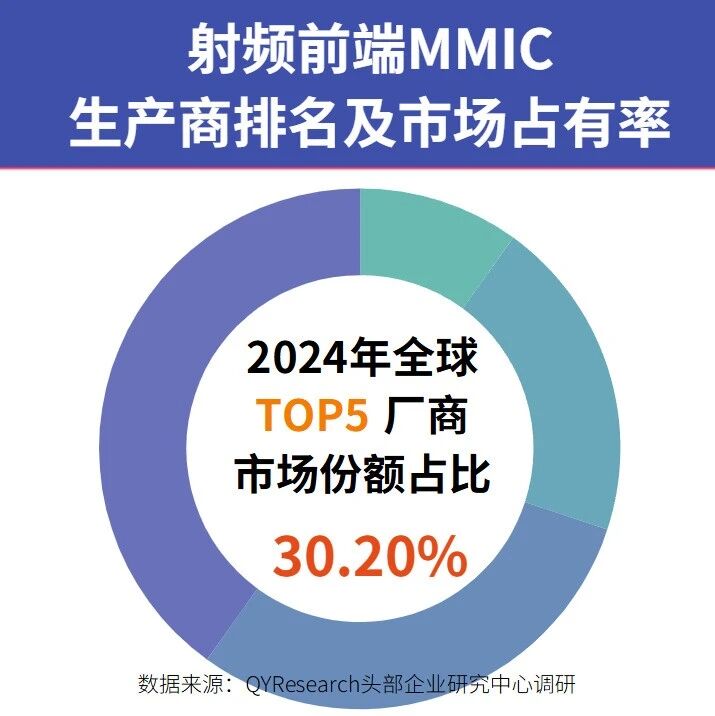
射频前端MMIC行业洞察:2024年TOP5 企业占据全球30.20%的市场份额
QYResearch· 2025-10-14 02:16
Core Viewpoint - The RF front-end MMIC market is experiencing significant growth driven by advancements in wireless communication technologies such as 5G, satellite communication, radar, and the Internet of Things (IoT) [1][2]. Market Overview - RF front-end MMICs are critical components in modern wireless communication systems, integrating multiple functions like amplification, filtering, and switching into compact semiconductor devices, thus reducing system size and power consumption [1]. - The market is becoming a focal point for technological advancements and strategic investments, supporting the performance and scalability of next-generation connectivity solutions [1]. Current Development Status - The development of RF front-end MMIC technology is steadily improving, with increasing diversification in materials, architectures, and applications [2]. - GaAs-based MMICs remain widely used due to their stable high-frequency performance, while GaN technology is rapidly gaining traction in demanding environments like radar and defense [2]. - SiGe technology is also evolving as a cost-effective solution, particularly in mass markets such as consumer electronics and communications [2]. Future Trends - Advanced semiconductor materials will significantly influence the future development of the RF front-end MMIC market, with GaN being highlighted for its high power density and efficiency at high frequencies [3]. - The global deployment of 5G networks and ongoing research into 6G technology are increasing the demand for RF front-end solutions capable of handling higher bandwidth and faster data transmission [3]. - Miniaturization and system integration are key trends, with a focus on integrating multiple RF front-end functions into compact MMIC modules to enhance reliability and reduce power consumption [3]. Thermal Management and Packaging Innovations - Thermal management is becoming a critical factor affecting the performance and lifespan of RF front-end MMICs, especially in high-power and high-frequency applications [4]. - Future designs will emphasize advanced packaging methods and thermal management technologies to address reliability challenges [4]. SWOT Analysis Strengths - The RF front-end MMIC market thrives due to its essential role in enhancing the high-frequency performance of advanced communication systems, radar, and satellite applications [5]. - The availability of mature semiconductor technologies like GaAs and SiGe, along with the growing adoption of GaN technology, provides a range of solutions balancing efficiency, power consumption, and cost [5]. Weaknesses - The industry faces challenges such as complex production processes and high costs, particularly in the GaN device sector, where manufacturing processes are still evolving [6]. - Thermal management issues at high power densities remain a technical bottleneck, and reliance on specialized foundries and advanced packaging technologies increases supply chain risks [6]. Opportunities - The development of 5G and future 6G networks, along with the growing demand for high-frequency and millimeter-wave solutions, presents significant growth potential for the industry [7]. - Expanding applications in aerospace, defense, and satellite communications further broaden market opportunities [7]. Threats - Global supply chain disruptions and geopolitical uncertainties pose risks to raw material procurement and semiconductor manufacturing [8]. - Intense competition between existing companies and new entrants may lead to increased price competition, compressing profit margins [8]. - Rapid technological changes, such as emerging alternative architectures or disruptive wireless technologies, could challenge the long-term dominance of existing millimeter-wave integrated circuit solutions [8]. Market Size and Forecast - According to QYResearch, the global RF front-end MMIC market is projected to reach approximately $14.13 billion by 2031, with a compound annual growth rate (CAGR) of 8.31% in the coming years [11]. - GaN currently dominates the product type segment, holding about 33.94% of the market share, while IT and telecommunications represent the largest downstream market, accounting for approximately 30.34% of the demand [15][16].

BofA Downgrades Texas Instruments to Underperform, Citing Limited AI Exposure and Tariff Risks
Financial Modeling Prep· 2025-10-13 20:42
Core Viewpoint - BofA Securities downgraded Texas Instruments from Neutral to Underperform, citing concerns over global tariffs and limited participation in the AI investment cycle impacting near-term growth [1] Company Analysis - Despite recognizing Texas Instruments' strong execution and asset quality, BofA highlighted that ongoing trade-related disruptions could hinder demand recovery in the industrial economy [2] - Texas Instruments has minimal exposure to AI-related capital expenditures compared to peers like Infineon [2] Valuation and Earnings Estimates - Analysts noted that Texas Instruments' stock valuation appears stretched, trading at 25x consensus and 31x BofA's calendar year 2026 earnings estimates, which is higher than Analog Devices despite weaker free cash flow generation [3] - BofA reduced its 2026 and 2027 earnings estimates by 3% each, to $6.05 and $6.91 per share, which are 8% and 13% below Street consensus, respectively [3]

从 IGBT 到碳化硅(SiC)-全球功率半导体巨头能否在与中国的竞争中保持领先-Japan_EU Semi_ IGBT to SiC - Can global power semi giants stay ahead of China competition_
2025-09-29 03:06
Summary of Key Points from the Conference Call Industry Overview - The report focuses on the power semiconductor industry, specifically SiC (Silicon Carbide) and IGBT (Insulated Gate Bipolar Transistor) technologies, assessing the competitive landscape against Chinese manufacturers [1][7]. SiC Market Insights - The SiC industry is currently experiencing severe oversupply, but demand is projected to grow fourfold over the next five years, with a significant improvement in supply-demand balance expected in three years [2][8]. - SiC penetration in xEV (electric vehicles) is forecasted to increase from 19% in 2025 to 49% by 2030, driven by advancements in 800V technology and cost reductions [2][14]. - The cost of SiC devices is expected to decrease by 30% over the next five years due to improved yields and declining substrate prices [2][16]. - Substrate capacity is expanding, particularly due to Chinese entrants, which is expected to lower substrate prices [2][33]. - Utilization rates for front-end capacity are projected to rise from 50% in 2024 to 76% in 2028, indicating a recovery in the market [2][42]. IGBT Market Insights - The global IGBT market is expected to grow from USD 6.8 billion in 2024 to USD 8.3 billion by 2030, reflecting a 3% CAGR [3][62]. - Despite competition from local Chinese manufacturers, overseas suppliers are expected to maintain stable revenues, particularly in high-end markets [3][73]. - The market share of global players in China is projected to decline from 62% to 35%, but they will continue to dominate the high-end segment [3][62]. Company-Specific Insights - **Infineon**: Recognized as a leader in SiC and IGBT technology, expected to gain market share due to its product strength and low manufacturing costs [4][48]. - **Renesas**: Although it has canceled its SiC plans, it benefits indirectly through its stake in Wolfspeed, which is not reflected in its current valuation [4][56]. - **DISCO**: Anticipated to benefit from the improving SiC outlook and potential capacity expansions in the future [4][55]. Investment Implications - Infineon, DISCO, and Renesas are rated as outperformers, with target prices set at EUR 49.00, JPY 52,800, and JPY 2,300.00 respectively [6][54]. Additional Insights - The SiC market is expected to see significant growth in applications such as xEVs (64.5% contribution) and solar energy systems, with solar demand projected to reach 124 kwpy by 2030 [9][10]. - The report highlights the importance of SiC in high-voltage applications due to its superior power efficiency and thermal conductivity [17][19]. - The competitive landscape indicates that overseas suppliers will continue to dominate the SiC market, despite the emergence of Chinese players [47][53]. Conclusion - The power semiconductor market, particularly for SiC and IGBT technologies, is poised for growth despite current oversupply challenges. Key players like Infineon and DISCO are well-positioned to capitalize on this growth, while the competitive dynamics with Chinese manufacturers will continue to evolve.
全球半导体 -用于先进封装的碳化硅(SiC):识别投资机会-Global Semis SiC for advanced packaging Identifying the investment opportunities
2025-09-25 05:58
Summary of Conference Call on Global Semiconductors and SiC Technology Industry Overview - The focus is on the semiconductor industry, specifically the potential use of Silicon Carbide (SiC) in advanced packaging processes, particularly by Taiwan Semiconductor Manufacturing Company (TSMC) [1][12]. Key Points and Arguments 1. **SiC Adoption in CoWoS**: TSMC is considering SiC to replace existing materials in the CoWoS (Chip on Wafer on Substrate) process due to its high thermal conductivity, which is three times that of silicon [1][14]. 2. **Applications of SiC**: - **Conductive SiC**: Used for Thermal Interface Material (TIM) to improve heat transfer from silicon chips to cooling systems [2][13]. - **Semi-insulating SiC**: Proposed for interposers, replacing conventional silicon or RDL materials [2][13]. 3. **Implementation Challenges**: The transition to SiC technology faces challenges such as capacity limitations, extended production times, and increased contact resistance, indicating that widespread adoption may take time [3][15][17]. 4. **Market Capacity Estimates**: - Current CoWoS capacity is estimated at approximately 70 kilowatts per month (kwpm), projected to grow to around 110 kwpm by the end of the next year [4][16]. - If all interposers and TIM are replaced by SiC, the required capacity would be 220 kwpm, which is double the current SiC capacity of 92 kwpm by the end of 2025 [4][16]. 5. **Company-Specific Insights**: - **DISCO**: Expected to benefit significantly as its SiC revenue contribution has decreased from nearly 20% to one-third of previous levels. Higher consumables intensity of SiC could improve margins [5][25]. - **Renesas**: Holds a 35% stake in Wolfspeed, valued at approximately $400 million, which could provide upside if Wolfspeed benefits from advanced packaging [5][26]. - **SUMCO**: Currently overvalued with no direct benefits from SiC, presenting a potential short opportunity [5][28]. - **Infineon**: Does not produce substrates in-house and will not benefit from the SiC trend despite being a SiC maker [27]. Additional Important Insights - **Wolfspeed's Capacity**: Although capable of producing 12" substrates, Wolfspeed's financial constraints will limit its capacity expansion, impacting its ability to meet potential demand from CoWoS [27]. - **Market Reactions**: The market has reacted positively to news regarding SiC, with GlobalWafers' share price increasing by 36% since early September, although Japanese markets have not shown similar movements [25]. - **Investment Ratings**: - DISCO: Outperform with a price target of ¥52,800 [7]. - Renesas: Outperform with a price target of ¥2,300 [8]. - Infineon: Outperform with a price target of €49.00 [9]. - SUMCO: Market-Perform with a price target of ¥1,260 [10]. - TSMC: Outperform with a price target of NT$1,444.00 [11]. This summary encapsulates the critical insights from the conference call regarding the semiconductor industry and the implications of SiC technology for various companies involved.

Graphic Packaging: From A CAPEX-Heavy Consolidator To A Cash Flow Compounder
Seeking Alpha· 2025-09-23 10:39
Editor's note: Seeking Alpha is proud to welcome Matheo Langlais as a new contributing analyst. You can become one too! Share your best investment idea by submitting your article for review to our editors. Get published, earn money, and unlock exclusive SA Premium access.I am a dual Master’s graduate in Finance from Fordham University and ESSCA School of Management, with experience in equity research at Kepler Cheuvreux and TP ICAP Midcap, and audit at PwC. I specialize in ESG integration, valuation, and sm ...


Major European Markets Up In Positive Territory As Investors Eye Central Bank Meetings
RTTNews· 2025-09-15 13:50
Market Overview - European markets showed positive movement on Monday afternoon, driven by investor optimism regarding a potential rate cut by the Federal Reserve [1] - The pan-European Stoxx 600 index increased by 0.43%, with Germany's DAX up 0.15% and France's CAC 40 gaining 1.1% [2] Sector Performance - In the French market, Kering was the top performer, rising nearly 5%, followed by Thales and Societe Generale with increases of 4% and 3.6% respectively [3] - In Germany, Sartorius climbed nearly 3%, while several other companies including Rheinmetall and Infineon saw gains between 1% and 2.5% [4] - The UK market saw Sainsbury (J) increase by about 4.7%, while Centrica surged 3.5% [5] Economic Indicators - The euro area trade surplus decreased to EUR 12.4 billion in July from EUR 18.5 billion a year earlier, although it was above June's level of EUR 8 billion [7] - Annual export growth in the euro area halved to 0.4% in July, while imports rose by 3.1% [7] - Germany's wholesale price inflation accelerated to 0.7% in August, driven by higher food and non-ferrous ores [8]

2025 年台湾国际半导体展_3.5D 先进封装、共封装光学及更多测试_ SEMICON Taiwan 2025_ 3.5D advanced packaging, co-packaged optics and more testing
2025-09-15 13:17
Summary of Key Points from the Conference Call Industry Overview - The conference focused on the semiconductor industry, particularly advancements in AI chips, heterogeneous integration, advanced packaging, and optical interconnect technologies, reflecting the growing importance of these areas in the market [2][3][20]. Core Findings 1. **TSMC's Capacity Expansion**: TSMC is expected to expand its CoWoS capacity to 100kwpm by the end of 2026, up from 70kwpm at the end of 2025, driven by robust demand for Cloud AI GPUs and ASICs [3]. 2. **AI Computing Demand**: AI computing requirements have surged by 10x in the past year, necessitating advancements in chip scaling, memory, and interconnect technologies [3]. 3. **3.5D Advanced Packaging**: The event highlighted significant discussions around 3.5D advanced packaging, which is anticipated to become mainstream for high-performance computing, improving cost structures and product design speeds [3]. 4. **Heterogeneous Integration**: The trend towards co-packaged optics (CPO) is gaining traction, with expectations for power consumption to be optimized by 2028, allowing for the replacement of copper in AI server integrations [3]. 5. **Testing Innovations**: The complexity of die and package designs is increasing the need for more rigorous testing at the wafer/die level to identify yield issues early [3]. Stock Recommendations - Top stock picks in the Greater China semiconductor sector include TSMC, ASE, MediaTek, Alchip, and Aspeed, all rated as "Buy" due to their structural AI opportunities [4]. Additional Insights - **Optical Interconnects**: Nvidia's advancements in networking infrastructure, particularly with its Spectrum-X CPO solution, promise significant power savings and improved signal integrity [12]. - **AI Data Center Power Consumption**: The power consumption of AI data centers is projected to rise dramatically, with examples like Meta's Hyperion data center expected to consume 2GW by 2030 [16]. - **Challenges in Advanced Packaging**: The industry faces challenges in transitioning to panel-level packaging and CoWoP technologies, which require overcoming technical hurdles related to system design and materials [30][39]. Emerging Technologies - **Silicon Photonics**: TSMC's COUPE platform aims to enhance integration of optics and electrical signaling, addressing bandwidth bottlenecks in computing performance [12]. - **GaN Technology**: GaN is highlighted for its efficiency and potential in powering AI applications, with Texas Instruments and Infineon leading developments in this area [36][38]. Conclusion - The semiconductor industry is at a pivotal point, driven by AI advancements and the need for innovative packaging and integration solutions. Companies like TSMC, Nvidia, and MediaTek are positioned to capitalize on these trends, while challenges in testing and power consumption remain critical areas for development [3][4][16][20].
Bank of America Lowers PT on Texas Instruments Incorporated (TXN) to $208
Yahoo Finance· 2025-09-12 15:12
Core Insights - Texas Instruments Incorporated (NASDAQ:TXN) is recognized as one of the best stocks for Roth IRA investments [1][4] Price Target Adjustment - Bank of America Securities has lowered its price target for Texas Instruments from $218 to $208, reflecting a cautious outlook on analog and automotive semiconductor demand [2] Market Forecasts - The investment firm has revised its auto semiconductor market forecasts for 2025-2027 down by up to 2.2%, projecting next year's sales at $50 billion, which represents a 7% year-over-year decline [3] - Despite anticipated softening in industrial chip forecasts, consensus estimates from various diversified vendors remain optimistic, indicating short-term resilience in the market [3] Company Overview - Texas Instruments operates as a designer and manufacturer of analog and embedded semiconductors, serving a diverse range of sectors [4]
英伟达抢进SiC?什么情况
半导体行业观察· 2025-09-12 01:14
Core Viewpoint - NVIDIA is initiating a "power revolution" by increasing the output voltage of AI server chips from 54V to 800V, utilizing Silicon Carbide (SiC) components to enhance power efficiency and performance in server cabinets [1][2]. Group 1: Silicon Carbide (SiC) Overview - Silicon Carbide (SiC) is a compound semiconductor material made from silicon and carbon, offering a wider bandgap than silicon, high-temperature resistance over 200 degrees Celsius, and excellent heat dissipation, making it suitable for high-power applications [1]. - SiC has been used in various applications such as 5G communications, electric vehicles (EVs), charging stations, and renewable energy systems, enhancing energy efficiency and performance [1]. Group 2: NVIDIA's Power Revolution - NVIDIA's new generation processor plans to upgrade the silicon intermediary layer to SiC, aiming for full-scale production of the 800V high-voltage direct current (HVDC) data center architecture by 2027 [2]. - The power consumption of AI servers is expected to increase from kilowatt (KW) levels to 1 million watts (MW), indicating a nearly 100-fold rise in future power demand [2]. - The traditional 54V architecture is nearing its limits in terms of copper loss, space, and conversion efficiency, necessitating the shift to SiC for improved efficiency and power density [2]. Group 3: Challenges and Considerations - While SiC offers significant advantages for high-performance server cabinets, it does not completely replace silicon in chip design and manufacturing, as silicon remains essential for CPU and GPU designs [3]. - The adoption of SiC is hindered by its high cost and the previous low voltage requirements of data centers, which limited the realization of SiC's benefits [4]. - Implementing SiC components requires careful design and wiring, complicating the control and safety verification of power systems, and necessitating an upgrade of the entire supply chain to accommodate the new architecture [4]. Group 4: Industry Implications - SiC is becoming a key material upgrade for power supply manufacturers, who are integrating SiC power components into server power supply units (PSUs) and HVDC distribution modules, highlighting the importance of technical expertise in this transition [5].


TrendForce:二季度全球电动车牵引逆变器装机量达766万台 同比增长19%
Zhi Tong Cai Jing· 2025-09-10 09:17
Group 1 - The global electric vehicle (EV) traction inverter installation is expected to reach 7.66 million units in Q2 2025, representing a 19% year-on-year growth, driven by the increase in battery electric vehicle (BEV) sales [1] - The installation ratio of BEVs is projected to be 52%, maintaining its position as the leading power mode, surpassing the combined share of hybrid electric vehicles (HEVs), plug-in hybrid electric vehicles (PHEVs), and range-extended electric vehicles (REEVs) [1] Group 2 - BYD and Denso lead the market with shares of 17% and 14% respectively, while Huawei's market share increased from 3% to 4% due to the popularity of BEV and REEV models [4] - The penetration rate of silicon carbide (SiC) inverters reached 17% in Q2, primarily installed in BEVs, but also expanding into PHEVs and REEVs, with the latter two accounting for nearly 19% of installations, all contributed by Chinese manufacturers [4] - The demand for REEVs has not displaced the demand for other power vehicles but has instead expanded the overall inverter market size, becoming a key driver for the proliferation of SiC models [4] Group 3 - The demand for SiC inverters is expected to grow as the REEV market matures, reducing the risk of over-concentration in the BEV market [5] - The largest markets for PHEVs, REEVs, and BEVs are in China, prompting international semiconductor companies like Infineon to increase their production share in the Chinese market [5] - The mature end-user application market in China is shifting the overall industry chain's bargaining power, making it more challenging for non-Chinese manufacturers to catch up [5]

