
宇树科技

Search documents
马斯克「吹爆」中国AI:美国将不战而败?
创业邦· 2026-02-09 10:37
Core Viewpoint - Elon Musk expresses admiration for China's manufacturing capabilities and energy infrastructure, suggesting that without significant innovation, the U.S. may fall behind in AI and robotics, particularly in the context of a potential SpaceX IPO and the establishment of a space-based computing center [5][27]. Group 1: AI and Energy Infrastructure - Musk believes that the efficiency of solar energy generation in space could be five times greater than on Earth, which could address power shortages faced by U.S. data centers [7][13]. - He highlights that the U.S. is experiencing power shortages due to outdated infrastructure, while China's energy supply is more stable and efficient, making it a competitive advantage in AI development [7][11]. - Musk warns that without breakthrough innovations, China could surpass the U.S. in AI and robotics, as both countries are the primary players in this field [8][13]. Group 2: Robotics and Manufacturing - Musk identifies robots with full autonomy as crucial for the U.S. to regain its competitive edge in productivity against China, which is advancing in smart factory deployments [15][17]. - Data from the International Federation of Robotics indicates that by 2024, China will account for over 50% of global industrial robot installations, with significant growth projected for 2025 [17][18]. - In the humanoid robot sector, Chinese companies are leading, with significant market shares and production capabilities compared to Tesla's Optimus, which is still in testing phases [18][20]. Group 3: Space Computing Center Challenges - Musk's vision for a space-based computing center faces numerous challenges, including heat dissipation and maintenance logistics in space, which could complicate the feasibility of such a project [23][25]. - The ambitious timeline set by Musk for resolving these issues within 30 months raises skepticism about the practicality of the plan [25]. - The competition between the U.S. and China in technology is evolving beyond just chips to encompass energy, manufacturing, aerospace, and AI, indicating a broader strategic rivalry [27].



今年,机器人组团“上春晚”
Xin Lang Cai Jing· 2026-02-09 07:58
2月8日,中央广播电视总台《2026年春节联欢晚会》完成第四次彩排。从节目内容到舞台呈现,从文化 表达到科技亮相,本届春晚在守正创新中勾勒出一幅传统与未来交汇的时代图景。 随着春节申遗成功,这一传统节日正成为连接中国与世界的文化纽带。今年,总台"春晚序曲 全球看春 晚"活动已在美国、俄罗斯、法国、意大利以及非洲多国陆续展开,文艺演出、民俗体验、文创集市等 多元形式,让世界感受欢乐祥和的中国年味。 在本届春晚筹备过程中,科技力量的呈现尤为瞩目,人形机器人正成为舞台内外的高频词。从1月下旬 起,银河通用、宇树科技、魔法原子、松延动力四家机器人公司相继官宣"上春晚"。"我要上春晚",这 句曾属于文艺工作者的口号,如今也成为人形机器人赛道的真实写照。当技术路径逐渐趋同,品牌声量 正成为企业竞争的关键变量。登上春晚舞台,不只是一次表演,更像是一场面向全民的"产品发布会"。 机器人亮相春晚,既展示了我国智能制造与具身智能的发展水平,也为本土科技品牌提供了面向全球的 展示窗口。 从舞台艺术到前沿科技,2026年春晚正在以更开阔的视野回应时代脉动。当传统年俗与未来科技同框呈 现,也宣告着一个更加可感、可见的机器人时代,正走向 ...


黄晓明开心麻花助演!智元机器人春晚太会整活了
量子位· 2026-02-09 05:52
Core Viewpoint - The article discusses the first large-scale robot gala organized by Zhiyuan Robotics, showcasing the advancements in robotics and the company's decision to host its own event instead of participating in the traditional Spring Festival Gala [1][32][56]. Group 1: Robot Gala Highlights - The robot gala featured over 200 robots performing various acts, including dance, skits, magic, and martial arts, demonstrating their capabilities in entertainment [3][30]. - The event marked a significant evolution in robotics, showcasing robots not just performing tasks but also engaging in complex performances, such as the first robot skit and the first human-robot waltz [30][31]. - The gala included a variety of performances, such as a robot singing act from Shouxing Technology, known for its human-like robots, which added to the immersive experience [27][30]. Group 2: Industry Context and Competitors - Several robotics companies are set to participate in this year's Spring Festival Gala, including Yushu Technology, Magic Atom, Galaxy General, and Songyan Power, all of which are at critical junctures in their development [36][48]. - Yushu Technology, having previously gained attention from its 2025 Spring Festival Gala performance, is pursuing an IPO, while Magic Atom and Galaxy General are also looking to leverage the gala for visibility and market validation [37][42]. - The competition for visibility at the Spring Festival Gala has intensified, prompting Zhiyuan Robotics to withdraw and focus its budget on research and development, which has generated significant discussion in the industry [54][56].

IDC:2025年全球人形机器人出货量接近1.8万台 同比增长约508%
Zhi Tong Cai Jing· 2026-02-09 05:50
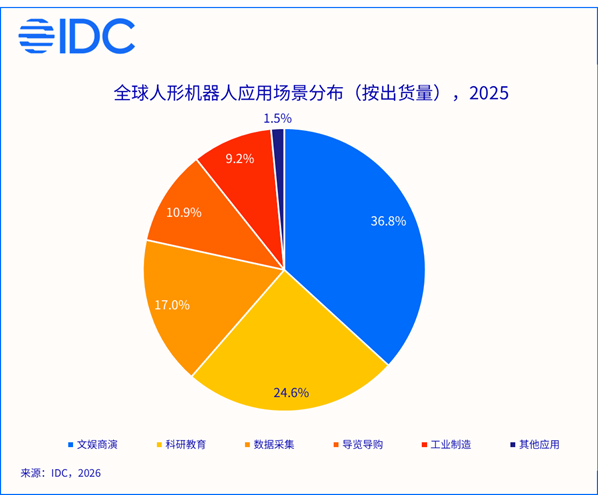
Core Insights - The global humanoid robot market is set to reach a significant scale in 2025, with an expected shipment of nearly 18,000 units, representing a year-on-year growth of approximately 508%, and sales revenue projected at around $440 million [1] - Chinese manufacturers are leading the market with a robust manufacturing system, rapid iteration capabilities, and cost advantages, establishing a dominant position globally [2] - The market is primarily driven by bipedal humanoid robots, which contribute 66.3% of the total sales revenue, with full-sized bipedal robots accounting for 41.6% of the sales [3] Market Dynamics - In 2025, the demand for humanoid robots is mainly driven by applications in entertainment, education, and data collection, emphasizing display effects and interactive experiences [4] - The industry is transitioning from one-time hardware sales to a model that includes Robot as a Service (RaaS), operational services, and a platform ecosystem, creating conditions for scalable applications and sustained revenue [6] Technological Advancements - Humanoid robots are advancing towards engineering and scalable applications, with a focus on enhancing intelligent collaboration capabilities [7] - The integration of upper limb dexterity and the fusion of cognitive models are key breakthroughs that will enhance autonomous operations and human-robot collaboration [7]
2025年全球人形机器人出货量近1.8万台 智元、宇树等中企产品占据主导
Feng Huang Wang· 2026-02-09 04:50
Core Insights - The global humanoid robot shipment is projected to reach nearly 18,000 units by 2025, representing a year-on-year growth of approximately 508%, with a market size of around $440 million [1] - Cumulative order volume is expected to exceed 35,000 units during the same period [1] Company Landscape - Chinese companies dominate the shipment volume, with Zhiyuan Robotics and Yuzhu Technology each shipping around 5,000 units [1] - Other companies such as Leju Robotics, Accelerated Evolution, and Songyan Power shipped approximately 1,000 units each [1] - Companies like Galaxy General, UBTECH, Zhongqing Robotics, and Stardust Intelligence shipped between 400 to 1,000 units [1] - Emerging companies including Xingdong Jiyuan, Magic Atom, Beijing Humanoid Robot Innovation Center, Xinghai Map, Mojia Zhichuang, and Zhujiji Power achieved shipments of over 100 units [1] - In contrast, international firms like Apptronik and Figure AI are still in pilot testing phases, with shipment volumes in the tens [1] - Tesla's humanoid robot is expected to begin large-scale production in 2026 [1] Product Form Factor - Bipedal robots (including full-size and small-to-medium size) contribute to 66.3% of market sales [1] - Full-size humanoid robots account for the highest sales proportion at 41.6%, with Zhiyuan Robotics leading in this segment [1] Industry Analysis - IDC analysis indicates that Chinese manufacturers hold a first-mover advantage in the current stage of humanoid robot commercialization due to a complete industrial chain, rapid iteration capabilities, and cost advantages [1] - Future industry competition is expected to shift from hardware sales to dimensions such as technical services and ecosystem development [1]

最新!快手杀入2026年总台春晚“战局”
Xin Lang Cai Jing· 2026-02-09 03:33
编辑|陈柯名 魏文艺宋思艰 继抖音、B站之后,快手也加入了抢夺2026年总台春晚流量的"战局"之中。 2月9日,快手宣布与中央广播电视总台《2026年春节联欢晚会》达成合作。用户打开快手搜索"春晚", 即可提前预约马年央视春晚直播。 据悉,春晚期间,快手将通过直播、点播及短视频等呈现2026年央视春晚全程内容。同时,春节期间, 快手还将上线红包互动活动,摇一摇即可领红包。 《每日经济新闻》记者注意到,此前,抖音、B站已分别宣布成为2026年总台新媒体《竖屏看春晚》独 家合作伙伴、《2026年春节联欢晚会》独家弹幕视频平台。 据不完全统计,2026年总台春晚的合作阵营堪称"豪华",除抖音、快手、B站等互联网视频平台之外, 还有宇树科技、火山引擎等AI科技公司,以及五粮液、洋河、郎酒等传统酒企,各领域"玩家"摩拳擦 掌,纷纷试图"大手笔"抓住这块流量大蛋糕。 记者|温梦华 据悉,春晚期间,快手将通过直播、点播及短视频等呈现2026年央视春晚全程内容。同时,春节期间, 快手还将上线红包互动活动,摇一摇即可领红包。 《每日经济新闻》记者注意到,此前,抖音、B站已分别宣布成为2026年总台新媒体《竖屏看春晚》独 家合作 ...

宗门大比,智元抢先开演机器人晚会
3 6 Ke· 2026-02-09 01:00
Core Viewpoint - The article highlights the innovative showcase of robotics by AGIBOT through the "AGIBOT NIGHT 2026," marking a significant advancement in the field of robotics, particularly in complex motion control, high-precision collaboration, and initial emotional expression [1][3]. Group 1: Event Overview - AGIBOT, in collaboration with Heqing Tianzhu, hosted the "AGIBOT NIGHT 2026," featuring twelve diverse performances that demonstrate breakthroughs in robotics [1]. - The event is positioned as a major platform for robotics companies, akin to a "training ground" for showcasing their technologies [3][30]. - The event is seen as a significant step in presenting robotics as not just tools but as future life partners and creative collaborators [6][28]. Group 2: Performance Highlights - The event included various performances such as dance, magic, martial arts, and fashion shows, showcasing the capabilities of AGIBOT's robots [1][6]. - Notable performances included a robot magic show featuring Huang Xiaoming, and a martial arts segment where robots performed traditional kung fu [10][8]. - The fashion show presented robots on a futuristic runway, emphasizing the aesthetic potential of robotics [14]. Group 3: Technological Advancements - The event showcased AGIBOT's flagship robots, including the Lingxi X2 and Yuanzheng A2, demonstrating advanced control and coordination capabilities [6][28]. - The robots performed complex tasks with precision, aiming to reshape public perception of robots from cold tools to warm companions [6][22]. Group 4: Market Implications - AGIBOT's initiative to launch a "999 yuan nationwide robot experience plan" during the event aims to integrate robots into everyday life, targeting high-frequency social scenarios [28]. - The article suggests that the upcoming 2026 Spring Festival Gala will focus on showcasing the core capabilities of robots in real-life applications, moving beyond mere entertainment [30][31]. Group 5: Industry Context - The article notes that the Spring Festival Gala has become a significant platform for robotics companies to demonstrate their advancements, with AGIBOT leading the way this year [3][30]. - The competition among robotics companies is expected to intensify as they strive to deliver scalable applications and commercial viability following their performances [31][32].

投资机构预见2026“DeepSeek时刻” 这些现象级爆款正在酝酿
Zhong Guo Zheng Quan Bao· 2026-02-09 00:41
Group 1 - The recent promotion by Qianwen App allowing users to purchase milk tea for 0.01 yuan signifies a pivotal moment for AI applications in China, moving from simple chat functions to actionable tasks [1] - OpenClaw, an open-source AI agent, has gained rapid popularity among developers, indicating a shift in AI applications towards more practical uses [2] - Investment analysts are optimistic about AI as a key market trend, with expectations for significant technological breakthroughs in AI multimodal applications and biomedical fields over the next few years [2][3] Group 2 - The emergence of "AI-native super applications" like LiblibAI is anticipated to create benchmark cases of user growth and revenue by 2026 [3] - The AI application market is transitioning from infrastructure investment to commercial value realization, with a focus on cash-generating applications in the downstream sector [3] - Hardware innovations in smartphones, cars, and smart home devices are expected to drive sustainable industry trends, with companies like Apple leading the charge [3] Group 3 - The field of embodied intelligence, particularly humanoid robots, is gaining attention, with expectations for significant advancements in 2026 [4] - Major robotics companies are collaborating with the 2026 CCTV Spring Festival Gala, showcasing the potential for humanoid robots to perform real-world tasks [4] - Breakthroughs in action models for humanoid robots are predicted to enhance their operational capabilities in unstructured environments [5] Group 4 - The commercial space sector is identified as a significant growth area, with expectations for a pivotal moment in 2026 when SpaceX is projected to go public [6] - Chinese commercial space companies are likely to successfully implement rocket recovery operations, marking a significant milestone for the industry [6] - The low Earth orbit satellite internet sector is entering a phase of industrial explosion, with a ten-year growth cycle anticipated [6][7] Group 5 - The rocket segment is under scrutiny due to its potential to address capacity bottlenecks and high costs, with a focus on companies that can successfully reduce costs [7] - The satellite operations market is viewed as a scarce resource, with significant potential for growth in traditional high-end markets and emerging low-altitude economies [7] - The concept of space computing, utilizing AI data centers in space, is being explored as a revolutionary approach to energy and computational efficiency [7] Group 6 - The 14th Five-Year Plan emphasizes the importance of quantum technology, biomanufacturing, hydrogen energy, and other advanced fields as new economic growth points [9] - Key technological breakthroughs in areas like quantum computing and brain-machine interfaces are expected to occur by 2026, significantly impacting market confidence [9][10] - The Chinese pharmaceutical industry is poised for a breakthrough in global drug development, with several companies expected to achieve significant clinical trial results in 2026 [10] Group 7 - AI-driven drug development is anticipated to reach a validation point in 2026, showcasing the potential of AI in creating tangible medical solutions [10] - The brain-machine interface sector is expected to achieve clinical breakthroughs, particularly in flexible electrodes and signal processing chips [10] - Investment strategies are shifting towards companies that can effectively translate technological innovations into commercial success, moving away from resource accumulation [11]

2025商用具身智能白皮书
艾瑞咨询· 2026-02-09 00:03
Core Insights - Embodied intelligence has gained significant traction globally, with Figure achieving a valuation of $39 billion despite zero revenue, while domestic players are securing commercial orders and projecting substantial revenue growth [1][4] - The Chinese market is integrating embodied intelligence into its strategic development plans, indicating a shift towards a trillion-dollar market landscape [1][9] Definition and Understanding - Embodied intelligence is recognized as a crucial development in artificial intelligence, characterized by agents that interact with their environment through a closed-loop of perception, understanding, decision-making, and action [2] - It represents a convergence of machine learning, computer vision, and robotics, marking a significant step towards practical AI applications [2] Commercial Scene Classification - Different forms of embodied intelligence robots are evolving to meet diverse needs across retail, dining, manufacturing, logistics, education, and healthcare [4] - Commercial applications focus on enhancing service experiences and operational flexibility in dynamic environments, while industrial applications emphasize precision and stability in structured settings [4] Strategic Significance - Embodied intelligence is pivotal in narrowing the technological gap between China and the U.S., driving innovation across various sectors including manufacturing, transportation, and healthcare [6] - The competition in advanced technology between the two nations highlights the importance of breakthroughs in embodied intelligence for economic and competitive advantages [6] Policy Incentives - The Chinese government is actively promoting the development of embodied intelligence through various policies, funding, and standardization efforts [8][9] - Local governments are also implementing initiatives to support industry growth, including funding for humanoid robots and establishing collaborative platforms [9] Development Stages - The evolution of embodied intelligence can be categorized into three phases: conceptual development (1950s), technological accumulation (2000-2020), and application expansion driven by large models (2020 onwards) [11] - The current phase is marked by rapid advancements, with the U.S. leveraging its computational resources and China accelerating its catch-up through policy support and industry collaboration [11] Bottlenecks and Challenges - The transition from experimental to commercial applications faces challenges, including data scarcity, technological maturity, high costs, and long ROI cycles [13][16] - Key issues include the lack of high-quality multimodal data, underdeveloped technologies for dexterous manipulation, and ethical considerations [13] Data Challenges - The industry relies on various data acquisition methods, but high-quality data remains scarce, posing a significant bottleneck for development [16] - Efforts are underway to alleviate data challenges through innovative solutions like "world models" and data collection training grounds [19] Model Evolution - The VLA model is emerging as a consensus for the development of embodied intelligence, integrating reasoning capabilities with real-world perception and action [21] - This evolution is expected to lead to a breakthrough similar to the GPT moment in AI, with significant implications for cross-scenario learning and application [21] Commercialization Breakthroughs - The path to large-scale commercialization of embodied intelligence hinges on overcoming challenges in endurance, latency, execution, reliability, and economic viability [29] - Current applications are focusing on low-complexity, high-ROI scenarios, with future expansions into more complex environments as technology matures [31] Global Market Predictions - The global market for embodied intelligence is projected to reach 19.2 billion RMB by 2025, with a compound annual growth rate of 73% over the next five years [46] - China's market is expected to experience significant growth, potentially reaching over 280 billion RMB by 2035, driven by a robust industrial ecosystem [50] International Expansion - Chinese companies are accelerating their international presence, transitioning from core capabilities to localized applications in global markets [53] - Successful case studies illustrate the feasibility of Chinese embodied intelligence in meeting high international standards [53] Competitive Landscape - The competition in embodied intelligence features three main players: AI-native challengers like Figure, traditional industrial players like ABB, and cross-industry giants like Tesla [55] - The market is witnessing early signs of product homogenization, suggesting an impending consolidation phase [57] Startup Strategies - Startups must leverage their agility and innovation to survive against established giants, focusing on strategic partnerships and long-term value creation [59]

投资机构预见2026“DeepSeek时刻
Zhong Guo Zheng Quan Bao· 2026-02-08 20:22
Core Insights - The article discusses the rapid rise of AI applications, particularly highlighting the success of the OpenClaw AI agent and its implications for the future of AI technology and investment opportunities in 2026 [1][2]. AI and Embodied Intelligence - AI is viewed as a key market trend, with expectations for breakthroughs in multi-modal AI and biomedical fields over the next 2-3 years [1][2]. - OpenClaw, an open-source AI agent, has gained significant traction, indicating a shift towards practical AI applications that can perform tasks on behalf of users [2]. - Investment interest is focused on the emergence of super platforms and applications, with predictions of a surge in user engagement and revenue for AI-native applications by 2026 [2][3]. Hardware and Robotics - The AI application market is transitioning from infrastructure investment to commercial value realization, with a focus on cash flow-generating applications [3]. - There is potential for explosive growth in hardware, particularly in smart devices like smartphones and smart homes, driven by AI integration [3]. - The field of embodied intelligence, particularly humanoid robots, is expected to advance significantly, with predictions of breakthroughs in model efficiency and operational capabilities in real-world environments by 2026 [4][5]. Commercial Space Industry - The commercial space sector is identified as a significant growth area, with expectations for major developments, including the potential IPO of SpaceX, which could establish a new commercial model for the industry [5][6]. - The Chinese commercial space sector is anticipated to achieve milestones in rocket recovery and satellite internet, marking a critical point for rapid development [5][6]. Future Industry Breakthroughs - Emerging technologies such as quantum computing, biomanufacturing, and brain-computer interfaces are expected to see significant advancements by 2026, contributing to new economic growth points [7][8]. - The article highlights the potential for Chinese pharmaceutical companies to achieve significant milestones in drug development and clinical applications, particularly in AI-driven drug discovery and brain-computer interface technologies [8][9].