
中航光电

Search documents
分享军工行业发展机遇 6月30日高端装备ETF(159638)上涨4.13%
Xin Lang Ji Jin· 2025-06-30 07:37
Core Viewpoint - The aerospace and defense sectors are entering a golden development period in 2025, with strong performance in related thematic indices and ETFs, particularly the high-end equipment ETF (159638) which has shown significant gains recently [1][2]. Group 1: ETF Performance - The high-end equipment ETF (159638) achieved a five-day consecutive increase with a weekly growth rate of 6.19%, and a further rise of 4.13% on June 30, totaling a six-day increase of 10.58% [1]. - On June 30, the trading volume for the high-end equipment ETF reached 90.88 million yuan, significantly higher than the average daily trading volume of 50.93 million yuan over the past year [1]. - The ETF tracks the CSI High-end Equipment Sub-index 50, which includes leading stocks in various sub-sectors such as aerospace equipment manufacturing and radar systems, with a high concentration in the aerospace sector [1]. Group 2: Profit Expectations - The continuous rise of the high-end equipment ETF is supported by strong profit expectations, with projected year-on-year net profit growth of 85.81% and 36.49% for 2025 and 2026, respectively [2]. - The dividend payout ratios for the CSI High-end Equipment Sub-index 50 are expected to increase from 29.25% in 2022 to 54.49% in 2024, indicating a positive trend [2]. Group 3: Company Initiatives - As one of the earliest fund companies to engage in passive investment, the company has been a leader in broad-based and thematic ETFs, launching the first domestic CSI 300 index fund in August 2005 [3]. - The company has continuously innovated in the thematic ETF space, introducing several first-of-their-kind products, including the aerospace high-end equipment ETF (159638) and others focused on green energy and technology sectors [3].
高端装备ETF(159638)盘中涨近4%,成分股航天南湖领涨,中光学、国睿科技10cm涨停
Sou Hu Cai Jing· 2025-06-30 03:13
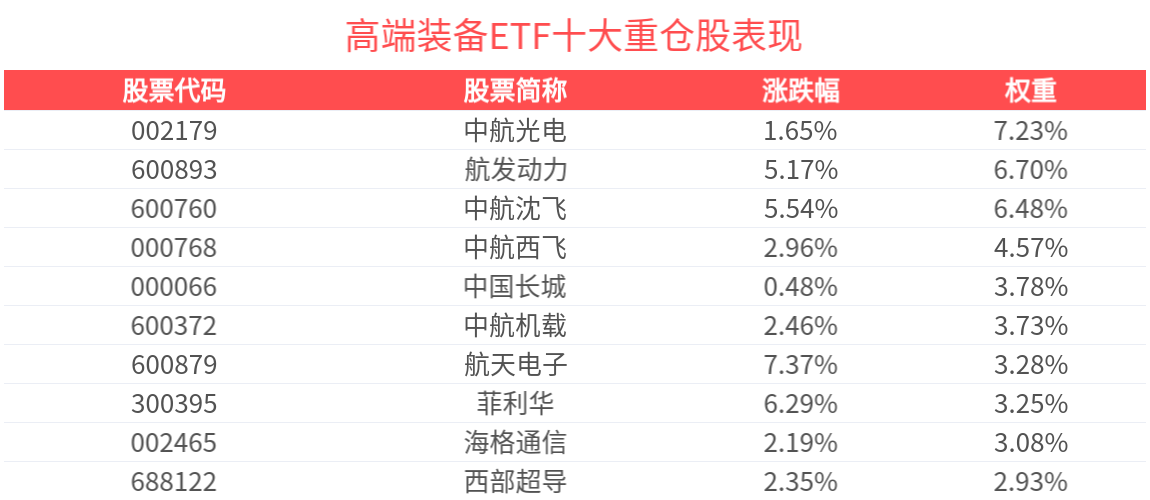
Core Insights - The China Securities High-end Equipment Sub-index 50 has shown a strong increase of 3.72% as of June 30, 2025, with notable gains from stocks such as Aerospace South Lake, which rose by 13.57% [1] - The High-end Equipment ETF (159638) has experienced a 3.77% increase, marking its sixth consecutive rise, and has accumulated a 6.19% increase over the past week [1] - The ETF's latest scale reached 1.193 billion yuan, with a daily average transaction volume of 7.76158 million yuan over the past week [1] Performance Metrics - As of June 27, 2025, the High-end Equipment ETF has achieved a net value increase of 27.30% over the past year [1] - The highest single-month return since inception was 19.30%, with the longest consecutive monthly increase being two months and a maximum increase of 29.39% [1] - The average monthly return during rising months is 6.28% [1] Market Dynamics - The top ten weighted stocks in the High-end Equipment Sub-index account for 45.86% of the index, with significant contributors including AVIC Shenyang Aircraft, AVIC Optoelectronics, and Aero Engine Corporation of China [2] - The geopolitical tensions have led to a rapid increase in global military spending, which is expected to significantly boost overall demand for military trade, potentially leading to a growth period for Chinese military trade and improving the profitability and quality of earnings for related companies [4]


国防ETF(512670)涨超3%,关注内贸+外贸+自主可控三大主线
Xin Lang Cai Jing· 2025-06-30 02:18
Group 1 - Military stocks are active with significant gains, including Morningstar Aviation and Hengyu Xintong rising over 10%, and Changcheng Military Industry and Lijun Co. rising over 5% as of June 30 [1] - The defense ETF (512670.SH) increased by 3.17% [1] Group 2 - Three main reasons for optimism in the military sector: global regional tensions, upcoming military parades showcasing main battle equipment and new combat forces, and recent deep-sea technology policies indicating investment opportunities [2] - The upcoming military parade on September 3 will feature both traditional and new combat forces, highlighting the military's adaptation to technological advancements [2] - Recent deep-sea technology policies from Guangdong and Shanghai indicate a focus on emerging fields like UUVs, suggesting significant growth potential [2] Group 3 - The period from 2025 to 2027 is expected to see substantial growth in both domestic and foreign demand for military products, driven by multiple catalysts including the "14th Five-Year Plan" and the "Centenary of the Army" [3] - The National Defense ETF closely tracks the CSI National Defense Index, which includes listed companies under major military groups and those providing equipment to the armed forces [3] - The National Defense ETF has the lowest management and custody fees among its peers at 0.40% [3] Group 4 - Related products include the National Defense ETF (512670) [4] - Related stocks include AVIC Shenyang Aircraft Company, AVIC Optoelectronics, Aero Engine Corporation of China, and others [4]
深海科技:海洋强国战略的关键支柱产业赛道投资图谱
Tianfeng Securities· 2025-06-29 07:16
Group 1 - The ocean economy is a significant driver of GDP growth, with the national marine production value expected to exceed 10 trillion yuan in 2024, accounting for 7.8% of the GDP, and contributing 11.5% to economic growth [1][8] - The government has highlighted "deep-sea technology" in its reports, indicating its importance alongside commercial aerospace and low-altitude economy, suggesting a rapid development potential in deep-sea equipment and exploration [1][8] - The deep-sea technology sector is identified as a key pillar for building a maritime power, encompassing three main areas: deep-sea materials, deep-sea equipment manufacturing, and deep-sea digital applications [3][17] Group 2 - Various provinces and cities are accelerating the development of marine economy, with policies focusing on high-end, intelligent, and green development, and establishing multi-level industrial systems [2][13] - Shanghai's marine industry development plan (2025-2035) proposes a "3+5+X" industrial system, while Guangdong's regulations emphasize support for eight emerging marine industry clusters [2][14] - The deep-sea materials sector is crucial for deep-sea technology, involving structural and buoyancy materials necessary for the development of marine resources, with a focus on high-performance steel, alloy materials, and composite materials [3][21] Group 3 - The deep-sea equipment sector is essential for supporting deep-sea development, facing challenges from complex underwater environments, with significant growth in China's shipbuilding industry, which saw a 13.8% increase in completed shipbuilding volume in 2024 [4][26] - The deep-sea digitalization and intelligence sector is a vital direction for deep-sea technology development, aiming to create a "digital ocean" that enhances marine decision-making and governance through advanced information technologies [5][17] - The report suggests focusing on marine engineering equipment manufacturing, marine equipment components, and marine observation instruments as key areas for investment [4][26]




研判2025!中国电子连接器行业产业链、市场规模及发展趋势分析:技术加速向高频高速智能化演进,助力产业升级[图]
Chan Ye Xin Xi Wang· 2025-06-29 01:25
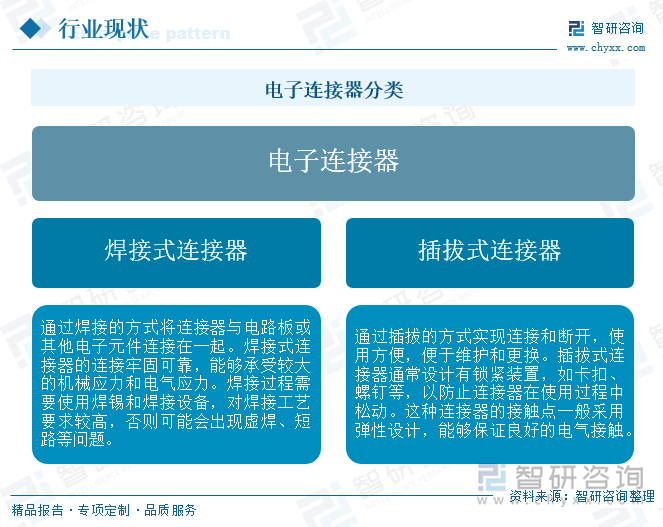
Industry Overview - China has become the largest production base and consumer market for electronic connectors globally, with a market size projected to reach approximately 212.37 billion yuan in 2024, representing a year-on-year growth of 11.67% [1][12] - The electronic connector industry in China is rapidly evolving towards high-frequency, low-loss, and high-reliability products, driven by advancements in technologies such as 5G, IoT, and AI [1][12] Industry Development History - The development of China's electronic connector industry can be divided into four stages: the embryonic period (1940-1949), the initiation period (1950-1970), the rapid development period (1980-2000), and the maturity period (2000-present) [4][5] Industry Supply Chain - The upstream of the electronic connector industry includes raw materials such as copper, alloy materials, and various plastics, while the midstream involves the manufacturing of electronic connectors, and the downstream applications span across automotive, communication, consumer electronics, and industrial control sectors [7] Market Demand and Trends - The demand for electronic connectors is continuously growing, primarily driven by the rapid development of the new energy vehicle market and consumer electronics, with significant increases in the demand for high-density and high-voltage connectors [21] - The trend towards smart and high-frequency connectors is becoming a core focus, with innovations in materials and manufacturing processes enhancing performance and driving the industry towards high-end and intelligent solutions [20] Competitive Landscape - The competition in the electronic connector industry is intensifying, with domestic companies like Luxshare Precision and AVIC Optoelectronics gaining market share through technological innovation and customized services, while international brands maintain dominance in the high-end market [22][14]


方正证券:国家战略新引擎驱动 深海产业迎1-10跨越式发展
智通财经网· 2025-06-28 08:34
Group 1 - The core viewpoint is that deep-sea technology has been recognized as a strategic emerging industry in China's 2025 government work report, alongside commercial aerospace and low-altitude economy, highlighting its potential for economic growth and resource security [1][3] - The deep-sea area covers 65% of the ocean and 49% of the Earth's surface, containing abundant energy and resources, making it crucial for China's economic strategy and international standing [2][3] - The deep-sea technology sector is expected to experience rapid development, with a market potential in the trillion-level range, driven by government policies and financing opportunities [3] Group 2 - The construction of underwater defense systems is accelerating, with military-civilian integration expected to drive growth in the deep-sea industry, enhancing the application and commercialization of deep-sea equipment [4] - The upstream sector, including sonar and titanium alloy production, is anticipated to see early growth, while midstream and downstream applications are expanding into various deep-sea scenarios [5] - Key companies in the upstream sector include China Marine Defense, West Materials, and Xiangdian Co., while midstream and downstream players include China Shipbuilding, CNOOC, and China Petroleum [5]

海通证券晨报-20250627
Haitong Securities· 2025-06-27 02:43
Core Insights - The report emphasizes the long-term positive trend in the military industry due to escalating great power competition and increased defense spending in response to regional tensions [7][17][20] - The report highlights the significant growth in the scale of credit bond ETFs, with a total scale of 1,066 billion yuan as of June 20, 2025, reflecting a substantial increase since March [2][34] - The report identifies potential investment opportunities in low-valued newly issued sci-tech bonds, suggesting that there is still room for exploration in the primary market [4][37] Group 1: Credit Bond ETF Insights - The expansion pace of index constituent bonds is significantly slower than the growth of credit bond ETF scale, with the scale increasing by 777 billion yuan since March [2][34] - The report notes that the duration of Shenzhen credit bond ETFs is 3.05 years, while Shanghai credit bond ETFs have a duration of 4.11 years, indicating a shift in demand towards mid to long-term credit bonds [3][35] - The report suggests that the low valuation transactions in constituent bonds are becoming more prominent, particularly for those with larger outstanding scales and stable valuations [2][34] Group 2: Military Industry Insights - The military sector experienced a decline recently, with the defense industry index dropping by 2.39% in the week of June 15-20, 2025, underperforming the broader market [8][19] - The report highlights the successful launch of the Zhongxing 9C satellite and the showcasing of advanced military equipment at the Paris Air Show, including the J-35A stealth fighter [8][19] - The report indicates that the ongoing international military dynamics underscore the importance of national defense construction, with a focus on advanced technology and informationization in modern warfare [20]
上涨超3%!国防ETF(512670)涨幅位列国防军工类ETF第一,且费率同类最低!
Xin Lang Cai Jing· 2025-06-25 03:15
Group 1 - The China Defense Index (399973) has seen a strong increase of 3.13%, with notable gains from stocks such as China Aerospace Science and Industry Corporation (10.02%) and Northern Navigation (9.99%) [1] - The Defense ETF (512670) rose by 3.18%, reaching a latest price of 0.75 yuan, marking it as the top performer among defense and military ETFs [1] - The latest scale of the Defense ETF reached 5.462 billion yuan, achieving a new high in nearly a year [1] Group 2 - Recent developments include the launch of the world's first high-orbit commercial relay satellite project in Shenzhen, indicating a strategic focus on the aerospace industry for local economic transformation [1] - China Galaxy Securities highlights the underestimated long-tail effect of military trade and the acceleration of military transformation contributing to enhanced combat capabilities [2] - The Defense ETF closely tracks the China Defense Index, which includes listed companies under the top ten military groups and those providing equipment to the armed forces, reflecting the overall performance of defense industry stocks [2]
深市公司探“赢” 逐浪科技星辰|资本市场赋能低空经济 深市企业发力新赛道
Zheng Quan Ri Bao Wang· 2025-06-19 12:10
Group 1 - The core viewpoint of the articles emphasizes the profound structural changes in China's capital market, which effectively promotes a virtuous cycle among technology, capital, and industry, particularly in the burgeoning low-altitude economy sector [1] - The low-altitude economy is characterized by significant challenges in technology research and development, funding, and industrialization, which require long cycles and substantial demand [2] - Capital markets play a crucial role in supporting the low-altitude economy by providing diverse financing options, venture capital, and capital support, which help companies overcome development bottlenecks and achieve scalable growth [2] Group 2 - Companies like Zhejiang Wanfeng Aowei and CITIC Ocean Helicopter have successfully leveraged capital market resources to enhance innovation, expand operations, and secure funding for research and development [2][3] - CITIC Ocean Helicopter has utilized its IPO and subsequent equity refinancing to introduce advanced international models and develop high-value domestic helicopter component repair capabilities [3] - The collaboration between CITIC Ocean Helicopter and Huawei to build a low-altitude communication network using 5G technology exemplifies the integration of advanced technology in enhancing operational safety and efficiency [3] Group 3 - The low-altitude economy faces various challenges, including technological maturity, commercial viability, safety compliance, and capital recovery cycles, which test the industry's resilience [4] - Companies need to enhance their independent innovation capabilities and align their strategic direction with technological advancements to strengthen their competitive edge [4] - The limited market demand for domestic helicopters and new aviation vehicles constrains the industry's growth and innovation, necessitating a focus on developing new consumption scenarios [5] Group 4 - A strategic focus on "technical breakthroughs, scenario development, and ecological collaboration" is essential for companies to overcome development bottlenecks in the low-altitude economy [5] - Companies are prioritizing research directions that enhance aviation transport efficiency and operational support capabilities while actively pursuing partnerships with universities and research institutions to tackle key technological challenges [5]


红宝书20250617
2025-06-19 09:46
Summary of Key Points from Conference Call Records Industry or Company Involved - **Brain-Computer Interface (BCI) Industry**: Significant developments in the BCI sector, particularly in the U.S. and China, with a notable rise in stock prices for related companies. - **Military Trade and Aerospace Industry**: Increased military trade due to geopolitical conflicts, with a focus on companies involved in military aircraft and drone manufacturing. - **Logistics and Shipping Industry**: Impact of geopolitical tensions on oil transportation and logistics services. - **Solid-State Battery Technology**: Advancements in solid-state battery technology and related equipment manufacturing. Core Points and Arguments - **BCI Market Growth**: The global BCI market is projected to grow from $2.61 billion in 2024 to $2.93 billion in 2025, with a compound annual growth rate (CAGR) of 17% expected until 2033 [20][20][20] - **Investment in BCI Companies**: Companies like Oriental Zhongke and Lihua Kechuang are making strides in BCI hardware and systems, indicating a robust investment landscape in this sector [20][20][20] - **Military Trade Opportunities**: The ongoing geopolitical conflicts are expected to benefit military trade, with companies like Chengxi Aviation and AVIC Chengfei actively participating in international exhibitions to showcase military capabilities [20][20][20] - **Oil Transportation Risks**: The recent conflicts in the Middle East have led to increased oil transportation costs, with companies like China Merchants Energy and COSCO Shipping Energy facing operational challenges due to heightened risks in the Strait of Hormuz [21][22][22] - **Solid-State Battery Equipment Demand**: The solid-state battery sector is seeing increased demand for manufacturing equipment, with companies like Winbond Technology and others delivering key technologies to major clients [22][23][23] Other Important but Possibly Overlooked Content - **Emerging Technologies in BCI**: Companies are exploring various applications of BCI technology, including medical devices and educational tools, which could expand the market further [20][20][20] - **International Logistics Expansion**: Companies are enhancing their international logistics capabilities, particularly in rail transport, to meet the growing demand for cross-border trade [22][22][22] - **Smart Sports Equipment Development**: The collaboration between Meta and Oakley to develop smart glasses for sports indicates a trend towards integrating technology with fitness and outdoor activities [23][23][23] - **Environmental and Regulatory Considerations**: The development of RWA (Real World Assets) technology and its application in energy storage solutions reflects a growing focus on sustainability and regulatory compliance in the energy sector [23][23][23]