网易

Search documents
港股午评:恒指跌0.04%、科指跌0.66%,内房股、新消费概念股走强,科网股、商业航天及生物医药股下挫
Sou Hu Cai Jing· 2026-01-20 04:13
Market Overview - The Hong Kong stock market opened high but experienced a decline, with the Hang Seng Index down 0.04% at 26,552.57 points, the Hang Seng Tech Index down 0.66% at 5,712.19 points, and the National Enterprises Index down 0.12% at 9,123.18 points, while the Red Chip Index rose 1% to 4,183.81 points [1] - Major tech stocks generally fell, with Alibaba down 0.25%, Tencent down 1.48%, and Xiaomi down 1.48%, while JD.com rose 1.07% and NetEase rose 1.85% [1] - Real estate stocks showed strength, with Greentown China rising over 5%, while new consumption concepts were active, with Hu Shang Ayi rising over 10% [1] - The commercial aerospace sector weakened, with Asia Pacific Satellite down over 6%, and the biopharmaceutical sector continued to adjust, with WuXi AppTec down over 4% [1] Corporate News - Code-B (02487.HK) reported positive top-line results from a Phase III clinical trial for CU-20101, an injectable type A botulinum toxin for moderate to severe glabellar lines [2] - Saint Bella (02508.HK) signed a strategic cooperation framework agreement with Cloud Technology to explore the integration of AI and robotics in high-demand home care scenarios [2] - China Pacific Insurance (00966.HK) expects a net profit increase of approximately 215% to 225% in 2025, compared to 8.432 billion HKD in the previous year [2] - TCL Electronics (01070.HK) anticipates an adjusted net profit of approximately 2.33 to 2.57 billion HKD in 2025, representing a growth of about 45% to 60% [2] - Jihong Co. (02603.HK) expects a net profit of approximately 273 to 291 million HKD in 2025, a year-on-year increase of 50% to 60% due to growth in packaging and cross-border e-commerce [2] - Guolian Minsheng (01456.HK) expects a net profit of approximately 2.008 billion RMB in 2025, a year-on-year increase of around 406% [2] - China Railway (00390.HK) reported a new contract amount of 1,165.98 billion RMB in Q4 2025, with a cumulative new contract amount of 2,750.9 billion RMB, a year-on-year increase of 1.3% [2] Additional Corporate Updates - Shenzhen Holdings (00604.HK) expects a total contract sales amount of approximately 13.311 billion RMB in 2025, a decrease of 21.55% year-on-year [3] - SF Holding (06936.HK) reported a total revenue of 27.339 billion RMB in December from its express logistics, supply chain, and international business, a year-on-year increase of 3.41% [4] - China Ruyi (00136.HK) plans to invest approximately 14.2 million USD in AIsphere to explore AI applications in film, streaming, and gaming content production [4] - Baide International (02668.HK) signed a memorandum of understanding with potential sellers regarding the possible acquisition of part or all of a target company's equity [5] - HAPO (02142.HK) exercised warrants under an agreement with Spruce [6] - Yuanda Pharmaceutical (00512.HK) had its new drug application for TLX591-CDx accepted by the Chinese drug regulatory authority [7] - Yancoal Australia (03668.HK) reported a coal production of 10.4 million tons in Q4 2025, a 12% increase quarter-on-quarter and a 7% increase year-on-year [7] Institutional Insights - Dongwu Securities noted that the Hong Kong market is in a long-term upward trend but faces short-term challenges, with strong consensus on domestic fundamentals but mixed views on overseas factors [8] - Huaxia Fund highlighted the high sensitivity of the Hong Kong market to corporate earnings and macroeconomic data, suggesting that positive economic surprises could significantly boost market expectations [8] - Citigroup expressed optimism about the Hong Kong market's prospects compared to A-shares, anticipating support from both southbound and foreign capital in 2026, while cautioning against potential risks from high overseas interest rates [8] - Guolian Minsheng Securities remains bullish on the revaluation of AI in China, citing a solid industrial catalyst timeline and upcoming model releases from major companies [8]
成立两年,2025年全球收入比肩米哈游,何方神圣?
3 6 Ke· 2026-01-20 02:46
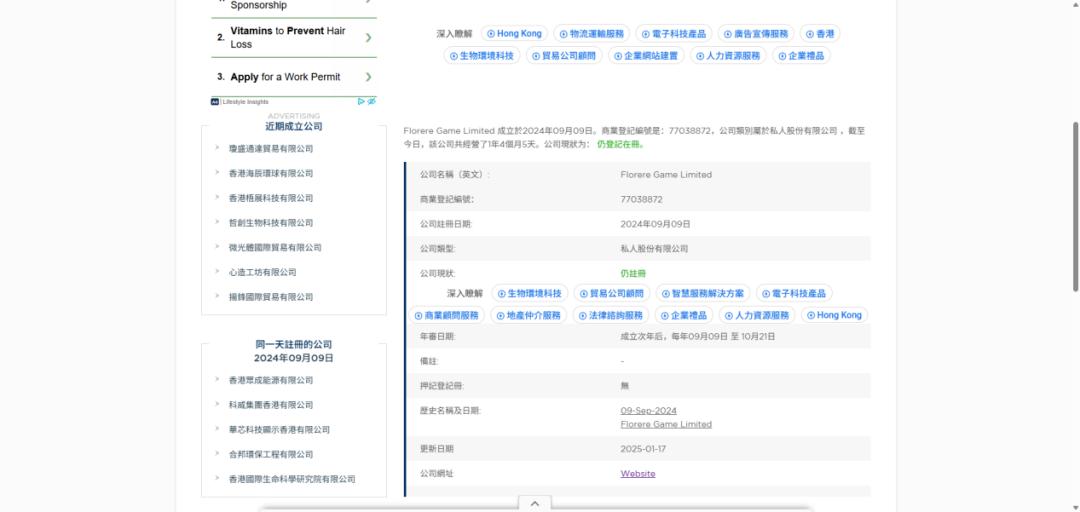
Core Insights - The 2025 global revenue ranking for Chinese mobile game publishers has been released, with Tencent at the top, followed by DianDian Interactive and NetEase. A surprising entry is Florere Game, which ranks sixth, being the only new company in the top 30 [1][3]. Group 1: Company Overview - Florere Game is a private limited company established in Hong Kong on September 9, 2024, with limited public information available regarding its founding team or shareholders [3]. - The company has two successful titles, "Last Z: Survival Shooter" and "Dark War Survival," both of which made it to the top 30 overseas mobile game revenue rankings in 2025, ranking sixth and eighth respectively [3][4]. Group 2: Game Performance - "Last Z: Survival Shooter" entered the top 30 revenue rankings in March 2025 at position 23 and has since stabilized in the top five, while "Dark War Survival" has consistently remained in the top ten since its entry [4]. - Both games are based on a post-apocalyptic zombie theme, with gameplay mechanics that are similar to other successful titles in the genre [5][8]. Group 3: Market Connections - There are indications that Florere Game has connections to a Beijing-based company that was previously involved in the development and publishing of its games, although the exact relationship remains unclear [2][23]. - The previous publisher of "Dark War Survival," Silkworld Game Limited, was linked to the Beijing company, which has since been dissolved [23][25]. Group 4: Revenue Insights - "Last War: Survival," another game with a similar theme, achieved significant success, generating over $1.5 billion in revenue in 2025, marking a 40% increase from 2024 [5][8]. - The combined revenue potential of Florere Game's titles could position it as a leading player in the overseas mobile game market, although direct evidence linking these games to the Beijing company is lacking [25].

一个游戏皮肤被炒到几十万?背后全是平台生意经
Bei Jing Qing Nian Bao· 2026-01-20 02:36
Core Viewpoint - The trading of virtual skins in the game CS has created a volatile market driven by player emotions, with significant profits and losses experienced by participants [1] Group 1: Market Dynamics - The value of virtual skins can reach exorbitant prices, driven by player vanity and the operational rules of the game [1] - The market is influenced by a group known as "倒狗" (speculators), who manipulate prices for profit, often without participating in the game [1] - The primary channels for skin transactions include official server drops, weapon case openings, the Steam community market, and direct player-to-player trades [1] Group 2: Trading Platforms - The evolution of trading models has enabled seamless cash integration with virtual skins, with platforms like Steam initially limiting cash withdrawals [2] - The introduction of platforms like NetEase's BUFF has broken these barriers, allowing players to withdraw earnings, thus attracting more participants [2] - Other notable trading platforms in China include 悠悠有品 and C5game, which also facilitate cash withdrawals, lowering transaction barriers [2] Group 3: Price Volatility Factors - The price of CS skins is highly sensitive and can fluctuate dramatically, influenced by rarity, wear value, game updates, esports events, and social media trends [3] - Official game strategies, such as limited edition skins, can significantly increase value due to scarcity, as seen with certain commemorative skins [3] - Events like team disbandments or game feature updates can lead to rapid price changes, highlighting the speculative nature of the market [3]
恒生科技指数开盘下跌,智谱、MiniMax股价回涨后走低
Di Yi Cai Jing· 2026-01-20 02:24
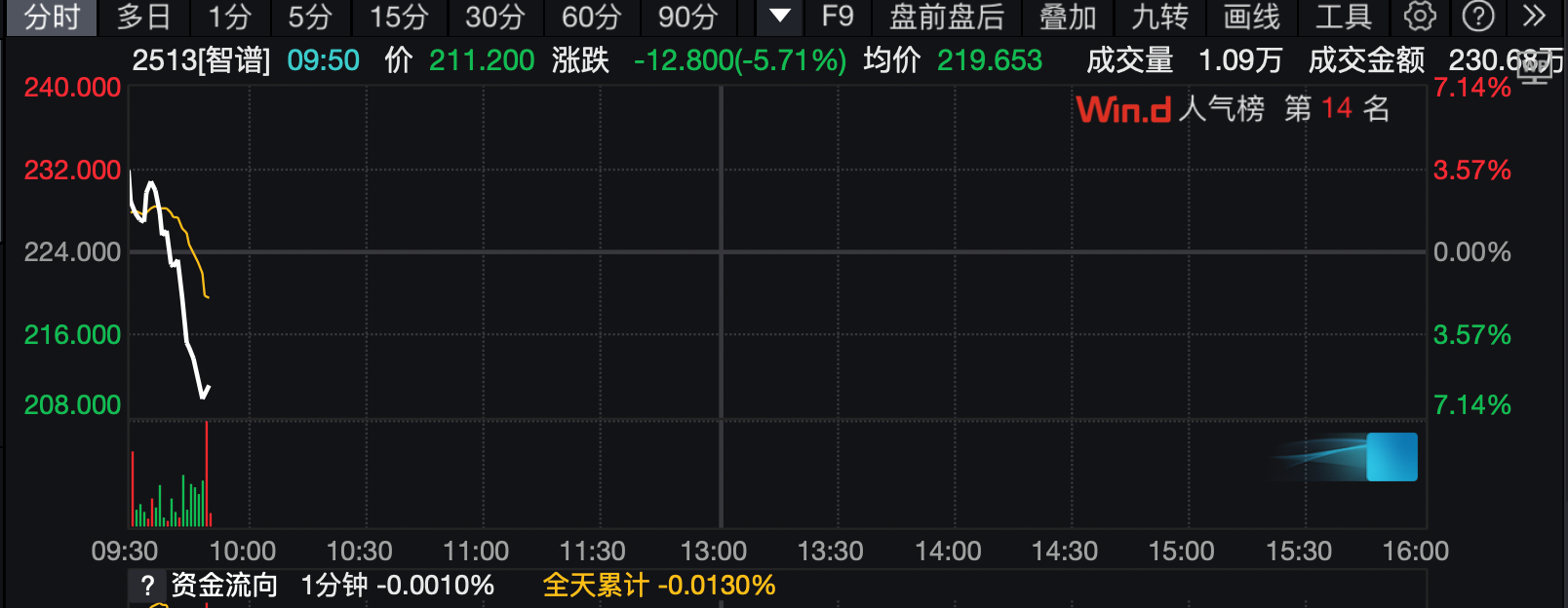
Group 1 - The Hong Kong stock market is currently experiencing a volatile upward trend, but faces short-term challenges [1][3] - The Hang Seng Technology Index opened down 0.22%, with major tech stocks mostly declining; notable declines include Zhizhu (down 8.48%) and MiniMax (up 0.79%) [3] - Zhizhu and MiniMax reported significant losses, with cumulative losses of over 6.2 billion yuan and approximately 9.2 billion yuan respectively from 2022 to mid-2025 [3] Group 2 - Google DeepMind's CEO highlighted that Chinese teams, represented by DeepSeek and Alibaba, are rapidly approaching the technological frontier, with only a few months' gap compared to Western teams [4] - The research team from China International Capital Corporation noted that seven leading tech stocks in Hong Kong contributed significantly to the Hang Seng Index, with a peak contribution of 14 percentage points to a 37% return [4] - The discussion around potential bubbles in the AI industry is deemed less important than confirming the current stage of development, as bubbles can drive industry growth [4]
大行评级|高盛:游戏与娱乐板块风险回报仍具吸引力,核心买入股份包括腾讯、快手等
Ge Long Hui· 2026-01-20 02:22
Core Viewpoint - Goldman Sachs reports that the Chinese gaming and entertainment sector experienced significant stock price increases in 2025, with mid to large-cap stocks rising by 50% to 80% compared to the Hang Seng China Enterprises Index's 26% [1] Group 1: Market Performance - The strong performance continued into early 2026, with some stocks increasing by as much as 30% compared to related indices' growth of approximately 3-5% [1] - The price increase is attributed to a combination of valuation expansion and earnings per share growth [1] Group 2: Future Outlook - For 2026, Goldman Sachs outlines key themes and debates for the sector, indicating that the risk-reward profile remains attractive but is more alpha-driven [1] - The firm prefers companies with new growth potential, such as those benefiting from AI application penetration and accelerated overseas expansion [1] Group 3: Competitive Landscape - Companies that still have compound growth and profit expansion potential amid increasing competition, particularly with ByteDance raising competitive concerns, are favored [1] - Core buy stocks selected by Goldman Sachs include Tencent, NetEase, Kuaishou, Bilibili, and Tencent Music [1] Group 4: Stock Ratings - Goldman Sachs maintains a "Buy" rating on Tencent, adjusting the target price from HKD 770 to HKD 752 [1]




硬核技术铸“龙骨” 中国游戏出海按下“快进键”
Zhong Guo Jing Ji Wang· 2026-01-20 00:41
Core Insights - The Chinese cultural "new three" including online literature, online film and television, and online games have rapidly risen and gained popularity in overseas markets, with game exports becoming a new engine for China's service trade growth [1] - In the first half of 2025, the actual sales revenue of independently developed Chinese games in overseas markets reached $9.501 billion, a year-on-year increase of 11.07% [1] Group 1: Game Development and Technology - The first domestic 3A game "Black Myth: Wukong" showcases top-notch graphics and artistic expression, while "Yanyun Sixteen Sounds" utilizes nano-level detail rendering technology, achieving over 50 million views on overseas platforms [2] - Chinese game companies have developed a "premium R&D system" that enables them to produce high-quality mobile and cross-platform games, leveraging a deep understanding of the free-to-play model and refined operational capabilities [2][4] - The integration of AI-generated content (AIGC) is accelerating game exports, enhancing player experience through real-time NPC interactions and significantly improving production efficiency [3] Group 2: Cultural Integration and Global Appeal - The integration of traditional cultural IP with games is enhancing the global dissemination of Chinese culture, with games like "Black Myth: Wukong" and "Genshin Impact" incorporating cultural elements that resonate with international players [5][6] - The strategy of "core leading, shell universal" ensures that games maintain universally appealing core gameplay while integrating cultural elements as value-added content [6][7] Group 3: Policy Support and Market Strategy - The growth of Chinese games in overseas markets is supported by various government policies that provide institutional guarantees and promote systematic layouts for game exports [8] - Local governments, such as Guangdong and Beijing, are implementing policies to accelerate game exports and support the development of a collaborative ecosystem among game companies [8][9] Group 4: Future Growth Opportunities - Future growth in game exports will focus on refined operations in emerging markets, with an emphasis on deep customization based on local cultures and social habits [10] - The integration of AI technology is seen as a significant opportunity, with companies that embrace AI likely to gain a competitive edge [10] - Products that enable cross-platform data interoperability and create an ecosystem of "games + events + community" are identified as future growth points [10]
中国游戏出海按下“快进键”
Jing Ji Ri Bao· 2026-01-19 22:14
Core Insights - The Chinese cultural "new three" represented by online literature, online film and television, and online games has rapidly risen and gained popularity in overseas markets, with game exports becoming a new engine for the growth of China's service trade [1] - In the first half of 2025, the actual sales revenue of independently developed Chinese games in overseas markets reached $9.501 billion, a year-on-year increase of 11.07% [1] Group 1: Game Development and Technology - The first domestic 3A game "Black Myth: Wukong" showcases top-notch graphics technology and artistic expression, while "Yanyun Sixteen Sounds" utilizes nano-level detail rendering technology, achieving over 50 million views on overseas platforms [2] - Chinese game companies have developed a "premium R&D system" that enables them to produce high-quality mobile and cross-platform games, supported by a deep understanding of the free-to-play (F2P) model and refined operational capabilities [2][4] - The integration of artificial intelligence-generated content (AIGC) is accelerating game exports, enhancing player experience through real-time NPC interactions and significantly improving production efficiency [3] Group 2: Cultural Integration and Global Appeal - The integration of traditional cultural IP with games is enhancing the quality of the gaming industry and spreading Chinese culture to global players [5] - Games like "Black Myth: Wukong" and "Genshin Impact" incorporate elements of Chinese culture, such as using Pinyin for character names and designing events based on traditional festivals, which has sparked interest among international players [5][6] - The current trend in game exports has shifted from mere product output to cultural empowerment and systemic output, with major game companies actively participating in global competition [7] Group 3: Policy Support and Industry Growth - The growth of Chinese games in overseas markets is supported by various policies from national and local governments, which provide institutional guarantees for companies to expand internationally [8] - The Ministry of Commerce has outlined a comprehensive plan for the game export industry, covering everything from IP creation to overseas operations, with notable companies and games included in the national cultural export directory [8] - Local governments, such as Guangdong and Beijing, are implementing policies to accelerate the development of the gaming industry and support international market expansion [9] Group 4: Future Growth Opportunities - Future growth in game exports will focus on refined operations in emerging markets, with an emphasis on deep customization based on local cultures and social habits [10] - The integration of AI technology is seen as a significant opportunity that will transform game development and user experience, with companies that adopt AI early gaining a competitive edge [10] - Products that enable data interoperability across mobile, PC, and console platforms, as well as those that create an ecosystem of "games + events + community," are expected to drive future growth [10]
南京建邺打造“万平千企OPC社区”集群
Xin Hua Ri Bao· 2026-01-19 21:02
Group 1 - The core focus of the Jiangyin District is to develop the Hexi Central Science and Technology Innovation Zone, aiming to cultivate over 200 OPC companies by leveraging resources from leading enterprises and targeting alumni, industry experts, and university students [1] - The 20 key initiatives for the Hexi Central Science and Technology Innovation Zone in 2026 include attracting over 100 AI niche projects, advancing significant projects like Alibaba's Jiangsu headquarters phase II and Xiaomi's East China headquarters upgrade, and establishing more than 5 high-energy, large-scale flagship enterprises [1] - The initiative to create a "10,000 square meters, 1,000 enterprises OPC community" has garnered significant attention [1] Group 2 - The district has launched several specialized OPC communities, including the largest "亲橙OPC社区" in collaboration with Alibaba, the first "数创OPC社区" focused on fintech with Hengsheng Electronics, and the first gaming and animation "极客码头OPC社区" in partnership with Tencent, NetEase, and Migu [2] - A set of measures to support OPC community construction has been introduced, offering up to 2 years of full rent exemption for office space and tiered subsidies for R&D investments, computing costs, and high-quality data set usage, with R&D investments eligible for up to 5 million yuan in subsidies [2] - The "AI Time. Nanjing Artificial Intelligence International Community Construction Three-Year Action Plan (2026-2028)" aims to attract over 1,000 AI companies and entrepreneurial teams and gather more than 20,000 innovative talents by 2028, targeting the formation of a trillion-level "AI+" industrial cluster in the district [2]
大摩深度解析:中国互联网公司海外收入占比超10%,AI与出海成投资新焦点
傅里叶的猫· 2026-01-19 15:39
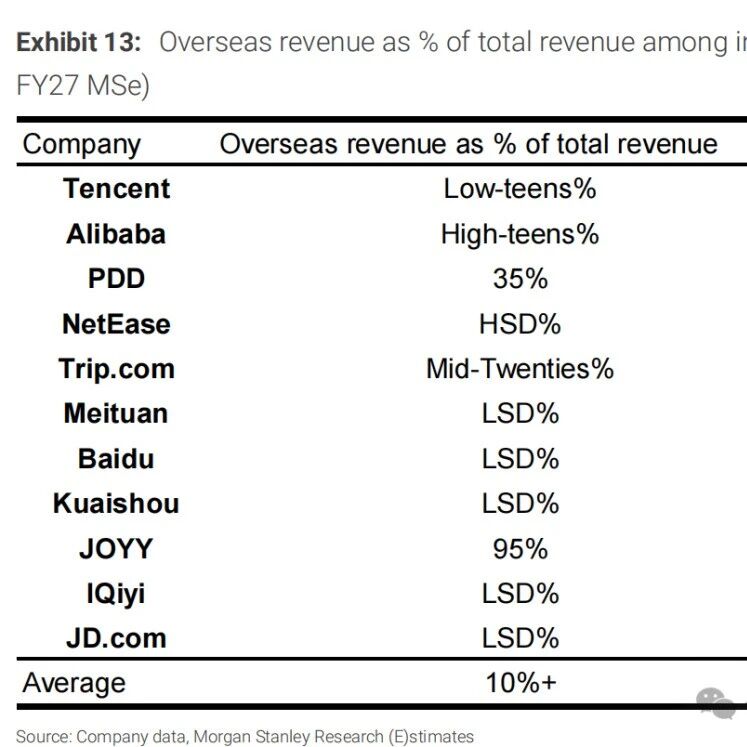
Core Insights - The article emphasizes the significance of AI in investment decisions, particularly in the context of Chinese internet companies and their overseas revenue potential [2][3]. Group 1: Overseas Revenue of Chinese Internet Companies - Chinese internet companies have an average overseas revenue exceeding 10%, with Pinduoduo leading at 35% [3]. - Companies like Tencent and Alibaba have low to high teens percentages of overseas revenue, indicating a growing trend towards international markets [3]. Group 2: Cloud Computing Sector - Alibaba Cloud and Tencent Cloud are rapidly expanding their international presence, with Alibaba planning new business regions in Brazil, France, and the Netherlands, and Tencent deploying services in 22 regions globally [4]. - Morgan Stanley projects that Alibaba Cloud's revenue growth will exceed 40% by FY2027, while Tencent's enterprise service revenue is expected to grow by 25% by FY2026 [5]. Group 3: Autonomous Driving Services - Baidu's autonomous driving service, "Luobo Kuaipao," is a leader in the sector, achieving over 250,000 weekly orders in fully autonomous mode as of Q3 2025, and has expanded to 22 cities including Dubai and Switzerland [7]. - Despite its leadership, Morgan Stanley anticipates that Baidu's revenue from this service will remain low and require continued investment [9]. Group 4: AI Models and Applications - Alibaba's Tongyi Qianwen model has gained significant traction globally, becoming the most downloaded AI model with over 700 million downloads by January 2026 [11]. - Kuaishou's Keling is expected to generate substantial revenue from overseas markets, with projections indicating an 80% year-on-year growth to reach $270 million by 2026, driven by B2B customer expansion [14].


一年超8万家游戏公司成立,网易字节阿里老兵纷纷创业
3 6 Ke· 2026-01-19 12:41
Core Insights - The domestic gaming industry and user base experienced steady growth in 2025, with over 80,000 gaming companies established, marking an increase from over 50,000 in 2024 and over 60,000 in 2023 [1] - A wave of entrepreneurship is emerging in the gaming sector, with notable industry figures leaving established companies to start their own ventures [1][2] - Despite a competitive market, opportunities remain for new companies due to an influx of talented individuals and market openings created by larger firms focusing on leading projects [1] Company Developments - Guangzhou Fenglan Games, founded in January last year, has nearly 100 employees and is developing a hardcore space-themed SLG titled "Code: Space," set for its first test in March [2] - Chengdu Xiaozhiyou, founded by Chen Shaohao, has over 300 team members and is working on a UE5-based open-world action game, with significant past revenue from previous projects exceeding 30 billion [4] - Shanghai Mengshang Technology, founded by former MiHoYo technical director He Jia, focuses on AI gaming and has secured funding [7] - Guangzhou Jiezhi Information, co-founded by former NetEase executive Jin Tao, has received IP authorization for "Onmyoji" and is developing a project similar to a previously unapproved title [7] Trends in Entrepreneurship - Many former industry leaders are launching startups, often securing funding before product launches, indicating a strong demand for quality content providers [2][7] - Companies are increasingly exploring new directions such as AI-driven content and interactive gaming experiences, with several startups focusing on these emerging trends [13][15] - The SLG genre continues to attract attention, with global strategy mobile game revenue increasing by 20% year-on-year, prompting more companies to enter this space [20][22] Market Dynamics - The gaming industry remains volatile, yet this environment has created entrepreneurial opportunities for many professionals [26] - New companies are often targeting lighter, hybrid gameplay experiences, reflecting a shift in consumer preferences [20][22] - The rise of AI and interactive gaming is drawing interest from outside the traditional gaming sector, leading to innovative projects and collaborations [13][15]