
华泰证券

Search documents
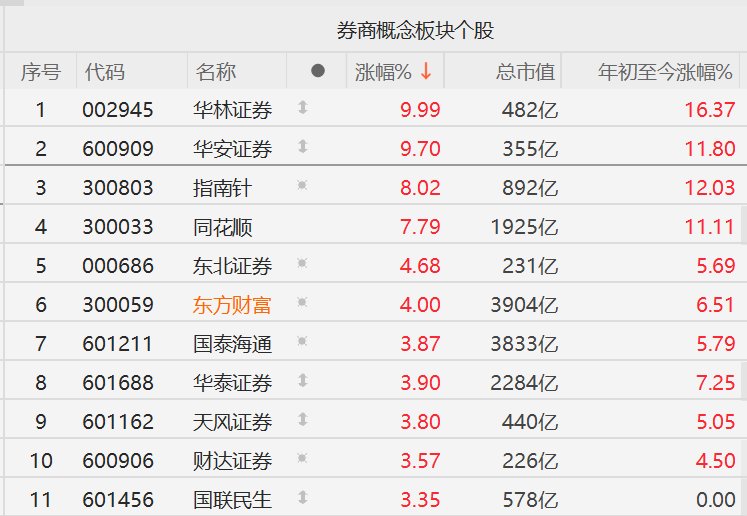
A股券商股走强,华林证券涨停,东方财富涨4%
Ge Long Hui A P P· 2026-01-06 02:16
Core Viewpoint - The A-share market has seen a strong performance in brokerage stocks, with several companies experiencing significant price increases, indicating a positive trend in the sector [1]. Group 1: Brokerage Stock Performance - Huayin Securities (华林证券) reached a limit-up increase of 9.99%, with a total market capitalization of 48.2 billion and a year-to-date increase of 16.37% [2]. - Hua'an Securities (华安证券) increased by 9.70%, with a market cap of 35.5 billion and a year-to-date increase of 11.80% [2]. - Zhina Compass (指南针) rose by 8.02%, with a market cap of 89.2 billion and a year-to-date increase of 12.03% [2]. - Tonghuashun (同花顺) saw a rise of 7.79%, with a market cap of 192.5 billion and a year-to-date increase of 11.11% [2]. - Northeast Securities (东北证券) increased by 4.68%, with a market cap of 23.1 billion and a year-to-date increase of 5.69% [2]. - Dongfang Caifu (东方财富) rose by 4.00%, with a market cap of 390.4 billion and a year-to-date increase of 6.51% [2]. - Other notable increases include Guotai Haitong (国泰海通) at 3.87%, Huatai Securities (华泰证券) at 3.90%, and Tianfeng Securities (天风证券) at 3.80% [2]. Group 2: Market Indicators - The MACD golden cross signal has formed, indicating a positive momentum for these stocks [2].







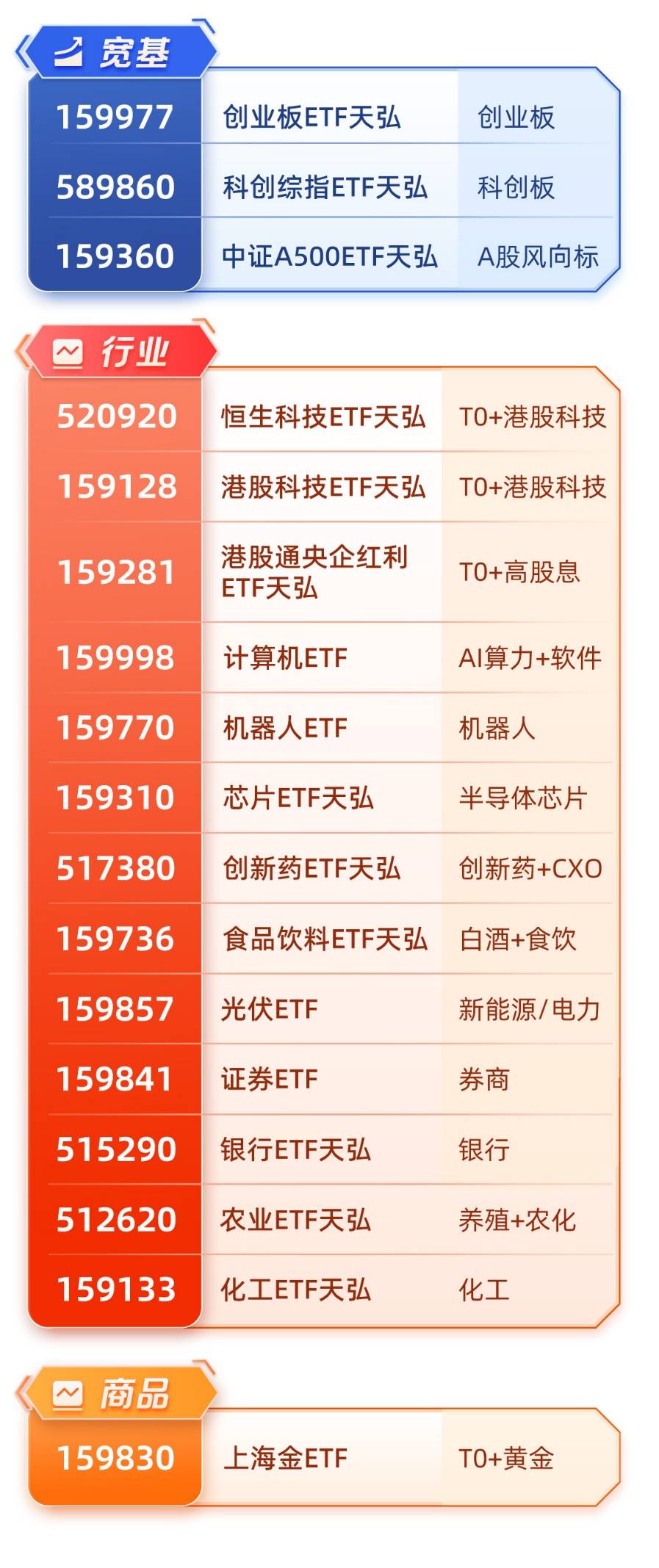
行情一到,证券就躁!“牛市旗手”证券ETF(159841)跟踪指数大涨近3%,沪指冲击13连阳,盘中再创阶段新高!
Sou Hu Cai Jing· 2026-01-06 02:10
Core Viewpoint - The A-share market is experiencing a strong upward trend, with the Shanghai Composite Index reaching a new high not seen since July 2015, indicating a potential structural market phase in 2026 [1][2]. Market Performance - As of January 6, 2026, the Securities ETF (159841) saw a turnover of 2.58% and a transaction volume of 274 million yuan, while the tracked CSI All Share Securities Index (399975) rose by 2.76% [1]. - The Shanghai Composite Index achieved a 12-day consecutive rise, marking the longest streak since March 1992, with significant historical context provided [2]. Institutional Insights - Zhongyou Securities predicts that the A-share market will transition to a phase dominated by structural trends, with average daily stock fund transaction volumes expected to range between 2.2 trillion to 3.2 trillion yuan, reflecting a moderate increase from 2025 [3]. - Shenwan Hongyuan Securities notes that the current valuation of the brokerage sector is at a historical low, with expectations for public funds to increase allocations due to the sector's stable growth and high index weight [3]. Sector Highlights - The brokerage sector is anticipated to benefit from improved performance metrics and increased merger and acquisition activities, which will enhance industry leverage and resource allocation efficiency [3]. - The transition towards wealth management and internationalization is expected to accelerate, providing strong upward momentum for the brokerage sector in 2026 [3].



2026,四大消费赛道丨尼尔森IQ年度报告同步首发
吴晓波频道· 2026-01-06 00:29
Core Insights - The article discusses the evolving consumer landscape in China, particularly focusing on the dual strategy of "first-time purchases + upgrade activation" in the context of county-level economies and the growing significance of lower-tier markets [3][14][16]. Group 1: Consumer Trends - During the New Year holiday, domestic tourism revenue reached 847.89 billion yuan, recovering to 112.3% of 2019 levels, with 1.35 billion domestic tourists, reflecting a strong rebound in consumer activity [3]. - In Hainan, post-"closure," tourism revenue surged to 32.8 billion yuan, a 28.9% year-on-year increase, with duty-free shopping reaching 7.12 billion yuan, up 128.9% [4]. - The consumer base is increasingly divided into "carefree" and "cautious spending" types, with 24% and 39% of the population respectively identified in 2024, and the "carefree" segment expected to grow to 31% by 2025 [7][9]. Group 2: Market Dynamics - The lower-tier cities are experiencing significant growth in tourism, with cities like Jingzhou and Huaihua seeing over 30% year-on-year increases in visitor numbers, outpacing first-tier cities [5]. - The report highlights that 68% of companies in lower-tier markets have seen stagnant or negative growth in market share over the past two years, indicating challenges in maintaining momentum [16]. - The demand for durable goods in lower-tier markets is growing, with a 12% year-on-year increase in sales, and the importance of these markets is rising by 38% [16]. Group 3: Product and Brand Strategies - The report emphasizes the importance of "first-time purchases" and "upgrade activation," suggesting that brands should focus on attracting consumers making their first significant purchases, such as smart appliances and electric vehicles [17]. - 57% of consumers in lower-tier markets have not upgraded their appliances in over three years, indicating a need for strategies to stimulate replacement purchases through trade-in programs and experiential upgrades [17]. - Key consumer preferences include price sensitivity, product performance, and the desire for smart technology, with a notable increase in sales of energy-efficient appliances by 38% on platforms like JD.com [4][21]. Group 4: Sales Channels - Emerging sales channels are gaining traction, with content e-commerce and membership warehouse stores showing significant growth, while traditional channels like hypermarkets are declining [24][25]. - The top five sales channels with year-on-year growth include content e-commerce (27%), membership warehouse stores (25%), and snack stores (20%) [24]. - The shift in consumer behavior is towards valuing unique products and experiences, with 69% of consumers believing private label brands offer better value [27]. Group 5: Future Outlook - The article suggests that the next growth wave in consumer goods will be driven by AI and smart technology, with a focus on health and convenience [43][44]. - The new round of national subsidies will target high-efficiency products, particularly in the tech and appliance sectors, which are expected to stimulate further growth [34]. - The report concludes that brands that can adapt to consumer preferences and provide meaningful experiences will define the future of the market [56].

华泰证券:春季行情预期或进一步强化 建议沿两条主线布局
Xin Lang Cai Jing· 2026-01-06 00:08
Core Viewpoint - The report from Huatai Securities is optimistic about the spring market, indicating a strengthening trend with most broad-based indices showing a rebound in scores and the Shanghai Composite Index entering a bullish zone [1] Group 1: Market Outlook - The macroeconomic environment suggests that the all-weather strategy in January is betting on growth exceeding expectations and increasing stock allocations [1] Group 2: Investment Recommendations - The report recommends two main investment themes: 1. Growth style, with a positive outlook on the electric equipment and new energy sectors [1] 2. Focus on the improvement of domestic demand in the context of the 14th Five-Year Plan, recommending sectors such as social services, real estate, home appliances, and beverages [1]
华泰证券:Q布入局者增加不改短期格局
Xin Lang Cai Jing· 2026-01-06 00:01
华泰证券研报称,2025年四季度以来,上市公司中公告新投石英纤维电子纱/布(第三代低介电电子 布,简称"Q布")项目明显增加。华泰证券认为2026年第二代低介电(LowDk-2)和低热膨胀 (LowCTE)电子布供给缺口明显,量价高景气有望延续,Q布有望于2026年二季度开始量产,但需求 规模仍有待下游技术路线的确定,关注2026年一季度终端验证节点。Q布具备较强的生产工艺和客户认 证壁垒,先发企业在垂直一体化研发和生产端具备优势,短期竞争格局或较难改变,具备全产业链生产 和客户优势的龙头企业有望胜出。 ...
华泰证券:春季行情预期或进一步强化,建议沿两条主线布局
Sou Hu Cai Jing· 2026-01-05 23:59
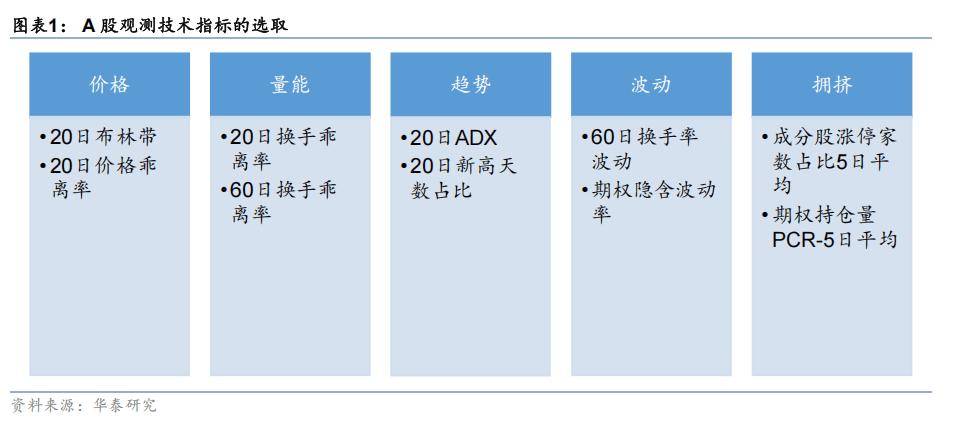
Core Viewpoint - The expectation for the spring market may further strengthen, with A-share indices showing signs of recovery and entering a bullish phase [2][3] Technical Analysis - The A-share technical scoring model indicates that most broad indices have seen a slight rebound in technical scores, with the Shanghai Composite Index surpassing the bullish threshold [3][10] - The model's performance for 2025 shows a timing return of 12.54%, while the overall return for the Wind All A index is 27.65%, resulting in an underperformance of -15.11% [10] Market Strategy - The macro strategy for January is focused on an optimistic growth outlook, with an increased allocation to equities [2][6] - Recommended investment themes include: - Growth style, particularly in the electric equipment and new energy sectors - Domestic demand improvement themes, focusing on consumer services, real estate, home appliances, and beverages [2][5] Style Timing Model - The style timing model has shifted from neutral to bearish on dividend style since December 22, 2025, favoring growth style instead [4][14] - The model indicates a preference for small-cap stocks, operating in a low crowding zone, which suggests a bullish outlook for small-cap stocks [20][23] Industry Rotation Model - The industry rotation model, which utilizes genetic programming techniques, has identified consumer services, electric equipment and new energy, real estate, home appliances, and beverages as favorable sectors [5][24] - The model achieved an absolute return of 40.34% in 2025, outperforming the industry equal-weight benchmark by 15.88 percentage points [24] All-Weather Strategy - The all-weather enhanced portfolio strategy for 2025 has yielded an absolute return of 13.86%, with a Sharpe ratio of 2.22 and a maximum drawdown of 2.67% [6][34] - The strategy has significantly over-allocated to the "growth exceeding expectations" quadrant and slightly to the "inflation below expectations" quadrant [34][35]
华泰证券:供需逐步向好下PC或迎景气周期
Zheng Quan Shi Bao Wang· 2026-01-05 23:53
人民财讯1月6日电,华泰证券研报认为我国聚碳酸酯(PC)供需拐点已逐渐明确,需求端受新能源汽车等 下游环节直接拉动,以及自给率提升下出口增长与国产替代,PC需求整体有望保持较高增长;供给端 预计2025—2027年行业新增产能相对有限,伴随存量产能的持续消化,行业开工率已修复至较高水平, 预计2025—2027年行业开工率分别为87%、94%、95%。供需持续改善下PC行业有望逐步步入景气周 期。 ...
华泰证券股份有限公司 第六届董事会第二十一次会议决议公告
Zhong Guo Zheng Quan Bao - Zhong Zheng Wang· 2026-01-05 17:08
证券代码:601688 证券简称:华泰证券 公告编号:临2025-082 华泰证券股份有限公司 第六届董事会第二十一次会议决议公告 本公司董事会及全体董事保证本公告内容不存在任何虚假记载、误导性陈述或者重大遗漏,并对其内容 的真实性、准确性和完整性承担法律责任。 一、董事会会议召开情况 华泰证券股份有限公司(以下简称"公司")第六届董事会第二十一次会议通知及议案于2025年12月26日 以专人送达或电子邮件方式发出。本次会议于2025年12月31日以通讯方式召开。会议应参加董事13人, 实际参加董事13人。会议的召开符合《公司法》、公司《章程》和《董事会议事规则》的有关规定。 本次会议审议通过了相关议案,并形成如下决议: (一)同意关于选举公司第七届董事会成员(非独立董事)的预案,并同意提交公司股东会审议。 1、同意王会清先生、周易先生、丁锋先生、于兰英女士、柯翔先生、晋永甫先生、陈建伟先生为公司 第七届董事会非独立董事候选人; 2、同意将上述人选提交公司股东会审议。 表决结果:13票赞成,0票反对,0票弃权 待上述人选在公司股东会选举通过后,将正式履行公司第七届董事会董事职责,任期三年。 此外,经公司研究, ...
券商投行业务竞争格局重塑
Zheng Quan Ri Bao· 2026-01-05 16:51
Core Insights - The investment banking sector is expected to see accelerated revenue growth in 2026, driven by the core mission of serving the real economy and the continued strength of equity underwriting [1][4] Group 1: Market Overview - In 2025, the total equity underwriting amount by securities firms in the A-share market exceeded 1 trillion yuan, with a year-on-year increase of 226.1% [1][2] - Five leading securities firms accounted for 74.5% of the total market share, with CITIC Securities leading at 2416.68 billion yuan in underwriting [2] Group 2: Competitive Landscape - In the IPO segment, the total underwriting amount reached 1308.35 billion yuan in 2025, marking a 97.4% increase year-on-year, with CITIC Securities again leading the market [2][3] - The competition in the technology innovation sector is notable, with CITIC Securities leading in the Sci-Tech Innovation Board IPO underwriting at 168.95 billion yuan [3] Group 3: Business Growth Drivers - The refinancing business has become a key driver for the growth of equity underwriting, with a total of 8267.2 billion yuan in underwriting for private placements in 2025, a 300.05% increase year-on-year [3] - The convertible bond market is also becoming increasingly competitive, with total underwriting reaching 647.13 billion yuan, a 66.97% increase year-on-year [3] Group 4: Future Outlook - Analysts predict that the investment banking revenue will continue to accelerate in 2026, particularly for firms with a mature "three-in-one" mechanism [4][5] - The "three-in-one" mechanism integrates research, investment, and banking services, creating a closed-loop process that enhances value creation and service delivery [5]





硬科技公司加速IPO,券商投行谋变革:“投资+保荐”联动成主流,头部机构领跑
Mei Ri Jing Ji Xin Wen· 2026-01-05 13:49
Core Insights - The rapid rise of AI technology is reshaping industries, leading to a surge in IPOs for tech companies, particularly in the AI and GPU sectors [1][3][4] - MiniMax, an AI model company, is expected to become one of the fastest companies to go public, with a potential listing in January 2026 [3] - The IPO market is witnessing a significant shift, with a notable increase in listings from unprofitable tech companies, driven by supportive policies and market conditions [4][5] Industry Trends - As of December 26, 2025, the A-share market saw a total IPO amount of 1,290.1 billion, significantly lower than previous years, but with a fundamental shift towards unprofitable tech companies [4][10] - The introduction of new listing standards on the Sci-Tech Innovation Board and the Growth Enterprise Market has facilitated the entry of unprofitable tech firms into the market [5][11] - The trend of unprofitable tech companies going public is supported by a clear policy direction aimed at fostering innovation and growth in the tech sector [5][17] Market Dynamics - The majority of newly listed companies in 2025 are tech firms, with a significant portion being unprofitable, indicating a shift in investor sentiment towards innovation over immediate profitability [6][9] - Major brokerage firms dominate the IPO landscape, with a concentration of listings from a few top firms, highlighting a monopolistic trend in the tech IPO market [9][10] - The rapid listing process for companies like Moer Thread and Muxi reflects a broader trend of accelerated capital market access for tech firms [7][11] Investment Opportunities - The current environment presents a unique opportunity for investment banks to engage with high-potential tech companies early in their development, emphasizing the importance of "investment first" strategies [12][14] - The success of IPOs for companies like Moer Thread and Muxi has generated significant profits for their underwriting banks, showcasing the lucrative nature of tech IPOs [9][10] - The focus on deep industry engagement and support for tech firms is reshaping the role of investment banks, moving from traditional underwriting to comprehensive value creation [11][12] Regulatory Environment - Recent regulatory changes have created a more inclusive environment for tech companies, allowing for greater flexibility in listing requirements, particularly for unprofitable firms [5][15] - The role of investment banks as gatekeepers is emphasized, with a focus on maintaining high standards for tech firms seeking to go public [17] - The ongoing support from government and institutional investors is crucial for the sustainability of the tech IPO boom, particularly in high-growth sectors like semiconductors and AI [15][16]