
苹果

Search documents
英伟达V型反转!美股终结周线三连涨
Zhong Guo Zheng Quan Bao - Zhong Zheng Wang· 2025-11-08 00:55
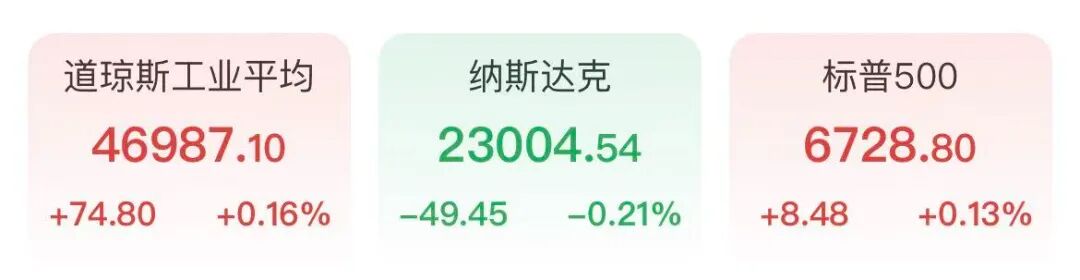
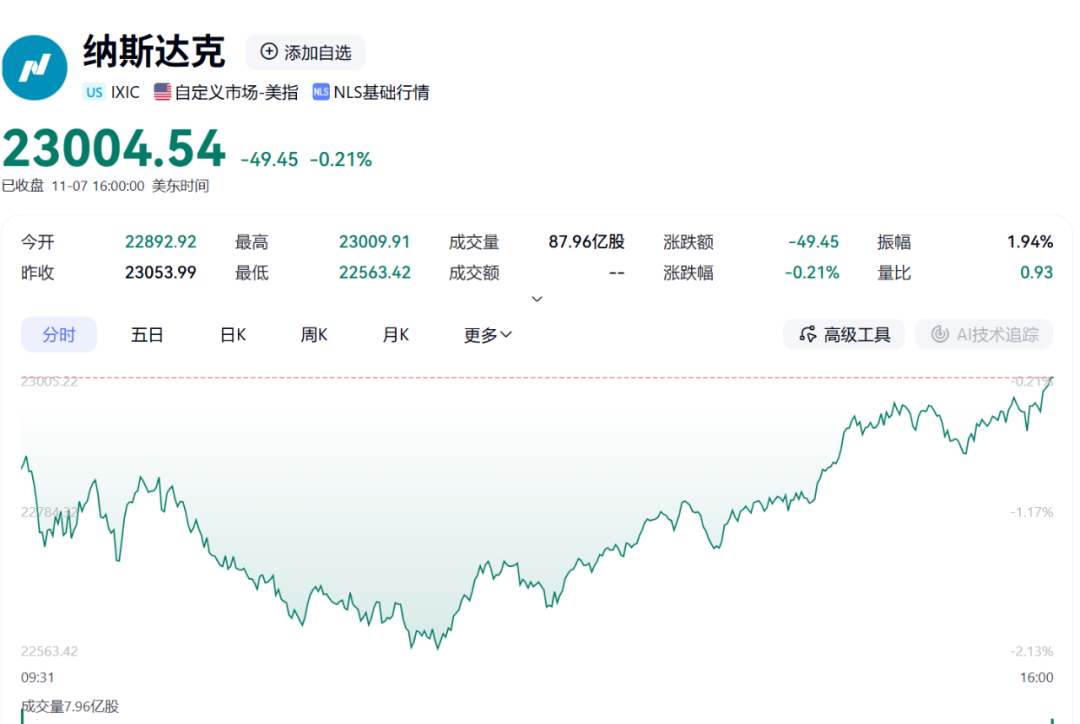
Market Performance - The U.S. stock market ended mixed on November 7, concluding a three-week streak of gains, with the Nasdaq down 0.21% and a weekly decline of 3.04%, marking the largest weekly drop since May [1][2] - The S&P 500 rose 0.13% but fell 1.63% for the week, while the Dow Jones increased by 0.16% with a weekly decline of 1.21% [1][2] Technology Sector - Major tech stocks showed mixed results, with the "Big Seven" tech index down 0.56%. Tesla fell 3.68%, and Microsoft dropped 0.06%, marking its longest losing streak since November 2011 [2][3] - Nvidia experienced a near 5% drop during the day but closed slightly higher, while storage stock SanDisk surged over 15%, reaching a historical high [1][6] Economic Indicators - The U.S. Labor Statistics Bureau failed to release the October non-farm payroll report for the second consecutive time due to the government shutdown, raising concerns about economic stability [4][8] - The preliminary consumer confidence index from the University of Michigan for November was reported at 50.3, the lowest since June 2022, against expectations of 53.2 [4] AI Sector Concerns - The decline in AI-related stocks, which previously led market gains, is attributed to concerns over high valuations and profitability, with Meta's announcement of significant capital expenditures for AI data centers leading to a stock price drop [5] - A report indicated that the number of corporate layoffs in October reached the highest level for that month in over two decades, adding to market pressures [5] Commodity Prices - International precious metals and oil prices saw an increase, with COMEX gold futures rising by 0.42% and NYMEX crude oil futures up by 0.69% [8][9]


深夜,美股大反转,英伟达V型反弹,中概股多数下挫!特斯拉市值一夜蒸发超3800亿元,加密币市场超25万人爆仓
Mei Ri Jing Ji Xin Wen· 2025-11-08 00:51
Core Viewpoint - The U.S. stock market experienced a "V-shaped reversal" as signs of a resolution to the government shutdown emerged, with the S&P 500 and Dow Jones Industrial Average turning positive towards the end of trading [1]. Market Performance - As of the market close, the Nasdaq Composite fell by 0.21%, with a weekly decline of 3.04%. The S&P 500 rose by 0.13%, with a weekly decline of 1.63%. The Dow Jones increased by 0.16%, with a weekly decline of 1.21% [2]. Individual Stock Movements - Nvidia, a leading AI trading stock, saw a nearly 5% drop during the day but managed to close slightly up. Microsoft missed the opportunity to turn positive, marking its longest losing streak since November 2011, with a total market value loss exceeding $330 billion [8]. - Tesla's stock dropped over 3%, resulting in a market value loss of $54.5 billion (approximately 388.2 billion RMB) [10]. - Major Chinese stocks listed in the U.S. mostly declined, with the Nasdaq Golden Dragon China Index falling by 0.95% and a weekly decline of 2.62%. Xpeng Motors dropped over 6%, while other companies like Tencent Music and NIO saw declines exceeding 4% [12]. Economic Indicators - The U.S. consumer confidence index fell to its lowest level since June 2022, dropping from 53.6 to 50.3, influenced by concerns over the government shutdown and high inflation [18]. - Concerns about rising unemployment have increased, with 71% of respondents expecting a rise in the unemployment rate over the next year, more than double the proportion from the previous year [19].
中概股多数下挫,小鹏跌超6%,蔚来跌超4%,特斯拉跌超3%,微软连跌8天
2 1 Shi Ji Jing Ji Bao Dao· 2025-11-07 23:32
Market Overview - The three major U.S. stock indices closed mixed, with the Dow Jones up 0.16%, the S&P 500 up 0.13%, and the Nasdaq down 0.21% [1] - Large-cap tech stocks showed mixed performance, with the Wande American Tech Giants Index down 0.56% [2] Individual Stock Performance - Tesla fell over 3%, Google down over 2%, and Apple down 0.48%. In contrast, Amazon rose 0.56%, Facebook up 0.45%, and Nvidia slightly increased by 0.04% [2][3] - Energy stocks collectively rose, with ExxonMobil up over 2%, Chevron up over 1%, and ConocoPhillips up over 1% [2] Sector Performance - Airline stocks mostly increased, with American Airlines up over 3% and Southwest Airlines up 3%, while Boeing fell nearly 1% [4] - Semiconductor stocks generally declined, with the Philadelphia Semiconductor Index down 1.01% [4] Chinese Stocks - Chinese stocks mostly fell, with the Nasdaq Golden Dragon China Index down 0.95% and the Wande Chinese Tech Leaders Index down 0.98% [4] Precious Metals - Spot gold rose 0.58% to $4000.29 per ounce, while COMEX gold futures increased by 0.42% to $4007.8 per ounce [5] Economic Context - There is a growing consensus of risk in the U.S. capital markets regarding the sustainability of the AI narrative, primarily due to uncertainty surrounding the path to achieving General Artificial Intelligence (AGI) [6] - The U.S. government shutdown has entered its 37th day, impacting economic reporting, including the delay of the October non-farm payroll report [6]

中概股多数下挫,小鹏跌超6%,蔚来跌超4%,特斯拉跌超3%,微软连跌8天
21世纪经济报道· 2025-11-07 23:31
记者丨黎雨桐 编辑丨曾静娇 美国三大股指收盘涨跌不一,道指涨0.16%,标普500指数涨0.13%,纳指跌0.21%。 能源股集体上涨,埃克森美孚涨超2%,雪佛龙涨逾1%,康菲石油涨超1%,斯伦贝谢涨近1%,西方石油涨超2%。 航空股多数上涨,波音跌近1%,美国航空涨超3%,达美航空涨近2%,西南航空涨3%,美联航涨超1%。 芯片股多数下跌,费城半导体指数跌1.01%,微芯科技跌逾5%,ARM跌超3%,迈威尔科技跌逾2%,英特尔涨超2%。 中概股多数下跌,纳斯达克中国金龙指数跌0.95%,万得中概科技龙头指数跌0.98%。 个股方面, 个股方面,小鹏汽车跌超6%,再鼎医药、小马智行跌超5%,腾讯音乐、禾赛科技,跌超4%;大全新能源涨超9%,阿特斯太阳能 涨超6%,唯品会、华住集团涨逾2%,百胜中国涨逾1%。 大型科技股涨跌互现,万得美国科技七巨头指数下跌0.56%。 个股方面,特斯拉跌超3%,谷歌跌超2%,苹果跌0.48%,亚马逊涨0.56%,脸书涨0.45%,微软跌0.06% 连跌8天,创2011年11月以来最长连 跌天数。 英伟达涨0.04%。 | 资彩 成分 | 资讯 | 相关基金 | 月度收益 | | ...

一句话炸掉5000亿美元市值!OpenAI紧急“救火”
Di Yi Cai Jing· 2025-11-07 09:52
2025.11.07 本 文字数:2337,阅读时长大约4分钟 作者 | 第一财经 刘晓洁 OpenAI高管一句"需要政府为AI投资担保",在美股市场掀起巨浪。当地时间周四,美国科技股集体重 挫,六大科技巨头及多家与OpenAI合作的算力厂商总市值一夜蒸发近5000亿美元。 11月7日凌晨,OpenAI CEO奥尔特曼(Sam Altman)发布近2000字长文回应,不仅澄清"不需要也不想 要美国政府担保",还首度披露公司收入预期——预计今年年化收入将超200亿美元,2030年将达数千亿 美元,试图以此挽回市场信心。 尽管美股盘后部分科技股出现小幅反弹,例如英伟达盘后上涨约0.85%,微软盘后上涨0.12%,但相比 一夜蒸发的巨额市值,这样的反弹无异于杯水车薪。 美股今年一路上涨,自4月低点以来涨幅超过30%,但市场从未打消对科技圈AI泡沫的疑虑,也担忧上 世纪90年代末的互联网泡沫再现,而众多华尔街机构的态度和行动也印证了这一点,这也是这次言论能 引发美股巨震的根本原因。 一夜蒸发近5000亿美元 这场风暴的起点,是OpenAI首席财务官萨拉·弗里尔(Sarah Friar)在一场公开活动中的发言。她提到, ...

一句话炸掉5000亿美元市值!OpenAI紧急“救火”
第一财经· 2025-11-07 09:40
2025.11. 07 本文字数:2337,阅读时长大约4分钟 作者 | 第一财经 刘晓洁 OpenAI高管一句"需要政府为AI投资担保",在美股市场掀起巨浪。当地时间周四,美国科技股集体 重挫,六大科技巨头及多家与OpenAI合作的算力厂商总市值一夜蒸发近5000亿美元。 11月7日凌晨,OpenAI CEO奥尔特曼(Sam Altman)发布近2000字长文回应,不仅澄清"不需要 也不想要美国政府担保",还首度披露公司收入预期——预计今年年化收入将超200亿美元,2030年 将达数千亿美元,试图以此挽回市场信心。 11月7日收盘,美股三大指数集体下跌,科技股成为重灾区。万得美国科技七巨头指数跌1.91%。具 体来看,英伟达跌3.65%,特斯拉跌3.5%,亚马逊跌2.86%,Meta跌2.67%,领跌七巨头。另外微 软已连续七个交易日下跌,昨夜跌1.98%,创2022年以来最长连跌天数,苹果微跌0.14%。七巨头 中仅谷歌微涨0.21%。 尽管美股盘后部分科技股出现小幅反弹,例如英伟达盘后上涨约0.85%,微软盘后上涨0.12%,但相 比一夜蒸发的巨额市值,这样的反弹无异于杯水车薪。 美股今年一路上涨,自4 ...

全球资产配置大转向持续发酵:投资者仍不愿全仓押注美国
Jin Shi Shu Ju· 2025-11-07 08:21
Core Viewpoint - A significant trend is emerging among investors as they approach 2025, characterized by a reluctance to heavily invest in U.S. assets, a phenomenon referred to as "Sell America" or "Anywhere But the USA" [1] Group 1: Investor Sentiment - Many investors are increasingly discussing the need to withdraw from the U.S. market, as noted by ETF.com’s Dave Nadig [1] - Despite a rebound in major U.S. indices, international investors continue to favor portfolios that are not dominated by U.S. stocks [1][2] - The "Trump sell-off" initiated by trade policy concerns is still evolving, according to AJ Bell's Daniel Coatsworth [1] Group 2: Global Fund Trends - There is a rising interest in global funds that exclude U.S. assets, allowing investors to gain market exposure while avoiding U.S. equities [2] - The MSCI World Ex-U.S. Index has risen by 24% year-to-date, outperforming the S&P 500 Index, which has increased by approximately 15.6% [2] Group 3: Asset Allocation Factors - Investors may limit their U.S. asset allocation due to already significant exposure or dissatisfaction with the current U.S. political climate [3] - Concerns about the extreme concentration of the U.S. stock market, particularly among the "Magnificent 7" tech stocks, are influencing asset allocation decisions [3][4] Group 4: International Demand - Evidence suggests that demand for international assets remains strong, with Brandes Investment Partners reporting significant inflows into international and global strategies [4] - Investors are still allocating funds to U.S. stocks but are increasingly focusing on value stocks or small-cap stocks as part of diversified global portfolios [4] Group 5: Diverging Perspectives - Not all analysts agree on a mass exodus from U.S. assets; some see a trend more aligned with "hedging against the U.S." rather than outright selling [5] - There is a notable difference in experiences between domestic and international investors, with European investors facing lower net returns from U.S. investments due to currency fluctuations [6]
十年五倍,纳斯达克100的泡沫,究竟有多大?
雪球· 2025-11-07 08:05
Core Viewpoint - The article discusses the perceived "bubble" in the Nasdaq 100 index, arguing that the index's performance is primarily driven by substantial earnings growth rather than inflated valuations [3][4][5]. Valuation and Earnings Growth - The Nasdaq 100 index currently has a five-year PE ratio of 36.8, which is above the median of 34.4, indicating a relatively high valuation [8]. - The total profit of Nasdaq 100 constituents grew from $256.5 billion in the first three quarters of 2020 to $718.2 billion in 2025, representing a 180% increase, while the index itself rose approximately 170% [9][10]. - The article emphasizes that if only valuation were considered, the Nasdaq should have been sold off five years ago, but the sustained high valuation has been justified by significant earnings growth [10][11]. Performance of Individual Stocks - A detailed analysis of individual stocks within the Nasdaq 100 shows remarkable profit growth over five years, with companies like Nvidia achieving a 3400% increase in net profit, and Tesla seeing a 1500% increase [15][16]. - Other notable performers include Apple (82%), Microsoft (119%), and Amazon (353%), indicating that many tech companies have thrived due to continuous innovation and investment [15][16]. Factors Behind Strong Performance - The article attributes the strong performance of U.S. tech stocks to a combination of technological innovation and a robust business model that generates recurring cash flow [19][20]. - The presence of a protective environment for private property and patents in the U.S. has facilitated significant returns on new industry investments, reinforcing the success of the tech sector [21]. AI and Future Outlook - The discussion raises the question of whether AI represents a bubble, suggesting that those at the forefront of AI technology are unlikely to view it as such due to its vast potential applications [22][23]. - The article warns that while the current tech revolution is significant, historical patterns indicate that growth cycles will eventually slow, leading to potential declines in both growth rates and stock valuations [24][25].

一句话炸掉5000亿美元市值!OpenAI紧急“救火”,AI泡沫临近?
Di Yi Cai Jing· 2025-11-07 07:59
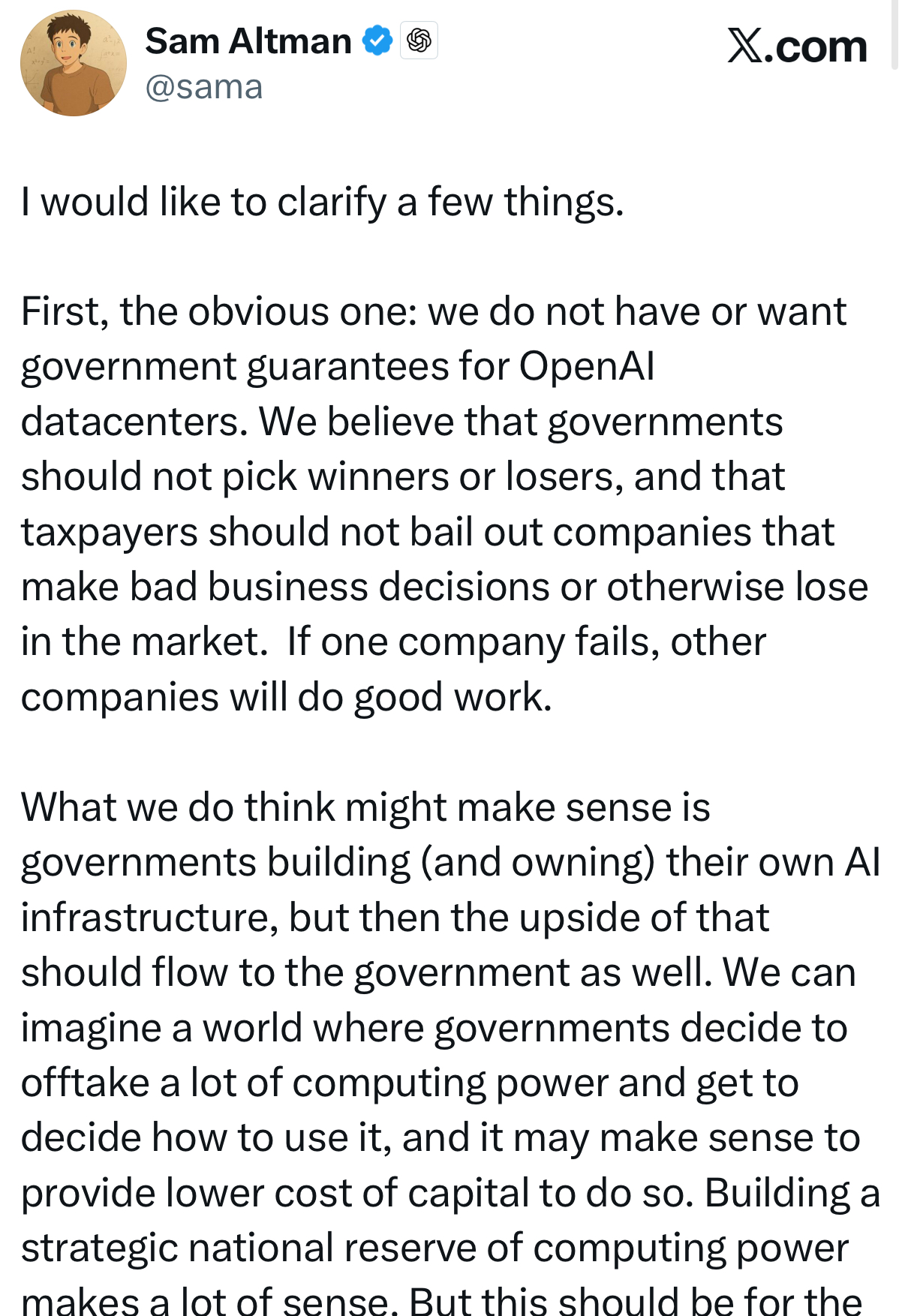
市场从未打消对科技圈AI泡沫的疑虑。 OpenAI高管一句"需要政府为AI投资担保",在美股市场掀起巨浪。当地时间周四,美国科技股集体重挫,六大科技巨头及多家与OpenAI合作的算力厂商总 市值一夜蒸发近5000亿美元。 11月7日凌晨,OpenAI CEO奥尔特曼(Sam Altman)发布近2000字长文回应,不仅澄清"不需要也不想要美国政府担保",还首度披露公司收入预期——预计 今年年化收入将超200亿美元,2030年将达数千亿美元,试图以此挽回市场信心。 $$\mathbf{X}_{\circ}\mathbf{C}\mathbf{0}$$ 尽管美股盘后部分科技股出现小幅反弹,例如英伟达盘后上涨约0.85%,微软盘后上涨0.12%,但相比一夜蒸发的巨额市值,这样的反弹无异于杯水车薪。 美股今年一路上涨,自4月低点以来涨幅超过30%,但市场从未打消对科技圈AI泡沫的疑虑,也担忧上世纪90年代末的互联网泡沫再现,而众多华尔街机构 的态度和行动也印证了这一点,这也是这次言论能引发美股巨震的根本原因。 一夜蒸发近5000亿美元 这场风暴的起点,是OpenAI首席财务官萨拉·弗里尔(Sarah Friar)在一场 ...
创业板人工智能ETF华夏(159381)、5G通信ETF(515050)蓄力调整,阿里宣布打造超级AI云
Xin Lang Cai Jing· 2025-11-07 06:58
Group 1 - The AI computing sector experienced slight fluctuations, with the AI ETF down by 0.36% and the 5G communication ETF down by 1.49% as of 14:31 [1] - Alibaba's CEO announced the company's investment in building large-scale AI infrastructure and a super AI cloud, positioning Alibaba Cloud as a full-stack AI service provider [1] - CITIC Securities highlighted that in Q3 2025, sectors related to computing power, including PCB and domestic computing chip leaders, are expected to perform well, driven by AI and growth in both overseas and domestic computing power [1] Group 2 - The 5G communication ETF tracks the CSI 5G Communication Theme Index, with a scale exceeding 8 billion yuan, focusing on the supply chains of Nvidia, Apple, and Huawei [2] - The index has a high purity of "hard technology," with telecommunications and electronics accounting for nearly 80% of the weight, emphasizing network infrastructure and terminal components [2] - The AI ETF tracks the ChiNext AI Index, with a significant allocation to optical modules and coverage of domestic software and AI application companies, featuring a low comprehensive fee rate of 0.20% [2]
