
长安汽车

Search documents
车企密集明确2026销量目标,市场格局将会有哪些变化?
Xin Lang Cai Jing· 2026-01-10 10:07
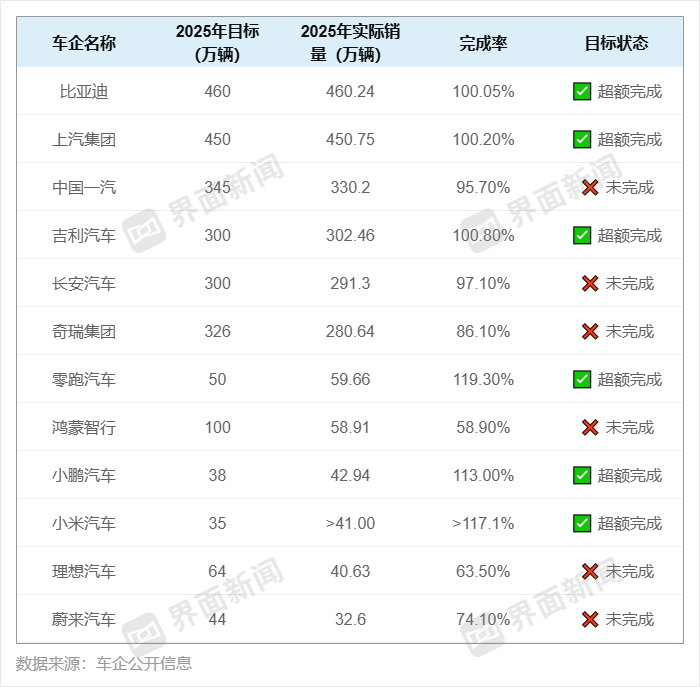
Core Insights - The Chinese automotive market is experiencing unprecedented differentiation as companies announce their annual sales and plans for 2026, reflecting a deep competition regarding survival, development, and industry positioning [1] Group 1: Sales Performance in 2025 - In 2025, six companies achieved their sales targets, including three traditional automakers (BYD, Geely, SAIC) and three new players (Leap Motor, Xpeng, Xiaomi) [1] - BYD led with 4.6024 million units sold, exceeding its target and becoming the global leader in pure electric vehicle sales [1] - Geely delivered 3.0246 million units, achieving a 100.8% completion rate and a 39% year-on-year growth [1] - SAIC's sales surpassed 4.5075 million units, marking a 12.32% increase year-on-year [1] - Leap Motor topped the new energy vehicle sales with 596,600 units delivered, achieving a 119% completion rate [2] - Xpeng delivered 429,400 units, a 113% completion rate with a 126% year-on-year growth [2] - Xiaomi, as a newcomer, delivered over 410,000 units, exceeding its first-year target [1] Group 2: Differentiation in Performance - Companies like Li Auto and Hongmeng Zhixing failed to meet their targets, with Li Auto delivering 406,000 units, only 63.5% of its goal, and Hongmeng Zhixing delivering 589,100 units, significantly below its 1 million target [2] - The performance disparity among automakers is attributed to differences in sales scale, product structure, transformation stages, and technological accumulation [2] - The differentiation is further accelerated by electrification and intelligent technology, along with strong policy guidance [2] Group 3: Strategic Approaches for 2026 - Automakers are adopting different strategies for 2026, categorized into three camps: aggressive, stable, and conservative [2] - Leap Motor and Hongmeng Zhixing represent the aggressive camp, with Leap aiming for 1 million units (a 67.5% increase) and Hongmeng targeting between 1 million to 1.3 million units, requiring up to 120% year-on-year growth [3][4] - The stable camp includes Great Wall and Xiaomi, focusing on steady growth rather than aggressive targets [7][8] - Great Wall set a target of over 1.8 million units for 2026, reflecting a 36% growth rate, while Xiaomi aims for 550,000 units, a 34% increase [7][8] Group 4: Challenges and Opportunities - Leap Motor's growth is supported by its dual breakthrough in scale and profitability, but it faces challenges in expanding production and maintaining quality [4] - Hongmeng Zhixing plans to launch 11 to 18 new models in 2026, but must balance brand differentiation and collaboration among its multiple brands [5] - The conservative camp, represented by Geely and Li Auto, emphasizes quality over sheer volume, with Geely targeting 3.45 million units for a 14% growth [10][11] - Li Auto and NIO are expected to adopt more cautious strategies in 2026, focusing on consolidating their market positions rather than aggressive growth [11][12] Group 5: Market Dynamics and Future Outlook - The 2026 Chinese automotive market is characterized by a strategic landscape where aggressive players like Leap and Hongmeng fight for market share, stable players like Great Wall and Xiaomi serve as the backbone of industry transformation, and conservative players like Geely and Li Auto represent rationalization in the industry [14] - The competition will shift from merely selling units to achieving profitability and sustainable sales, with a projected electric vehicle penetration rate exceeding 60% [15] - The outcomes of this competition will reshape the Chinese automotive industry and influence the global market dynamics [15]

汽车“自主五强”的2025年:增长之下现战略分野
经济观察报· 2026-01-10 08:22
Core Viewpoint - The Chinese automotive market is entering a critical phase in 2025, with domestic brands collectively capturing nearly 70% of the passenger car market share, driven by the rise of new energy vehicles and international expansion [2][4]. Group 1: Market Dynamics - The "self-owned five strong" brands, including BYD, Geely, Chery, Changan, and Great Wall, have established a stable market presence, with total sales of 14.67 million units, accounting for over half of the overall passenger car market [2][4]. - BYD leads the global new energy vehicle sales with 4.6024 million units sold in 2025, marking a 7.73% year-on-year increase, while its pure electric vehicle sales reached approximately 2.257 million units, surpassing Tesla [4][5]. - Geely's total sales exceeded 3.02 million units in 2025, a 39% increase, with new energy vehicle sales reaching 1.6878 million units, reflecting a 90% growth [5][6]. Group 2: Strategic Developments - Geely has initiated a significant restructuring by merging with Zeekr Technology to enhance operational efficiency and resource integration, aiming to save billions in R&D costs annually [9][10]. - Chery has restructured its brand architecture to improve domestic market efficiency, establishing a new business group to streamline operations and enhance competitiveness [9][10]. - Changan has launched a 6 billion yuan capital increase plan to support the development of new energy vehicles and global R&D centers, reinforcing its strategic alignment with major shareholders [10][11]. Group 3: Technological Advancements - The competition among Chinese automakers has evolved from individual technological breakthroughs to a more systemic confrontation, with companies like BYD and Geely focusing on comprehensive technology integration and smart driving solutions [11][12]. - Great Wall has introduced a next-generation intelligent super platform that supports various powertrains, emphasizing its advancements in smart cockpit and driving technologies [12].





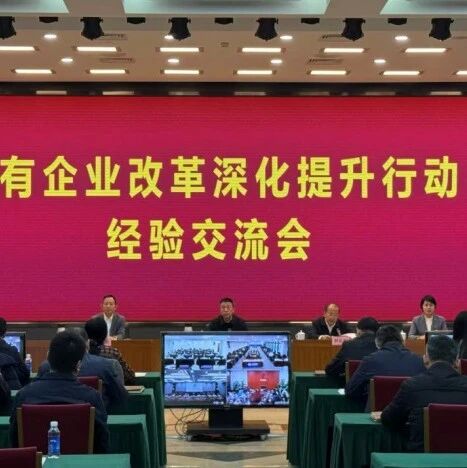
国企改革深化提升行动主体任务基本完成 国有经济向“新”布局明显提速
Yang Shi Wang· 2026-01-10 03:42
Group 1 - The core viewpoint is that by the end of December 2025, the main tasks of the state-owned enterprise reform will be largely completed, with a significant enhancement in core competitiveness and a noticeable acceleration in the layout of state-owned economy towards new productive forces [1] - The State-owned Assets Supervision and Administration Commission (SASAC) has facilitated the establishment of new central enterprises such as China Yajiang Group and China Zihuan Group through strategic restructuring and professional integration, focusing on concentrating industries in key areas and advantageous tracks [3] - In 2021, from January to November, central enterprises achieved revenue exceeding 11 trillion yuan in strategic emerging industries [5] Group 2 - The continuous optimization of the technological innovation system in state-owned enterprises has led to a significant improvement in their innovation capabilities, with an average annual growth of 6.5% in R&D expenditure since the 14th Five-Year Plan, surpassing 1 trillion yuan for three consecutive years from 2022 to 2024 [7] - Central enterprises have established 23 innovation consortia and opened 134 external pilot verification platforms, creating over 800 application scenarios in 16 key industries [7]

从深化提升行动“成绩单”看国企改革攻坚新成效
Xin Lang Cai Jing· 2026-01-10 02:59
Group 1 - The core viewpoint of the news is that the latest round of state-owned enterprise (SOE) reforms has significantly enhanced the core functions and competitiveness of these enterprises, with the main tasks of the reform action being largely completed [1] - The average annual growth of R&D expenditure for central enterprises has been 6.5% since the 14th Five-Year Plan, with R&D spending exceeding 1 trillion yuan for three consecutive years from 2022 to 2024, and basic research investment growing at an average rate of 19% [2] - The establishment of a modern enterprise system with Chinese characteristics is being continuously improved, with a more scientific and efficient operation of boards of directors and a deepening of market-oriented management mechanisms [3] Group 2 - The optimization of the state-owned asset structure is a key focus of the reform, aimed at accelerating the transformation of momentum and enhancing the strategic support role of the state-owned economy [4] - New central enterprises such as China Chang'an Automobile Group have been established, and 116 strategic reorganizations have been carried out to support pillar industries [4] - The China National Offshore Oil Corporation is advancing the development of strategic emerging industries, with revenue from these industries expected to exceed 15% by 2025 [4] Group 3 - The effectiveness of state-owned asset supervision is being continuously improved, with a focus on a matrix-style regulatory model that balances object and behavior supervision [6] - The integration of smart technology and penetrating supervision has become a trend in regulatory reforms, with platforms being developed to enhance oversight capabilities [7] - Despite the completion of the reform action, there is a commitment to continue deepening reforms and solidifying their outcomes [7]
天海电子IPO将于1月16日上会
Zheng Quan Ri Bao Wang· 2026-01-10 02:46
Core Viewpoint - Tianhai Electronics plans to raise approximately 2.46 billion yuan through its IPO, with funds allocated to various projects aimed at enhancing production capacity and technological advancement in the automotive components sector [2]. Group 1: Fundraising and Investment Projects - The IPO is expected to raise around 2.46 billion yuan, which will be directed towards projects including connector technology upgrades, harness production base, automotive electronics production base, smart transformation and information technology construction, and the Tianhai Intelligent Connected Vehicle Industry Research Institute and supporting industrial park [2]. Group 2: Company Overview and Partnerships - Tianhai Electronics specializes in the research, production, and sales of automotive components such as automotive harnesses, connectors, and electronics, primarily serving the new energy vehicle and traditional fuel vehicle manufacturing sectors [2]. - The company has established multi-level and multi-dimensional partnerships with well-known automotive manufacturers including Chery Automobile, SAIC Group, Geely Automobile, Changan Automobile, Li Auto, NIO, Leap Motor, and Xpeng Motors [2]. Group 3: Strategic Goals and Market Position - The construction of the fundraising projects is expected to enhance the company's research and development capabilities, improve the intelligence and informatization of production processes, and expand existing production capacity, thereby supporting the gradual implementation of the company's development plan [2]. - These initiatives aim to strengthen the company's core competitiveness and profitability, ultimately increasing its market share [2].
智驾行业杀入“曼哈顿时刻”
Xin Lang Cai Jing· 2026-01-10 01:29
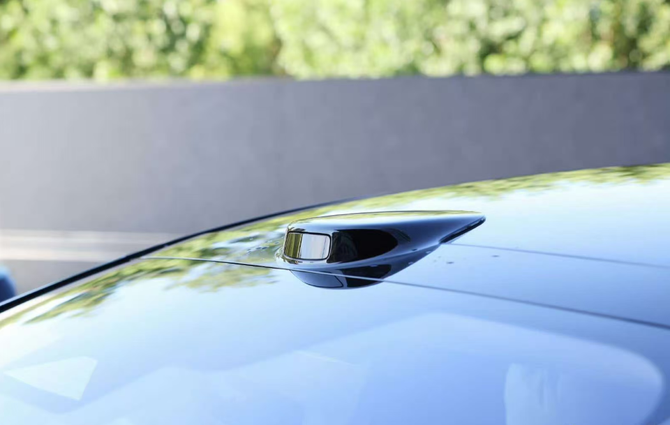
Core Insights - The autonomous driving industry is approaching a state of transparency, with multiple automakers and tech companies targeting the sub-100,000 yuan market for advanced driving features [1][4][9] - The competition has intensified, with companies like BYD, Chery, and Geely launching models equipped with high-level autonomous driving capabilities at lower price points [5][6][7] - The industry is witnessing a convergence of algorithmic approaches, with discussions around VLA and world model architectures, as companies aim to enhance the usability of autonomous driving features [3][20][21] Group 1 - The introduction of advanced driving features in vehicles priced below 100,000 yuan has become a key focus for both automakers and autonomous driving technology providers [1][2][4] - Companies like Horizon Robotics and Huawei are planning to expand their advanced driving capabilities into lower price segments, aiming to break the perceived barriers of high costs associated with such technologies [8][11] - The competition is not only about vehicle pricing but also about the technological advancements in algorithms and hardware, with a significant push towards reducing costs in chips and sensors [10][11][13] Group 2 - The industry is transitioning from a phase of diverse approaches to a more consolidated focus on effective algorithmic solutions, with VLA and world model architectures being at the forefront of discussions [3][20][21] - The recent approval of L3-level conditional autonomous driving vehicles by the Ministry of Industry and Information Technology marks a significant milestone, indicating a potential "breakthrough year" for L3 technology [4][28] - Companies are also exploring the integration of autonomous driving technologies into broader applications, such as logistics and robotics, indicating a shift towards a more comprehensive ecosystem [30][33] Group 3 - The competitive landscape is evolving into a "red ocean" as more players enter the sub-100,000 yuan market, necessitating a focus on efficiency and differentiation [9][13] - The advancements in chip technology and the reduction in costs for essential components like lidar are enabling more companies to offer competitive autonomous driving solutions [10][11] - The push towards L3 and L4 capabilities is becoming a race among automakers and tech firms, with significant investments and developments expected in the coming years [29][30]


国务院国资委 最新部署!
Zheng Quan Shi Bao· 2026-01-10 00:53
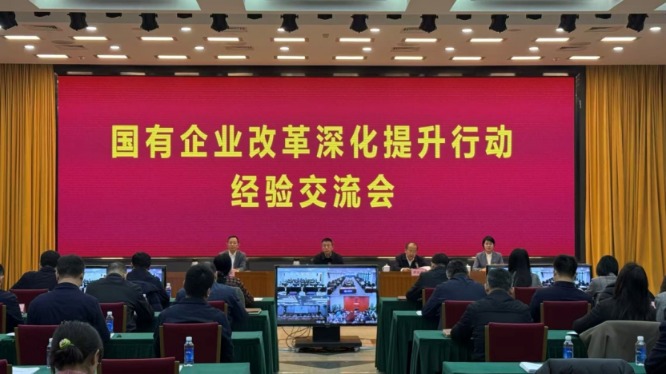
Core Insights - The State-owned Assets Supervision and Administration Commission (SASAC) announced that the main tasks of the deepening reform action have been largely completed, but further reforms are still necessary to meet targets [1] - By November 2025, central enterprises' revenue in strategic emerging industries is expected to exceed 11 trillion yuan, indicating significant growth in this sector [6][7] Group 1: Reform Progress - The SASAC has facilitated the integration and restructuring of state-owned enterprises (SOEs) to enhance efficiency and focus on core competencies, with 116 strategic reorganizations involving 229 primary enterprises reported [3][2] - Local governments have initiated various restructuring efforts, such as the establishment of Hebei Water Development Group to improve water resource management and the integration of grain enterprises in Hebei [3] Group 2: Industry Transformation - Traditional industries are accelerating their transformation, with companies like Ansteel and China National Building Material increasing their share of high-end products and new materials [5] - The focus on digitalization, intelligence, and green transformation is being emphasized, with Guizhou increasing the weight of these factors in annual scientific and technological assessments [5] Group 3: Innovation and Investment - Central enterprises' R&D expenditure has seen an annual growth of 6.5%, with total spending exceeding 1 trillion yuan for three consecutive years from 2022 to 2024, and a 19% annual growth in basic research investment [7] - The government is promoting the integration of technological and industrial innovation, with a focus on key areas such as energy security and national defense [7] Group 4: Management and Performance - Performance evaluation is now closely linked to compensation and promotion within SOEs, with over 20,000 managerial personnel experiencing salary adjustments of more than 20% based on performance [9] - The implementation of flexible income distribution mechanisms and long-term incentive tools is becoming widespread, with various enterprises adopting innovative compensation strategies to motivate R&D teams [9]
国务院国资委,最新部署!
证券时报· 2026-01-10 00:40
Core Viewpoint - The State-owned Assets Supervision and Administration Commission (SASAC) has completed the main tasks of the deepening reform action, but emphasizes that reform efforts must continue to address existing gaps and prepare for the next round of reforms [1][4]. Group 1: Reform Progress and Achievements - By November 2025, central enterprises' revenue in strategic emerging industries surpassed 11 trillion yuan [6][7]. - A total of 116 strategic reorganizations involving 229 first-level enterprises have been conducted across various regions to enhance core competitiveness [5][4]. - New central enterprises such as China Yajiang Group and China Zihuan Group have been established, focusing on specialization and efficiency [4][5]. Group 2: Technological Innovation and Industry Development - Central enterprises' R&D expenditure has increased by an average of 6.5% annually, with total spending exceeding 1 trillion yuan for three consecutive years from 2022 to 2024 [7][9]. - The focus on technological innovation has intensified, with a 19% annual growth rate in basic research investment [7]. Group 3: Management and Performance Evaluation - Performance evaluation is now closely linked to compensation and promotion, with over 20,000 managerial members experiencing salary changes of more than 20% due to performance evaluations [9]. - The adjustment and exit of underperforming management personnel have become common, with a 6% adjustment exit rate in central enterprises [9].
天海电子历时8年终上会,毛利率逐年下降,应收账款占资产四成
Shen Zhen Shang Bao· 2026-01-10 00:36
Core Viewpoint - Tianhai Automotive Electronics Group Co., Ltd. is set to undergo its IPO review after an eight-year preparation period, showcasing significant growth in revenue and profit, but facing challenges related to raw material costs and accounts receivable [1][2]. Group 1: Company Overview - Tianhai Electronics specializes in the research, production, and sales of automotive components such as wiring harnesses, connectors, and electronics, holding a market share of 8.45% in the automotive wiring harness sector and 3.52% in the connector sector in China [1]. - The company has established partnerships with major automotive manufacturers including Chery, SAIC, Geely, Changan, Li Auto, NIO, and XPeng, as well as international giants like General Motors [1]. Group 2: Financial Performance - From 2022 to 2024, the company's revenue is projected to grow from 8.215 billion to 12.523 billion yuan, with a compound annual growth rate (CAGR) of 23.47%, while net profit is expected to rise from 402 million to 614 million yuan [1]. - In the first half of 2025, the company reported revenue of 6.557 billion yuan and a net profit of 315 million yuan, continuing its growth trend [1]. Group 3: Cost and Margin Challenges - The company's gross profit margins have been declining, from 15.94% to 13.93% over the reporting period, with a further drop to 13.93% in the first half of 2025 [2]. - Raw material costs are a significant concern, with direct material costs accounting for 78% of the main business costs, and copper material purchases representing over 40% of this [2]. - The price of electrolytic copper increased from 59.85 yuan/kg to 68.78 yuan/kg, a rise of 14.9%, impacting profit margins despite a copper price linkage mechanism with clients [2]. Group 4: Accounts Receivable and Inventory - Accounts receivable have increased significantly, from 3.162 billion yuan to 5.201 billion yuan, constituting about 40% of total assets, with overdue accounts receivable reaching 6.70% by the end of the reporting period [2]. - Inventory value rose from 1.427 billion yuan to 1.710 billion yuan, with the provision for inventory impairment increasing from 6.49% to 8.60%, indicating potential risks due to unsold stock amid intensified competition [3]. Group 5: Outsourcing and Operational Risks - The company has utilized labor outsourcing to enhance production flexibility, with outsourcing costs accounting for 8.38% to 6.51% of operating costs over the reporting periods [3]. - There are risks associated with potential disputes with outsourcing partners or issues in labor organization that could adversely affect production schedules [3].
锂电回收行业迎来转机能源金属涨价推升“城市矿山”价值
Zheng Quan Shi Bao· 2026-01-09 23:02
Core Viewpoint - The lithium battery recycling industry is transitioning from extensive development to a new phase characterized by refinement, standardization, and globalization, driven by rising prices of lithium and cobalt, along with supportive policies [1][8]. Industry Overview - The lithium battery recycling sector is being recognized as a "urban mine," converting waste batteries into valuable, recyclable resources [1]. - A green circular market exceeding 100 billion yuan has emerged, reshaping the resource supply landscape in the new energy industry [1]. Profitability and Market Dynamics - The profitability of lithium battery recycling businesses has improved significantly due to increased retirement volumes and rising prices of lithium and cobalt [2]. - The price surge of energy metals has shifted the profit model from relying on subsidies to focusing on the intrinsic value of recycled materials, expanding profit margins for companies [2][3]. Policy Developments - New regulations have eased the import of recycled materials, allowing certain types of black powder to be imported without being classified as solid waste, thus facilitating the global resource allocation for China's battery recycling industry [2][3]. Capacity Expansion and Capital Operations - Leading companies are adopting a dual strategy of capacity expansion and capital operations to seize market opportunities, including new base construction and technology partnerships [4][6]. - Companies like Greeenme and Tianqi are actively pursuing acquisitions and financing to enhance their operational capabilities and market presence [4][5][6]. Technological Advancements and Industry Collaboration - The industry is evolving from merely end-of-life disposal to playing a crucial role in the entire battery lifecycle, with companies establishing comprehensive value chains [7]. - Greenme has achieved a lithium recovery rate exceeding 96.5% and has formed partnerships with over 1,000 automotive and battery manufacturers to create a closed-loop supply chain [7]. Market Outlook - The lithium battery recycling market is expected to grow at an annual rate exceeding 50% over the next 3 to 5 years, with the domestic market projected to surpass 100 billion yuan by 2030 [8].

