
易方达基金

Search documents
中金2026年展望 | “固收+”基金:多资产大时代的增长法则
中金点睛· 2026-01-07 23:43
Core Viewpoint - The "Fixed Income +" fund is expected to continue its growth trajectory into 2026, driven by various factors including the migration of resident wealth seeking stable returns, institutional demand for enhanced yields, and the market consensus on cross-asset diversification [2][25][28]. Group 1: Growth Drivers for "Fixed Income +" Funds - The long-term low interest rate environment is driving residents to seek stable and moderately higher returns, making "Fixed Income +" funds an attractive option for wealth migration [25][28]. - Institutional investors are facing rigid liability cost pressures, leading them to increase their risk exposure and volatility tolerance to achieve better returns, thus favoring "Fixed Income +" funds as a new allocation channel [25][28]. - The performance of "Fixed Income +" funds has already gained market recognition, with significant returns reported in 2025, making them appealing to both retail and institutional investors [25][26][28]. Group 2: Performance and Strategy Insights - In 2025, "Fixed Income +" funds saw a notable increase in market attention, with strategies dynamically evolving alongside market trends, such as a focus on convertible bonds and equity markets [4][8][18]. - The "Fixed Income + Technology" and "Fixed Income + Growth" strategies outperformed others, with median returns of 11.71% and 8.85% respectively, indicating strong market interest in these areas [16][18]. - The growth of "Fixed Income +" funds is significantly influenced by long-term performance metrics, with a strong correlation between past performance and fund size growth [34][36]. Group 3: Competitive Landscape and Fund Management - The competitive landscape for "Fixed Income +" funds has shifted, with some institutions achieving rapid growth in management scale through differentiated strategies and strong performance in equity opportunities [18][19]. - Institutions that successfully attract incremental funds often leverage unique product offerings and strong stock-picking capabilities, particularly in high-volatility sectors like technology and growth [45][41]. - The market is expected to see a bifurcation in "Fixed Income +" fund strategies, with "extreme style" funds attracting more capital, while funds focusing on stable returns and cost-effectiveness also hold significant potential for growth [46][47].


中国规模最大ETF将“更名”
Zhong Guo Xin Wen Wang· 2026-01-07 23:35
Group 1 - The largest ETF in China, managed by Huatai-PineBridge Fund Management Co., will change its abbreviated name from "CSI 300 ETF" to "CSI 300 ETF Huatai-PineBridge" effective January 9, 2026 [1] - As of January 6, the Huatai-PineBridge CSI 300 ETF has an asset management scale of nearly 440 billion RMB, making it the largest ETF in China [1] - Other fund management companies, including E Fund and GF Fund, are also initiating standardized naming for their ETFs [1] Group 2 - The general manager of E Fund's Index Research Department stated that the adjustment in naming will significantly enhance product recognition and reduce investor screening costs [2] - A unified and clear naming standard is expected to contribute to the deep development and ecological optimization of the Chinese ETF market, promoting higher quality development in the fund industry [2]
头部公募“一指多发”持续抢占市场份额
Zheng Quan Shi Bao Wang· 2026-01-07 23:01
Core Insights - The article highlights the strategic shift of large public funds towards index funds, with a focus on the "one index, multiple funds" approach to capture market share [1] Group 1: Market Strategy - Major public funds like Huatai-PB Fund, Huitianfu Fund, and E Fund are increasingly adopting a strategy of launching multiple fund products linked to the same index [1] - This strategy involves first establishing core products, such as ETFs, to achieve scale effects, followed by the gradual issuance of additional products to create a multi-product matrix [1] Group 2: Performance and Trends - The "one index, multiple funds" strategy has shown significant success, particularly with indices like the CSI A500 and CSI 300, where leading players have emerged [1]
管理费与收益率“倒挂”引争议 部分大集合产品等待转型末班车
Zhong Guo Zheng Quan Bao· 2026-01-07 22:24
Core Viewpoint - The transition of large collective asset management products to public funds is underway, with many products extending their duration to 2026, while some face liquidation. The management fees of these products remain high despite low yields, leading to market controversy [1][2][6]. Group 1: Transition of Products - By the end of 2025, most large collective asset management products are set to transition to public funds, with some extending their duration to 2026. A few products are also moving towards liquidation [1][2]. - Several products, such as the Yuekai Cash Benefit Money Market Fund, have announced extensions of their duration, with plans to convert to public funds in collaboration with fund companies [2]. - In 2025, over a hundred collective asset management plans are expected to transition to public funds, with companies like Everbright Prudential Fund and GF Fund being the major beneficiaries of this shift [3][4]. Group 2: Management Fee Controversy - Many money market funds that transitioned from large collective products to public funds have retained high management fees, leading to a situation where management fees exceed the low yields, causing disputes in the market [5][6]. - As of January 7, 2023, 13 money market funds still charge a management fee of 0.9%, while others have temporarily reduced fees due to low estimated yields [6][7]. - The high management fees are seen as unreasonable in the context of declining yields, prompting a trend towards fee reductions among various public money market funds [7][8].
公募发力指数基金 “一指多发”成主流策略
Zheng Quan Shi Bao· 2026-01-07 22:20
Core Insights - The article discusses the emerging trend of large public funds adopting a "one index, multiple products" strategy in their index fund offerings, particularly focusing on the CSI A500 and CSI 300 indices [1][6]. Group 1: Strategy Overview - Major public funds like Huatai-PB, Huitianfu, and E Fund are increasingly launching multiple funds linked to the same index to capture market share, starting with core products like ETFs to achieve scale effects [1][2]. - The "one index, multiple products" strategy allows funds to create a product matrix that can cater to different types of capital demands, enhancing their competitive edge in the market [3][4]. Group 2: Market Dynamics - The CSI A500 index, launched in September 2024, has attracted nearly 80 fund companies, with Huatai-PB's CSI A500 ETF becoming the largest fund tracking this index, surpassing 50 billion yuan in size [2]. - E Fund has also established multiple products linked to the CSI A500 index, with its ETF exceeding 35 billion yuan in size, showcasing the trend of multiple offerings from a single fund company [2]. Group 3: Long-term Product Line Development - The "one index, multiple products" strategy is not limited to the CSI A500 index; it is also evident in the CSI 300 index, where major public funds have developed a diverse range of products over several years [5]. - For instance, E Fund has four products linked to the CSI 300 index, with a timeline spanning from 2009 to 2020, indicating a long-term commitment to product line development [5]. Group 4: Industry Trends - The shift towards index funds reflects a broader change in fund companies' product line strategies, driven by the increasing demand for diversified investment options and the structural changes in the A-share market [7][8]. - While large public funds dominate the "one index, multiple products" strategy, smaller funds tend to have a more limited product offering, suggesting a potential consolidation trend in the industry [8].
部分大集合产品等待转型末班车
Zhong Guo Zheng Quan Bao· 2026-01-07 20:50
Core Viewpoint - The transition of large collective asset management products to public funds is underway, with some products extending their duration to 2026, while others face liquidation. The management fees of some converted products remain high despite low yields, leading to market controversy [1][3][4]. Group 1: Transition of Products - By the end of 2025, most existing large collective products are set to transition to public fund status, with some opting for extensions to 2026 [1][2]. - Several products, such as the Yuekai Cash Benefit and Guolian Cash Benefit, have announced extensions to their duration, indicating a strategic shift towards public fund registration [2][3]. - Over 100 collective asset management plans are expected to convert to public funds in 2025, with major fund companies like Everbright, GF Fund, and Huaxia Fund being the primary beneficiaries of this transition [3][4]. Group 2: Management Fees and Yield Concerns - Many converted money market funds maintain high management fees of 0.9%, despite having low annualized yields around 0.7%, creating a "fee-yield inversion" issue [1][6]. - Some funds have temporarily reduced their management fees due to low yields but reverted to higher rates once conditions improved, raising concerns among investors [4][6]. - Comparatively, public money market funds charge lower management fees, typically around 0.2% to 0.15%, highlighting the disparity in fee structures post-transition [6][7]. Group 3: Operational Changes Post-Transition - The operational framework of converted products has changed significantly, including management fee structures, investment scopes, and performance benchmarks [3][4]. - For instance, the transition of the Guangfa Asset Management's mixed fund involved changes in investment limits and the removal of performance fees, reflecting a shift towards more standardized public fund practices [4].
华泰柏瑞官宣!国内规模最大ETF正式更名
Bei Ke Cai Jing· 2026-01-07 13:21
Core Viewpoint - The ETF market in China is undergoing significant changes, with the largest ETF, Huatai-PB CSI 300 ETF, officially changing its name to Huatai-PB CSI 300 ETF as part of a broader trend among fund companies to comply with new regulations [1][4]. Group 1 - Huatai-PB CSI 300 ETF is currently the largest product in the domestic ETF market, with a scale of 439.44 billion yuan, surpassing the second-largest ETF by over 100 billion yuan [2]. - Multiple fund companies, including E Fund, Fullgoal, and Huabao, have recently renamed their ETFs, indicating a trend in the industry [3]. - The name change is in response to a revised fund business handling notice issued by the Shanghai and Shenzhen Stock Exchanges, which requires existing ETFs to include the fund manager's identifier in their names by March 31, 2026 [4].
从籍籍无名中闯出天地,6万亿ETF市场5年养成
2 1 Shi Ji Jing Ji Bao Dao· 2026-01-07 12:45
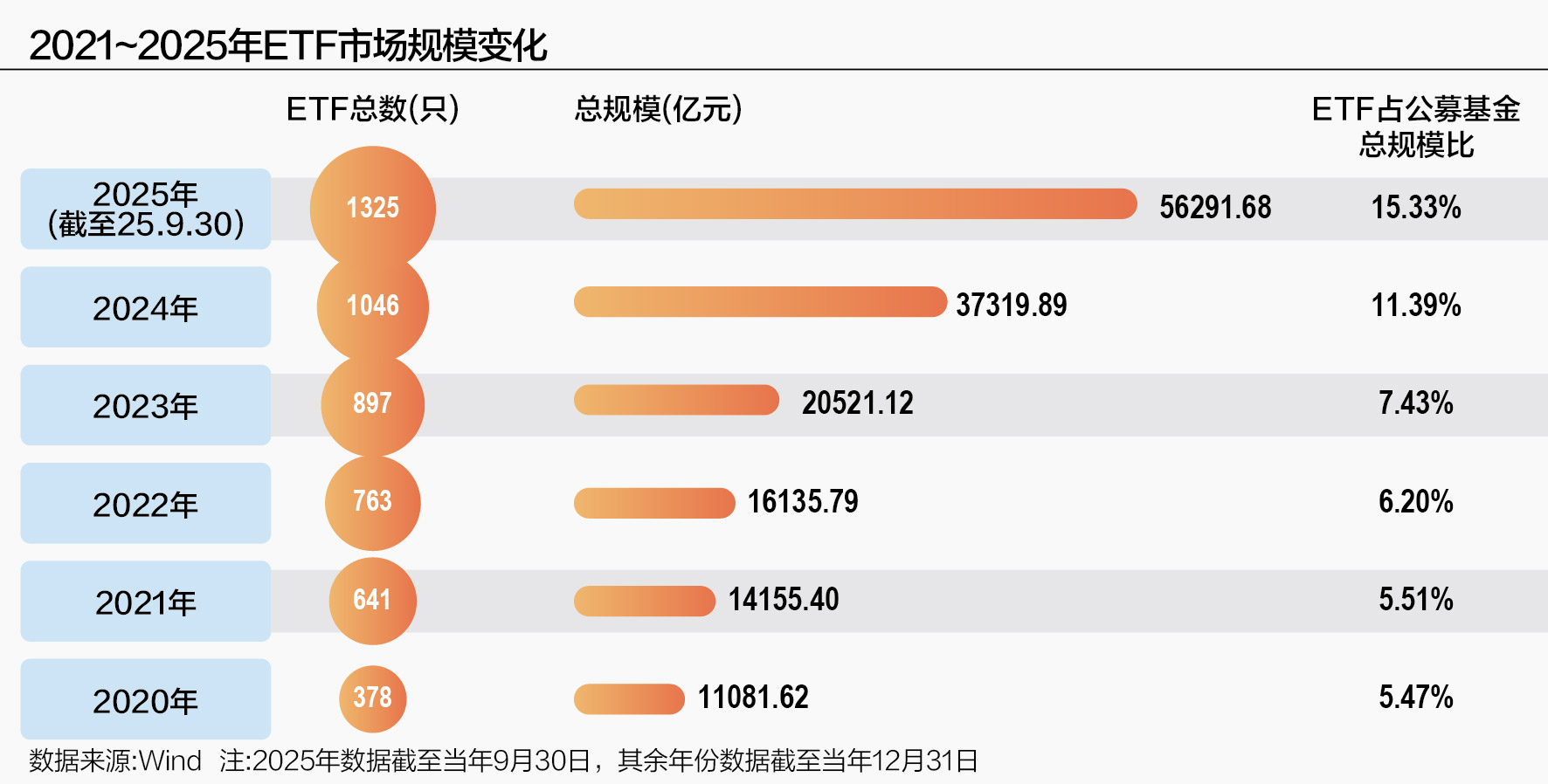
Core Insights - The ETF market in China has reached a significant milestone, with total assets surpassing 6 trillion yuan, reflecting a growth of over 60% year-on-year [3][5] - The rapid expansion of the ETF market is characterized by a shift from slow accumulation to accelerated growth, with a cumulative increase of 452.53% over the past five years [5][6] - The market is witnessing a consolidation of leading fund companies, with a clear top tier emerging in ETF management [7][10] Market Overview - As of December 2025, the total ETF market size reached 6.03 trillion yuan, with an increase of 2.29 trillion yuan within the year [3] - The number of ETF products has grown from 326 to 1402 over the past five years, with a total issuance of 1076 new products [6] - The total trading volume of ETFs has surged from 843.48 billion yuan to 3.96 trillion yuan, marking a growth of 369.51% [6] Management Competition - The top seven fund companies have maintained their positions in the ETF management scale, with 华夏基金 (China Asset Management) leading the market [7][10] - 华夏基金's ETF management scale increased from 187.9 billion yuan in 2020 to 957 billion yuan by the end of 2025 [10] - The entry threshold for the top ten ETF managers has significantly risen, with the requirement increasing from 30 billion yuan five years ago to 200 billion yuan by the end of 2025 [11] Index Performance - The 沪深300 index remains the most popular, with ETF assets linked to it reaching 1.185 trillion yuan by the end of 2025 [14] - The 中证A500 index has emerged as a new favorite, with its ETF size surpassing 300 billion yuan, reflecting a shift towards quality assets [15] - The diversification of asset classes in the top ten indices indicates changing investor preferences, with new themes and sectors gaining traction [16] Holder Structure - Institutional investors have solidified their dominance in the ETF market, increasing their share from 69.07% at the end of 2020 to 76.84% by mid-2025 [20] - The absolute scale of institutional holdings has grown from 743.8 billion yuan to 3.3 trillion yuan, indicating a fourfold increase [20] - Individual investors have shown consistent participation in equity ETFs, maintaining a net value share close to that of institutional investors [21] National Team Involvement - The "national team" has increasingly utilized ETFs as a tool for market stabilization, with significant purchases made during market fluctuations [22][23] - By the end of 2024, the central government’s holdings in ETFs had surged to over 1 trillion yuan, reflecting a strategic shift towards broader ETF investments [23][24] - The national team's involvement in ETFs is expected to play a crucial role in the future of China's capital market ecosystem [24]
固收+市场全景解析
Mai Gao Zheng Quan· 2026-01-07 12:33
- The report focuses on the "Fixed Income+" (固收+) product, which aims to achieve absolute returns higher than pure fixed-income products, with risk-return characteristics between bond and equity products. The specific scope includes mixed bond funds with average convertible bond positions not exceeding 80% over the past eight quarters and equity positions (stocks + 0.5×convertible bonds) not exceeding 40% on average, with a maximum equity position of 60%[18] - The classification of "Fixed Income+" funds is based on long-term equity risk exposure, dividing them into three categories: conservative, balanced, and aggressive. The classification thresholds are set at 15% and 25% for average equity positions over the past eight quarters[21][20] - The report highlights the growth in "Fixed Income+" fund scale, with a total increase of 7700.41 billion yuan (63.50%) from the end of 2024 to Q3 2025. Among the categories, conservative funds grew by 3695.98 billion yuan, balanced funds by 2101.94 billion yuan, and aggressive funds nearly doubled with an increase of 1902.49 billion yuan[18][21] - The performance of "Fixed Income+" funds from 2020 to 2025 demonstrates strong stability and cross-cycle return capabilities. Even aggressive funds show significantly lower drawdowns compared to equity and convertible bond products. The products exhibit strong return elasticity during equity market uptrends and resilience during downturns[31][35] - The leverage ratio of "Fixed Income+" funds has been declining, from 1.24 at the end of 2023 to 1.10 by Q3 2025. Conservative funds generally maintain higher leverage, while aggressive funds rely more on equity asset elasticity for returns[57][60] - The duration of "Fixed Income+" funds has increased from 1.92 years in 2024 to 3.04 years by Q3 2025, reflecting a strategy to extend duration for bond yield enhancement amid declining bond yields[61][63]
公募基金年度策略报告:固收+基金:2025年度策略回顾与2026年度策略展望-20260107
Shenwan Hongyuan Securities· 2026-01-07 10:15
Group 1 - The total scale of fixed income + funds reached 1.93 trillion by Q3 2025, with low-positioned funds experiencing the fastest growth in Q1 and Q2, while mid-high positioned funds saw significant inflows in Q3, primarily in secondary bond funds [2][11] - In 2025, 21 funds increased their scale by over 10 billion, indicating a diverse market with various strategies gaining investor interest, including Hong Kong stock strategies, technology growth themes, and cyclical themes [2][14] - The average return of fixed income + funds in 2025 was 4.86%, with a maximum drawdown median of -2.03%, showcasing a "steady progress" characteristic [3][7] Group 2 - The top-performing fixed income + funds included Yongying Stable Enhancement, Jingshun Longcheng Jingyifengli, and others, with absolute returns being notably high [3][14] - Jingshun Longcheng Fund saw its fixed income + fund scale increase by over 100 billion in 2025, characterized by multi-team competition and collaboration between equity and bond fund managers [3][18] - Zhongou Fund is actively developing a professional, industrialized, and intelligent research system to empower the diversified development of fixed income + business [3][18] Group 3 - The industry-themed funds, particularly in technology innovation and advanced manufacturing, performed well due to structural market conditions [3][21] - Small-cap strategy products are relatively scarce, but those available outperformed similar-positioned fixed income + funds in 2025 [3][22] - Quantitative strategies are increasingly being adopted, with about 20% of new products in 2025 utilizing quantitative strategies, indicating a rich strategy pool [3][24] Group 4 - In 2025, the issuance of fixed income + funds increased significantly, with 104 new funds launched, reflecting a 42.47% year-on-year growth [21][24] - The top three funds by net subscription in 2025 were Yongying Stable Enhancement, Zhongou Fengli, and Jingshun Longcheng Jingyifengli, with net subscription amounts ranging from 150 to 300 billion [24][25] - Institutional investors have shown a higher interest in fixed income + funds since the second half of 2022, with significant growth in both institutional and individual holdings in 2025 [29][31]