
圆通速递

Search documents
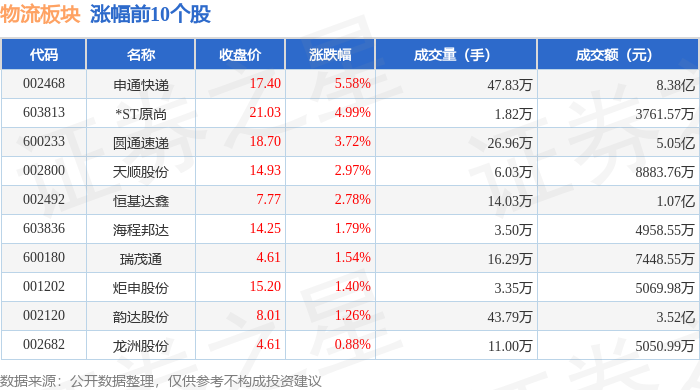
物流板块9月10日涨0.46%,申通快递领涨,主力资金净流入144.45万元
Zheng Xing Xing Ye Ri Bao· 2025-09-10 08:30
Market Overview - On September 10, the logistics sector rose by 0.46% compared to the previous trading day, with Shentong Express leading the gains [1] - The Shanghai Composite Index closed at 3812.22, up 0.13%, while the Shenzhen Component Index closed at 12557.68, up 0.38% [1] Individual Stock Performance - Shentong Express (002468) closed at 17.40, with a gain of 5.58% and a trading volume of 478,300 shares, amounting to a transaction value of 838 million [1] - Other notable performers included: - ST Yuanshang (603813) at 21.03, up 4.99% [1] - YTO Express (600233) at 18.70, up 3.72% [1] - Tiens Holdings (002800) at 14.93, up 2.97% [1] - Hengkai Daxin (002492) at 7.77, up 2.78% [1] Fund Flow Analysis - The logistics sector saw a net inflow of 1.4445 million in main funds, while retail funds experienced a net outflow of 68.1491 million [2] - Retail investors contributed a net inflow of 66.7047 million [2] Detailed Fund Flow for Key Stocks - Shentong Express had a main fund net inflow of 79.7019 million, with retail funds showing a net outflow of 44.4659 million [3] - YTO Express recorded a main fund net inflow of 46.6307 million, with retail funds experiencing a net outflow of 33.2871 million [3] - Yunda Express (002120) had a main fund net inflow of 31.6127 million, while retail funds saw a net outflow of 28.9086 million [3]




浙商证券:快递提价风起全国 盈利修复空间广阔
智通财经网· 2025-09-10 07:48
Core Viewpoint - The logistics industry is experiencing a price increase trend since July and August, with approximately 80% of the national market share in provinces that have announced price hikes, indicating a potential recovery in performance for franchisees and listed companies [1][3][4]. Group 1: Price Adjustment Trends - Starting from August 4, Guangdong initiated collective price hikes, with the price for a 0.1kg special item rising to over 1.4 yuan per ticket, aiming to stabilize market shares [2]. - By August 11, Zhejiang and Jiangsu began adjusting prices, with increases of 0.3 yuan per ticket in Zhejiang and 0.4 yuan in Jiangsu, contributing to 16.9% and 7.9% of the national express delivery volume respectively [2]. - On August 20, Fujian issued price increase notices, setting a minimum price of 1.5 yuan for packages under 0.3kg, with a total volume of 32.6 billion items in the first half of 2025, accounting for 3.4% of the national total [2]. Group 2: Regional Price Adjustments - By September 4, regions including Beijing-Tianjin-Hebei and Henan began to follow suit with price increases, with Henan raising all outbound express prices by 0.2 yuan per ticket [3]. - The Hebei and Henan provinces are significant players in the express delivery market, contributing 6.0% and 5.7% to the national volume respectively [3]. - Shandong's YTO Express updated its pricing parameters, automatically increasing all outbound express prices by 0.2 yuan, reflecting the importance of price adjustments in the northern e-commerce market [3]. Group 3: Industry Outlook and Performance Recovery - The ongoing price adjustments are seen as a response to cost pressures and a step towards establishing a long-term mechanism against "involution" in the industry [3]. - Based on the price increase trend, the industry is expected to continue raising prices, leading to potential performance recovery for franchisees and listed companies as the peak season in September approaches [4]. - According to estimates, a price increase of 0.1 yuan could lead to an increase in net profit per ticket for listed companies, with varying price elasticity among major players like Zhongtong, YTO, and Shentong [4]. Group 4: Investment Recommendations - In the context of the "anti-involution" policy, despite the overall pressure on the express delivery sector in the first half of 2025, there is optimism for performance recovery in the short term due to price stabilization and improved competitive dynamics [5]. - Companies such as Jitu Express, Shentong Express, YTO Express, and Zhongtong Express are recommended for investment, with expectations of performance recovery driven by price adjustments and market share growth [5].

快递反内卷:反内卷保障良性竞争,监管力度决定持续性
2025-09-09 14:53
Summary of the Express Delivery Industry Conference Call Industry Overview - The express delivery industry has undergone significant changes, transitioning from a "Spring and Autumn" phase (2017-2019) characterized by high growth and light asset models to a "Warring States" phase (2020 onwards) marked by heavy asset investments and price wars [3][10]. Key Points and Arguments - **Revenue Decline Factors**: The decline in single ticket revenue is attributed to three main factors: cost-driven efficiencies, rational competition, and irrational price wars. The past five years have seen revenue declines primarily driven by cost factors such as scale effects and automation upgrades [1][4][20]. - **Impact of New Entrants**: The entry of Jitu in 2020 triggered irrational price wars, leading to a decline in industry performance and valuations, putting pressure on networks and couriers [1][8]. - **Regulatory Actions**: Local governments, such as in Yiwu, have implemented measures to raise minimum delivery prices to curb irrational competition, which has stabilized the network and improved valuations for lower-ranked companies [1][9]. - **Market Recovery**: Following the anti-involution actions in 2021, leading companies regained market share, and single ticket revenue increased, significantly restoring profitability [10][11]. - **Future Price Competition**: The industry is expected to enter another price competition phase in the second half of 2024, with intensified price wars anticipated post-Chinese New Year in 2025 [1][12]. Important but Overlooked Content - **Regulatory Influence**: The effectiveness of the anti-involution measures heavily relies on regulatory strength, which has shown to alleviate competitive pressures in the short term and promote healthy competition in the long term [2][16]. - **Profitability Elasticity**: Future profitability in the express delivery sector will depend on the sustainability of price increases and regulatory actions. Current net profits for major companies are low, indicating a need for effective price adjustments to enhance profitability [17][21]. - **Long-term Implications**: The current anti-involution measures are expected to foster a healthy competitive environment, leading to industry consolidation and the rise of leading companies, ultimately benefiting consumers and investors alike [22]. Conclusion - The express delivery industry is at a critical juncture, with regulatory measures playing a pivotal role in shaping its future. The focus on sustainable pricing and profitability recovery presents significant investment opportunities in the sector, particularly for leading companies poised for growth in a more stable competitive landscape [19][22].

圆通速递跌2.02%,成交额1.08亿元,主力资金净流出326.07万元
Xin Lang Cai Jing· 2025-09-09 03:17
Core Viewpoint - YTO Express has experienced a stock price increase of 29.50% year-to-date, with significant gains in recent trading periods, indicating strong market performance and investor interest [1][2]. Financial Performance - For the first half of 2025, YTO Express reported a revenue of 35.883 billion yuan, representing a year-on-year growth of 10.19%. However, the net profit attributable to shareholders decreased by 7.90% to 1.831 billion yuan [2]. - Cumulative cash dividends since the A-share listing amount to 6.2 billion yuan, with 3.288 billion yuan distributed over the past three years [3]. Shareholder Information - As of June 30, 2025, the number of shareholders decreased by 11.66% to 52,500, while the average circulating shares per person increased by 13.20% to 65,589 shares [2]. - The top ten circulating shareholders include Hong Kong Central Clearing Limited, which reduced its holdings by 8.7471 million shares, and Huatai-PB CSI 300 ETF, which entered the list with 30.7431 million shares [3]. Market Activity - On September 9, YTO Express's stock price fell by 2.02% to 17.91 yuan per share, with a trading volume of 1.08 billion yuan and a turnover rate of 0.18% [1]. - The stock has seen a net outflow of 3.2607 million yuan in principal funds, with significant selling pressure compared to buying activity [1]. Business Overview - YTO Express, established on December 22, 1992, and listed on June 8, 2000, is primarily engaged in comprehensive express logistics services. The main revenue sources include domestic time-sensitive products (89.93%) and freight forwarding services (2.91%) [1]. - The company operates within the transportation and logistics sector, with concepts including smart logistics, express delivery, pension concepts, cross-border e-commerce, and margin financing [1].
中国快递 “反内卷” 更新-大范围涨价,后续如何-China ExpressAnti-Involution Update #5 - Widespread Price Hikes, What's Next
2025-09-09 02:40
Summary of Key Points from the Conference Call Industry Overview - The conference call focuses on the **China Express** industry, particularly discussing the **"anti-involution"** initiatives and recent price hikes affecting the parcel delivery sector in China [1][2]. Recent Developments - **Price Hikes**: Approximately **70%** of the industry parcel volume has been affected by recent price hikes, with successful implementation expected to sustain and potentially expand coverage [9]. - Price increases in **Guangdong, Zhejiang, and Fujian** regions range from **Rmb0.1 to Rmb0.4** per parcel since August. - Regions including **Hunan, Hubei, Jiangxi, Henan, Hebei, Beijing, and Tianjin** have seen hikes of **Rmb0.2 to Rmb0.4** per parcel since September, with further increases planned in Hubei and Jiangxi effective from October. - Discussions for price hikes are ongoing in **Shandong and Jiangsu** [9]. Market Dynamics - **Market Share Lock-Up Period**: The lock-up period for market share has been extended in several regions, including Guangdong, Zhejiang, and Fujian. Most regions have a lock-up period following price hikes, except for Hunan and Hubei [9]. - The current lock-up period is shorter in regions outside Guangdong, which has a lock-up from **August 5 to September 20**, but may be extended further [9]. Industry Volume Growth - **Volume Growth Deceleration**: Both **ZTO** and **YTO** have reported a deceleration in industry volume growth as of August [5]. Future Catalysts - Potential catalysts for further price hikes include: 1. The trend of industry volume growth post-price hikes, which may influence local regulators' decisions on executing further price increases. 2. Market share dynamics once the lock-up periods conclude [9]. Analyst Insights - Analysts from **Morgan Stanley** are closely monitoring these developments, indicating a cautious but optimistic outlook on the industry dynamics and pricing strategies [6][7]. Important Considerations - The report emphasizes the importance of understanding the regulatory environment and market dynamics that could impact pricing strategies and overall industry performance [7][9]. This summary encapsulates the critical insights and developments discussed in the conference call regarding the China Express industry and its pricing strategies.
聚焦:重视油轮旺季弹性+干散底部布局机会
Huachuang Securities· 2025-09-08 02:46
Investment Rating - The report maintains a "Buy" recommendation for the oil tanker sector and dry bulk sector, highlighting potential opportunities in both areas [3][24]. Core Insights - The VLCC freight rates have continued to rise, with the Clarkson VLCC-TCE index reaching $56,000 on September 5, marking a week-on-week increase of 34% [1][10]. - The report emphasizes the elasticity of oil tanker rates as the market approaches the peak season, driven by expected OPEC+ production increases and recovering refinery utilization rates [19][20]. - The dry bulk market is anticipated to gradually recover, supported by low supply growth and potential demand increases from upcoming projects and economic factors [23]. Summary by Sections Focus on Oil Tankers and Dry Bulk Opportunities - VLCC freight rates have shown significant increases across various routes, with Middle East to China rates at $58,000/day, up 38% week-on-week [1][10]. - OPEC+ is expected to increase production by approximately 137,000 barrels per day in October, which may contribute to higher freight demand [19]. - Refinery utilization rates have improved, with major refineries operating at 81.59%, a 0.2 percentage point increase from the previous week [19]. Industry Data Tracking - The Baltic Dry Index (BDI) was reported at 1979 points, down 2.3% week-on-week, indicating a mixed performance in the dry bulk sector [23]. - The report notes that the supply side remains constrained, with only 10.4% of dry bulk vessels on order, suggesting limited capacity growth in the coming years [23]. Market Review - The transportation sector experienced a decline of 1.4% in the week, underperforming the CSI 300 index by 0.6 percentage points [64]. - Notable stock performances included significant gains for companies like China Merchants Energy and China Merchants Jinling, while others like Shentong Express saw declines [64]. Investment Recommendations - Continued recommendations for the oil tanker sector include China Merchants Energy, China Merchants Jinling, and China Merchants South Oil [24]. - For the dry bulk sector, recommendations include Haitong Development and China Merchants Jinling, with a suggestion to pay attention to Pacific Shipping [24].




广州召开邮政快递业“扫黄打非”线索核查推进会
Guang Zhou Ri Bao· 2025-09-08 01:56
Core Insights - The meeting in Guangzhou focused on the "sweep away pornography and illegal publications" initiative within the postal and express delivery industry, analyzing the current situation and planning future tasks [1] Group 1: Current Situation and Analysis - The Guangzhou Postal Administration reported on the progress of the "sweep away pornography and illegal publications" initiative in the postal and express delivery sector this year [1] - The "sweep away pornography and illegal publications" office summarized the distribution and handling processes of related clues in the postal and express delivery sector [1] - Participants identified issues such as insufficient identification capabilities, lax implementation of regulations, and inadequate customer supervision [1] Group 2: Proposed Measures and Key Focus Areas - The meeting emphasized three key areas for improvement: enhancing the ability to identify illegal publications, strictly enforcing real-name delivery and package inspection systems, and strengthening the review and dynamic supervision of agreement clients [1] - The goal is to establish a robust risk prevention mechanism from the source, solidify responsibilities throughout the delivery process, and effectively close management loopholes [1]
水陆空货通全球 武汉连续四年拿下全国第一
Chang Jiang Ri Bao· 2025-09-08 00:15
Core Points - Wuhan has 455 A-level logistics companies in 2024, ranking first in the country [1] - This marks the fourth consecutive year that Wuhan has held the top position in this sector [2] - Wuhan has completed the layout of five types of national logistics hubs in just five years, becoming the second city in the country to achieve this [3] Industry Overview - A-level logistics companies are considered the elite in the logistics industry, indicating better logistics service capabilities, levels, and environments in a region [3] - The establishment of logistics hubs is crucial for enhancing a city's logistics capabilities and overall economic development [5][6] - The logistics sector is increasingly seen as a key driver for economic growth, linking production and consumption [5][6] Strategic Developments - Wuhan has been approved to build a production service-type national logistics hub, which will enhance the integration of logistics and manufacturing, particularly in the automotive industry [5] - The logistics hub will significantly reduce logistics costs, making "Wuhan-made" vehicles more competitive in the market [5] - The city is developing various transport channels, including rail, water, and air, to facilitate domestic and international trade [8] Economic Impact - The logistics industry is expected to attract more automotive companies and parts manufacturers to Wuhan, further supporting the growth of the automotive sector [5] - The phrase "logistics leads to wealth accumulation" encapsulates the rationale behind Wuhan's push to develop its logistics industry [6] - The city is transforming from a traditional logistics hub to a modern logistics center, enhancing its role in both domestic and international supply chains [8]
周道2025:当前时点,如何看待周期板块
2025-09-07 16:19
Summary of Key Points from Conference Call Records Industry Overview Steel Industry - **Iron Water Production Decline**: Iron water production has significantly decreased from an average of 2.4 million tons to 2.288 million tons, potentially impacting raw material prices negatively but may lead to higher steel prices in Q4 [3][4] - **Valuation Opportunities**: High-end special steel companies like Baosteel and Nanjing Steel may benefit from valuation increases. Companies like Hualing and Ansteel are seen as potential investment opportunities due to production cut targets [1][5][6] - **Market Sentiment**: The steel sector is influenced by systemic valuation increases amid the US-China geopolitical context and domestic supply chain stability [5] Non-Ferrous Metals - **Economic Recession Expectations**: The expectation of an economic downturn has led to a bullish outlook for gold stocks, with companies like Zhaojin Mining and Shandong Gold being highlighted as key players [1][7][8] - **Profit Elasticity**: Both gold and copper are expected to show significant profit elasticity, with a favorable price-volume relationship anticipated [7][8] Building Materials - **Anti-Competition Initiatives**: The fiberglass sector has seen unexpected initiatives against cutthroat competition, although these lack administrative enforcement. Leading companies like China Jushi are expected to perform well [1][10] - **Cement Industry**: Potential for a capacity reduction fund to be introduced, which could support price increases [10] AI Electronic Fabric - **Stable Demand and Supply Monopoly**: The demand for AI electronic fabric is stable, with a market space of 30 billion RMB dominated by a few leading companies like China National Materials and Fiberglass [1][11] Logistics Industry - **Price Recovery Trends**: The express delivery sector is experiencing a clear trend of price recovery, with companies like YTO Express and Shentong Express recommended for investment [1][12][13] - **Regulatory Actions**: A special governance action for car transport is expected to improve profitability for compliant companies [13] Chemical Industry - **Product Recommendations**: Focus on polyester filament and organic silicon, with significant demand growth expected. MDI and n-hexane are also highlighted for their potential price increases due to US interest rate cuts [14][15][17] Energy Sector - **Green Energy Support**: The green energy sector is benefiting from policy support, with a notable increase in subsidy recovery and green certificate trading volumes [19][20] Core Insights and Arguments - **Steel Price Dynamics**: The decline in iron water production is expected to lead to a rebound in steel prices, particularly in the spot market, despite potential negative impacts on raw material prices [3][5] - **Gold Stock Recovery**: The anticipated strong recovery of gold stocks is driven by economic recession fears and the potential for significant price increases in the coming months [8][9] - **Logistics Sector Transformation**: The logistics industry is undergoing a transformation with price recovery and regulatory support, indicating a positive outlook for major players [12][13] Additional Important Content - **Market Sentiment**: The overall market sentiment remains cautious, with expectations of limited upward elasticity in steel prices despite some recovery signs [2] - **Investment Recommendations**: Specific companies are highlighted for potential investment based on their market positioning and expected performance in the upcoming quarters [1][5][12][19] - **Future Price Trends**: The MDI market is expected to see price increases due to recovering demand and supply constraints, indicating a healthy growth outlook [16][17]
黄金历史新高,美国非农爆冷,周期怎么看?
2025-09-07 16:19
Summary of Key Points from Conference Call Records Industry Overview - The records primarily discuss the transportation and logistics industry, particularly focusing on the impact of U.S. economic data and OPEC+ oil production decisions on various sectors including shipping, airlines, and express delivery services [1][2][3][4][5][6][7][8][9][10]. Core Insights and Arguments 1. **U.S. Non-Farm Employment Data**: - June's non-farm employment data was revised down to negative for the first time since December 2020, indicating potential for Fed rate cuts, which could benefit Chinese transportation companies with high U.S. debt exposure [1][3][4]. - August's non-farm employment increased by only 22,000, significantly below the expected 75,000, with an unemployment rate rising to 4.3%, the highest since late 2021 [2][3][11]. 2. **Impact of OPEC+ Oil Production**: - OPEC+ increased oil production, leading to a 3% drop in oil prices, which lowers transportation costs and benefits the transportation sector [1][5]. - VLCC (Very Large Crude Carrier) rates have risen to $54,000 per day, with expectations for increased cruise transportation rates in Q4 due to seasonal demand and sanctions [1][5]. 3. **Airline Sector Performance**: - Airlines experienced lower-than-expected summer operations, but ticket prices are projected to turn positive year-on-year from mid-September, making airline stocks attractive for investment [1][6]. - Recommended airline stocks include Huaxia Airlines, Juneyao Airlines, and the three major state-owned airlines [1][6]. 4. **Express Delivery Industry Trends**: - The express delivery sector is undergoing a trend of price increases, with multiple regions announcing price hikes. Yiwu's low base price suggests further increases are likely [1][7][8]. - Recommended stocks in this sector include Shentong Express and YTO Express [1][8]. 5. **Coking Coal Price Impact**: - Coking coal prices have risen from around 700 RMB to approximately 1,000 RMB, significantly improving the trading profits for Jiayou International, with expectations for a strong Q3 performance [1][9]. 6. **Long-term Logistics Developments**: - The Ministry of Transport's crackdown on overloaded car transporters could lead to a 20% increase in transportation fees for Longjiu Logistics, translating to a potential earnings increase of 200 to 400 million RMB [1][10]. Other Important Insights - The potential for a stronger RMB due to U.S. rate cuts could benefit airlines with significant dollar-denominated debt, particularly Huaxia Airlines, Juneyao Airlines, and the three major state-owned airlines [1][4]. - The overall sentiment in the transportation sector is cautiously optimistic, with several companies positioned to benefit from macroeconomic trends and regulatory changes [1][5][10]. This summary encapsulates the critical insights and data points from the conference call records, providing a comprehensive overview of the current state and future outlook of the transportation and logistics industry.