
洋河股份

Search documents
白酒板块11月11日跌0.18%,水井坊领跌,主力资金净流出4.97亿元
Zheng Xing Xing Ye Ri Bao· 2025-11-11 08:37
Market Overview - The liquor sector experienced a decline of 0.18% on November 11, with Shui Jing Fang leading the drop [1] - The Shanghai Composite Index closed at 4002.76, down 0.39%, while the Shenzhen Component Index closed at 13289.0, down 1.03% [1] Individual Stock Performance - Shede Liquor (600702) rose by 2.56% to a closing price of 67.31, with a trading volume of 319,700 shares and a transaction value of 2.144 billion [1] - Gujing Gongjiu (000596) increased by 0.92% to 164.00, with a trading volume of 37,400 shares and a transaction value of 606 million [1] - Shui Jing Fang (600779) fell by 1.13% to 42.87, with a trading volume of 48,200 shares and a transaction value of 206 million [2] - Moutai (600519) decreased by 0.23% to 1458.99, with a trading volume of 26,700 shares and a transaction value of 3.883 billion [2] Capital Flow Analysis - The liquor sector saw a net outflow of 497 million from institutional investors, while retail investors contributed a net inflow of 244 million [2] - The main capital inflow and outflow for selected stocks showed varied trends, with Shanxi Fenjiu (600809) experiencing a net inflow of 1.06 billion from main capital [3] - Shede Liquor (600702) had a net inflow of 46.2 million from main capital, while it faced a net outflow of 90.1 million from speculative capital [3]





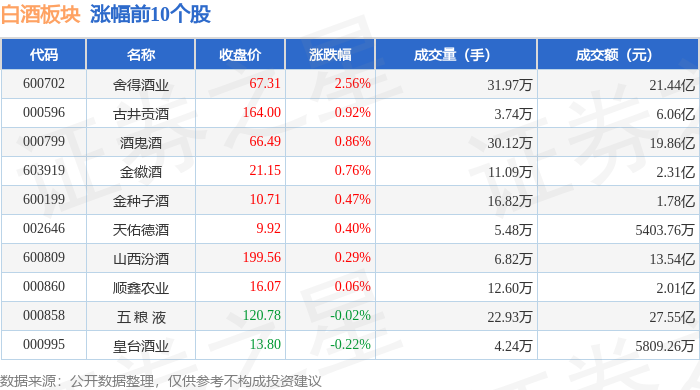
12只白酒股下跌 贵州茅台1458.99元/股收盘
Bei Jing Shang Bao· 2025-11-11 07:41
Core Viewpoint - The liquor sector showed mixed performance with a slight overall increase, while individual stocks experienced varied movements, indicating a potential recovery in the industry by 2026 according to CICC's forecast [1] Industry Summary - On November 11, the Shanghai Composite Index closed at 4002.76 points, down 0.39%, while the liquor sector index closed at 2359.06 points, up 0.39% [1] - CICC predicts that the liquor industry will see a gradual improvement starting in the first half of next year, with leading companies benefiting the most due to their strong fundamentals and market share logic [1] Company Summary - Kweichow Moutai closed at 1458.99 CNY per share, down 0.23% [1] - Wuliangye closed at 120.78 CNY per share, down 0.02% [1] - Shanxi Fenjiu closed at 199.56 CNY per share, up 0.29% [1] - Luzhou Laojiao closed at 141.64 CNY per share, down 0.60% [1] - Yanghe Brewery closed at 70.80 CNY per share, down 1.05% [1]




申万宏源:白酒报表端继续释放压力 行业进入底部战略性布局期
Zhi Tong Cai Jing· 2025-11-11 06:59
Core Viewpoint - The liquor industry is experiencing significant pressure on demand due to external structural disturbances, with expectations of a bottoming out in the third quarter of 2025 and a potential turning point in the third quarter of 2026 [1][2]. Fundamental Analysis - Since the fourth quarter of 2024, some companies have begun to see declines, but the first quarter of 2025 showed resilience in sales, with leading brands still achieving growth [2]. - The demand environment has been notably pressured since the second quarter of 2025, with a significant loss of consumption scenarios, leading to accelerated clearing in the third quarter of 2025 [2]. - Sales volume is expected to decline by 20%-30% year-on-year in the third quarter of 2025, following a 30%-50% decline in the second quarter [2]. - High-end liquor prices continue to fall as the market seeks a balance between volume and price [2]. - The first quarter of 2026 is anticipated to still face double-digit declines in sales volume, with continued pressure on financial reports, but stabilization is expected in the second quarter and a turning point in the third quarter [2]. Valuation Analysis - As of October 31, 2025, the absolute PE level for the liquor sector is 18.7x, below the historical average of 27.6x since 2011 [3]. - The relative PE multiple compared to the Shanghai Composite Index is 1.14x, also below the historical average of 2.01x since 2011 [3]. - Future dividend rates for liquor companies are expected to increase, with leading companies disclosing three-year dividend return plans, and most companies currently offering dividend yields above 3%, indicating medium to long-term investment value [3]. Holdings Analysis - In the third quarter of 2025, the liquor sector's holding proportion fell to 5.52%, returning to levels seen in the second quarter of 2017 [4]. - The market value of heavy holdings in the liquor sector decreased by 1.26 percentage points compared to the previous quarter, below the average level since 2009 [4]. Investment Recommendations - The company suggests a strategic bullish outlook on the liquor sector, anticipating a fundamental turning point in the third quarter of 2026 [5]. - If the fundamentals recover as expected, a dual boost in valuation and performance is anticipated by the end of 2026 and into 2027 [5]. - It is recommended to begin long-term positioning in quality companies, while remaining patient regarding fundamental improvements and recognizing the potential for differentiated stock performance [5]. - Key recommended stocks include Luzhou Laojiao, Shanxi Fenjiu, Kweichow Moutai, and Wuliangye, with additional attention to Yingjia Gongjiu, Jinhui Jiu, Gujing Gongjiu, Jianshiyuan, and Yanghe Distillery [5].

吃喝板块回调,食品ETF(515710)全天低位震荡!机构:2026白酒上行拐点逐步清晰
Xin Lang Ji Jin· 2025-11-11 06:14
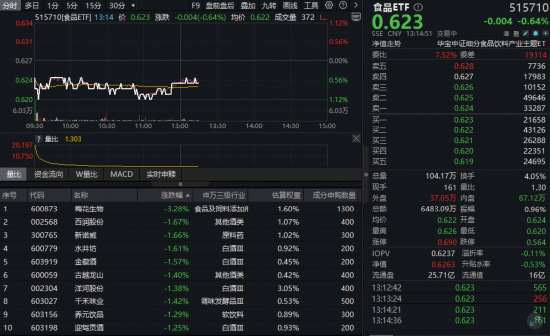
Group 1 - The food and beverage sector is experiencing a downturn, with the Food ETF (515710) showing a decline of 0.64% as of the report time [1][2] - Key stocks in the sector, particularly in the liquor and consumer goods categories, are seeing significant drops, with Meihua Biological down over 3% and several others down more than 1% [1][2] - The report indicates that the overall performance of the food and beverage sector is under pressure due to policy impacts and increased competition, leading to reduced profit margins for companies [1][4] Group 2 - The valuation of the food and beverage sector is at a historical low, with the Food ETF's underlying index PE ratio at 21.22 times, indicating a potential opportunity for left-side positioning [3] - The report highlights that leading liquor companies are showing resilience despite the pressure on their financial statements, suggesting a potential for high-quality development in the coming year [4][5] - The demand side is expected to improve gradually, with policies likely to become less restrictive, which may drive demand recovery in the sector [5]


研报掘金丨华西证券:维持洋河股份“增持”评级,深度调整决心坚定,全方位改革优化
Ge Long Hui· 2025-11-11 05:50
Core Insights - Yanghe Co., Ltd. reported a net profit attributable to shareholders of 3.975 billion yuan for Q1-Q3 2025, a year-on-year decrease of 53.66% [1] - In Q3 2025, the company experienced a net profit loss of 369 million yuan, marking a year-on-year decline of 158.38% [1] - The company is committed to deep adjustments and comprehensive reforms while maintaining its market investment and brand activities [1] Financial Performance - The net profit for Q1-Q3 2025 was 3.975 billion yuan, reflecting a significant decline compared to the previous year [1] - The Q3 2025 loss of 369 million yuan indicates ongoing financial challenges since the fourth quarter of 2024 [1] Strategic Initiatives - Yanghe Co. continues to launch new products, including the seventh generation of Hai Zhi Lan and other brands, to maintain brand visibility [1] - The company focuses on solidifying its market presence in its home base of Suqian while expanding nationally, particularly targeting the surrounding markets [1] - The strategy includes enhancing organizational focus and resource allocation, with a special emphasis on talent acquisition [1] Market Positioning - As of November 7, 2025, the closing price was 69.46 yuan, with projected price-to-earnings ratios for 2025-2027 at 29, 28, and 27 times respectively [1] - The company maintains an "overweight" rating, indicating confidence in its long-term market strategy despite current challenges [1]
白酒股普跌
Ge Long Hui A P P· 2025-11-11 03:49
Core Insights - The article highlights a significant decline in the stock prices of major Chinese liquor companies, with many experiencing drops of over 1% in a single trading session [1] Company Performance - Luzhou Laojiao (泸州老窖) saw a decrease of 1.87%, with a market capitalization of 205.8 billion [2] - Water Margin (水井坊) dropped by 1.45%, with a total market value of 20.8 billion [2] - Yanghe Brewery (洋河股份) fell by 1.24%, holding a market cap of 106.4 billion [2] - Moutai (贵州茅台) experienced a smaller decline of 0.67%, with a substantial market capitalization of 1,818.8 billion [2] - Other notable declines include Wuliangye (五粮液) at -0.54% and Gujing Gongjiu (古井贡酒) at -0.62% [2] Market Trends - The overall trend indicates a bearish sentiment in the liquor sector, with many companies showing negative year-to-date performance, such as Water Margin at -18.34% and Yanghe Brewery at -11.94% [2] - The article suggests that the recent launch of a new pricing reference for liquor may impact market dynamics, as investors seek to understand true market prices [1]


中国白酒追踪 - 品牌对 2026 年春节仍持谨慎展望;聚焦持续严格的发货管控-China Spirits Tracker_ Brands still cautious outlook on 2026CNY; focus on continued stringent shipment control
2025-11-11 02:47
Summary of China Spirits Tracker Conference Call Industry Overview - The spirits industry is currently facing challenges due to weakening demand influenced by anti-extravagance policies and a shift in the Mid-Autumn festival calendar, leading to a tough quarter for many companies in Q3 2025 [1][1][1]. - Companies are adopting a cautious outlook for the upcoming Chinese New Year (CNY) sales and earnings performance, primarily due to a high base effect and lingering policy impacts, resulting in low visibility on demand recovery [1][1][1]. Company-Specific Insights Kweichow Moutai - Moutai is pursuing growth targets mainly through wholesale channels, reporting a 14% year-over-year increase in sales for Q3 2025, despite a 15% decline in direct sales [1][1][1]. - The company is likely to adjust its growth targets for 2026 to be more rational due to pressures on wholesale prices from competitors [1][1][1]. Wuliangye - Wuliangye anticipates back-ended growth in 2026, with the first half of the year facing headwinds from a high comparative base [1][1][1]. - The wholesale price of Common Wuliangye has remained relatively stable, with a slight decrease of RMB 5 to RMB 855 per bottle [2][2][2]. Luzhou Laojiao - Laojiao is also expected to maintain stringent shipment controls, focusing on channel health and pricing strategies into the first half of 2026 [1][1][1]. Feitian Moutai - The wholesale price of Original case Feitian Moutai has decreased by RMB 25 to RMB 1,675, while unpacked Feitian Moutai's price dropped by RMB 40 to RMB 1,640 [2][2][2]. - Various SKUs of Moutai have seen price reductions ranging from RMB 60 to RMB 120 per bottle [2][2][2]. Guojiao 1573 - The wholesale price for Guojiao 1573 has remained stable at RMB 850 per bottle, indicating a lack of significant price movement in the current market [2][2][2]. Market Dynamics - The spirits market is characterized by stringent shipment controls among leading premium brands, with a focus on maintaining channel health and pricing systems [1][1][1]. - The overall sentiment in the spirits industry remains cautious, with companies preparing for potential challenges in the upcoming quarters due to regulatory impacts and market conditions [1][1][1]. Performance Metrics - The stock performance of select spirits companies shows mixed results, with Kweichow Moutai and ZJLD being relatively better performers, while others like Jiangsu Yanghe and Jiugui Liquor have faced significant declines [35][35][35]. Key Risks - Potential risks include regulatory changes, such as consumption tax hikes, and a slower-than-expected macroeconomic recovery, which could impact the spirits market significantly [41][41][41]. This summary encapsulates the key points discussed in the conference call regarding the spirits industry and specific company performances, highlighting the cautious outlook and market dynamics as of Q3 2025.
消费政策暖风频吹,食品饮料ETF天弘(159736)10月以来累计"吸金”近2亿元,机构:白酒板块进入布局区间
2 1 Shi Ji Jing Ji Bao Dao· 2025-11-11 02:14
Group 1 - The three major indices opened higher collectively, while the food and beverage sector experienced a slight pullback, with the Tianhong Food and Beverage ETF (159736) declining by 0.14% [1] - The Tianhong Food and Beverage ETF has shown significant capital inflow, with a net inflow exceeding 180 million yuan since October, indicating strong investor interest [1] - The ETF tracks the CSI Food and Beverage Index, focusing on leading stocks in high-end and mid-range liquor, as well as key players in beverages, dairy, condiments, and beer [1] Group 2 - The National Bureau of Statistics reported that the Consumer Price Index (CPI) rose by 0.2% year-on-year in October, reversing a previous decline, while the Producer Price Index (PPI) saw a year-on-year decrease of 2.1%, with a narrowing decline for the third consecutive month [2] - Huajin Securities noted that the improvement in core CPI and PPI indicates a positive trend, emphasizing the need to strengthen domestic demand amid uncertainties from global supply chain restructuring [2] - Open Source Securities suggested that liquor manufacturers are managing inventory levels to support long-term health, and the current white liquor sector is entering a favorable investment phase [2]

通胀,迎来拐点时刻了吗?
2025-11-11 01:01
Summary of Key Points from Conference Call Records Industry Overview - The records primarily discuss the **Chinese economy**, focusing on inflation trends, consumer spending, and various sectors such as **aviation**, **tire manufacturing**, **chemicals**, **retail**, and **food and beverage** industries. Core Insights and Arguments 1. **Consumer Spending and Economic Growth** - China's current consumer spending rate is approximately **40%**, with a target to reach **60%** to align with high-income countries by **2035**. This indicates significant room for growth in consumer spending [2][3][4]. 2. **Inflation Trends** - October's **CPI** turned positive year-on-year, while **PPI** showed a narrowing decline, indicating marginal improvement in prices. The core CPI reached a new high since 2022, suggesting a potential turning point in inflation [6][7][8]. 3. **Policy Measures** - The **15th Five-Year Plan** suggests measures to enhance consumer capacity and willingness, including promoting employment, increasing income, and improving public service spending [3][4]. 4. **Sectoral Focus for Investment** - The **Changjiang Strategy Team** is optimistic about sectors such as **chemicals**, **agriculture**, **telecommunications**, and **service consumption** due to expected improvements in profitability driven by supply-side reforms and demand recovery [10][13]. 5. **Aviation Industry Insights** - The aviation sector is experiencing price increases due to a rebound in business travel and tourism, alongside supply chain disruptions. Future ticket prices are expected to remain high due to limited aircraft supply [29][30]. 6. **Tire Manufacturing Outlook** - The tire sector is poised for growth due to EU tariffs on Chinese imports, leading to increased prices and improved margins for domestic manufacturers [31]. 7. **Food and Beverage Sector** - The food and beverage industry is recovering from low performance, with specific recommendations for companies like **Fenjiu** and **Yanghe** as they are expected to rebound due to low base effects and improving market conditions [19]. 8. **Retail Sector Opportunities** - The retail sector, particularly supermarkets, is expected to benefit from economic recovery, with recommendations for companies like **Yonghui Supermarket** and **Bubugao** due to their operational leverage and potential for same-store sales improvement [18]. 9. **Paper Industry Dynamics** - The paper industry is currently facing overcapacity but is expected to see price increases due to seasonal demand. Companies like **Sun Paper** are highlighted as potential investment opportunities [34][36]. 10. **Investment Recommendations** - Key investment opportunities include sectors such as **duty-free**, **hotels**, and **tourism**, with specific companies like **China Duty Free** and **Jin Jiang Hotels** recommended for their growth potential [16][17]. Other Important Insights - The records emphasize the importance of **policy support** in sustaining economic recovery and improving consumer confidence, particularly in the service sector [9][11]. - The relationship between **PPI** and stock market performance suggests that stock prices often react positively before PPI turns positive, indicating a forward-looking market [12]. - The **agriculture sector**, particularly pig farming, is currently in a loss cycle, with recommendations to focus on low-cost producers as the market stabilizes [14]. This comprehensive overview captures the essential insights and recommendations from the conference call records, providing a detailed understanding of the current economic landscape and investment opportunities in various sectors.
中信证券“3万亿”成笑话!茅台跌回1700元,900天库存压垮经销商
Sou Hu Cai Jing· 2025-11-10 23:03
Core Viewpoint - The Chinese liquor industry, particularly the baijiu sector, is experiencing a systemic crisis rather than a temporary fluctuation, indicating deep-rooted issues affecting the entire industry [2][24]. Industry Development - The baijiu market is witnessing a significant price collapse, with the wholesale price of Moutai dropping below 1700 yuan, a stark contrast to its previous status as a highly sought-after product [4][6]. - Approximately 60% of liquor companies are facing "price inversion," where selling prices are lower than wholesale prices, leading to severe financial strain on distributors [6][10]. - The stock performance of the baijiu sector has been poor, with many companies experiencing substantial declines in share prices, including a 40% drop for Moutai over four years [8][10]. Financial Performance - Recent quarterly reports reveal that nearly all listed liquor companies are experiencing negative growth, with some companies like Yanghe and Jiugui seeing revenue declines exceeding 30% [10][12]. - The average inventory turnover period for the industry has reached over 900 days, indicating severe overstock issues [21]. Consumer Behavior Changes - The baijiu industry has shifted towards a financial product mentality, prioritizing investment over consumption, which has alienated traditional consumers [13][15]. - Changes in consumer demographics, particularly the rise of younger generations (90s and 00s), have led to a decline in traditional consumption patterns associated with baijiu [19][23]. Future Outlook - The industry faces challenges in revitalization, requiring a shift back to the core value of baijiu as a consumable product rather than a speculative asset [24][28]. - Companies need to innovate and adapt to new consumer preferences, such as offering smaller, lower-alcohol products and engaging in modern marketing strategies to attract younger consumers [26][28].

