京东集团

Search documents
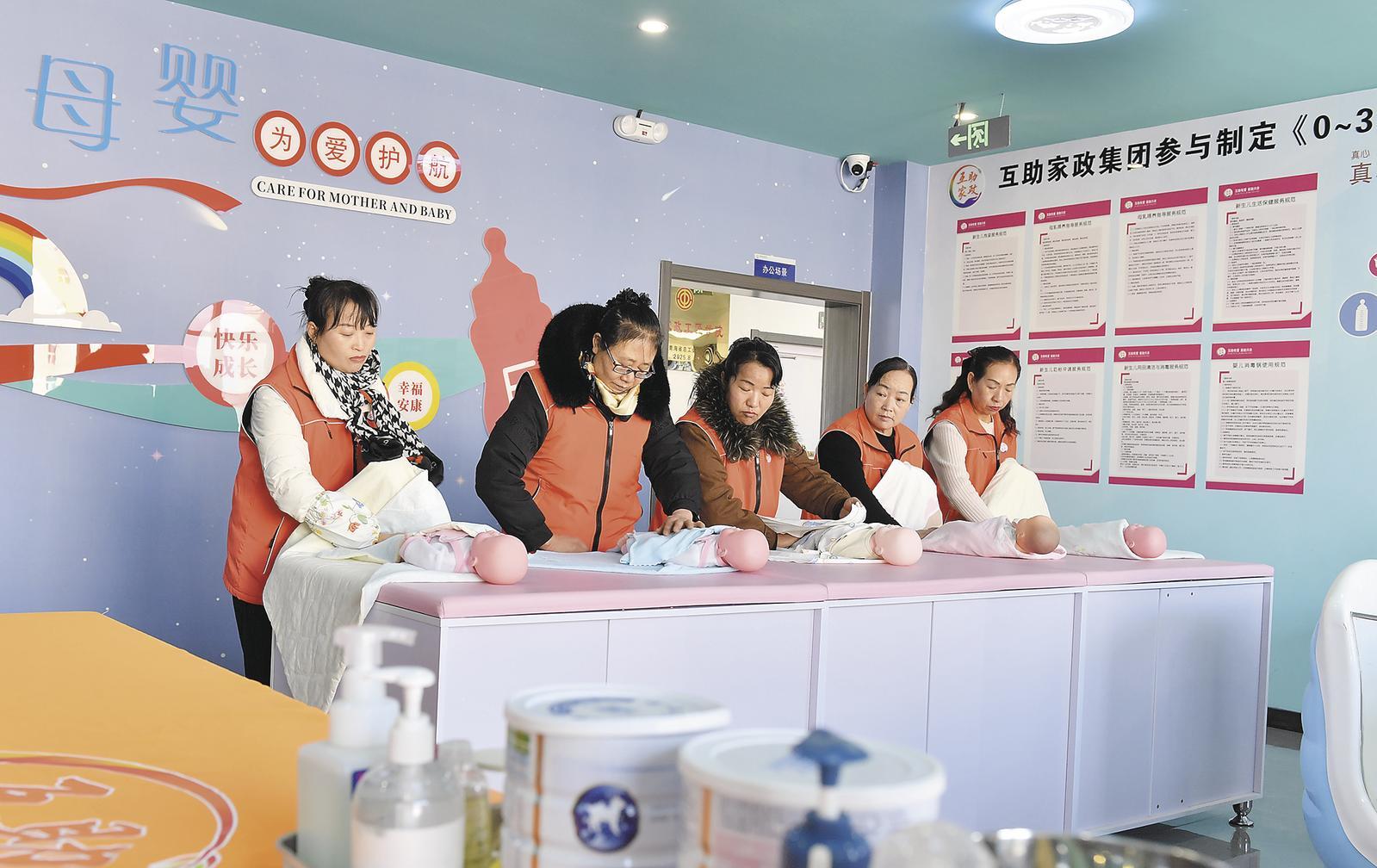
腊月里:忙碌的互助家政人
Xin Lang Cai Jing· 2026-02-04 20:31
"看着老人们干干净净的家、满意的笑容,再累也值!"结束一天的工作,东尕背拖着疲惫的身体却满脸欣慰。互助家政的忙碌,是家政市场蓬勃发展的缩 影。随着母婴照护、居家养老等需求激增,家政服务从业人员供不应求。 为破解供需难题、提升服务品质,互助家政不断探索创新。不仅与京东、美团、58到家等平台深度合作,还推出"直播+家政"新模式,用数字化手段拓宽服 务渠道。智能保洁机器人等设备的引入,让服务更高效便捷。互助家政用专业与温度,既撑起了万千家庭的幸福生活,也为乡亲们铺就了一条稳定增收的致 富路,让家政服务成为乡村振兴与民生保障的暖心纽带。本报记者 王伟才 摄 ...

9568亿资本版图再扩容!刘强东冲刺第七家上市公司
Sou Hu Cai Jing· 2026-02-04 16:23
Group 1 - The core point of the news is that JD.com is set to add its seventh listed company, JD Intelligent Property Development Co., Ltd., which aims to enhance its logistics infrastructure and global presence, potentially reaching a valuation of 9,568 billion RMB [1][3][5] - JD Intelligent Property Development has refiled its prospectus with the Hong Kong Stock Exchange, with major underwriters including Bank of America and Goldman Sachs, indicating a well-prepared approach for its second attempt at going public [3] - The company specializes in logistics parks and smart warehousing, managing assets exceeding 120 billion RMB across 285 projects globally, with 12.8% of its assets located overseas [3] Group 2 - The valuation of 9,568 billion RMB is derived from the combined market capitalization of JD.com's existing and upcoming listed companies, including JD Group, JD Health, JD Logistics, and JD Industry, among others [4][5] - JD Group's market capitalization is approximately 300 billion RMB, while the combined market value of JD Health, JD Logistics, and JD Industry exceeds 400 billion RMB, contributing significantly to the overall valuation [4] - The upcoming IPO of JD Intelligent Property Development is expected to raise funds for expanding overseas logistics nodes and upgrading domestic infrastructure, aiming to replicate China's logistics model globally [5] Group 3 - The expansion of JD's logistics capabilities through the new company is anticipated to enhance delivery speeds, particularly in remote areas, benefiting consumers and intensifying competition in the e-commerce logistics sector [5] - The comprehensive listing strategy of JD.com across various sectors, including retail, health, logistics, and infrastructure, is expected to create stronger synergies within its business ecosystem [5][6] - The upcoming IPO is seen as a significant milestone for JD.com and reflects the company's ambition for global expansion in the e-commerce landscape [6]




美股中概股,集体下跌
Di Yi Cai Jing Zi Xun· 2026-02-04 14:51
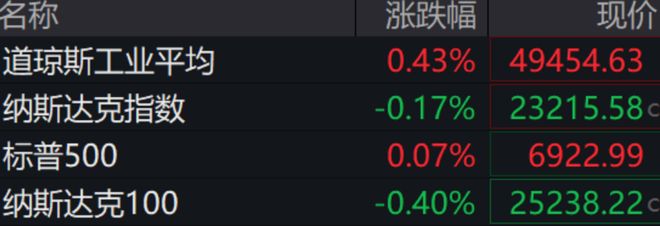
2月4日,美股三大指数开盘涨跌不一,道指涨0.43%,标普500指数涨0.07%,纳指跌0.17%。 热门中概股集体走低,金山云跌超5%,携程集团、网易、哔哩哔哩跌超4%,百度集团、富途控股跌超 3%。 | 名称 | 涨跌幅 ▲ | 现价 | | --- | --- | --- | | 我们之 | -5.45% | 12.414 | | 携程集团 | -4.84% | 57.550 | | 网易 | -4.20% | 122.970 | | 旋面临加 | -4.27% | 30.480 | | 百度集团 | -3.60% | 139.640 | | 富途控股 | -3.52% | 154.155 | | 小鹏汽车 | -2.10% | 16.800 | | 腾讯音乐 | -1.98% | 16.075 | | 小马智行 | -1.61% | 13.430 | | 搜狐 | -1.46% | 16.190 | | 京东集团 | -1.41% | 27.645 | | 蔚来 | -1.25% | 4.493 | | 阿里巴巴 | -1.12% | 161.820 | | 文远知行 | -0.79% | 7.520 ...
美股中概股,集体下跌


第一财经· 2026-02-04 14:50
Market Overview - The Dow Jones Industrial Average increased by 0.43% to 49,454.63, while the Nasdaq Index decreased by 0.17% to 23,215.58, and the S&P 500 rose slightly by 0.07% to 6,922.99 [1] - The Nasdaq 100 saw a decline of 0.40% to 25,238.22 [1] Major Technology Stocks - AMD experienced a significant drop of 11.00% [2] - SanDisk fell by 6.89% [2] - Oracle decreased by 3.72% [2] - Facebook (Meta Platforms) declined by 1.46% [2] - Broadcom saw a decrease of 1.16% [2] - NVIDIA and Amazon also experienced minor declines of 0.67% and 0.33% respectively [2] Chinese Concept Stocks - Major Chinese concept stocks collectively declined, with Kingsoft Cloud dropping over 5% [3] - Ctrip Group, NetEase, and Bilibili each fell by over 4% [3] - Baidu Group and Futu Holdings decreased by over 3% [3] Detailed Performance of Chinese Stocks - Kingsoft Cloud fell by 5.45% to 12.414 [4] - Ctrip Group decreased by 4.84% to 57.550 [4] - NetEase dropped by 4.20% to 122.970 [4] - Baidu Group declined by 3.60% to 139.640 [4] - Futu Holdings decreased by 3.52% to 154.155 [4] - Other notable declines include XPeng Motors (-2.10%), Tencent Music (-1.98%), and JD Group (-1.41%) [4]

京东集团-SW(09618.HK)2025Q4业绩前瞻:零售承压见底 新业务亏损收窄
Ge Long Hui· 2026-02-04 14:47
Group 1 - The company is expected to achieve a revenue of 350.8 billion yuan in Q4 2025, representing a 1% year-on-year growth, while Non-GAAP net profit is projected to be 400 million yuan, primarily impacted by declining retail profits and investments in new businesses [1] - The retail business is showing a stable foundation, but revenue growth is slowing down, with an expected revenue of 298.126 billion yuan in Q4 2025, a year-on-year decline of 2.91%. The performance varies by category, with significant declines in the electric category due to high base effects and depletion of national subsidies, particularly in home appliances [1] - New businesses are expected to reduce losses sequentially, with healthy growth in takeaway orders. The overall performance of new businesses in Q4 2025 is anticipated to exceed expectations, with improved user experience (UE) in the takeaway segment and a slight increase in losses for Jingxi and international businesses, which remain within controllable limits [1] Group 2 - Looking ahead to 2026, the impact of national subsidy policies is expected to weaken, leading to a tightening of the total amount of subsidies for consumer goods. The company's overall profit is anticipated to gradually recover due to the continued reduction in takeaway losses, with healthy growth in takeaway orders and further narrowing of losses [2] - The earnings per share (EPS) forecast for 2025-2027 has been adjusted downwards from 9.7/12.1/14.6 yuan to 8.3/9.1/11.2 yuan, corresponding to price-to-earnings (PE) ratios of 11.9/10.8/8.8 times for the respective years [2] - Despite the challenges faced by the retail business due to the decline in national subsidies, the company maintains a "buy" rating, considering the clear trend of reduced losses in the takeaway business [2]
京东产发赴港IPO:1200亿物流地产的惊险一跃
Sou Hu Cai Jing· 2026-02-04 13:57
Group 1 - JD Property Development has submitted its A1 application to the Hong Kong Stock Exchange, marking its return after three years, and is positioned as a leading modern infrastructure development and management platform in China and Asia [2] - As of September 30, 2025, JD Property Development's total asset management scale is projected to reach 121.5 billion, with 12.8% located overseas and a total construction area of 27.1 million square meters, ranking among the top three in the Asia-Pacific region [2] - The IPO represents a critical moment for JD Property Development, balancing its reliance on JD Group and its need for independence, which is essential for the valuation of its logistics assets worth 120 billion [2] Group 2 - The prospectus highlights that external customer revenue has increased to 62.5%, indicating a shift from being primarily an internal infrastructure provider for JD Group to serving external clients [4] - Historically, external customer revenue was negligible until 2018, when it began to grow significantly, reflecting the changing dynamics of JD Property Development's business model [5][6] - The close integration with JD's e-commerce business has ensured a high occupancy rate of over 90%, but this dependency poses risks as JD's e-commerce performance has faced challenges [7][8] Group 3 - The prospectus outlines a strategic shift towards a light-asset model, with plans to further this transition by 2026, although current asset management revenue is insufficient to support this transformation [10][11] - JD Property Development's income is primarily derived from infrastructure solutions, with a significant portion coming from rental income, but the management fee rate is lower than that of established international asset management firms [13] - The company faces challenges in transitioning from property ownership to asset management, particularly regarding fair value fluctuations influenced by macroeconomic factors [13] Group 4 - The prospectus emphasizes the importance of overseas expansion as a strategic growth avenue, with JD Property Development actively pursuing projects in Southeast Asia despite JD Group's retreat from local e-commerce markets [14][15] - As of September 30, 2025, JD Property Development has established 53 infrastructure projects across 10 countries, with overseas asset management accounting for 12.8% of its total assets, indicating significant potential [16] - However, the overseas expansion strategy is not without risks, including regulatory challenges and operational difficulties, which will need to be navigated for successful growth [16]
10亿红包、1600亿投入、3800亿加码!2026春节引爆AI军备竞赛
Ge Long Hui· 2026-02-04 13:21
Core Insights - The competition among major tech giants in the AI sector is intensifying, with significant cash incentives being offered to users during the upcoming Spring Festival [1][3] - ByteDance has planned approximately 160 billion RMB for AI capital expenditures in 2026, while Alibaba's previous estimate of 380 billion RMB may be conservative, indicating potential for increased investment [2] Group 1: AI Empowerment - Major companies are embedding AI capabilities into traditional business models, such as Alibaba's Quark browser being transformed into an "AI Super Box" by March 2025 [5] - Tencent launched the Qbot smart assistant in May 2025, upgrading its QQ browser to integrate various AI functionalities [5] - Baidu is set to transition its traditional search box to an "intelligent box" by July 2025, fully adopting AI-driven search capabilities [6] - Meituan has introduced an AI life assistant named "Xiao Mei" [7] - Didi has announced a strategic partnership with Zhipu AI, while Ctrip has upgraded its platform to "Intelligent Engine 3.0," enhancing AI-driven service experiences [8] - Nearly all internet entry points have transformed into "AI+" applications, with the exception of Pinduoduo [9] Group 2: Independent AI Applications - Companies are shifting focus from AI empowerment to independent AI applications, with Alibaba's "AI Super Entrance" strategy now centered on the Qianwen app, which has seen rapid user growth [13] - Doubao, a product from ByteDance, continues to expand its lead by securing sponsorship for the Spring Festival Gala [14] - Current independent AI applications show no clear winner, with average daily usage times remaining low, indicating potential challenges in user engagement [16][17] Group 3: AI Hardware - The competition has expanded from software to hardware, with ByteDance's Doubao phone selling out within a day of its launch, indicating strong market interest [19] - Privacy and security concerns are likely to be ongoing discussions, but the disruptive potential of Doubao's phone has raised alarms among other tech giants [20] - AI glasses have also gained popularity, with Alibaba's Quark AI glasses S1 selling out quickly and global shipments of smart glasses increasing significantly [23][24] Group 4: Strategic Directions of Major Players - Alibaba focuses on providing tool value through its AI applications, aiming to create a seamless service experience across its ecosystem [27] - Tencent emphasizes social value, with its "Yuanbao" platform allowing users to invite friends through WeChat and QQ, exploring new social dynamics in the AI era [29][31] - ByteDance aims to deliver emotional value through its AI products, fostering user engagement and emotional connection rather than efficiency [33] - The strategies of Alibaba, Tencent, and ByteDance reflect their unique strengths and market positions, with competition likely to encroach on each other's territories [39]


三年百亿,京东中兴联手,友商无眠
3 6 Ke· 2026-02-04 12:51
Core Insights - The strategic agreement between JD.com and ZTE aims for a sales target of 10 billion yuan over three years, indicating a significant partnership beyond mere sales collaboration [2][5] - The collaboration reflects a shift towards "certainty" in business operations, with ZTE seeking to hedge financial risks and JD.com offering a comprehensive solution to ensure predictable revenue streams [2][12] Group 1: ZTE's Financial Strategy - ZTE is experiencing a duality in performance, with revenue growth of over 11% year-on-year but a significant drop in net profit by nearly one-third, indicating underlying financial instability [4] - The company's core business of network construction for telecom operators has seen its revenue share fall below 50%, marking a structural shift in its revenue model [4] - ZTE's new business ventures, while growing at 180%, have lower profit margins, leading to a situation where increased sales do not equate to higher profits [4][5] - The partnership with JD.com is viewed as a long-term income swap agreement, providing ZTE with a stable cash flow amidst declining traditional revenue sources [5][10] Group 2: JD.com's Strategic Positioning - JD.com has evolved from a simple online marketplace to a provider of comprehensive retail solutions, offering brands a package that includes guaranteed traffic, sales channels, logistics, and financial services [12][18] - The collaboration with ZTE serves as a model for JD.com to attract other brands facing similar market uncertainties, thereby expanding its ecosystem and reinforcing its competitive edge [19][20] - JD.com's strategy aims to transform its role from a mere platform to a "retail infrastructure supplier," enhancing its value proposition through a robust network effect [22][23] Group 3: Market Dynamics and Future Implications - The partnership may lead to a new market structure where brands align closely with a few dominant platforms, creating "symbiotic monopolies" that could reshape competition dynamics [27][29] - As brands increasingly rely on platforms like JD.com for stability, the market may shift from open competition to ecosystem-based alliances, limiting choices for consumers [30][32] - The focus on data-driven product development may enhance efficiency but could also stifle innovation, leading to a market that prioritizes short-term gains over long-term breakthroughs [40][41] - Regulatory frameworks may need to adapt to address the challenges posed by these new ecosystem dynamics, ensuring fair competition and consumer choice [47][48]


读懂人群战报:一场2026年手机厂商的“用户争夺战”
Xin Lang Cai Jing· 2026-02-04 12:20
Core Insights - The Chinese smartphone market has entered a phase of stock competition, with cost pressures and market differentiation posing core challenges [1] - The competition logic has fundamentally shifted from price wars to a focus on precise user targeting, emphasizing the importance of understanding consumer needs [1][30] - JD.com has launched innovative weekly smartphone sales rankings based on user demographics, providing valuable insights for both consumers and manufacturers [1][34] Group 1: Market Dynamics - The updated rankings reflect the competitive landscape among different consumer segments, showcasing brand recognition and product penetration in various demographics [4][34] - Huawei dominates the high-end business segment with its Mate 80 model, while vivo and OPPO have made significant inroads in the high-end market [4][35] - The competition among younger consumers is intense, with OPPO and vivo leading in the female and male college student categories, respectively [4][34] Group 2: Brand Strategies - Leading brands like Huawei, OPPO, and vivo are focusing on long-term, targeted user engagement strategies to build competitive advantages [8][37] - Huawei's user engagement is centered around its "Huawei Fan" ecosystem, which facilitates deep connections with core users and incorporates their feedback into product development [8][39] - OPPO employs a dual-series strategy with its Find and Reno lines to cater to high-end and younger demographics, enhancing brand recognition through targeted marketing efforts [8][43] Group 3: Collaborative Efforts - JD.com plays a crucial role as a collaborative partner for brands, leveraging its user data and resources to enhance user engagement and conversion rates [8][39] - The partnership between JD.com and Huawei has led to effective high-end user acquisition strategies, including targeted marketing events and exclusive offers [8][41] - OPPO's collaboration with JD.com has amplified its user engagement initiatives, resulting in significant growth in its high-end market presence [8][45] Group 4: Future Outlook - The smartphone market in 2026 is expected to see intensified competition, with brands needing to focus on deep user insights and emotional connections to succeed [30][56] - JD.com's unique position as a direct channel to high-quality users will be pivotal for manufacturers seeking to innovate and grow [30][56] - The key to success will be the ability of brands to build long-term, emotional relationships with users throughout the entire product lifecycle [30][56]

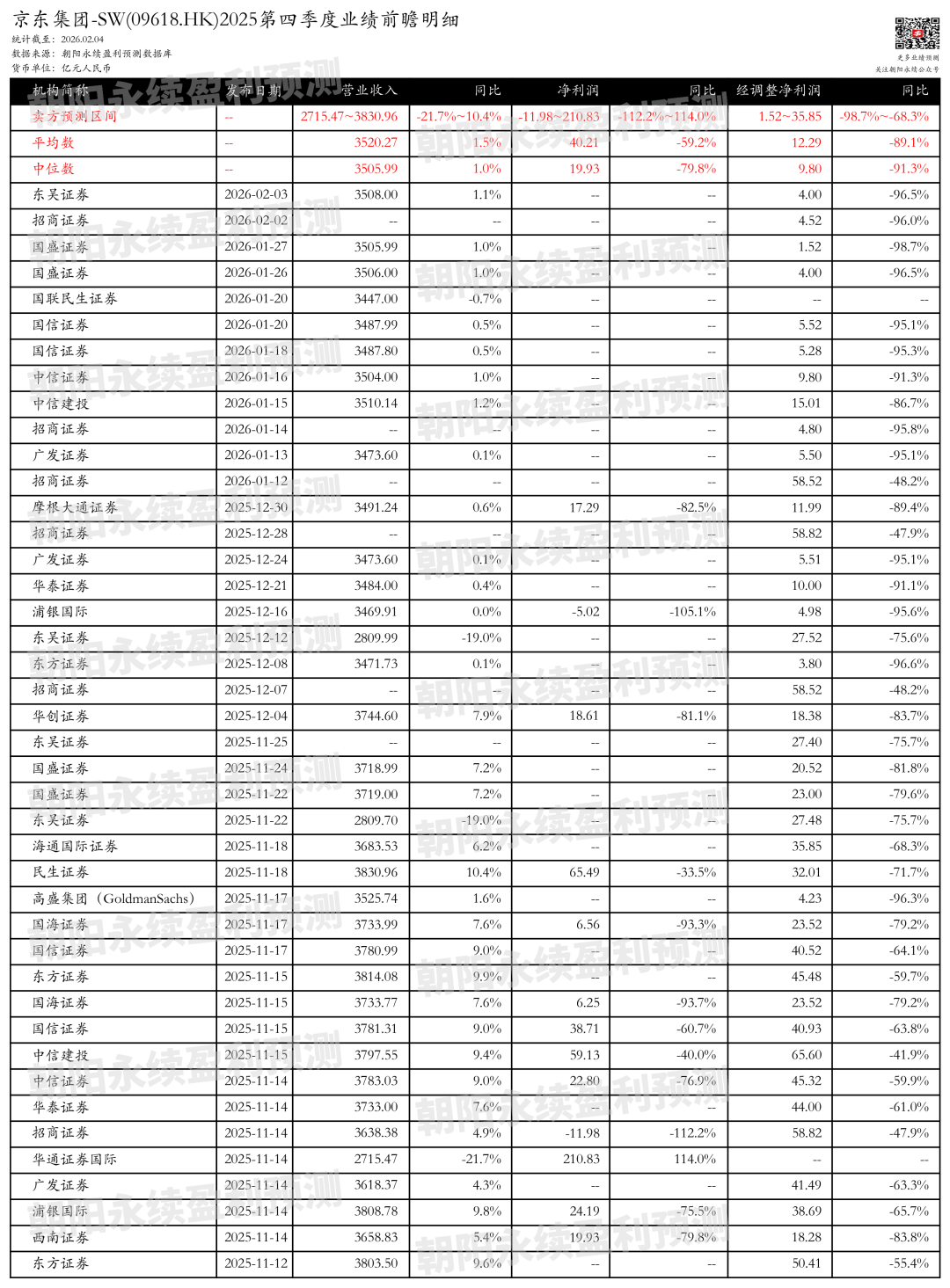
京东集团-SW:新业务减亏,预测第四季度营业收入2715.47~3830.96亿元,同比变动-21.7%~10.4%
Xin Lang Cai Jing· 2026-02-04 12:20
Core Viewpoint - JD Group is expected to report a mixed performance in Q4 2025, with revenue forecasts ranging from 271.55 to 383.10 billion yuan, reflecting a year-on-year change of -21.7% to 10.4% [1][6][8] - The net profit is projected to be between -1.20 to 21.08 billion yuan, with a year-on-year change of -112.2% to 114.0% [1][6][8] - Adjusted net profit is anticipated to be between 0.15 to 3.58 billion yuan, showing a year-on-year change of -98.7% to -68.3% [1][6][8] Revenue Forecast - The revenue forecast for JD Group in Q4 2025 is between 271.55 billion and 383.10 billion yuan, with a significant range indicating uncertainty in performance [1][6][8] - Specific predictions include a revenue of 350.80 billion yuan, representing a 1.1% increase year-on-year [2][8] Profitability Insights - The expected net profit range indicates a potential loss, with estimates showing a drastic decline compared to the previous year [1][6][8] - Non-GAAP net profit is expected to be negatively impacted by declining retail profits and investments in new business ventures [2][9] Business Segment Analysis - Retail business revenue is projected to reach 298.13 billion yuan, down 2.91% year-on-year, with significant declines in the sales of electronic products [3][9] - New business losses are expected to narrow, with improvements in user experience (UE) and healthy growth in order volume for the food delivery segment [4][9] Future Outlook - The company anticipates a recovery in profits in 2026, driven by improvements in the food delivery business and manageable losses in JD's new ventures [4][11] - The implementation of national subsidy policies in 2026 is expected to enhance retail demand, particularly for home appliances and digital products [11]