凯盛科技

Search documents
光研之声2026年3月联合月报:春归-20260301





EBSCN· 2026-03-01 07:47
2026 年 3 月 1 日 联合研究 春归 ——光研之声 2026 年 3 月联合月报 要点 当前策略观点 2 月权益市场先抑后扬。2 月份的资本市场在月初出现了一定程度的波动, 但之后持续回升。我们认为主要原因一方面与春节前市场交易热度下行有 关,另一方面也受到了短期政策引导市场降温以及部分中长期资金短期流出 影响。并不影响市场长期趋势。在春节后,市场逐步回升,交易热度也有所 提升。 未来将进入到经济数据与政策验证阶段,市场表现值得期待。在春节之后, 市场交易热度会出现季节性回升,奠定了未来市场表现的基础。同时,未来 一个月市场将进入到密集的数据与政策验证期。1、2 月份的一系列经济金融 数据将会逐步披露,奠定市场对于全年经济的基础预期。从目前已经披露的 部分数据以及高频数据来看,经济仍然处于高质量逐步修复的趋势之中。结 合之前的年报预告情况,预计未来经济与企业盈利数据将给资本市场带来支 撑。此外,全国"两会"也将在 3 月份召开,这将确定全年的政策基调以及 经济目标,对于资本市场同样意义重大,值得重点关注。不过外部可能会有 一定的不确定性,例如中东区域,或许会带来一定程度扰动。总体来看,3 月份权益市场 ...
太空光伏,未来最具确定性的25家公司
Sou Hu Cai Jing· 2026-02-27 13:45
关于报告的所有内容,请于公众『市场分析报告』阅读原文 《太空光伏,未来最具确定性的25家公司》 近日,中国一次性向国际通信联盟提交了超20万颗卫星的部署计划,同时,SpaceX也向美国联邦通信委员会申请 发射100万颗卫星。这一轮卫星互联网的密集部署,背后不仅是频轨资源的排他性争夺,更预示着太空基础设施 建设正从单纯的通信功能向算力上天演进。在大国科技竞争的背景下,低轨卫星市场的规模正从数十兆瓦级向百 兆瓦、甚至吉瓦级迈进,能源补给成为了限制太空资产扩张的核心瓶颈。 本次梳理重点聚焦太空光伏这一前沿领域,通过对太空算力趋势、太空光伏市场前景以及中国相关产业链企业发 展机遇的系统性分析,展现能源转型在星辰大海中的新路径。太空光伏主要包含太空对太空供电(S2S)以及太 空对地面供电(S2E)两大主流场景,前者决定了当前卫星与空间站的生命线,后者则承载着人类实现24小时全 天候清洁能源补给的终极梦想。 一、轨道资源与太空算力驱动能源变革 短期内,太空卫星基础设施的频轨资源具有显著的先到先得特征。由于地球轨道空间有限,且电磁频谱属于不可 再生资源,谁先占领轨道并投入运行,谁就拥有了这一区域的话语权。随着人工智能应用呈 ...

能源转型新技术观察(6):太空光伏,是否会成为下一个星辰大海?
HTSC· 2026-02-25 02:50
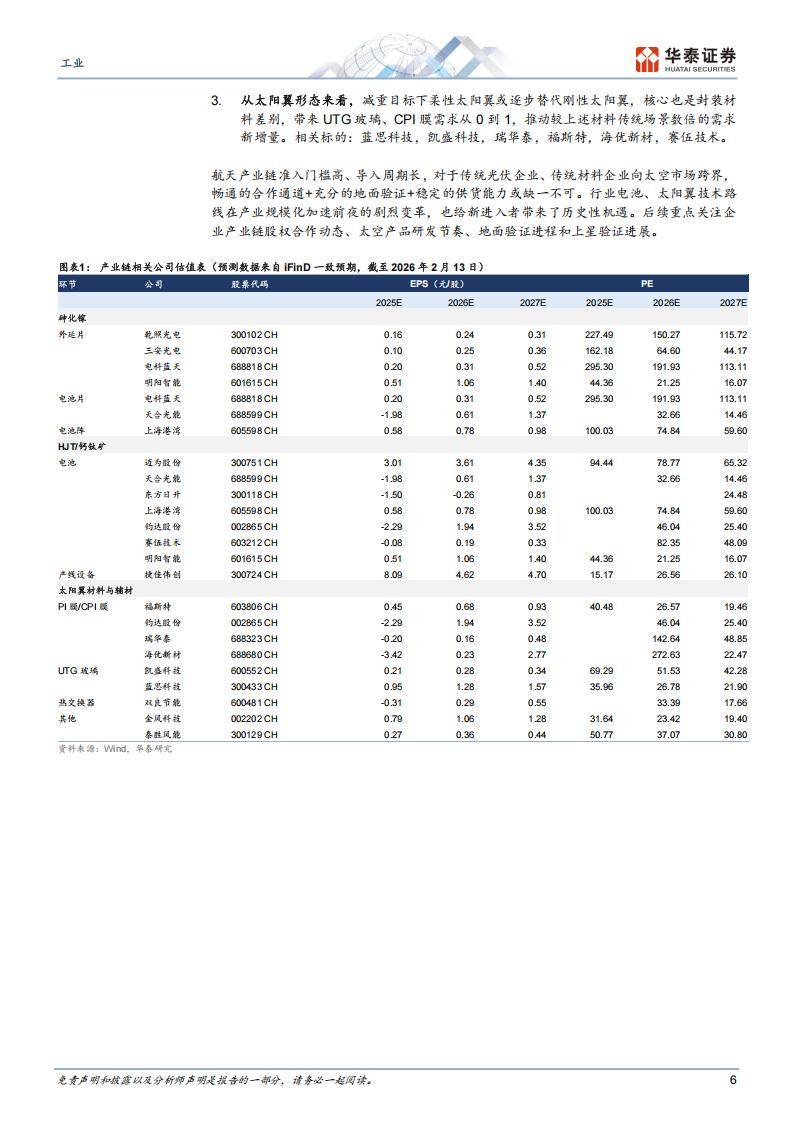
Investment Rating - The report does not explicitly provide an investment rating for the industry Core Insights - The satellite launch industry is entering an accelerated phase, with significant growth expected in satellite deployment plans, including over 200,000 satellites submitted by China and 1 million by SpaceX, indicating a potential increase in the global satellite market from tens of MW to hundreds of MW and GW levels [15][21][22] - The space photovoltaic market is currently valued at 30 MW, representing only 2% of the terrestrial photovoltaic market, but could expand significantly under various scenarios, potentially reaching 100 GW and generating up to 9 times the value of the terrestrial market [3][18] - The competition for orbital resources is intensifying, with low Earth orbit (LEO) communication satellites becoming the primary focus, as they offer lower latency and broader applications compared to traditional satellites [16][35] Summary by Sections Section 1: Industry Growth and Satellite Launches - The global satellite launch volume is expected to reach a historical high in 2025, with a projected increase of 72.5% in new satellites launched, totaling approximately 4,330 satellites [22][21] - China's satellite deployment plans are ambitious, with a significant increase in the number of satellites expected to be launched by 2030, potentially exceeding 10,000 annually [21][27] Section 2: Space Photovoltaics Market Potential - The current space photovoltaic market is small, but three scenarios could lead to substantial growth: 1. A dense launch of communication satellites could push the market to 40% of the terrestrial photovoltaic market 2. Initial networking of computing constellations could create a demand for 10 GW of space photovoltaics, surpassing terrestrial values 3. Dominance of computing satellites could lead to a demand of 100 GW, increasing market value significantly [3][18] Section 3: Technological Developments and Supply Chain Opportunities - The report highlights the need for technological advancements in space photovoltaic systems, particularly in materials and efficiency, as traditional technologies face limitations in space environments [8][17] - The supply chain for space photovoltaics is expected to see increased demand for packaging materials, which are significantly more valuable in space applications compared to terrestrial uses [19][18] - The shift towards flexible solar wings is anticipated to replace rigid designs, creating new opportunities for materials such as UTG glass and CPI films [19][18]
重磅!2025年中国及31省市宠物芯片行业政策汇总及解读(全) 宠物芯片从“试点”走向“规模化推广”
Qian Zhan Wang· 2026-02-24 02:09
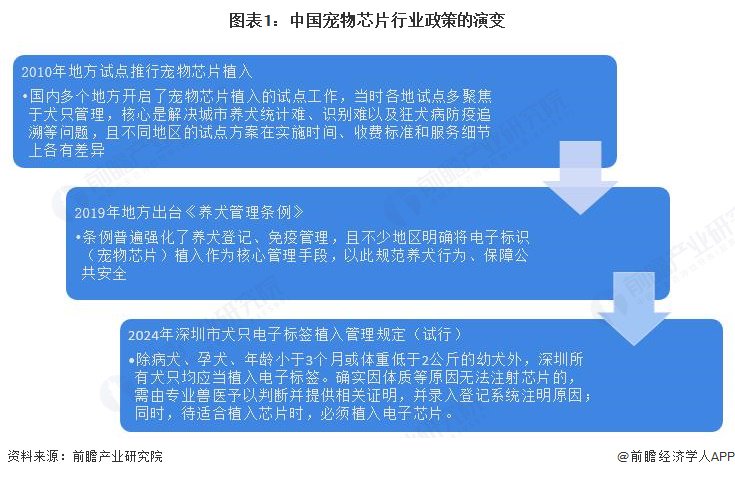
Core Viewpoint - The article discusses the development and regulatory landscape of the pet chip industry in China, highlighting the importance of pet chips for pet management and public safety, as well as the evolving policies at both national and local levels [1][5][7]. Policy Development Timeline - The pet chip industry in China began pilot programs in 2010, focusing on dog management to address issues like urban dog population statistics and rabies prevention. By 2019, many regions implemented dog management regulations that emphasized the use of electronic identification (pet chips) [3]. - In 2024, Shenzhen's regulations mandate that all dogs, except for certain exceptions, must be implanted with electronic tags, reinforcing the importance of pet chips in public safety and management [3][9]. National Policy Summary - Currently, there are no direct national policies specifically targeting the pet chip industry; it falls under the broader pet economy sector. However, relevant regulations include customs announcements that require pets to be microchipped for identification when entering the country [5][6]. - Key national policies include the "Pet Feed Labeling Regulations" and "Pet Feed Hygiene Regulations," which aim to standardize pet food labeling and hygiene standards [6]. Local Policy Summary - Several provinces, including Shandong, Guangdong, Chongqing, Fujian, and Guizhou, have implemented mandatory pet chip implantation policies. For instance, Shandong's regulations require all registered dogs to have electronic chips as identification [7][9]. - Guangdong's regulations specify that all dogs must be microchipped and registered, with detailed management protocols established for pet ownership [9][10]. Development Goals - The regulations aim to standardize dog management, ensure public health and safety, and maintain social order. Local governments are actively promoting the pet chip industry to enhance pet management practices [12][13].



凯盛科技(600552.SH):没有T-glass微型玻璃纤维相关业务及技术
Ge Long Hui· 2026-02-12 10:01
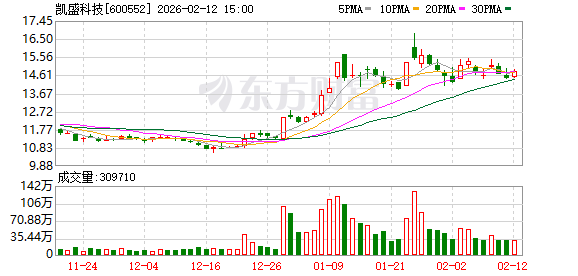
Core Viewpoint - Kaisheng Technology (600552.SH) clarified on its investor interaction platform that the company primarily produces display materials and application materials, and does not have any business or technology related to T-glass micro glass fiber [1] Company Summary - The company focuses on the production of display materials and application materials [1] - There is no involvement in T-glass micro glass fiber business or technology [1]

凯盛科技(600552.SH):目前暂无产品用于光纤制造和光通信
Ge Long Hui· 2026-02-12 09:48
Group 1 - The company, Kaisheng Technology (600552.SH), primarily produces display materials and application materials [1] - Currently, the company does not have any products used for fiber manufacturing and optical communication [1]
凯盛科技:公司生产的超薄柔性玻璃可用于折叠屏手机,已向下游客户批量交付并产生一定的经济效益
Mei Ri Jing Ji Xin Wen· 2026-02-12 09:41
Group 1 - The company, Kaisheng Technology (600552.SH), confirmed that its ultra-thin flexible glass can be used in foldable smartphones and has already delivered it in bulk to downstream customers, generating certain economic benefits [2] - The inquiry from investors specifically asked about the application of the company's flexible glass in brands such as Huawei, Honor, Oppo, and Vivo [2] - The company is actively engaging with investors regarding the performance and application of its products in the foldable smartphone market [2]
凯盛科技:公司没有T-glass微型玻璃纤维相关业务及技术
Mei Ri Jing Ji Xin Wen· 2026-02-12 09:41
Group 1 - The company, Kaisheng Technology (600552.SH), confirmed that it does not have any business or technology related to T-glass micro glass fiber [2] - The main products of the company are display materials and application materials [2] - The inquiry was made by an investor on an interactive platform regarding the company's capabilities in T-glass technology [2]
周期专场-节后投资主线解读
2026-02-11 15:40
Summary of Key Points from Conference Call Records Industry Overview Commercial Aerospace - Shanghai Port Bay's perovskite technology in collaboration with Dongfang Risen is expected to benefit from the SpaceX supply chain. The increase in satellite launches will boost the demand for solar wings, positively impacting related companies [1][3]. Refractory Materials - Companies like Zhongsen Technology, Luyang Energy, and Zhonggang Nairuo are performing well through business extensions and are considered important targets for investment as the sector begins to rally [1][3]. AI+ Sector - Companies such as China National Materials, Honghe Technology, Feilihua, and China Jushi are benefiting from LDK demand, leading to significant profit increases. Attention is drawn to upstream raw materials like high-end electronic fabrics [1][3]. Construction and Building Materials - New business models in the construction and building materials industry focus on increasing market share and revenue scale, with a clear supply clearing and gradual industry improvement. Sanjias Tree's beautiful countryside business and community stores are rapidly developing, while Yuhong enhances competitiveness through service model innovation [1][4]. Real Estate Market Insights Recent Data and Trends - Recent data indicates a positive trend in the real estate market, particularly in first and second-tier cities where second-hand housing transaction volume has increased year-on-year, and price indices have turned positive. The listing volume has decreased, with demand driven by school district housing improving transaction structure. The new housing market is expected to rebound post-holiday due to supply constraints [1][5]. Investment Strategy - The current rally in real estate stocks is characterized by a mix of speculative and long-term capital, suggesting a more sustainable upward trend. The second quarter may present an opportunity to increase real estate positions, with recommended stocks including China Merchants Shekou, New City Holdings, Jindi Group, and Wo Ai Wo Jia [1][6][8]. Transportation and Logistics Sector Investment Themes - The transportation and logistics sector has four main investment themes: 1. Domestic express logistics is entering a critical consolidation phase, with a focus on leading companies like ZTO Express and YTO Express [2][9]. 2. Cross-border e-commerce and the Belt and Road Initiative, with key companies including SF Holding and JD Logistics [2][9]. 3. Platform transportation through internet platforms like Didi and Cao Cao Mobility, which are expected to enhance profits with the realization of autonomous driving and new energy vehicle replacements [2][10]. 4. Large cycle sectors, including aviation and shipping, are anticipated to see profit growth due to tight supply and recovering demand. Companies like China Merchants Energy and COSCO Shipping are recommended, with significant profit elasticity expected from VLCC operations [2][10]. Additional Considerations - The real estate market's upward speed is not expected to be as rapid as in previous cycles, with a potential long-term upward trend following policy implementation. The core cities' housing prices may stabilize by the end of the year, with real estate stocks likely leading the fundamental bottom by 2 to 3 quarters [1][8]. - Long-term capital movements should be closely monitored to adjust investment strategies accordingly [1][7].
全球航天强国加码太空光伏!卫星组网驱动产业化提速,海内外共振拉升产业估值中枢
Xin Lang Cai Jing· 2026-02-09 10:09
Core Viewpoint - The articles highlight the growing interest and investment in space photovoltaic technology among various companies in China, indicating a significant potential for growth in this sector by 2026 as commercialization accelerates. Group 1: Company Overview - Xizi Clean Energy (002534) is a leading clean energy equipment manufacturer in China, focusing on high-performance perovskite photovoltaic technology and aiming to become a core supplier of materials for space photovoltaics by 2026 [1][24]. - Shanghai Port Construction (605598) is a major infrastructure company that is expanding into space photovoltaic systems, leveraging its engineering capabilities to support commercial space projects [2][25]. - TuoRi New Energy (002218) has a long-standing presence in the photovoltaic industry and is optimizing its space photovoltaic products, expecting to increase market share by 2026 [3][26]. - Mingyang Smart Energy (601615) is acquiring technology to enhance its capabilities in space solar cell development, aiming to integrate its wind and solar energy expertise [4][28]. - Woge Optoelectronics (603773) specializes in flexible solar wing materials for satellites, with a focus on high-temperature resistant films, anticipating significant growth in the space photovoltaic sector [5][29]. Group 2: Growth Outlook - Companies are expected to benefit from the rapid commercialization of space photovoltaics, with projections indicating substantial growth opportunities by 2026 [1][2][3][4][5]. - The synergy between commercial aerospace and space photovoltaic industries is anticipated to drive rapid business growth for companies like Shanghai Port Construction and Mingyang Smart Energy [2][4]. - The demand for flexible solar wings and high-efficiency photovoltaic materials is expected to surge, positioning companies like Woge Optoelectronics and TuoRi New Energy as key players in the market [3][5]. Group 3: Technological Advancements - Companies are focusing on developing materials that can withstand extreme space conditions, such as high-performance perovskite and flexible solar films, which are crucial for the success of space photovoltaic applications [1][5][6]. - The integration of advanced technologies, such as N-type solar cells and high-efficiency components, is being prioritized by firms like Junda Co. (002865) and Sanan Optoelectronics (600703) to enhance their competitive edge in the space photovoltaic market [6][10][35]. - The ongoing research and development efforts in high-efficiency solar technologies are expected to yield breakthroughs that will facilitate the commercialization of space photovoltaic solutions by 2026 [3][4][5][6].