Counterpoint Research

Search documents
阿尔特曼、皮查伊等科技巨头CEO将赴印度,出席关键市场AI峰会
Xin Lang Cai Jing· 2026-02-16 13:47
Group 1 - Global tech executives will gather in New Delhi, India, for an AI summit, highlighting the importance of the Indian market for growth [3][20] - The summit will feature key attendees such as OpenAI CEO Sam Altman and Alphabet CEO Sundar Pichai, with Indian Prime Minister Narendra Modi hosting the event [4][6][24] - The summit underscores India's potential as a critical player in AI development, with a large, tech-savvy consumer base and abundant talent [4][21] Group 2 - The Indian government aims to position the country as a global tech superpower, having approved a $18 billion semiconductor project to build a local supply chain [5][22] - Major tech companies, including Apple, are expanding their production in India, supported by government initiatives [8][22] - Venture capital is increasingly investing in Indian startups, with a significant rise in IPOs on Indian exchanges [9][23] Group 3 - The summit will focus on three main AI areas: infrastructure, users, and talent, with expectations for announcements regarding AI data center investments [10][26] - India is a top market for OpenAI's ChatGPT, which competes with other platforms for user acquisition and valuable data for model training [10][27] - The country is emerging as a hub for global capability centers (GCCs), with over 60% of newly established GCCs focusing on AI and data [12][31] Group 4 - The demand for AI talent in India is growing, with positions like "Chief AI Officer" becoming more common [11][29] - The establishment of GCCs is facilitating the recruitment of engineering talent and executives in India [13][28] - The trend indicates that over 80% of GCCs planned in the next 6-8 months will be AI-focused [31]





美股异动 | 美光科技(MU.US)盘前涨近5% 获董事增持780万美元股票
智通财经网· 2026-01-16 14:05
Group 1 - Micron Technology (MU.US) shares rose nearly 5% to $352.91 after board member Teyin Liu purchased 23,200 shares for $7.8 million, marking the first insider buy since 2022 [1] - Counterpoint Research indicates that the market has entered a "super bull market" phase, with storage chip prices expected to rise by 40% to 50% in Q1 2026 and an additional 20% in Q2 2026 due to increased demand from AI model training [1] - The demand for high-bandwidth memory (HBM) has surged, with AI servers requiring 8 to 10 times more memory than standard servers, leading major storage companies to shift over 40% of advanced DRAM capacity to HBM production [1] Group 2 - Citigroup analysts predict that storage chip prices will experience uncontrollable increases in 2026, raising the average selling price (ASP) forecast for DRAM from 53% to 88% and for NAND from 44% to 74% [2] - Nomura analysts believe the current "super cycle" in the storage industry, which began in the second half of 2025, will last at least until 2027, with significant new supply not expected until early 2028 [2] - Investors are advised to overweight leading storage companies in 2026, focusing on the "price-profit-valuation" dynamics of storage investments rather than solely on HBM as a single theme [2]

Counterpoint Research 中国系列公开线上研讨会 | 新际遇 新技术 新政策
Counterpoint Research· 2026-01-12 02:45
Core Insights - Counterpoint Research is hosting a series of webinars in January 2026 focusing on memory price trends, humanoid robots, and the automotive market dynamics, aimed at helping businesses anticipate industry changes and seize emerging opportunities [4][18]. Group 1: Memory Price Trends - The global memory market has experienced unprecedented fluctuations, with a projected price increase of 40%-50% by Q4 2025, driven by a significant shift in supply and demand dynamics due to strong demand for high-end memory from AI data centers and high-performance computing [10]. - Traditional memory types like LPDDR4 and DDR4 are facing supply shortages, leading to price inversion in the market [10]. - The webinar will explore supply-demand dynamics, pricing drivers, and their impact on OEMs and the broader technology ecosystem [10]. Group 2: Humanoid Robots - The humanoid robot market is expected to see significant growth, with a projected compound annual growth rate (CAGR) of 69.7% from 2025 to 2030, driven by expanded application scenarios, enhanced AI capabilities, and reduced hardware costs [13]. - The upcoming webinar will delve into the core technologies and definitions of humanoid robots, future application scenarios, market potential, and supply chain opportunities [17]. Group 3: Automotive Market Insights - The Chinese automotive market is undergoing a critical transformation driven by both policy and technology, with opportunities and challenges expected in 2026 [18]. - The webinar will feature insights from industry experts on market structure and sales trends, providing a unique macro perspective on the automotive landscape [16].

飙涨208%!芯片 重大利好!
Zheng Quan Shi Bao· 2026-01-08 14:56
Group 1: Samsung Electronics - Samsung Electronics reported a record operating profit of 20 trillion KRW (approximately 96.5 billion RMB) for Q4 2025, marking a significant year-on-year increase of 208%, exceeding market expectations [2][4] - The company's Q4 sales rose by 23% year-on-year to 93 trillion KRW, continuing a trend of quarterly sales surpassing 80 trillion KRW for two consecutive quarters [2] - The surge in performance is attributed to supply constraints and increased demand driven by AI, leading to higher prices for traditional memory chips, with DRAM prices rising over 30% and NAND flash prices increasing by about 20% [2][3] Group 2: Market Trends and Predictions - Analysts predict that the price of DDR5 memory will continue to rise, with a forecasted increase of 40% in Q1 2026 and an additional 20% in Q2 2026 [2] - The shift towards AI-related chip production is causing a squeeze on traditional memory chip capacity, while demand for both traditional and high-end chips is surging due to AI model training and operation [3] - Samsung's advancements in high-bandwidth memory (HBM) are exceeding market expectations, with anticipated HBM4 shipments expected to double in 2026 [3][4] Group 3: TSMC Developments - TSMC is experiencing high demand for its 3nm process technology, which remains in short supply, leading to a temporary halt in new 3nm project launches [5][6] - TSMC's 2nm process is projected to achieve a wafer production capacity 1.5 times that of the 3nm process, with expectations to capture over 95% of the global AI accelerator market [6] - The company plans aggressive production targets, aiming for a monthly wafer capacity of 140,000 for the 2nm process by the end of 2026, driven by strong demand from AI data centers [6] Group 4: Financial Outlook - Morgan Stanley forecasts a 30% year-on-year revenue growth for TSMC in 2026, with continued growth of over 20% in 2027, primarily fueled by AI data center demand [6] - The compound annual growth rate (CAGR) for AI revenue in data centers has been revised upward from 53% to 57%, with expectations that AI business will account for over 40% of TSMC's total revenue by 2029 [6]

智能手机2025年先扬后抑 2026年AI手机市占率或过半
Xin Lang Cai Jing· 2026-01-02 20:35
Core Insights - The Chinese smartphone market experienced a "first rise, then fall" pattern in 2025, driven by initial consumer demand from the "old-for-new" subsidy policy, followed by a market cooling due to tightening subsidy policies and rising costs [1][3][5] - Industry innovation continues with advancements in battery technology, imaging capabilities, and AI integration, shifting the competition from "parameter competition" to "experience competition" [1][8][10] Market Trends - The initial success of the smartphone market in early 2025 was marked by a significant sales surge during the Spring Festival, with over 4.5 million digital products sold, and smartphone sales reaching 14.1 billion yuan, a 182% year-on-year increase [3] - However, the market faced a 4% year-on-year decline in smartphone sales in Q2 2025 due to inventory adjustments by manufacturers and the diminishing effects of subsidy policies [3][5] - The global rise in storage chip prices, driven by AI demand, has significantly increased costs, with prices for Samsung LPDDR4X memory rising from approximately $6 to $25 per unit, a more than threefold increase [3][5] Pricing and Market Segmentation - Rising costs have led to increased retail prices for smartphones, with Xiaomi's Redmi K90 priced at 2,599 yuan, up 300 yuan from its predecessor [4] - High-end flagship models can better absorb cost increases, while the low-end market faces severe pressure, as price sensitivity among consumers can lead to reduced demand for new devices [4][6] - Forecasts for 2026 indicate a conservative outlook for smartphone production and shipment, with IDC predicting a 2.2% year-on-year decline in shipments to approximately 278 million units [5][6] Structural Changes in the Market - The high-end smartphone market (priced above $600) is expected to grow its market share by 5.4 percentage points to 35.9%, while the low-end market (below $200) is projected to shrink by 4.3 percentage points to 20% [6] - The second-hand smartphone market is anticipated to grow by 20% in 2026, reaching over 100 million units, as consumers may opt for second-hand devices due to rising new device prices [7] Technological Innovations - The industry is focusing on significant upgrades in battery capacity, with major brands adopting 6,000-7,000mAh batteries, and some models featuring batteries as large as 8,300mAh [8] - Imaging technology is advancing with new models featuring 200-megapixel cameras, while AI capabilities are being integrated into devices with high-performance chips [8][10] - The competition is shifting towards AI capabilities and ecosystem integration, with brands needing to differentiate themselves through innovation and emotional engagement with consumers [9][10] Future Outlook - The year 2026 is seen as critical for the Chinese smartphone market, where success will depend on manufacturers' ability to navigate cost pressures and establish emotional connections with consumers [2][5] - IDC forecasts that the shipment of AI-enabled smartphones will reach 147 million units in 2026, representing a 31.6% year-on-year growth and accounting for 53% of the overall market [10][11]
美股异动 禾赛(HSAI.US)涨逾3% 机构:2035年激光雷达和成像雷达市场规模预计将达280亿美元
Jin Rong Jie· 2025-12-30 15:59
Group 1 - The core viewpoint of the article highlights that the global market for Advanced Driver Assistance Systems (ADAS) and Autonomous Driving (AD) sensors is expected to reach $61 billion by 2035 according to Counterpoint Research [1] - Camera sensors are projected to remain the largest segment in terms of sales, with a market size expected to reach $20 billion by 2035, driven by their extensive use in braking systems, lane-keeping systems, and driver monitoring systems [1] - LiDAR and imaging radar are anticipated to be among the fastest-growing segments in terms of value, with a combined market size expected to reach $28 billion by 2035, as automakers seek higher resolution perception and redundancy technologies for advanced autonomous driving features [1]

禾赛(HSAI.US)涨逾3% 机构:2035年激光雷达和成像雷达市场规模预计将达280亿美元
Zhi Tong Cai Jing· 2025-12-30 15:14
Core Viewpoint - The global market for Advanced Driver Assistance Systems (ADAS) and Autonomous Driving (AD) sensors is projected to reach $61 billion by 2035, indicating significant growth in the automotive technology sector [1] Market Segmentation - Camera sensors are expected to remain the largest segment, with a market size projected to reach $20 billion by 2035, driven by their extensive use in braking systems, lane-keeping systems, and driver monitoring systems [1] - LiDAR and imaging radar are anticipated to be among the fastest-growing segments in terms of value, with a combined market size expected to reach $28 billion by 2035, as automakers seek higher resolution perception and redundancy technologies for advanced driving functionalities [1]
QNX Embedded Technology Now Powering More Than 275 Million Vehicles on the Road
Accessnewswire· 2025-12-16 13:00
Milestone reinforces QNX's role as the backbone of the SDV revolution, delivering trusted, safety-certified high performance foundational software to the automotive industry WATERLOO, ON / ACCESS Newswire / December 16, 2025 / QNX, a division of BlackBerry Limited (NYSE:BB)(TSX:BB) today announced that Counterpoint Research, a leading technology analysis and market research firm, has confirmed that QNX® software is now embedded in more than 275 million vehicles worldwide; an increase of 100 million since 20 ...


X @Bloomberg
Bloomberg· 2025-12-16 06:15
Market Trends - Global smartphone shipments are projected to decline by 2.1% next year [1] Industry Challenges - A shortage of memory chips is expected to drive up costs [1] - Increased costs are anticipated to squeeze smartphone production [1]
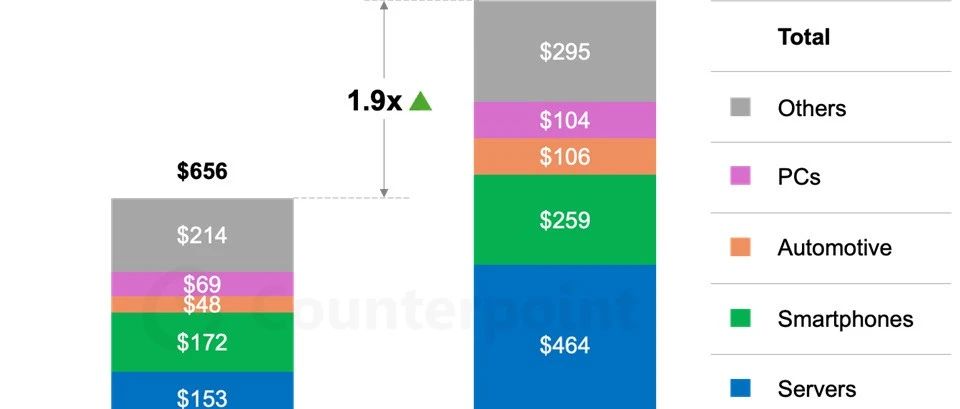
到2030年全球半导体营收将突破1万亿美元,受“Agentic AI”与“Physical AI”兴起驱动
Counterpoint Research· 2025-08-28 02:02
Core Insights - Counterpoint Research predicts that global semiconductor revenue will nearly double from 2024 to 2030, exceeding $1 trillion [4][5]. Group 1: Semiconductor Market Growth - The growth in semiconductor revenue is driven by the infrastructure needed for AI transformation, transitioning from GenAI to Agentic AI and eventually to Physical AI [5][9]. - Major demand will come from hyperscalers, with a focus on advanced AI server infrastructure to support the increasing needs for multi-modal GenAI applications [5][9]. Group 2: AI Token Economy - The emergence of the "Token economy" is highlighted, where tokens are becoming the new currency for AI, significantly increasing token consumption as applications evolve from basic text to richer multi-modal GenAI [7][10]. - The second phase of this economy is marked by exponential growth in token generation, supporting complex conversational AI and multimedia content production, which will drive substantial demand for computing power, memory, and networking in the semiconductor sector [7][10]. Group 3: Future of AI and Semiconductor Industry - The AI market in 2024 will be hardware-centric, with approximately 80% of direct revenue coming from semiconductor infrastructure and edge devices [10]. - The long-term evolution will see a shift from Agentic AI applications to Physical AI, promoting the development of autonomous robots and vehicles over the next decade [9][10].