
专项债券

Search documents
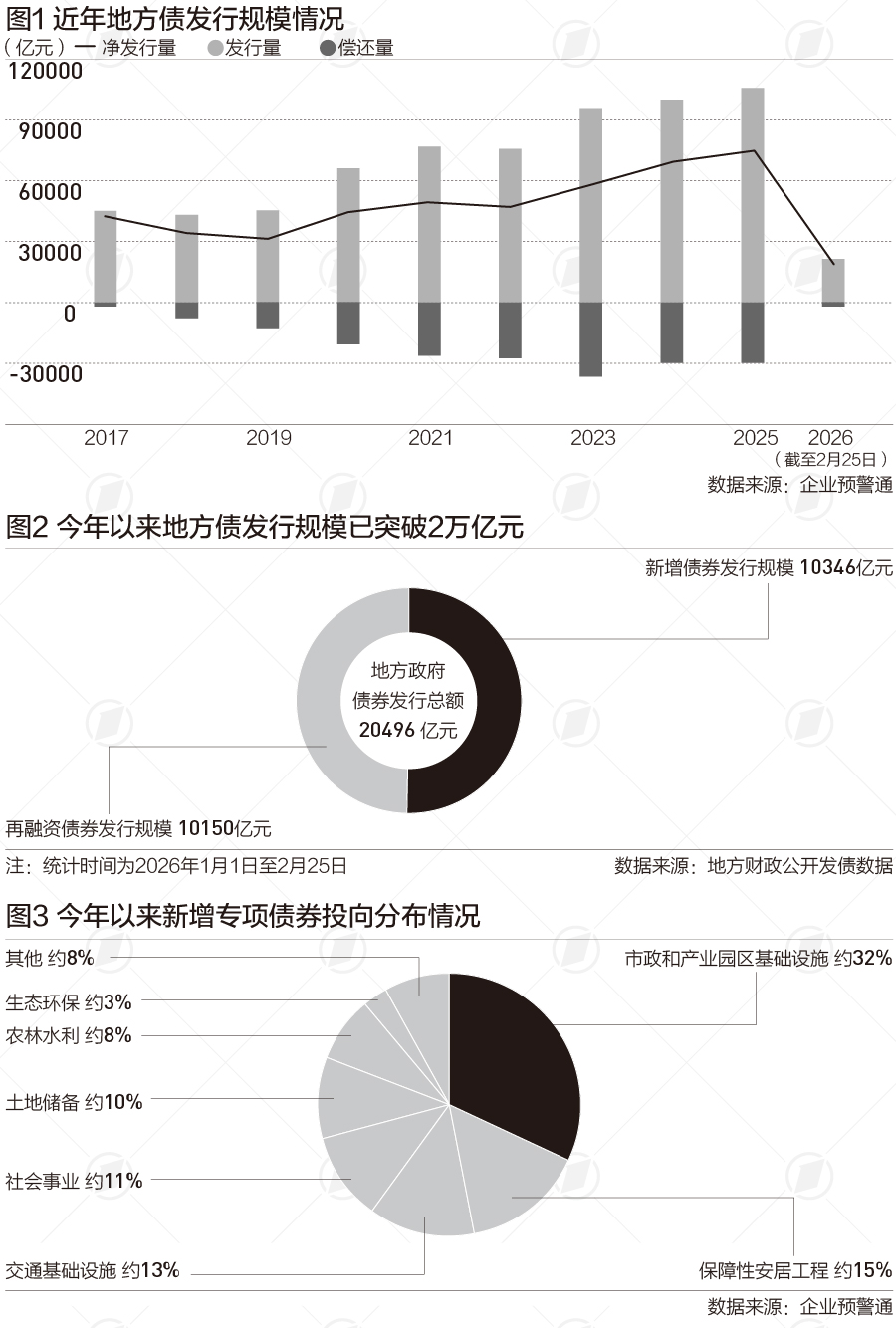
2026年开年不到两个月,地方政府债券发行规模已突破2万亿元,同比增长约22%
Sou Hu Cai Jing· 2026-02-26 13:47
值得关注的是,为提升专项债发行效率,2025年已有10个省份试点专项债"自审自发"。从试点效果看, 自审自发地区的发行进度快于全国平均水平,且项目审批更为严格。回顾2025年全年,全国地方政府债 券发行规模首次突破10万亿元,积极财政政策持续加力的态势十分明显。 2026年开年不到两个月,地方政府债券发行规模已突破2万亿元大关。根据地方财政部门公开发债信 息,截至2月25日,全国地方政府债券发行规模超过2万亿元。2月26日当天,江苏、重庆等5个省份合计 发行约1392亿元地方政府债券,2月27日湖南、辽宁还将合计发行约892亿元。据此测算,今年前2个月 地方政府债券发行规模约为2.28万亿元,预计较去年同期增长约22%。 声明:市场有风险,投资需谨慎。本文为AI基于第三方数据生成,仅供参考,不构成个人投资建议。 发债节奏加快的背后,是"十五五"规划开局之年各地重大项目建设的资金需求。去年底,财政部已提前 下达部分2026年新增地方政府债务限额——以广东为例,获得提前下达的新增债务限额达3412亿元,这 使得今年地方债发行工作早在1月便已启动。截至目前,全国已有32个省市(自治区、直辖市、计划单 列市)参与了地 ...
今年地方债发行规模已破2万亿,积极财政政策发力|财税益侃
Di Yi Cai Jing· 2026-02-26 12:50
"十五五"规划开局之年,不少地方推出重大建设项目。 春节假期之后,地方政府密集发行政府债券,筹集资金推动重大项目建设,以稳投资、稳经济、防风险。 根据地方财政部门公开发债信息,截至2月25日,全国地方政府债券发行规模已经突破2万亿元。26日,江苏、重庆等5省份将合 计发行约1392亿元地方政府债券;27日湖南、辽宁将合计发行约892亿元地方政府债券。因此,今年前2个月地方政府债券发行 规模(约2.28万亿元),预计比去年同期增长约22%。 长期关注地方债的中央财经大学教授温来成告诉第一财经,今年是"十五五"规划开局之年,不少地方推出重大建设项目。今年 以来,地方政府债券发行速度较快,将为这些政府重大项目开工建设筹集资金,推动项目尽早开工建设形成实物工作量。 近些年,中国持续实施积极财政政策。在严堵地方政府违规举债融资的"后门"同时,地方政府发行政府债券规模持续攀升。 2025年,全国地方政府债券发行规模首次突破10万亿元。多位接受第一财经采访的专家认为,今年地方政府债券发行规模将依 然维持在这一高位。 "今年经济增长仍面临一些压力,国内有效需求依然不足,而外部环境仍有诸多不确定性,今年以来地方密集发行地方政府 ...

上海百亿级国资基金 扩募
Shang Hai Zheng Quan Bao· 2026-02-05 15:47
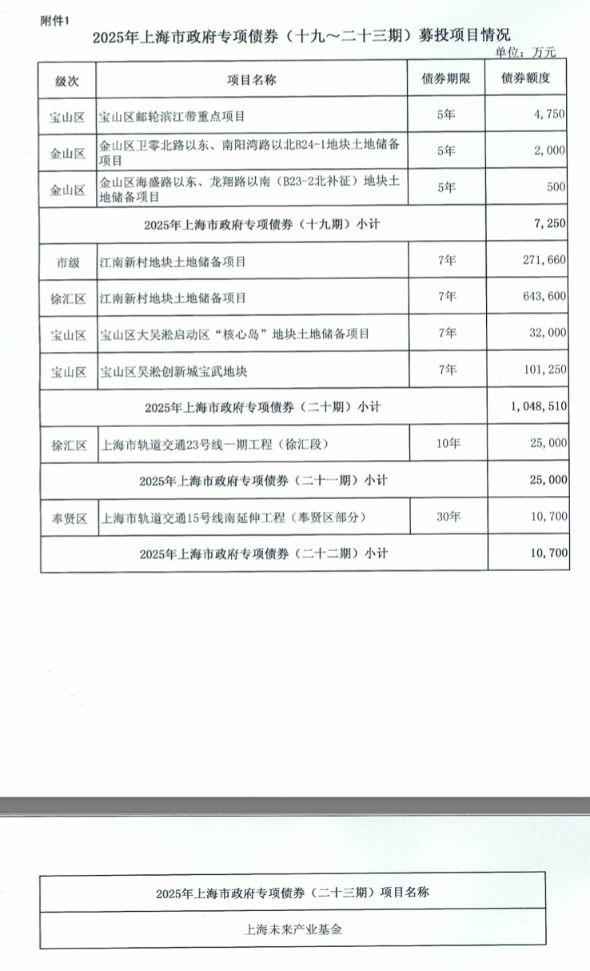
一级市场"活水"进一步扩充,助力科技创新企业发展。 日前,上海市科学技术委员会发布的《2025上海科技进步报告》显示,上海国投旗下的上海未来产业基 金规模已从100亿元扩募至150亿元。 报告显示,2025年上海加快推进未来产业基金投资布局,累计投决子基金及直投项目38个,累计投决金 额达33.2亿元。其中,23个子基金项目投决金额达28.55亿元,撬动资金超190亿元,初步形成聚焦科创 前沿领域、投早投小的子基金生态投资矩阵;15个直投项目投决金额达4.65亿元,覆盖先进核能、量子 计算、AI4S(Artificial Intelligence for Science)、脑机接口、合成生物、天基计算和具身智能等前沿领 域。 扩募资金源自专项债 上海未来产业基金负责人告诉上海证券报记者,本次扩募资金来源是2025年上海市政府专项债券。 2025年8月22日,2025年第三批上海市政府债券发行信息披露文件中显示,2025年上海市政府专项债券 二十三期用于上海未来产业基金。 | | | | 单位: 力元 | | --- | --- | --- | --- | | 级次 | 项目名称 | 债券期限 | 债券额度 | ...
财政部:将以“硬核”举措支持稳就业、稳企业、稳市场、稳预期
Zhong Guo Jing Ji Wang· 2026-01-20 08:17
Core Viewpoint - The Chinese government is committed to implementing a more proactive fiscal policy in 2026 to support employment, businesses, and market stability, ensuring a strong start for the 14th Five-Year Plan [1] Group 1: Fiscal Policy Measures - The fiscal department will increase the scale of fiscal spending, maintaining a reasonable level of fiscal deficit, debt, and total expenditure in 2026, ensuring that overall spending intensity "only increases" and key areas are "only strengthened" [1] - The proactive fiscal policy in 2026 builds on the measures taken in 2025, highlighting the government's commitment to an active policy stance while considering long-term fiscal sustainability [1] Group 2: Structural Optimization - The focus will be on optimizing the structure of fiscal spending, ensuring funds are allocated to critical areas, breaking the "base + growth" spending pattern, and applying zero-based budgeting to reduce ineffective expenditures [2] - More fiscal funds will be directed towards boosting consumption, investing in human capital, and ensuring social welfare, enhancing the public's sense of gain and happiness [2] Group 3: Efficiency Improvement - The aim is to improve the effectiveness of fiscal fund usage, ensuring that every penny generates expected benefits, with plans to issue long-term special bonds for key construction and new initiatives [2] - There will be an emphasis on enhancing the synergy between fiscal and financial policies, exploring innovative policy tools to amplify the impact of public funds and the spillover effects of public policies [2] Group 4: Strengthening Economic Momentum - The core of the strategy involves deepening reforms in key fiscal and tax areas to stimulate internal economic vitality, optimizing transfer payment structures, and enhancing local fiscal autonomy and coordination capabilities [2] - Measures will include improving the effectiveness of transfer payment funds, strengthening budget performance management, and refining tax rebate policies and fiscal subsidies to boost local fiscal development momentum [2]
国常会:加紧清理拖欠企业账款,尽快下达支持清欠的专项债额度
2 1 Shi Ji Jing Ji Bao Dao· 2026-01-16 13:07
21世纪经济报道记者 周潇枭 北京报道 1月16日,国务院总理李强主持召开国务院常务会议,部署做好 清理拖欠企业账款行动和保障农民工工资支付有关工作。 比如,2025年6月,云南省人大对外公布的云南省本级预算调整方案的审查结果报告显示,2025年财政 部下达云南省新增专项债务额度955亿元,包含用于项目建设的230亿元、用于解决地方政府拖欠企业账 款的356亿元、用于补充政府性基金财力的369亿元。 2025年10月,中央财政安排使用5000亿元地方债结存限额时,部分额度用于支持消化拖欠企业账款。财 政部相关负责人表示,从地方政府债务结存限额中安排5000亿元下达地方,支持地方化解存量政府投资 项目债务、消化政府拖欠企业账款、部分省份项目建设等。 会议指出,清理拖欠企业账款和保障农民工工资支付事关企业合法权益和群众切身利益,必须高度重 视,持续加大工作力度。要加紧清理拖欠企业账款,紧盯重点地区加强督促指导,压实地方责任,统筹 安排、尽快下达用于支持清欠的专项债券额度,更大发挥金融政策作用,健全清欠长效机制,加快清理 存量、坚决遏制增量。要扎扎实实解决拖欠工资问题,继续组织实施好治理欠薪专项行动,严格落实欠 薪 ...
年内专项债券投向政府投资基金合计规模近850亿元
Zheng Quan Ri Bao· 2025-12-15 16:08
Core Insights - Recent issuance of special bonds targeting government investment funds has created a "small peak" in multiple regions, with a total scale of 847.3 billion yuan reported by December 15 [1][2] Group 1: Special Bond Issuance - Shenzhen issued 3.48 billion yuan in special bonds for its government investment guidance fund on December 11 [1] - Guangdong issued 10 billion yuan in special bonds for its government investment fund on November 28, alongside Sichuan and Shanghai each issuing 5 billion yuan for their respective funds [1] - A total of 11 regions have disclosed special bond issuances directed towards government investment funds this year [1] Group 2: Utilization of Special Bonds - Approximately 26.6% of the special bond funds have been allocated to municipal and industrial park infrastructure, 17.2% to land reserves, and 16.9% to transportation infrastructure [2] - Traditional infrastructure remains a key focus, with over 60% of funds directed towards core areas such as municipal and industrial park infrastructure, land reserves, and transportation [2] - New infrastructure, although currently only 1.1% of total allocations, is gradually being included, aligning with the trends of digital economy development [2] Group 3: Expert Opinions - Experts believe that the issuance of special bonds to government investment funds provides a low-cost, long-term funding channel and can leverage significant social capital for long-term project needs [1] - There is a call for expanding the use of special bonds to include emerging fields and increasing the funding proportion for new infrastructure and strategic emerging industries [2]
多地积极部署2026年专项债券项目储备工作
Zheng Quan Ri Bao· 2025-11-23 17:09
Core Viewpoint - The Chinese government is intensifying its fiscal policy efforts as the year-end approaches, with a focus on advancing the planning and issuance of special bonds for 2026 to support key projects and economic recovery [1][2][3] Group 1: Fiscal Policy and Special Bonds - The Ministry of Finance plans to continue issuing new local government debt limits for 2026 to ensure funding for major projects and bolster economic recovery [1] - Various regions, such as Hubei and Jiangxi, have initiated the planning and review of special bond projects for 2026, focusing on areas like education, healthcare, and urban infrastructure [1][2] - As of November 23, the total issuance of new special bonds this year has reached approximately 42,315 billion yuan, achieving 96% of the annual target of 44,000 billion yuan [2] Group 2: Importance of Project Planning - Experts emphasize the necessity of early planning for special bond investment projects, particularly those aimed at urban renewal and improving living conditions, to ensure a stable economic outlook and high-quality development [2] - The proactive approach of local governments in preparing for 2026 special bond projects reflects a strong commitment to stabilizing investment and expanding domestic demand [2][3] - The successful issuance of special bonds this year has played a crucial role in stabilizing the macro economy and enhancing public welfare, laying a solid foundation for future fiscal policy continuity [3]
宏观纵览 | 前10月广义财政支出增速放缓至5.2%,待年末发力
Sou Hu Cai Jing· 2025-11-21 10:03
Group 1 - The core viewpoint of the articles highlights the proactive fiscal policies implemented in China, with significant increases in fiscal spending aimed at supporting economic recovery and enhancing social welfare [1][5][6] - In the first ten months of this year, the broad fiscal revenue was approximately 22.1 trillion yuan, showing a year-on-year growth of about 0.2%, while broad fiscal expenditure reached around 30.7 trillion yuan, with a year-on-year increase of approximately 5.2% [1][2] - The broad fiscal expenditure exceeded revenue by about 8.6 trillion yuan, marking a year-on-year increase of 21%, indicating a strong commitment to maintaining fiscal support for the economy [1][3] Group 2 - The national general public budget expenditure for the first ten months was approximately 22.6 trillion yuan, with a year-on-year growth of 2%, particularly in social security and employment, education, and health care, which all saw growth rates exceeding the average of 2% [2][3] - Notably, social security and employment expenditure surged by 9.3%, reflecting the government's focus on enhancing the welfare of families [2] - Infrastructure spending within the national general public budget has declined, with agricultural, forestry, and water expenditures down by 11.7%, and urban and rural community expenditures down by 7.3% [3][4] Group 3 - To maintain fiscal spending levels, new incremental policies have been introduced, including the allowance for local governments to issue an additional 500 billion yuan in special bonds [5][6] - These special bonds are expected to be rapidly issued starting in November, with over 10 billion yuan already issued in the first 19 days of November [6] - The new policy financial tools have been fully deployed, supporting over 2,300 projects with a total investment of approximately 7 trillion yuan, focusing on sectors such as digital economy, artificial intelligence, and urban infrastructure [6]
前10个月广义财政支出增速放缓至5.2%
第一财经· 2025-11-21 02:53
Core Viewpoint - China's fiscal policy has become more proactive this year, with fiscal spending maintaining a certain level of intensity, which supports the continuous recovery of the economy [3]. Fiscal Revenue and Expenditure - In the first ten months of this year, the broad fiscal revenue was approximately 22.1 trillion yuan, a year-on-year increase of about 0.2%, while broad fiscal expenditure was about 30.7 trillion yuan, a year-on-year increase of 5.2% [3]. - The broad fiscal expenditure exceeded revenue by approximately 8.6 trillion yuan, a year-on-year increase of 21% [3]. Fiscal Spending Structure - The structure of fiscal spending has shown a clear tilt towards the livelihood sector, aligning with the government's report advocating for more resources to be "invested in people" [4]. - In the first ten months, the general public budget expenditure was approximately 22.6 trillion yuan, with social security and employment spending reaching 3.8 trillion yuan, education spending at 3.4 trillion yuan, and health spending at 1.7 trillion yuan, all showing growth rates above the average of 2% [4]. Infrastructure Spending - Due to increased funding directed towards livelihood, infrastructure spending in the general public budget has seen an overall decline [5]. - Expenditures on agriculture, forestry, and water, as well as urban and rural community spending, decreased by 11.7% and 7.3% respectively [7]. Government Fund Expenditure - Government fund budget expenditure was approximately 8.1 trillion yuan, a year-on-year increase of 15.4%, primarily due to accelerated use of bond funds [7]. - The issuance of special bonds and long-term special treasury bonds has supported the commencement of numerous major projects, stabilizing investment and the economy [7]. Future Fiscal Policy Measures - To maintain a certain level of fiscal spending, new policies have been introduced, including allowing local governments to issue an additional 500 billion yuan in special bonds [9]. - As of mid-November, over 10 billion yuan in new special bonds had been issued, surpassing the total for October [9].

冠通期货早盘速递-20251103
Guan Tong Qi Huo· 2025-11-03 02:25
Hot News - The Minister of Finance, Lan Fuan, stated that during the "15th Five-Year Plan" period, funds such as special bonds and ultra-long-term special treasury bonds will be used comprehensively to optimize government investment directions and encourage private capital to participate in major project construction; tax, social security, and transfer payments will be adjusted to optimize the income distribution structure and boost consumption; and work will be done to replace the existing implicit debts of local governments, with strict accountability for illegal debt-raising and false debt reduction [2] - The National Bureau of Statistics announced that in October, China's manufacturing PMI was 49%, a decrease of 0.8 percentage points from the previous month. The non-manufacturing PMI was 50.1, an increase of 0.1 percentage points from the previous month. The composite PMI output index was 50%, a decrease of 0.6 percentage points from the previous month [2] - The Minister of Housing and Urban-Rural Development, Ni Hong, pointed out that the real estate development, financing, and sales systems need to be reformed and improved. In terms of commercial housing sales, the spot sales system will be promoted to fundamentally prevent delivery risks; for pre-sales, the supervision of pre-sale funds will be standardized to protect the legitimate rights and interests of homebuyers [2] - The Dalian Commodity Exchange announced that soybean meal and corn series options contracts will be listed for trading on February 2, 2026 (i.e., the night session on January 30). The first batch of contracts will start with the series options contracts corresponding to soybean meal M2607 and corn C2607 [2] - The Ministry of Finance and the State Tax Administration issued an announcement on the tax policy for gold, which will be implemented from November 1, 2025, to December 31, 2027. Industry insiders believe that the policy further improves the existing gold market policy, better distinguishes the commodity and financial attributes of gold, and the adjustment of the VAT policy for gold purchased on the exchange is expected to make the gold market consumption and investment environment more transparent and healthy [3] Key Focus - Key commodities to focus on include urea, lithium carbonate, polysilicon, crude oil, and PVC [4] Holiday Overseas Performance Sector Performance - Non-metallic building materials had a 3.11% increase; precious metals had a 29.39% increase; oilseeds and oils had a 9.56% increase; non-ferrous metals had a 23.08% increase; soft commodities had a 2.66% increase; coal, coke, and steel mines had a 13.49% increase; energy had a 2.87% increase; chemicals had a 10.78% increase; grains had a 1.15% increase; and agricultural and sideline products had a 3.92% increase [4] Sector Positions - The document shows the changes in the positions of commodity futures sectors in the past five days, including Wind agricultural and sideline products, Wind grains, Wind chemicals, Wind energy, Wind coal, coke, and steel mines, Wind non-ferrous metals, Wind commodity composites, Wind soft commodities, Wind oilseeds and oils, Wind precious metals, and Wind non-metallic building materials [5] Performance of Major Asset Classes Equity - The Shanghai Composite Index had a daily decline of 0.81%, a monthly increase of 0.00%, and an annual increase of 17.99%; the SSE 50 had a daily decline of 1.15%, a monthly increase of 0.00%, and an annual increase of 12.17%; the CSI 300 had a daily decline of 1.47%, a monthly increase of 0.00%, and an annual increase of 17.94%; the CSI 500 had a daily decline of 0.74%, a monthly increase of 0.00%, and an annual increase of 28.04%; the S&P 500 had a daily increase of 0.26%, a monthly increase of 0.00%, and an annual increase of 16.30%; the Hang Seng Index had a daily decline of 1.43%, a monthly increase of 0.00%, and an annual increase of 29.15%; the German DAX had a daily decline of 0.67%, a monthly increase of 0.00%, and an annual increase of 20.34%; the Nikkei 225 had a daily increase of 2.12%, a monthly increase of 0.00%, and an annual increase of 31.37%; the UK FTSE 100 had a daily decline of 0.44%, a monthly increase of 0.00%, and an annual increase of 18.89% [6] Fixed Income - The 10-year treasury bond futures had a daily increase of 0.04%, an annual decrease of 0.22%; the 5-year treasury bond futures had a daily decline of -0.01%, a monthly increase of 0.00%, and an annual decrease of 0.45%; the 2-year treasury bond futures had a daily decline of -0.02%, a monthly increase of 0.00%, and an annual decrease of 0.42% [6] Commodity - The CRB commodity index had a daily increase of 0.59%, a monthly increase of 0.00%, and an annual increase of 1.96%; WTI crude oil had a daily increase of 0.50%, a monthly increase of 0.00%, and an annual decrease of -15.36%; London spot gold had a daily decline of -0.54%, a monthly increase of 0.00%, and an annual increase of 52.53%; LME copper had a daily decline of -0.23%, a monthly increase of 0.00%, and an annual increase of 24.03%; the Wind commodity index had a daily increase of 1.47%, a monthly increase of 0.00%, and an annual increase of 30.63% [6] Other - The US dollar index had a daily increase of 0.19%, a monthly increase of 0.00%, and an annual decrease of -8.07%; the CBOE Volatility Index had a daily increase of 3.13%, a monthly increase of 0.00%, and an annual increase of 0.52% [6] Main Commodity Trends - The document presents the trends of various commodities, including the Baltic Dry Index (BDI), CRB spot index, WTI crude oil, London spot gold, London spot silver, LME 3-month copper, CBOT soybeans, and CBOT corn, as well as the risk premium of the stock market [7]