
数字化消费

Search documents
传统年俗焕新生 广西新春消费市场供需两旺人气足
Zhong Guo Xin Wen Wang· 2026-02-24 03:02
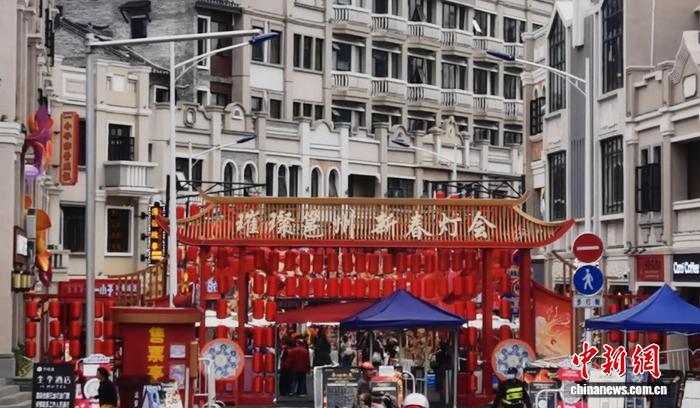
传统年俗焕新生 广西新春消费市场供需两旺人气足 商务监测数据显示,广西30个重点监测步行街、商圈客流量增长37%,销售额增长19%。其中,梧州骑 楼城、百色解放街客流量、营业额增长均超1倍。 南宁市以"三街两巷"为核心,推动中山路、水街与历史街区互联互通,打造广西规模最大的沉浸式步行 街区;防城港市举办年货潮集活动,汇聚东盟商品以及边海文创、非遗特产等产品,展现独特"国际年 味"。 图为南宁市一历史文化街区举办新春灯会吸引消费者。林浩 摄 中新网南宁2月24日电 (韦炳成 林浩)广西壮族自治区商务厅23日介绍,2026年春节假期期间,广西积极 开展"购在中国——2026广西乐购新春消费季"系列活动,通过政策红利释放、消费场景创新、业态融合 升级,不仅让传统年俗焕发新生,更带动消费市场供需两旺、活力拉满。 多重政策红利精准直达,焕新消费引领品质生活 2月15日—2月22日,广西各地推出政策补贴与节日促销的"双重红利",有效激发居民对高品质生活的追 求,广西重点企业通讯器材类、汽车类商品销售额分别同比增长(下同)32.7%、3.2%。 今年1月1日—2月22日,广西消费品以旧换新累计补贴数码和智能产品39.46万 ...

“数字化”服务助力“国际化”消费
Xiao Fei Ri Bao Wang· 2026-02-24 00:20
实施意见明确提出"完善数字化支付服务",这意味着在未来几年内,我国将不断优化跨境支付系统,进 一步打破支付平台之间的壁垒。通过实现更为通用、便捷的支付方式,极大提升境外人员的消费便利 性,鼓励更多国际消费者在中国消费。这不仅能提升他们的数字化体验,也为中国经济注入了源源不断 的消费活力。 在文旅方面,旅游业一直是我国消费领域的重要组成部分,尤其是近年来随着签证政策的放宽,境外游 客的数量不断增加。然而,尽管我国的旅游资源丰富,游客的消费潜力巨大,但由于服务体系的局限, 部分外国游客在出行过程中仍然面临信息不畅、支付困难、服务不周等问题。实施意见中提出的"优化 数字化旅游服务",不仅有助于解决外国游客在旅行中遇到的诸多难题,更将推动中国旅游消费的快速 增长。例如,数字化的旅游导航和实时翻译系统可以帮助外国游客更清晰地了解旅游线路、景点介绍和 周边设施,提升他们的旅行体验;线上购票、智慧酒店等数字化服务的普及,使外国游客能够更加便捷 地享受服务,方便他们在旅游过程中进行消费。 在数字化浪潮席卷各国的当下,做好数字化服务不仅关乎效率和便利,更在很大程度上直接影响到国家 的经济发展和国际竞争力。日前,国家网信办等11 ...
尺素金声|社零总额突破50万亿元,折射经济发展韧性与底气
Sou Hu Cai Jing· 2026-01-24 14:12
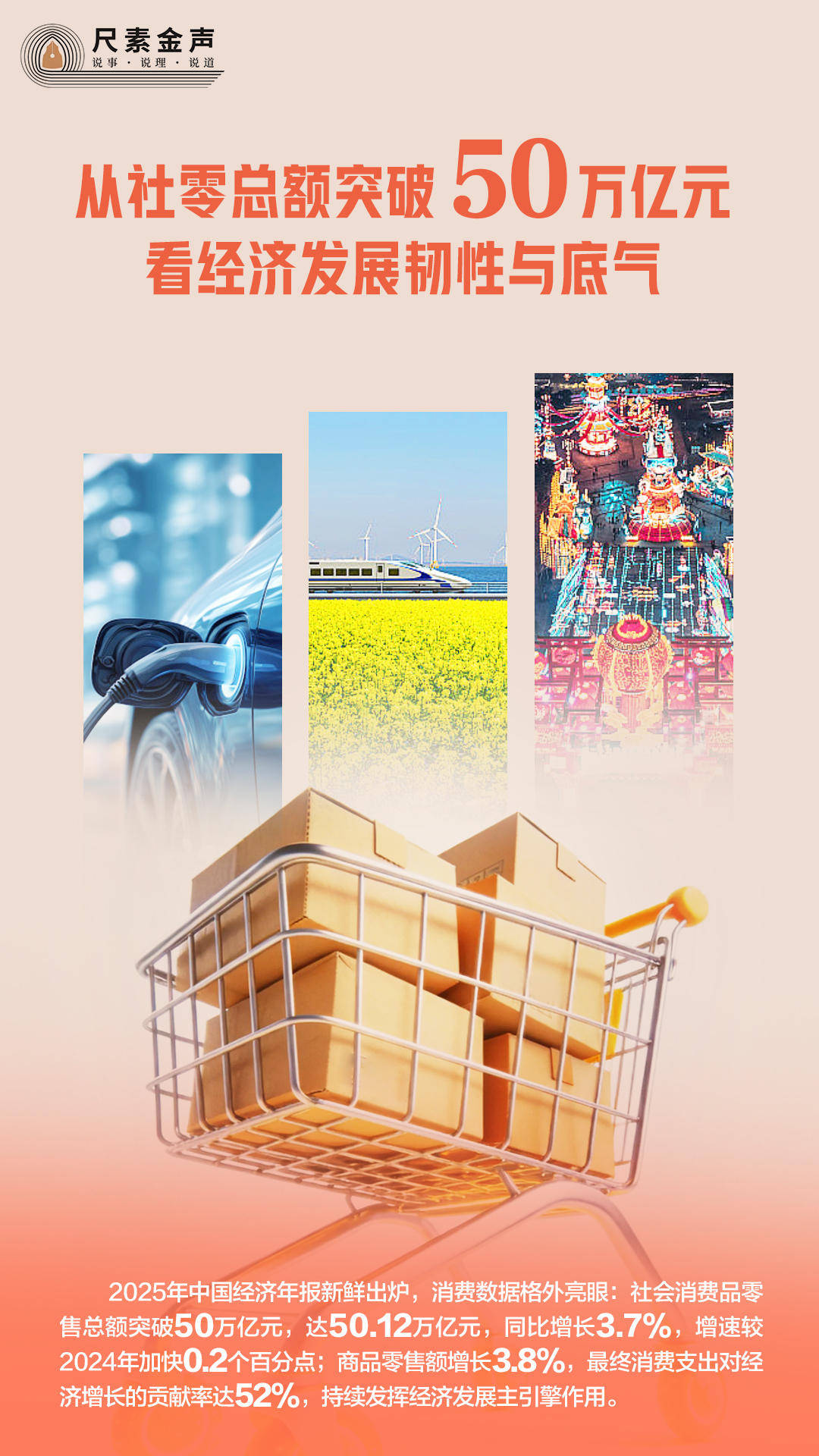
商品消费领域,升级类、绿色类产品成为新增长引擎。2025年,新能源乘用车零售量1280.9万辆,比上年增长17.6%;新能源车渗透率达到53.9%,比上年 提升6.3个百分点。消费品以旧换新政策的"真金白银",推动绿色高质量消费品走进寻常百姓家,既为消费市场注入绿色动能,也彰显人们对品质生活的 旺盛追求。 2025年中国经济年报新鲜出炉,消费数据格外亮眼:社会消费品零售总额突破50万亿元,达50.12万亿元,同比增长3.7%,增速较2024年加快0.2个百分 点;商品零售额增长3.8%,最终消费支出对经济增长的贡献率达52%,持续发挥经济发展主引擎作用。 回望"十四五",社会消费品零售总额先后迈上40万亿元、45万亿元、50万亿元新台阶。每一步跃升,都承载着民生改善的新期许;每一次突破,都为高质 量发展注入新动力。这份亮眼答卷,是中国经济内生动力持续增强的必然结果,更是超大规模市场潜力持续释放的生动注脚。 消费的支撑力,在于稳步扩容的市场体量,也在于持续优化的消费结构。2025年,我国市场活力不断提升,新型消费蓬勃发展,服务消费潜能进一步激 发,消费市场持续扩容提质升级。 服务消费同样亮点纷呈,全年服务零售额 ...
“乐购宁陕·惠享新春” 宁陕推出20项新春促消费活动
Sou Hu Cai Jing· 2026-01-21 13:42
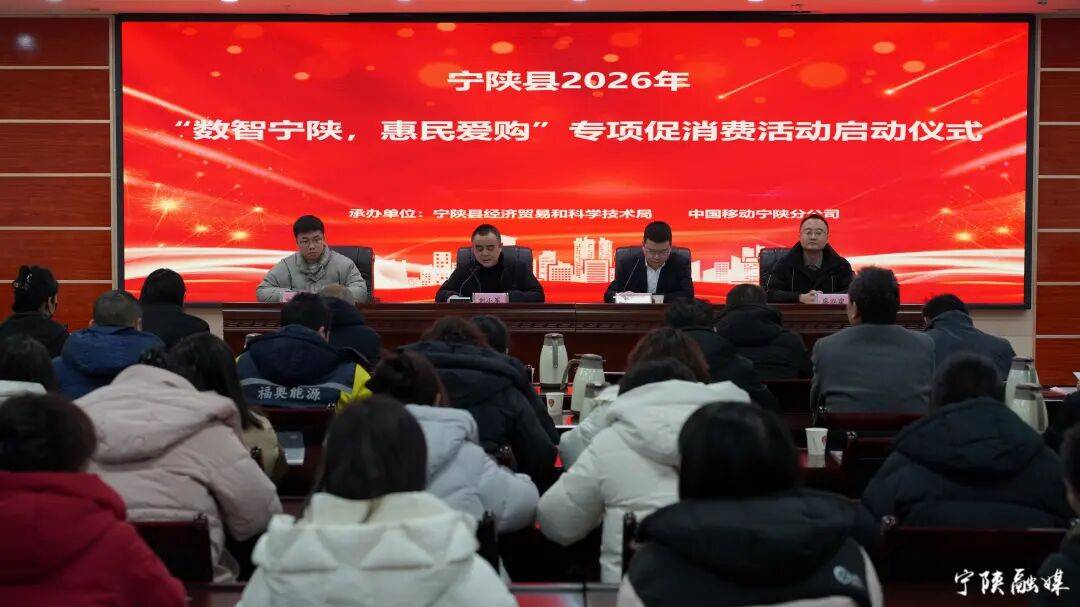
Group 1 - The core idea of the initiative is to enhance consumer engagement by offering benefits through a prepaid phone bill program, allowing customers to redeem rewards for various services [2][5] - China Mobile is providing a total of 10 million yuan in benefits under the "prepaid phone bill gift rights" model, aimed at meeting consumer demands [5] - The program encourages merchants to join the "Digital Consumption Ecological Alliance" by signing a settlement cooperation agreement and configuring dedicated POS machines, thus benefiting from mobile platform traffic and subsidy for redemption [2] Group 2 - The initiative aims to activate consumer potential through digital means, promoting a surge in consumption during the Spring Festival and improving the quality and efficiency of county-level consumption [5]

安心消费“码”上见
Xin Lang Cai Jing· 2026-01-06 21:34
Core Viewpoint - The article highlights the implementation of the "放心消费码" (Safe Consumption Code) in the Weisu Bay area of Huangshi City, which aims to enhance consumer confidence and transparency in the dining and shopping experience through digital integration and real-time information sharing [1][2][3]. Group 1: Consumer Experience - The "放心消费码" allows consumers to access essential information about merchants, including business licenses and food safety permits, enhancing their confidence in making purchases [1][3]. - The initiative aims to create a new consumption trend in Weisu Bay, where consumers can "scan to know everything" about the businesses they engage with [2][3]. Group 2: Regulatory Framework - The Huangshi Consumer Committee and the Xiaolu District Market Supervision Bureau developed the "放心消费码" to address issues such as slow consumer rights protection and outdated information on traditional public notice boards [2]. - The market supervision department ensures that the information displayed through the code is updated in real-time, maintaining a 0% occurrence rate for unlicensed operations and expired permits in the area [3]. Group 3: Complaint Management - The "放心消费码" includes a complaint public module, allowing consumers to view complaints against merchants and feedback on their integrity, which encourages compliance among businesses [4]. - A consumer rights protection service station is established in the area to facilitate dispute resolution between consumers and merchants, alongside various complaint channels [4][5]. Group 4: Cultural Integration - The initiative encourages merchants to incorporate cultural elements into the "放心消费码," enhancing the value of cultural tourism in the area by sharing historical and cultural narratives related to their products [5]. - This integration aims to elevate Weisu Bay from a mere tourist spot to an experiential destination, allowing consumers to enjoy both safe consumption and cultural richness [5].
“精彩消费在丰台”小程序上线,值得买科技打造丰台区全域消费新样板
Sou Hu Cai Jing· 2025-12-05 11:17
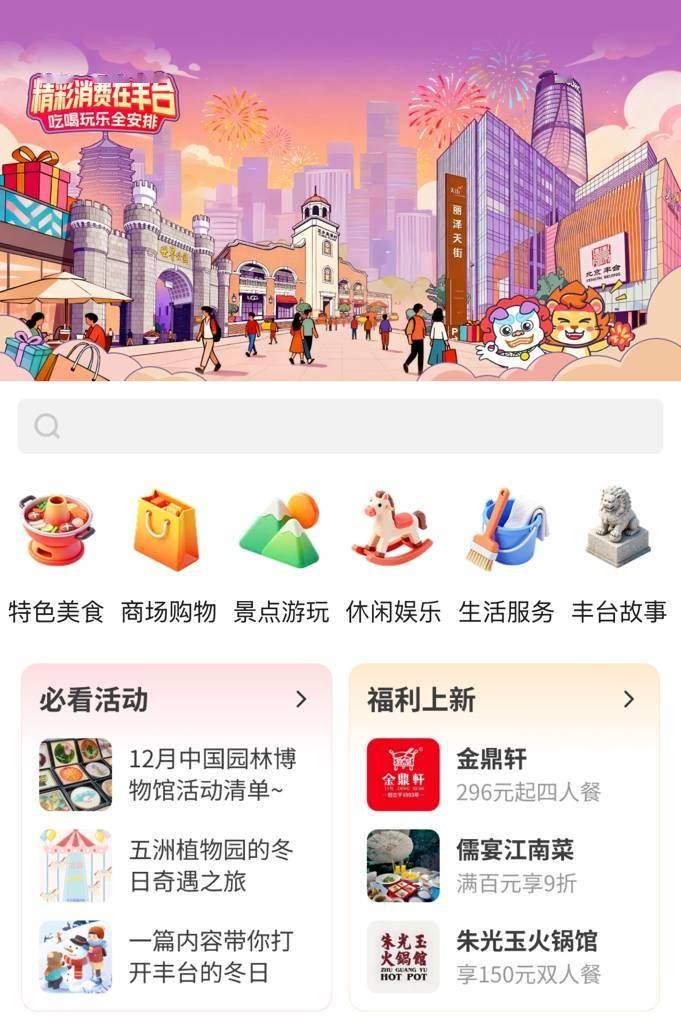
Group 1 - The "Exciting Consumption in Fengtai" WeChat mini-program has been launched, aiming to integrate various quality resources in the region to enhance local consumer services and promote sustained regional consumption growth [1][5] - The platform covers diverse scenarios including museums, scenic spots, supermarkets, restaurants, and cinemas, providing efficient consumption guidance while offering online display and digital operation tools for local merchants [5][6] - The mini-program has recorded over 2,250 merchants and will continue to expand its resources to enrich content and user experience [5] Group 2 - Fengtai District has initiated multiple consumer benefit activities through the mini-program, including the distribution of 10,000 no-threshold movie vouchers to citizens, aimed at enhancing cultural consumption supply [5][6] - Worthbuy Technology has been recognized for its contributions to regional economic development and has signed a strategic cooperation agreement with Fengtai District to further integrate platform resources and explore replicable models for digital empowerment of the real economy [6][7] - The company plans to continue leveraging its platform technology, content ecosystem, and user operation experience to explore more replicable and sustainable digital consumption scenarios in collaboration with Fengtai District [7]

超大规模市场!解锁“十五五”消费增长新引擎
Yang Shi Xin Wen· 2025-12-03 00:31
Core Viewpoint - Recent policies aimed at boosting consumption in China are crucial for economic growth, especially amid increasing external uncertainties. The "14th Five-Year Plan" emphasizes the importance of enhancing domestic demand and consumption [1][2]. Group 1: Consumption Market Advantages - China's consumption market benefits from a massive scale, with over 1.4 billion people, making it the second-largest consumer market globally and the largest in e-commerce. The retail sales of consumer goods are projected to exceed 48 trillion yuan in 2024 [2][3]. - The potential market demand for companion robots alone is estimated to be nearly 1 trillion yuan, highlighting the vast opportunities within the consumer sector [2]. Group 2: Growth Trends and Innovations - The retail sales of consumer goods have maintained an average annual growth of 5.5% over the past four years, while per capita service consumption expenditure has grown by 9.6% annually [3][4]. - New consumption scenarios, such as immersive experiences in cultural and technological contexts, are emerging as significant drivers of consumer engagement and spending [4][6]. Group 3: Service Consumption and Structural Upgrades - The shift towards service consumption is accelerating, with expectations that the service consumption share will exceed 50% during the "14th Five-Year Plan" period, indicating substantial room for growth compared to developed countries [5]. - The government plans to enhance service consumption by relaxing market access and promoting the integration of various service sectors [5]. Group 4: Urban Commercial Revitalization - The "Urban Commercial Quality Improvement Action Plan" aims to revitalize traditional urban commercial areas by creating unique consumption experiences through innovative business models and thematic developments [6][7]. - Examples include the integration of entertainment and shopping, such as small theaters within shopping malls, which enhance customer experience and increase sales [7]. Group 5: Digital Consumption Growth - The digital consumption scale is projected to reach 23.8 trillion yuan in 2024, accounting for 44.2% of total consumer spending, driven by improvements in digital infrastructure and policies [8]. - Continuous efforts to stabilize employment and enhance consumer capacity are essential for sustaining consumption growth and economic development [8].
一键玩转“吃住行游购娱” 丰台发布数字化全域消费示范平台
Sou Hu Cai Jing· 2025-11-18 03:37
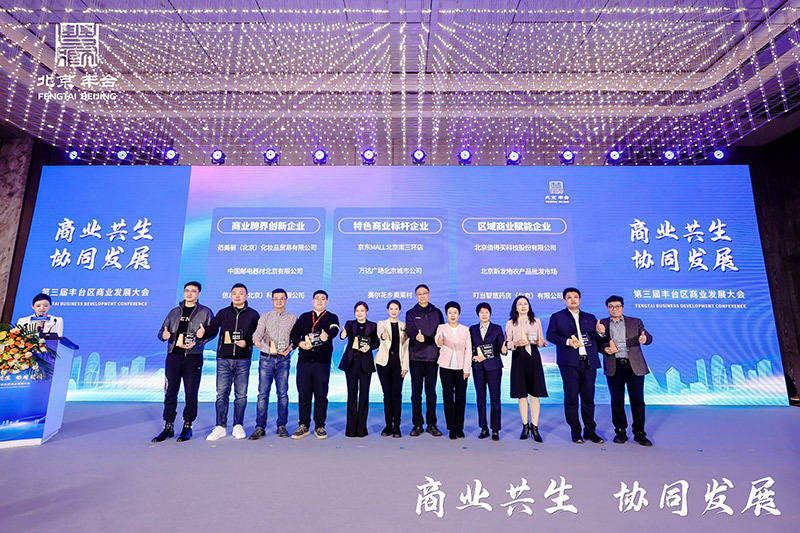
Core Insights - The third Fengtai District Commercial Development Conference was held, introducing the first comprehensive regional consumption platform in Fengtai, allowing consumers to access local merchant benefits and activities through a WeChat mini-program [1][5] - The conference focused on the theme of "Commercial Coexistence and Collaborative Development," with participation from over 120 commercial brands and various industry associations, aiming to promote the upgrade of the regional commercial ecosystem [1][3] Group 1: New Consumption Initiatives - Fengtai District is advancing 28 pilot projects related to new consumption scenarios and business models, focusing on the development of a service system for the first-release economy and innovative multi-service consumption scenarios [3][5] - Nine outstanding enterprises were awarded special titles for their contributions in the "three new" areas, highlighting the district's strategic cooperation with quality brands [3][5] Group 2: Digital Consumption Platform - The "Exciting Consumption in Fengtai" digital consumption demonstration platform was launched, designed to connect consumers with quality resources efficiently, featuring over 1,717 registered businesses [5][6] - The platform aims to enhance consumer experience by providing access to local merchant benefits, consumption maps, and popular event queries through a single interface [5][6] Group 3: Commercial Space Availability - A display area for vacant commercial spaces was set up at the conference, showcasing over 600,000 square meters of rentable space across various districts, catering to diverse business needs [6] - Notable projects include the Xiaowayao Industrial Park, offering 145,000 square meters for commercial and office use, and the Xiguotao Auto Service Base, providing 8,100 square meters for automotive-related businesses [6]
31省份消费三季报:西部发力 服务、乡村消费“上分”
2 1 Shi Ji Jing Ji Bao Dao· 2025-10-31 16:40
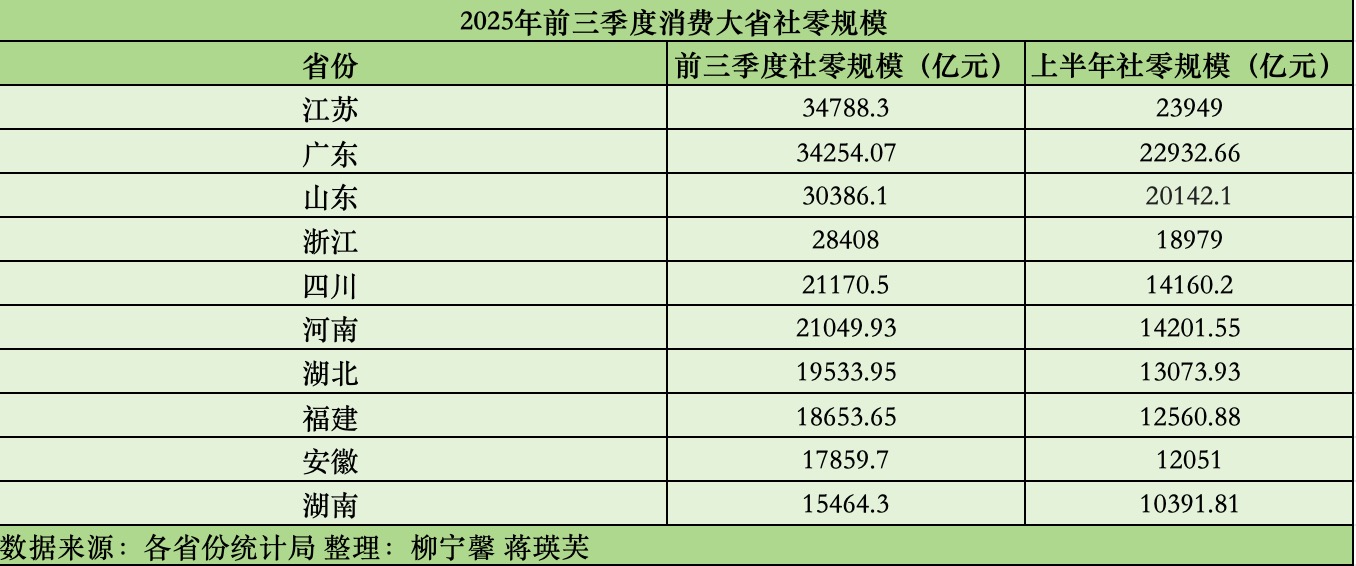
Core Insights - The growth of service consumption outpaces that of goods consumption, and rural consumption growth exceeds urban consumption, indicating significant optimization in China's consumption structure [1][9][15] - In the first three quarters, final consumption expenditure contributed 53.5% to economic growth, an increase of 9 percentage points compared to the previous year [1] - The total retail sales of consumer goods reached 36,587.7 billion yuan, with a year-on-year growth of 4.5% [1] Consumption Growth by Region - Jiangsu, Guangdong, and Shandong are the only provinces with retail sales exceeding 30,000 billion yuan, with figures of 34,788.3 billion yuan, 34,254.07 billion yuan, and 30,386.1 billion yuan respectively [6][7] - Hainan leads the nation with an 8.6% growth rate, followed by Inner Mongolia at 7.2%, and several provinces in central and western China also show strong growth [4][5] Changes in Consumption Structure - The consumption structure is shifting, with significant growth in spending on daily necessities, education, culture, and entertainment services [3][9] - The "old-for-new" policy has effectively stimulated consumption, particularly in home appliances and new energy vehicles, with notable growth rates in Inner Mongolia and Shanxi [5][9] Rural vs Urban Consumption - Rural consumption growth is outpacing urban consumption, with Jiangsu's rural consumption growth exceeding urban by 1.4 percentage points, and Guizhou by 1.7 percentage points [14][15] - The shift from basic to improved consumption in rural areas is driven by the "old-for-new" policy and the enhancement of consumption infrastructure [14][16] Policy Implications - The "14th Five-Year Plan" emphasizes boosting consumption and enhancing public service spending to increase residents' consumption capacity [8][14] - Future expansion of county-level markets is expected to support rural consumption as a new growth curve for national retail sales [16]
31省份消费三季报:西部发力,服务、乡村消费“上分”
2 1 Shi Ji Jing Ji Bao Dao· 2025-10-31 13:01
Core Insights - The growth of service consumption outpaces that of goods consumption, and rural consumption growth exceeds urban consumption, indicating an important signal for the optimization of China's consumption structure [1][12][18] Economic Contribution - In the first three quarters, final consumption expenditure contributed 53.5% to economic growth, an increase of 9 percentage points compared to the previous year [1] - The total retail sales of consumer goods reached 36,587.7 billion yuan, with a year-on-year growth of 4.5% [1] Provincial Performance - Fourteen provinces outperformed the national average in retail sales growth, with five provinces exceeding 6%: Hainan, Inner Mongolia, Shanxi, Henan, and Shaanxi [1][5] - The top ten provinces by retail sales in the first three quarters were Jiangsu, Guangdong, Shandong, Zhejiang, Sichuan, Henan, Hubei, Fujian, Anhui, and Hunan [3][8] Consumption Structure Changes - The consumption structure is shifting, with significant growth in spending on daily necessities, education, culture, and entertainment services [3][12] - The rural areas are showing strong consumption potential, with rural consumption growth driven by the replacement of large goods and upgrades in daily consumption [17][18] Policy and Future Outlook - The "14th Five-Year Plan" emphasizes boosting consumption and implementing special actions to stimulate consumption [3][17] - The expansion of quality consumer goods and services supply is highlighted, with a focus on enhancing service consumption [17][19] Digital and Service Consumption Trends - Digital consumption is on the rise, with significant growth in online retail sales in various provinces [10][12] - Service consumption, particularly in tourism and cultural sectors, is a key driver of growth, with notable increases in visitor numbers and revenue in several provinces [15][16]