数据共享

Search documents
中国气象数据服务惠及全球153个国家和地区
Zhong Guo Xin Wen Wang· 2026-02-28 03:14
中国气象数据服务惠及全球153个国家和地区 中新网北京2月28日电 (记者 陈溯)记者27日从国家气象信息中心获悉,自去年9月《中国气候数据产品 国际共享目录》发布以来,该批次数据集已吸引近416万次国外用户访问,被广泛应用于气候变化研 究、农业气候适应、灾害预警系统开发、人工智能气象模型训练及能源预测等多个关键领域。 近年来,中国气象局持续强化数据共享,正持续为全球多个关键领域提供支持。通过全球通信系统 GTS、世界气象组织信息系统WIS2.0、中国气象局卫星数据广播系统(CMACast)、风云卫星数据直收站 和海外云节点等多元化渠道,中国向全球153个国家和地区提供高质量气象数据服务,为国际科研与防 灾实践提供有力支撑。 广告等商务合作,请点击这里 本文为转载内容,授权事宜请联系原著作权人 中新经纬版权所有,未经书面授权,任何单位及个人不得转载、摘编或以其它方式使用。 关注中新经纬微信公众号(微信搜索"中新经纬"或"jwview"),看更多精彩财经资讯。 2025年,依据世界气象组织(WMO)全球交换协议,中国通过GTS/WIS向全球实时分发共享地面与高空 观测、风云卫星监测、数值预报和警报产品,以及商用 ...
中国气象数据服务惠及全球153个国家和地区 应用于气候变化研究、农业、灾害防御等多领域
Xin Lang Cai Jing· 2026-02-27 14:18
2月27日,记者从国家气象信息中心获悉,自去年9月《中国气候数据产品国际共享目录》发布以来,该 批次数据集已吸引近416万次国外用户访问,被广泛应用于气候变化研究、农业气候适应、灾害预警系 统开发、人工智能气象模型训练及能源预测等多个关键领域。 近年来,中国气象局持续强化数据共享,正持续为全球多个关键领域提供支持。通过全球通信系统 GTS、世界气象组织信息系统WIS2.0、中国气象局卫星数据广播系统(CMACast)、风云卫星数据直 收站和海外云节点等多元化渠道,中国向全球153个国家和地区提供高质量气象数据服务,为国际科研 与防灾实践提供有力支撑。 2025年,依据世界气象组织(WMO)全球交换协议,中国通过GTS/WIS向全球实时分发共享地面与高 空观测、风云卫星监测、数值预报和警报产品,以及商用飞机和船舶等多源数据,年共享数据量约为 23.5TB;通过WIS2.0向全球各相关政府和机构实时共享数据量约为320TB;通过CMACast向蒙古、马尔 代夫等17个国家的用户播发地面观测数据、风云卫星数据、全球数值预报产品,每用户年服务数据量达 136.6TB;通过风云卫星数据直收站向莫桑比克、纳米比亚、蒙古国 ...
商保支付在京破局:十八条新政打通数据壁垒与产业协同
Bei Jing Shang Bao· 2026-02-13 02:04
Core Viewpoint - The release of the "Beijing Commercial Health Insurance Eighteen Measures" aims to enhance the quality and development of commercial health insurance in Beijing, addressing long-standing issues in the industry and promoting data sharing and innovation in insurance products [1][2]. Group 1: Policy Measures - The "Eighteen Measures" include six main areas: strengthening product innovation, deepening collaboration with the pharmaceutical industry, enhancing service capabilities, optimizing settlement models, reinforcing regulatory cooperation, and strengthening organizational support [3]. - The measures encourage the inclusion of elderly and chronic disease patients in insurance coverage, aiming to better meet the health insurance needs of diverse groups [6][7]. Group 2: Data Sharing and Innovation - The establishment of a data-sharing mechanism for medical expenses and health records is a key focus, which is expected to address the lack of actuarial data in product design [2][4]. - The new policy allows for commercial insurance to cover innovative drugs without being restricted by existing regulations, facilitating better access to high-value treatments [4][8]. Group 3: Market Dynamics - The commercial health insurance market is projected to reach CNY 997.3 billion by 2025, with a significant shift towards medical insurance products that cater to innovative drugs, which are expected to see a compound annual growth rate of 70% over four years [5][6]. - The measures aim to break down barriers for high-risk groups, allowing for a broader range of potential insured individuals, including those with pre-existing conditions [6][7]. Group 4: Future Directions - The industry is transitioning towards a "3.0 era," characterized by a balanced product structure and a shift from traditional reimbursement models to value-based insurance that integrates health management services [8][9]. - Insurers are encouraged to leverage data platforms for optimizing actuarial models and to develop innovative insurance products targeting specific health conditions, enhancing user engagement and risk management capabilities [9].
商保支付在京破局 十八条举措欲破数据壁垒
Bei Jing Shang Bao· 2026-02-12 16:06
Core Viewpoint - The release of the "Beijing Commercial Health Insurance Eighteen Measures" aims to enhance the quality and development of commercial health insurance in Beijing, addressing long-standing issues in the industry and promoting data sharing and innovation in insurance products [1][2]. Group 1: Data Sharing and Innovation - The measures emphasize the establishment of a data-sharing mechanism for medical expenses, health check-ups, and imaging tests, which is expected to resolve the lack of actuarial data in product design [2][3]. - The policy encourages the development of innovative insurance products that are not restricted by existing regulations, particularly for high-value innovative drugs [3][5]. Group 2: Market Growth and Challenges - The commercial health insurance market is projected to reach CNY 997.3 billion by 2025, indicating a significant growth opportunity as it approaches the CNY 1 trillion threshold [4]. - The industry faces challenges such as rising product prices and increased claims, which have led to a mismatch between supply and demand in the critical illness insurance segment [4][5]. Group 3: Inclusion of Diverse Insured Groups - The measures advocate for relaxing underwriting conditions to include elderly individuals and those with chronic diseases, thereby expanding the potential insured population [5][6]. - The policy also proposes using personal medical account funds for purchasing eligible commercial health insurance products, creating a substantial funding pool for the market [5][6]. Group 4: Service Optimization and Industry Transformation - The measures call for the optimization of service experiences, including online insurance applications and claims processing, as well as collaboration with rehabilitation and nursing institutions [6][8]. - The industry is encouraged to transition from traditional fee-for-service models to value-based insurance products that integrate health management and proactive risk control [8]. Group 5: Strategic Role of Commercial Health Insurance - The measures position commercial health insurance as a proactive partner in the healthcare ecosystem, responding to the need for a multi-tiered medical security system and supporting pharmaceutical innovation [7][8]. - The industry is entering a "3.0 era," characterized by balanced product structures and a shift towards personalized insurance solutions driven by data analysis and risk management [7][8].
We will not allow you to share even a single data: SC pulls up Meta, WhatsApp over 2021 privacy policy
The Economic Times· 2026-02-03 06:16
Core Viewpoint - The Supreme Court is hearing appeals from Meta Platforms and WhatsApp regarding a penalty imposed by the Competition Commission of India (CCI) for abuse of market dominance related to WhatsApp's 2021 privacy policy, emphasizing user privacy and data sharing issues [1][3]. Group 1: Legal Proceedings - The Supreme Court, led by Chief Justice Surya Kant, is reviewing challenges to the National Company Law Appellate Tribunal (NCLAT) order that upheld a penalty of ₹213 crore (approximately $25.7 million) against WhatsApp and Meta for their 2021 privacy policy [1][3]. - The court has mandated WhatsApp and Meta to submit an affidavit confirming they will not share user data, warning that failure to do so could result in the dismissal of their appeals [3]. Group 2: Market Dominance and Consumer Rights - Chief Justice Surya Kant criticized WhatsApp's market dominance, stating that the company has created a monopoly and that consumers have no real choice, which undermines their privacy rights [2][3]. - The court expressed strong disapproval of the companies' practices, suggesting that they are compromising the constitutional rights of consumers by exploiting their personal data without adequate consent [2][3]. Group 3: Company Defense - Senior counsel for Meta and WhatsApp argued that the service is free and that not all user data is shared, only specific data, indicating a defense against the claims of monopolistic practices [2][3].



苏州市人大代表奚涛:构建智慧监管体系,守护食用农产品安全
Yang Zi Wan Bao Wang· 2026-01-25 11:17
Core Viewpoint - The importance of optimizing the safety regulation of edible agricultural products through digital technology is emphasized as a crucial public welfare project [1]. Group 1: Challenges in Agricultural Product Regulation - Current agricultural product regulation faces challenges such as long supply chains and inconsistent standards [3]. - For instance, the certification styles for local agricultural products vary, and there are instances of self-reporting, complicating source regulation and traceability [3]. Group 2: Systematic Suggestions for Improvement - It is suggested that agricultural and rural departments strengthen source control and unify qualification certificates [3]. - Market regulatory departments should increase inspection frequency and enhance intelligent detection capabilities [3]. - The commerce department is advised to focus on key areas such as bulk transactions for improved regulation [3]. Group 3: Data Sharing and Technological Integration - The key to improvement lies in breaking down data barriers, promoting inter-departmental sharing of production and sales data [3]. - A unified smart traceability regulatory platform should be established using big data technology to achieve traceability from source to destination [3]. Group 4: Modern Regulatory System - Building a modern regulatory system is deemed essential for ensuring citizens' food safety and enhancing urban governance [3]. - The aim is to create practical and scalable experiences in this field through a dual approach of institutional and technological advancements [3].


湖州政务服务“一网通办”率已达99.7%
Xin Lang Cai Jing· 2026-01-02 23:43
Group 1 - The core viewpoint of the articles highlights the significant improvements in local government services, particularly in pension application processes and the integration of online and offline services for residents [1][2] - In Huzhou, 1,284 community service points and 74 service centers have been established, achieving full coverage of grassroots service networks [1] - The "one-stop" service model has been enhanced through the use of RPA and AI technologies, leading to an 80% reduction in manual verification for educational enrollment [2] Group 2 - The city has achieved a 99.7% rate of online application processing for government services, indicating a strong push towards digitalization [1][2] - Collaborative efforts with 68 regions across the country have enabled cross-province handling of 151 high-frequency matters, enhancing service accessibility [2] - The government aims to further expand the depth and breadth of online services, focusing on creating a streamlined and efficient service environment for both citizens and businesses [2]
数据共享确保关怀“不落一人”
Xin Lang Cai Jing· 2025-12-28 20:28
Core Insights - The Xinjiang Uygur Autonomous Region Federation of Trade Unions has invested a total of 2.2969 million yuan to distribute "Warm New Gift Packages" to 22,969 new employment form workers across 12 leading platform companies since September [1][2] - The "Warm New Gift Package" includes practical items such as power banks, thermos cups, cold protection gear, and daily hygiene products, aimed at providing care and support to workers [1] - A digital platform, "Worker's Home" APP, has been utilized to streamline the membership process for workers, allowing for easy access to services and benefits [2] Summary by Sections - **Investment and Distribution**: The total investment of 2.2969 million yuan has been allocated for the distribution of gift packages to 22,969 workers, reflecting a targeted approach to support new employment forms [1] - **Contents of the Gift Package**: The gift packages contain essential items that are useful for daily life, demonstrating a thoughtful consideration of workers' needs [1] - **Digital Integration**: A data-sharing mechanism has been established with 12 leading platform companies to ensure that care reaches every worker, utilizing the "Worker's Home" APP for efficient identification and service delivery [2] - **Organizational Structure**: A three-tiered union system has been created to enhance collaboration between the federation and enterprise unions, ensuring effective implementation of support initiatives [2] - **Long-term Service Goals**: The initiative aims to transition from one-time support to ongoing services, including legal consultation, skills training, and health care, thereby enhancing the overall welfare of workers [2]
人工智能重构全球能源秩序底层逻辑
Zhong Guo Dian Li Bao· 2025-12-22 06:28
Core Insights - The rapid evolution of artificial intelligence (AI) is reshaping the global energy landscape, transitioning from a resource-based order to one centered on data, algorithms, and computing power [2][4] - AI's capabilities are significantly enhancing operational efficiency in the energy sector, with examples such as improved forecasting accuracy and reduced exploration times [2][4] Group 1: AI's Impact on Energy - AI's iteration cycle has accelerated, with parameter scales increasing tenfold every nine months, leading to cognitive abilities that surpass human capabilities in certain areas [1] - AI is enabling real-time predictions for renewable energy sources, drastically reducing operational inefficiencies, such as lowering wind power curtailment rates to below 3% [2] - Major energy companies are developing large-scale AI models to enhance system efficiency and transform operational paradigms [2] Group 2: Economic Implications of Computing Power - Computing power is becoming synonymous with economic output, with a return of 3 to 4 times for every unit invested in computing power [3] - The competition in the energy sector is shifting from asset-heavy investments to a focus on algorithmic efficiency and density [3] Group 3: Global Power Dynamics - The control of AI algorithms is concentrated, with the U.S. holding 85% of global AI frameworks, while Europe and China dominate in specific energy technologies and manufacturing capacities [4] - The future energy order will be defined by those who can integrate energy and computing power effectively, potentially relegating traditional energy producers to mere "energy subcontractors" [4] Group 4: Challenges in AI Adoption - The energy sector faces significant challenges in harnessing AI, including high computing power demands leading to increased energy consumption and carbon emissions [4] - Data silos hinder the training and effectiveness of AI models, with less than 30% data sharing across the energy system [5] - Supply chain security is a concern, particularly regarding reliance on foreign technology for AI hardware and software [6] Group 5: Strategic Pathways for Advancement - To overcome existing challenges, the industry must focus on creating a unified data and computing ecosystem, enhancing collaboration between computing resources and renewable energy [7] - Establishing a secure and trustworthy energy data-sharing environment is crucial, necessitating standardized data protocols and advanced technologies for data privacy [8] - Strengthening domestic capabilities in AI technology and reducing dependency on foreign systems is essential for long-term sustainability [8]
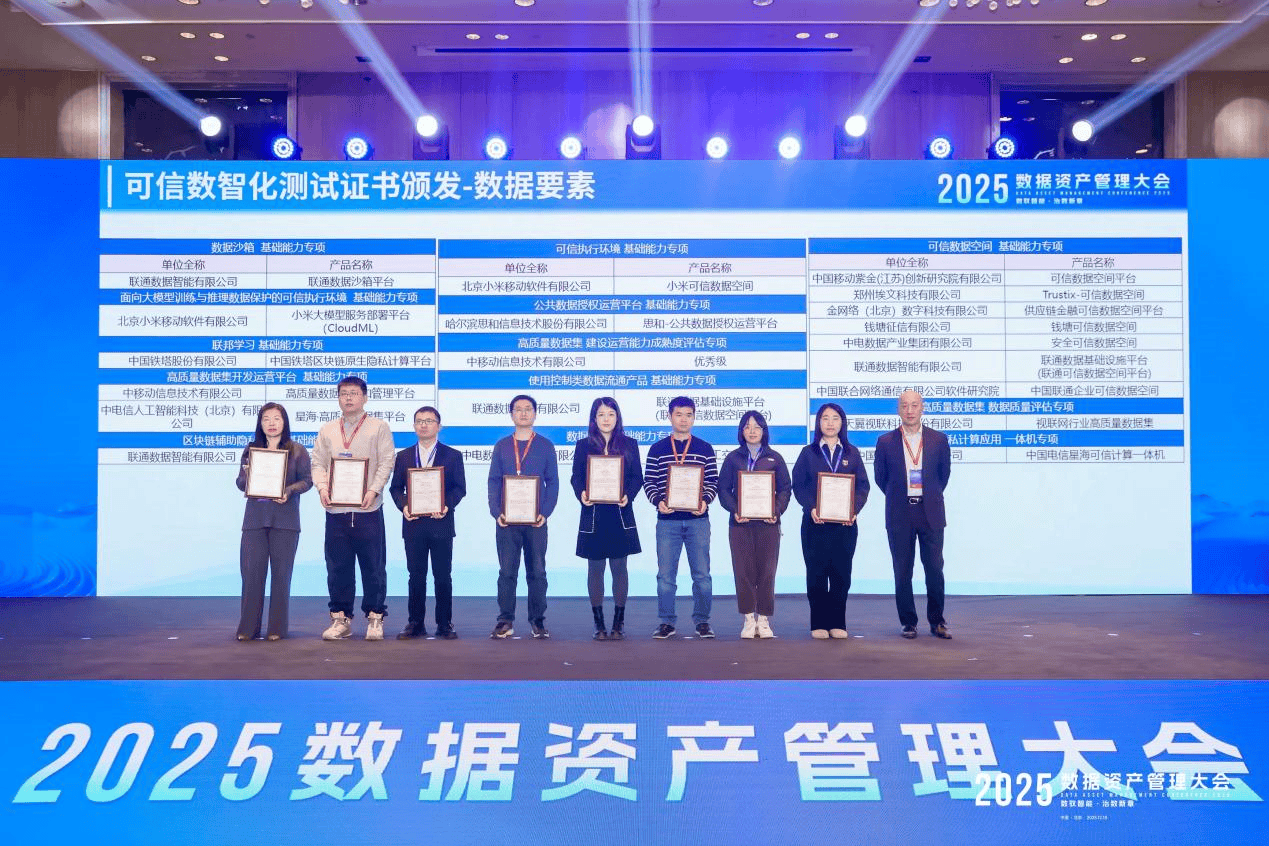
钱塘征信获得“可信数据空间”基础能力测评证书
Sou Hu Cai Jing· 2025-12-19 07:46
Group 1 - The 2025 Data Asset Management Conference was held in Beijing, organized by the China Communications Standards Association and hosted by the China Academy of Information and Communications Technology [1] - Qiantang Credit became the first personal credit company to pass the Trusted Data Space Basic Capability Special Inspection Certificate, alongside other notable companies such as China Mobile, China Unicom, and Xiaomi [1][3] - The Trusted Data Space Basic Capability Special Inspection covers thirteen core modules, including service platform management and security management, with over 70 testing items [3] Group 2 - Qiantang Credit's Trusted Data Space is built on principles of security, controllability, and auditability, facilitating efficient data flow across organizations and sectors while releasing data value based on credit business [3][6] - The technical framework of Qiantang Credit includes a Trusted Space Service Platform and Access Connector, forming a closed-loop system for cross-institution data collaboration and compliance auditing [6] - Qiantang Credit is a national personal credit institution approved by the People's Bank of China and has been designated as the authorized operator of public data resources in the credit service sector in Zhejiang Province [6]