
数码和智能产品购新补贴

Search documents
春节假期家电、数码和智能产品消费增长强劲
Jing Ji Ri Bao· 2026-02-27 02:05
Group 1 - The core viewpoint of the article highlights a significant increase in sales of home appliances and digital products during the Spring Festival holiday, with a total of 5.106 million units sold, representing a 21.7% growth compared to the previous year [1] - The subsidy policy has effectively supported offline retail development, with offline sales accounting for 73.3% of total sales in the home appliance and digital product categories [1] - The trend towards smart products and quality consumption is evident, with mid-to-high-end mobile phones making up 65.0% of sales, and the introduction of smart glasses into the subsidy program for the first time in 2026 [1] Group 2 - The Ministry of Commerce has organized effective implementation of the subsidy program, with strong consumer demand observed in provinces such as Hebei, Guangdong, Jiangsu, and Shandong [2] - Various regions have established service points in rural areas to facilitate the "trade-in for new" program, providing comprehensive services including delivery, installation, and old product recycling [2] - The combination of national subsidies, local incentives, and merchant discounts has allowed consumers to benefit from substantial financial incentives [2]
23万亿元、590亿元 多维度“数”说经济强劲“势能”
Yang Shi Wang· 2026-02-06 00:32
Group 1 - The core viewpoint of the articles indicates that China's light industry is expected to maintain stable and positive economic growth by 2025, with a projected increase in value-added output and revenue [1] - In 2025, the value-added output of the light industry is expected to grow by 5.3% year-on-year, achieving a revenue of 23 trillion yuan, with a profit margin of 6.04%, surpassing the overall industrial average by 0.73 percentage points and the manufacturing sector by 1.34 percentage points [1] - Among 90 major light industry products, 35 are anticipated to see production growth, driven by the widespread adoption of digital R&D tools that enhance the supply of high-value-added products [1] Group 2 - The consumer market is significantly influenced by policy-driven effects, with over 129 million home appliances and 12.5 million electric bicycles expected to be replaced under the old-for-new policy in 2025 [1] - Retail sales of 11 categories of light industry goods are projected to reach 867.19 billion yuan in 2025, reflecting a year-on-year growth of 7.8%, increasing their share of total social retail sales to 17.3% [1] - The export structure of the light industry is continuously improving, with light industry goods exports expected to reach 911.46 billion USD in 2025, accounting for 24.2% of the national total, with 11 out of 22 major export categories showing growth [1] Group 3 - In January 2026, the sales volume of six categories of home appliances and four categories of digital and smart products exceeded 15 million units, with sales revenue nearing 59 billion yuan, indicating the gradual effectiveness of the old-for-new and subsidy policies [2] - Offline sales accounted for nearly 80% of the total sales, reflecting a year-on-year growth of approximately 20% [2] - Green and smart products are gaining popularity, with online sales of energy-efficient water heaters and televisions increasing by 35.7% and 28.9% year-on-year, respectively [2]
上海家电数码购新补贴:新增“线下即时摇号”
Guo Ji Jin Rong Bao· 2026-02-05 14:07
Core Viewpoint - Shanghai's new subsidy policy for replacing old home appliances and purchasing new digital and smart products aims to enhance consumer participation through both online and offline channels, with the introduction of an "instant offline lottery" system starting February 5, 2026 [1][2] Group 1: Policy Implementation - The Shanghai Municipal Commission of Commerce released detailed implementation rules for the subsidy policy, which includes both online lottery and the new offline instant lottery method [1] - The offline instant lottery allows consumers to participate in real-time and receive immediate results, enhancing the shopping experience in physical stores [1][2] Group 2: Participation and Eligibility - Consumers can participate in the instant lottery through various online platforms, including major apps like Cloud Flash Payment, JD.com, and others, as well as banking apps from local banks [1][2] - The instant lottery is available daily from 08:00 to 22:00, and the subsidy qualification voucher is valid for 14 days after issuance [2] Group 3: Subsidy Details - The subsidy covers six categories of home appliances and four categories of digital and smart products, with specific eligibility criteria for each category [2] - The subsidy standard is set at 15% of the final price after discounts, with a maximum subsidy of 1,500 yuan for home appliances and 500 yuan for digital products per person per category [2]
家电、数码和智能产品补贴超1500万台
Ren Min Ri Bao· 2026-02-03 22:54
Group 1 - The core viewpoint of the article highlights the positive impact of the appliance trade-in and digital product subsidy policies, which have shown significant effects since their implementation [1] - In January, sales of six categories of home appliances and four categories of digital and smart products exceeded 15 million units, generating nearly 59 billion yuan in sales [1] - The nationwide appliance trade-in program saw 6.813 million units sold, driving sales of 29.71 billion yuan, while 9.115 million digital and smart products were purchased, contributing 29.21 billion yuan in sales [1] Group 2 - The retail sector is experiencing a trend of attracting customers through trade-in programs and diverse consumption, with offline sales of appliances and digital products nearing 80% and showing a year-on-year growth of approximately 20% [1] - Some offline stores have reported increased performance and foot traffic, which has positively influenced cross-scenario consumption in leisure, transportation, and specialty dining [1] - Green and smart products are gaining popularity, with the subsidy standards for appliance trade-ins raised to first-level energy efficiency, leading to rapid growth in high-performance appliance sales [1]
1月门店销售额环比增长超30% 其中智能产品销售额环比增长超85% 从一个家电卖场看国补新账(财经深一度)
Ren Min Ri Bao· 2026-02-01 21:58
Core Viewpoint - The new national subsidy policy for 2026 aims to stimulate consumer spending by focusing on energy-efficient and smart products, with a more targeted approach to financial support [3][15]. Policy Changes - The 2026 subsidy policy narrows the focus from 12 categories in 2025 to 6 key categories: televisions, refrigerators, water heaters, computers, washing machines, and air conditioners [3]. - The subsidy standard has been reduced from 20% to 15%, and the maximum subsidy per household appliance has decreased from 2000 yuan to 1500 yuan [3][15]. - The policy emphasizes support for first-level energy efficiency products, indicating a shift towards green and low-carbon products [3]. Market Response - The implementation of the subsidy policy has led to a significant increase in foot traffic at retail locations, with a doubling of visitors reported at the JD MALL Yangjiaqiao store [8]. - Sales of smart products, particularly smart glasses, have surged, with a reported 150% increase in sales for emerging categories since the policy's implementation [12][15]. - The average transaction value at retail locations has increased by over 40% compared to 2024, indicating a shift towards higher-quality purchases rather than just lower prices [15]. Operational Adjustments - Retailers have had to adapt quickly to the new subsidy rules, including system updates and staff training to ensure smooth operations [6][5]. - The Chongqing Municipal Commerce Committee has been proactive in addressing issues such as low coupon redemption rates, leading to adjustments in the rules to enhance consumer engagement [9][10]. Financial Support Mechanisms - Financial institutions are collaborating with local governments to provide support for businesses facing cash flow pressures due to the subsidy program, including the introduction of new financing products [11]. - The integration of financial services with subsidy programs is seen as crucial for maintaining stability and enhancing the effectiveness of the subsidy policy [11]. Consumer Behavior Trends - Consumers are increasingly prioritizing energy efficiency and quality in their purchasing decisions, reflecting a shift in market dynamics due to the new subsidy policy [14][15]. - The focus on high-quality, energy-efficient products is expected to contribute to the formation of a more advanced and sustainable domestic market [16].
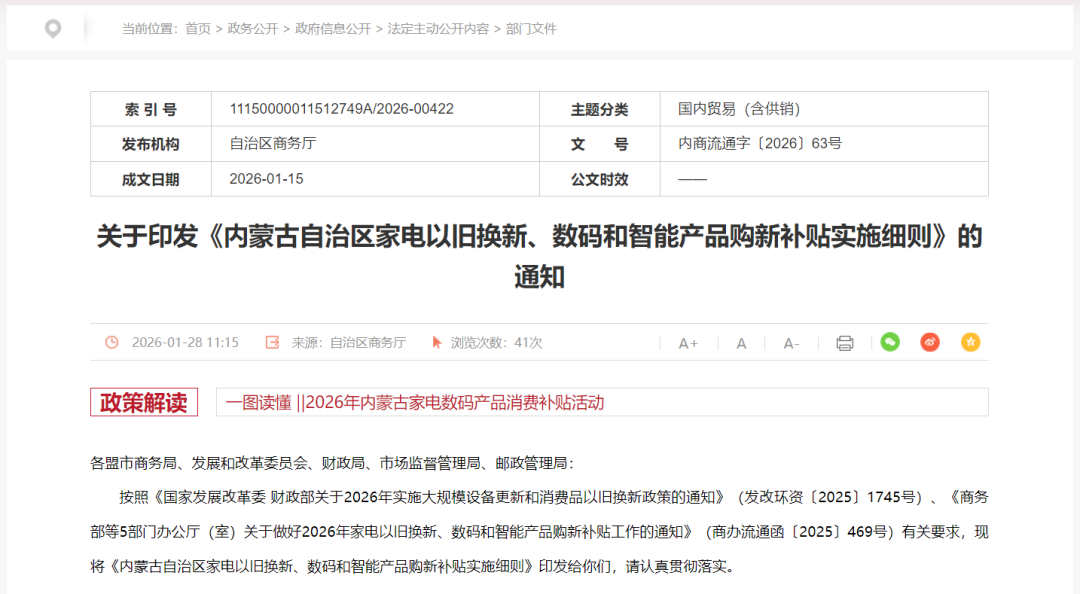
关于印发《内蒙古自治区家电以旧换新、数码和智能产品购新补贴实施细则》的通知
Xin Lang Cai Jing· 2026-01-29 12:12
Core Viewpoint - The Inner Mongolia Autonomous Region has issued implementation details for a subsidy program aimed at promoting the replacement of old household appliances and the purchase of new digital and smart products, effective from January 1, 2026, to enhance consumer spending and support the local economy [3][4][5]. Group 1: Implementation Details - The subsidy program is based on national policies aimed at large-scale equipment updates and consumer goods replacement [4][26]. - The program will be in effect from January 1, 2026, until the end of the year, with total funding subject to control and limits [5][27]. - Eligible consumers must purchase subsidized products and obtain valid sales invoices to qualify for the subsidies [6][28]. Group 2: Subsidy Categories - Subsidized categories include household appliances such as refrigerators, washing machines, televisions, air conditioners, computers, and water heaters [7][28]. - Digital and smart products eligible for subsidies include smartphones, tablets, smartwatches, and smart glasses [8][28]. Group 3: Subsidy Standards - For household appliances, the subsidy is set at 15% of the product's sales price, with a maximum subsidy of 1,500 yuan per item for energy-efficient products [9][28]. - For digital and smart products, the subsidy is also 15% of the sales price, with a maximum subsidy of 500 yuan per item, applicable to products priced up to 6,000 yuan [10][28]. Group 4: Subsidy Process - The subsidy will be processed through a "subsidy voucher" model, where consumers can directly deduct the subsidy amount at the point of sale [11][30]. - Consumers must register on the Cloud Flash Payment App to obtain subsidy vouchers, which are valid for one day [31][32]. - A detailed verification process is required for subsidy claims, including submission of personal and product information [32][33]. Group 5: Organizational Responsibilities - Local governments are tasked with coordinating efforts to implement the subsidy program effectively, ensuring compliance with regulations and enhancing consumer protection [16][34]. - The program aims to support both online and offline retail channels, particularly focusing on rural areas to ensure broad access to subsidies [19][37]. Group 6: Monitoring and Compliance - There will be strict monitoring of subsidy distribution and compliance with regulations to prevent fraud and ensure proper use of funds [21][39]. - Regular audits and checks will be conducted to maintain the integrity of the subsidy program and protect consumer rights [39][40].

京东集团-SW(9618.HK)25Q4前瞻:Q4国补退坡影响带电增速 外卖单量稳健亏损环比改善
Ge Long Hui· 2026-01-15 14:28
Core Viewpoint - The company expects a slight year-on-year increase in total revenue for Q4 2025, with a Non-GAAP net profit of approximately 480 million yuan, despite challenges in the electric product category due to subsidy reductions and high base effects [1][3]. Revenue Summary - Q4 revenue growth is pressured by the decline in subsidies for electric products, leading to a double-digit year-on-year decrease in this category, particularly affecting home appliances and digital products [2][3]. - Daily necessities and third-party (3P) revenue are expected to maintain double-digit growth in Q4, supported by healthy performance in supermarkets, fashion home goods, and health categories [2][3]. Profitability Summary - The company's Non-GAAP net profit for Q4 is projected to be around 480 million yuan, with a decline in retail operating profit attributed to subsidy reductions, changes in product mix, and increased costs from staff salary raises [3]. - Profitability is expected to improve in 2026, aided by continued government subsidies for appliance replacements and an expanded scope for digital product subsidies [2][3]. New Business Performance - The new business segment is expected to reduce losses in Q4, with improvements in delivery volume and user engagement (UE) for the takeaway service, indicating a stable overall performance [3]. Investment Recommendation - Given the impact of subsidy reductions on revenue and profit, the company has adjusted its Non-GAAP net profit forecasts for 2025-2027 to 26.4 billion, 32.7 billion, and 51 billion yuan respectively, with a target price of 125-150 HKD per share based on a 10-12x PE for 2026 [3].

京东集团-SW(09618):25Q4前瞻:Q4国补退坡影响带电增速,外卖单量稳健亏损环比改善
CMS· 2026-01-14 01:37
Investment Rating - The report maintains a "Strong Buy" rating for JD Group with a target price range of HKD 125 to 150, while the current stock price is HKD 117.4 [2][5]. Core Insights - JD Group's total revenue is expected to see a slight year-on-year increase in Q4 2025, with a projected Non-GAAP net profit of approximately 480 million yuan [1][5]. - The report highlights that the decline in revenue growth for the electric category is due to the reduction of national subsidies and a high comparative base from the previous year, while daily necessities and third-party (3P) revenues are expected to maintain double-digit growth [1][5]. - The report expresses a long-term positive outlook on the company's growth resilience under its self-operated model and strong supply chain bargaining power, which is expected to enhance profit margins [1][5]. Financial Data and Valuation - For the fiscal years 2023 to 2027, the projected main revenue (in million yuan) is as follows: 1,084,662 (2023), 1,158,819 (2024), 1,305,167 (2025E), 1,361,675 (2026E), and 1,419,895 (2027E), with year-on-year growth rates of 4%, 7%, 13%, 4%, and 4% respectively [2][6]. - The Non-GAAP net profit projections are: 35,200 (2023), 47,827 (2024), 26,428 (2025E), 32,720 (2026E), and 50,951 (2027E), with significant fluctuations in growth rates [2][6]. - The report indicates a P/E ratio forecast of 8.7 (2023), 6.4 (2024), 11.6 (2025E), 9.4 (2026E), and 6.0 (2027E) [2][9]. Stock Performance - The stock has shown an absolute performance of 9.1% over the past month, 17.6% over six months, and 20.0% over the past year [4]. - Relative performance indicates a 6.0% outperformance over one month, 2.4% over six months, but a 9.8% underperformance over the past year [4]. Business Segment Insights - The report notes that the new business segment is expected to reduce losses in Q4, with improvements in delivery volume and user experience (UE) for the food delivery service [1][5]. - The report anticipates that the food delivery business will continue to improve in 2026, with a focus on enhancing user experience [1][5]. Shareholder Information - The total share capital is 3,188 million shares, with 2,865 million shares listed in Hong Kong [3]. - The major shareholder, Max Smart Limited, holds a 9.6007% stake in the company [3]. Financial Ratios - The report provides key financial ratios, including a return on equity (ROE) of 17.8% and a debt-to-asset ratio of 57.3% [3][9]. - The projected earnings per share (EPS) for the years 2023 to 2027 are 8.34, 14.27, 5.85, 9.26, and 14.87 respectively [2][9].
2026年云南省数码和智能产品购新补贴活动来了!
Xin Lang Cai Jing· 2026-01-11 20:19
Group 1 - The core announcement is about the 2026 Yunnan Province digital and smart product purchase subsidy program, detailing the consumer coupon collection methods and the first batch of participating merchants [1] - The program aims to implement large-scale equipment updates and promote the replacement of old consumer goods as per national directives [1] - Consumers can collect electronic coupons through three methods: store coupons, rural exclusive coupons, and e-commerce platform coupons [1] Group 2 - Coupons will be distributed on a first-come, first-served basis starting from January 10, 2026, with specific collection times for different types of coupons [2] - Each consumer can collect a maximum of two coupons per month for a single product, with a total limit of five coupons during the activity period [3] - The electronic coupons will be redeemed through a "payment reduction" method, where the government subsidy is automatically deducted from the total price at the point of sale [4] Group 3 - The subsidy standard allows for a 15% discount on the final sales price of eligible products, with a maximum subsidy of 500 yuan per item for products priced up to 6000 yuan [5] - The first batch of participating merchants includes 2,569 entities and 7,043 stores, with ongoing enrollment and dynamic adjustments planned [7] - Further details and updates will be provided through official channels, including the Yunnan Provincial Department of Commerce's website and app [7]
济南公布2026年家电以旧换新、数码和智能产品购新补贴方案
Xin Hua Wang· 2026-01-02 05:04
Core Viewpoint - The Jinan Municipal Bureau of Commerce has announced the launch of a new subsidy program for the replacement of household appliances and the purchase of digital and smart products in 2026, aimed at promoting consumer spending and upgrading equipment [1][2]. Group 1: Subsidy Details - The subsidy program includes two main categories: household appliances and digital/smart products [1]. - For household appliances, consumers can receive a subsidy of 15% of the purchase price for energy-efficient products, with a maximum subsidy of 1,500 yuan per item, applicable to one item per category [1]. - The eligible household appliances include refrigerators, washing machines, televisions, air conditioners, computers, and water heaters [1]. - For digital and smart products, consumers can receive a subsidy of 15% of the purchase price, with a maximum subsidy of 500 yuan per item, applicable to one item per category [1]. - Eligible digital and smart products include mobile phones, tablets, smartwatches, and smart glasses, with a price limit of 6,000 yuan per item [1]. Group 2: Program Timeline - The subsidy program will officially start on a date to be announced on the Jinan Municipal Bureau of Commerce's official website, with an end date set for December 31, 2026 [2]. - A formal announcement regarding the details of the subsidy program will be released soon, providing consumers with the necessary information to participate [2].